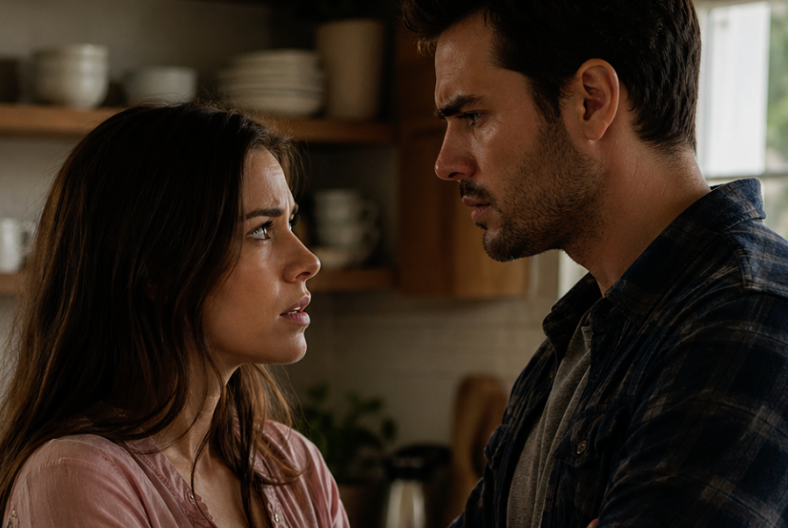
“Your sister smashed my car with a bat, and you’re saying it’s all my fault because I wouldn’t let her take a spin with her drunk girlfriends?!”
“Why are you so early?” Igor’s voice drifted from the living room—lazy and relaxed, muffled by the TV. He didn’t even turn his head when the key turned in the lock and the front door clicked shut.
Alina didn’t answer. She stepped into the hallway, every movement deliberate, stripped of her usual fuss. She didn’t toss her bag on the ottoman; she set it down carefully. She took off her light coat and hung it on a hanger, smoothing the collar with care. Her calm was unnatural, like the hush before a storm, when the air grows dense and the birds stop singing.
She walked into the kitchen, her steps utterly silent on the parquet. From her pocket she took a small black flash drive and placed it exactly in the center of the oak table. The tiny bit of plastic on the massive wooden surface looked like a detonator. The short, dry click with which it touched the lacquered wood finally made Igor tear himself away from the screen.
“And what’s that?” He appeared in the doorway in lounge pants and a T-shirt, remote in hand. His face showed mild irritation at being interrupted at the most interesting moment. He looked at the flash drive, then at his wife. “Downloaded a new movie?”
“There’s a video,” Alina’s voice was even, not a tremor in it. Just a statement of fact. “Of your Katya smashing my car with a bat. I’ve already called the police.”
Igor froze. His relaxed posture instantly went rigid, as if a steel cable had been tightened inside him. But he didn’t look at the flash drive. He didn’t even flick his eyes toward it. His whole gaze, heavy and already starting to fill with anger, was glued to Alina’s face. He didn’t ask “How?”, “Why?” or “Are you okay?”
“And what do you want?” he asked as if she were the one who’d done something irreparable. “For me to scold her like a child? Put her in the corner? It’s your own fault.”
Alina slowly raised her eyes to him. She had expected anything: shock, anger at his sister, promises to sort it out. But not this. Not the instant, reflexive blame laid on her.
“My fault?” she repeated, and for the first time a cold steel edge cut through her voice. “Guilty of what, exactly? Of buying a car your sister happened to like?”
“Of running straight to the cops!” Igor took a step forward, his nostrils flaring. The TV in the living room kept cheerfully chattering about the lives of wild animals. “You should’ve called me! Me! We’d have handled it within the family! I’d have talked to her, she’d have apologized, I’d have given you money for the repairs! But no! You had to put on a show! Drag our dirty laundry out so everyone sees how bad we are and you’re the victim!”
He spoke quickly, forcefully, constructing his own reality—convenient to him—in which the problem was not the wrecked car and not his sister’s deranged act, but that Alina had dared to violate their unwritten family code. A code by which Katya was allowed anything, and everyone else’s duty was to quietly clean up after her.
“Handled it?” Alina gave a crooked smile. “You mean I should’ve just swallowed it when your thirty-year-old ‘girl’ took a baseball bat and smashed the windshield, the headlights, and the hood to bits? Because I refused to give her the keys?”
“And why did you refuse?!” he exploded, his voice finally breaking into a shout. “W\hat, you couldn’t spare it?! She asked you nicely! Her friend’s having a bachelorette party, they wanted to arrive in style! It’s one evening! One damn evening! You refused out of principle, I know you! You decided to show character! Well, did you show it?! Happy now?! Now Katya’s going to have problems because of your stubbornness!”
Alina looked at his rage-twisted face and felt the last spark of hope for understanding go out inside her. She took a deep, slow breath, as if filling her lungs before plunging into icy water.
“They were drunk, Igor,” she said. Not loudly, but each word rang in the kitchen’s deafening silence like a hammer striking an anvil. “Your sister and her girlfriends reeked of cheap champagne from a mile away. Katya could barely stand. She giggled, asked for the keys to ‘ride with the wind,’ and called my car a ‘cherry ride.’ I should have given her the keys? So she could kill herself, kill her friends, and maybe a couple of random pedestrians too? Is that what you wanted from me?”
Igor brushed her words away like a pesky fly. Logic, common sense, the criminal code—all of it, to him, was just an annoying obstacle on the way to the main goal: protecting his sister.
“So what if they’d had a drink?” he snapped, genuine puzzlement in his voice, as if Alina were nitpicking. “They could’ve slept it off in the car somewhere in a parking lot and brought it back in the morning! They’re not little kids, they’d have figured it out! You think it’s the first time they’ve partied like that? But you just had to take a stand! To feel your power! To refuse—because you could! You just don’t like her, that’s all. You never did. You were looking for a reason to humiliate her, to show who’s boss in this house.”
He paced the kitchen, from the fridge to the window and back, his steps heavy, pressing into the floor. He didn’t look at his wife; he addressed some invisible judge, laying out his defense. Katya’s defense. And Alina’s indictment.
“Family means trust, Alina! Helping each other! Not tallying who drank how much! She asked you for help, and you rubbed her nose in her weakness! Of course she snapped! Anyone would in her shoes! You provoked her with your arrogance, your righteousness! You drove her to the edge, and now you stand here like some saintly innocent, brandishing a flash drive!”
Alina looked at him and understood they lived in different universes. In hers, adults bore responsibility for their actions. In hers, a drunk behind the wheel was a potential killer. In hers, the deliberate destruction of someone else’s property was a crime. In his, there was only one constant—Katya. And the rest of the world had to revolve around her, cater to her wishes, forgive her any whim.
“So, in your opinion, her reaction was adequate?” Alina asked quietly, feeling everything inside her turn to ice. “Refusing to give a car to a drunk person is sufficient grounds to grab a bat and smash that car to pieces?”
“People matter more than metal!” he shouted in her face, finally stopping right in front of her. “Yes, she lost her temper! Yes, she was wrong! But she can be understood! You trampled her feelings, and she took it out on your car! It’s just a thing! It can be fixed! But what you did to her, to her soul—that can’t be fixed! You treat her like she’s nothing! Like her requests mean nothing!”
He spoke about the feelings of a sister who had smashed someone else’s car to bits with such grief-stricken fervor, with such genuine sympathy, that for a moment Alina thought she was going mad. He didn’t see the absurdity of his words. To him everything was perfectly clear: Alina had hurt Katya, and the broken car was merely an annoying but quite understandable consequence of that hurt. Like a cup shattered from distress or a flower ripped off in anger. He didn’t see the difference in scale. He saw only his offended little sister. And the enemy standing before him. Everything that would happen to Katya now, all her problems with the police—would be your fault. Yours alone.
“My fault…” Alina repeated. The word hung between them, devoid of meaning, like a sound in a foreign language. She looked at him—the husband she had lived with for seven years—and for the first time saw him as he truly was. Not the Igor who brought her coffee in bed and laughed at her jokes, but the other one—a fanatical, blind defender of his clan. His sister’s attorney, for whom facts and logic didn’t exist, only one unshakable truth: Katya is the victim. Always.
“Yes, yours!” he pounced, growing even more heated by her calm tone. He took her calm for coldness, for yet another proof of her indifference. “You always looked down on her! From the first day you met! Everything about her annoyed you—how she dresses, how she talks, how she laughs. You thought she was a silly, spoiled airhead. You were just looking for a reason to put her in her place, to prove to her and to me that you’re better, smarter, more proper! And now you’ve got your moment in the spotlight! Now you can destroy her while hiding behind the law and your wounded pride over a scratched tin can!”
He talked, and with each word the world Alina had so long and carefully built collapsed. A world where they had their own family, their own rules, their own values. It turned out to be just a façade. And behind it, all this time, his real family had been hiding—primitive, welded together by blood ties—where she, an outsider, was not allowed. She was only a temporary, convenient add-on. A function. And Katya was the constant.
Suddenly Alina felt the absurdity of what was happening reach that critical point beyond which there was neither anger nor hurt. Only a numbing, icy amazement. She looked at her husband, who was seriously, eyes blazing, trying to convince her that an act of vandalism was the cry of a wounded soul, and that her refusal to abet a crime was callousness and egoism. And this monstrous, upside-down logic he defended so fiercely suddenly condensed into one simple phrase—murderous in its savagery.
“Wait. I want to understand,” she raised a hand, stopping his torrent of words. Her voice was surprisingly calm, almost dispassionate, like an investigator clarifying testimony. “Let’s make it clear. So…”
“What’s there to make clear?”
“Your sister smashed my car with a bat, and you’re saying it’s all my fault because I wouldn’t let her take a spin with her drunk girlfriends?!”
She said it slowly, spacing the words, letting each of them sound at full strength. She didn’t shout. She simply voiced the quintessence of his nonsense. She held a mirror up to his face, expecting him to recoil in horror from the reflection.
But Igor didn’t. His face brightened.
“Yes!” he exhaled with relief, as if she had finally grasped a simple truth. “Yes! Exactly! It finally got through to you! You value a thing more than a person! More than relationships! You preferred a hunk of metal over keeping peace in the family! You could’ve just given her the keys, and right now we’d be quietly having tea instead of all this! You created this problem out of thin air with your stubbornness!”
And in that moment, everything ended for Alina. The argument, the relationship, the marriage. She looked at him, and the veil fell from her eyes. She saw not the man she loved but a stranger, possessed, speaking a language she didn’t understand. A language where the notions of good and evil, responsibility and recklessness were warped beyond recognition. She realized that arguing with him was like trying to explain the laws of physics to a member of a primitive tribe worshipping an idol. And the idol in his tribe was Katya…
Continued in the comments.
“Why are you so early?” Igor’s voice drifted from the living room—lazy and relaxed, muffled by the TV. He didn’t even turn his head when the key turned in the lock and the front door clicked shut.
Alina didn’t answer. She stepped into the hall, every movement precise, stripped of her usual fuss. She didn’t toss her bag on the ottoman; she set it down carefully. She took off her light coat and hung it on a hanger, smoothing the collar. Her calm was unnatural, like the stillness before a storm, when the air grows heavy and the birds stop singing.
She walked into the kitchen, her steps utterly silent on the parquet. From her pocket she took a small black flash drive and set it exactly in the center of the oak table. That tiny piece of plastic on the massive wooden surface looked like a detonator. The short, dry tap as it touched the lacquered wood finally made Igor tear himself away from the screen.
“And what’s that?” He appeared in the doorway in lounge pants and a T-shirt, the remote in his hand. His face showed mild irritation at being interrupted at the best part. He looked at the drive, then at his wife. “Downloaded a new movie?”
“There’s a video on it,” Alina’s voice was even, not a single tremor. Just a statement of fact. “Of your Katya smashing my car with a bat. I’ve already called the police.”
Igor froze. His relaxed posture went rigid in an instant, as if a steel cable had been pulled tight inside him. But he didn’t look at the flash drive. He didn’t even flick his eyes toward it. His whole gaze, heavy and already starting to swell with anger, was locked on Alina’s face. He didn’t ask “How?”, “Why?” or “Are you okay?”
“And what do you want?” he asked, as if she’d done something irreparable. “For me to scold her like a little girl? Put her in the corner? It’s your own fault.”
Alina slowly lifted her eyes to him. She’d expected anything—shock, anger at his sister, promises to sort it out. But not this. Not a reflexive, instantaneous accusation aimed at her.
“My fault?” she repeated, and for the first time a cold steel edge cut through her voice. “Guilty of what exactly? Of buying a car your sister liked so much?”
“Of running to snitch to the cops right away!” Igor stepped forward, his nostrils flaring. The TV in the living room kept cheerfully chattering about the lives of wild animals. “You should’ve called me! Me! We would’ve handled it within the family! I would’ve talked to her, she would’ve apologized, I’d have given you money for the repairs! But no! You had to put on a show! Air our dirty laundry so everyone sees how bad we are and you’re the victim!”
He spoke fast, forcefully, constructing his own reality—a convenient one—where the problem wasn’t the wrecked car or his sister’s deranged act, but the fact that Alina dared to violate their unwritten family code. A code by which Katya was allowed anything, and everyone else’s duty was to silently clean up after her.
“Handled it?” Alina gave a crooked smile. “You mean I should’ve just swallowed the fact that your thirty-year-old ‘little girl’ took a baseball bat and smashed the windshield, the headlights, and the hood to bits? Because I refused to give her the keys?”
“And why did you refuse?!” he exploded, his voice finally breaking into a shout. “What, you couldn’t spare it?! She asked you like a human being! Her friend had a bachelorette, they wanted to make a grand entrance! Just one evening! One damn evening! You refused out of principle, I know you! Decided to show character! Well, did you? Happy now?! Now Katya’ll have problems because of your stubbornness!”
Alina looked at his face, twisted with anger, and felt the last spark of hope for understanding flicker out inside her. She took a deep, slow breath, like someone filling their lungs before plunging into icy water.
“They were drunk, Igor,” she said. Not loudly, but each word struck the kitchen’s ringing silence like a hammer on an anvil. “Your sister and her friends reeked of cheap champagne from a mile away. Katya could barely stand. She was giggling, asking for the keys to ‘take a breezy spin,’ and calling my car a ‘cherry hot rod.’ I was supposed to give her the keys? So she could kill herself, her friends, and maybe a couple of bystanders? Is that what you wanted from me?”
Igor waved her words away like a pesky fly. Logic, common sense, the criminal code—none of that mattered to him next to his main objective: defending his sister.
“So what if they’d had a few?” he threw back, genuine bewilderment in his voice, as if Alina were nitpicking. “They could’ve slept it off in the car somewhere in a parking lot and brought it back in the morning! They’re not little kids, they’d have figured it out! You think it’s their first time partying like that? But you had to take a stand! Feel your power! Say no—just because you could! You just don’t love her, that’s all. You never did. You were looking for a reason to humiliate her, to show who’s boss around here.”
He paced the kitchen, from the fridge to the window and back, his steps heavy, pressing into the floorboards. He wasn’t looking at his wife; he was addressing some invisible judge before whom he laid out his defense. Defense of Katya. Prosecution of Alina.
“Family means trust, Alina! It means helping each other! Not counting how much someone drank! She asked you for help, and you rubbed her nose in her own weakness! Of course she snapped! Anyone would have in her place! You provoked her with your snobbery, your righteousness! You drove her to it, and now you stand here like some saint, brandishing a flash drive!”
Alina looked at him and understood they lived in different universes. In hers, adults bore responsibility for their actions. In hers, a drunk behind the wheel was a potential killer. In hers, the deliberate destruction of someone else’s property was a crime. In his, there was only one constant—Katya. And the rest of the world had to revolve around her, adjust to her desires, forgive her every whim.
“So, in your view, her reaction is adequate?” Alina asked quietly, feeling everything inside her freeze. “Refusing to hand a car to a drunk person is sufficient grounds to take a bat and smash that car to pieces?”
“People matter more than tin!” he shouted in her face, finally stopping right in front of her. “Yes, she got carried away! Yes, she was wrong! But you can understand her! You trampled her feelings, and she took it out on your car! It’s just a thing! It can be fixed! But what you did to her—to her soul—can’t be fixed! You treat her like she’s nothing! Like her requests mean nothing!”
He spoke about the feelings of a sister who had just wrecked someone else’s car with such anguish, such unfeigned sympathy, that for a moment Alina wondered if she was losing her mind. He didn’t see the absurdity of his words. To him everything was perfectly clear: Alina had hurt Katya, and the smashed car was merely an unfortunate but entirely understandable consequence of that hurt. Like a cup broken in grief or a flower torn off in anger. He saw no difference in scale. He saw only his offended little sister. And the enemy standing before him. “Whatever happens to Katya now—all her problems with the police—will be your fault. Yours alone.”
“My fault…” Alina repeated. The word hung between them, drained of meaning, like a sound in a foreign language. She looked at him—the husband she had lived with for seven years—and for the first time she truly saw him. Not the Igor who brought her coffee in bed and laughed at her jokes, but another man—a fanatic, a blind defender of his clan. His sister’s advocate, for whom facts and logic did not exist, only one unshakable truth: Katya is the victim. Always.
“Yes, yours!” he seized on it, heating up even more at her calm tone. He took her calm for coldness, for further proof of her indifference. “You’ve always looked down on her! From the first day we met! Everything about her infuriated you: how she dresses, how she talks, how she laughs. You thought she was a silly, spoiled nothing. You were just waiting for a chance to put her in her place, to prove to her—and to me—that you’re better, smarter, more proper! Well, your big moment came! Now you can destroy her while hiding behind the law and your wounded pride over a scratched hunk of metal!”
He talked, and with each word the world Alina had so carefully constructed collapsed. A world where they had their own family, their own rules, their own values. It turned out it had been just a facade. Behind it, all along, lurked his real family—primitive, fused by blood ties—to which she, the outsider, had no entry. She had only ever been a temporary, convenient attachment. A function. Katya was the constant.
Suddenly Alina felt the absurdity of what was happening reach the critical point beyond which there was no anger and no hurt—only a deafening, icy astonishment. She looked at her husband who, with burning eyes, was seriously arguing that an act of vandalism was a cry of a wounded soul, while her refusal to abet a crime was callousness and selfishness. And this monstrous, upside-down logic he defended so fiercely crystallized into one simple phrase—murderous in its madness.
“Wait. I want to understand,” she raised a hand to halt his verbal torrent. Her voice was surprisingly calm, almost dispassionate—the way an investigator clarifies testimony. “Let’s make it clear. So…”
“What’s there to make clear?”
“Your sister smashed my car with a bat, and you’re saying it’s all my fault because I wouldn’t let her take a spin with her drunk girlfriends?!”
She said it slowly, breaking the sentence into parts and letting each word ring out at full strength. She didn’t shout. She simply voiced the quintessence of his nonsense. She held a mirror up to his face, expecting him to recoil at the reflection.
But Igor didn’t recoil. His face lit up.
“Yes!” he breathed with relief, as if she’d finally grasped a simple truth. “Yes! Exactly! Finally it got through to you! You care more about a thing than a person! More than relationships! You preferred a piece of metal over keeping peace in the family! You could’ve just given her the keys and we’d be calmly drinking tea right now instead of all this! You created this problem out of thin air with your stubbornness!”
And at that moment, everything ended for Alina. The argument, the relationship, the marriage. She looked at him, and the veil fell from her eyes. She no longer saw the man she loved, but a stranger, possessed, speaking a language she could not understand. A language in which the concepts of good and evil, responsibility and recklessness had been twisted beyond recognition. She realized that arguing with him was like trying to explain the laws of physics to a member of a primitive tribe worshiping an idol. And in his tribe, the idol was Katya.
He kept talking, waving his arms, accusing her of cruelty, of being unable to forgive, of destroying his family. But Alina no longer heard him. She looked through him, and a single thought beat in her head with icy clarity: “Run. I have to run.” Not from the quarrel. From the madness. From this toxic, suffocating loyalty that justified any crime and demanded she become an accomplice—or be declared the enemy. And she made her choice.
“You’re right,” Alina said.
Two words, almost whispered, instantly cut off Igor’s angry tirade. He fell silent mid-sentence, wrong-footed. He had expected anything—shouting, reproaches, counter-accusations—but not that quiet, emotionless assent. He looked at her distrustfully, trying to decipher what hid behind this sudden submission.
“What do you mean, ‘right’?” he asked warily.
“You’re right,” Alina repeated, lifting to him eyes that were utterly empty and cold. There was no love in them anymore, no hurt. Only the detachment of a surgeon pronouncing a time of death. “My car and my life really are more important to me than YOUR family. You just opened my eyes to that. Thank you.”
She turned, walked to the table, and picked up the flash drive. Her movements were smooth and precise; there wasn’t a trace of her earlier anger or confusion. The fight was over for her. She was no longer a participant—she was an observer making a final decision.
“What are you doing? Where are you going?” Igor watched her, bewildered, not understanding what was happening. The world in which he was the righteous defender and she the stubborn egoist began to split at the seams.
Alina didn’t answer. She walked past him to the hall and took his car keys from the shelf. The fob with the logo of the expensive SUV—his pride, a birthday present to himself—clinked dully in her hand. Igor jerked, instinctively stepping toward her.
“Put the keys down. This isn’t funny, Alina.”
She turned to him. There wasn’t even a shadow of a smile on her face—just a cold, businesslike expression.
“Why not? You just explained the rules of the game to me yourself,” her voice was steady and calm. “Problems should be handled within the family without involving outsiders, right? People matter more than metal. Did I get that right?”
He stared at her, and at last understanding began to show in his eyes. Not remorse—no. The animal, primal horror of a man whose own weapon has been turned against him.
“Your sister damaged my property. She caused me, a member of the family, material loss and moral harm. Since we don’t air our dirty linen and the police are ‘too much,’ I’ll just take your car. As compensation,” she gave the keys a small shake, and the fob clinked again—this time like a funeral bell tolling for their marriage. “It’s worth more, of course, but I won’t nitpick. We’ll call it even. You don’t mind, do you, Igor? It’s just a thing. It can be fixed. But soul wounds… you know yourself.”
He went numb. His mind, trained to function in a single coordinate system—”Katya is right”—refused to process what was happening. He stared at the keys in her hand, and his face began to blanch. His car. His fortress. His symbol of success.
“You… you can’t,” he croaked.
“I can. You just gave me permission,” she snapped. “And you can go to your little sister. Help her with her statement. Explain how she, poor thing, got carried away and how cruel I was to her. You can even tell her that now you’re the one paying for what she did. Maybe she’ll feel ashamed. Though I doubt it.”
She turned toward the door, slipped the flash drive into her coat pocket, and started putting on her shoes. Every gesture was deliberately calm. She wasn’t hurrying, she wasn’t fleeing. She was leaving. For good.
“I have nothing to do with this family anymore,” she said from the threshold, without looking back. “Deal with your problems yourselves.”
The door closed behind her. The click of the lock sounded in the apartment’s deafening silence like a gunshot. Igor stood in the hall. The TV in the living room still chirped on blithely. He looked at the closed door, then at the empty spot on the shelf where his keys had lain moments before. He had defended his sister. He had upheld his family values. He had proved himself right. And now he stood alone in an empty apartment, having lost his wife, his car, and the familiar world that had just collapsed with a deafening crash, burying him under its rubble. And for the first time in his life, he would have to pay for Katya’s deed himself. The full price.