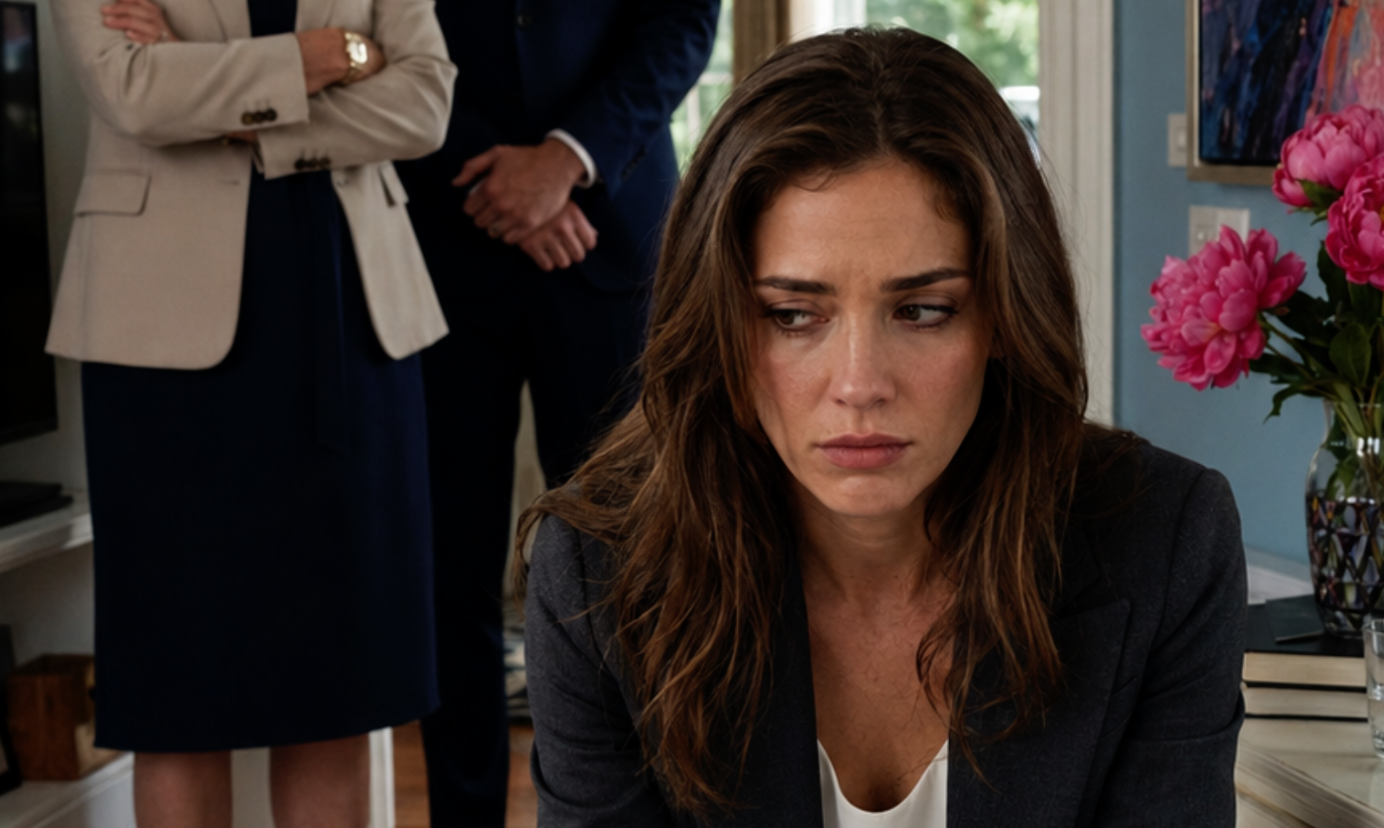
Whose slippers are those in our hallway?” Antonina froze on the threshold without taking off her shoes and stared at the shabby blue slippers, the color of old paint peeling from a shed. They weren’t hers. And they definitely weren’t Seryozha’s.
“Mom stopped by,” her husband’s voice came from the kitchen. Smooth as a freshly ironed sheet. No surprise, no embarrassment. Everything with him followed some kind of plan — whose plan, though, was unclear.
Antonina slowly set down her bag and pulled off her jacket. Her heart was pounding now not because of three rain-soaked bus stops, and not because of the stuffy minibus with its wheezing radio, but because of something sticky and unpleasant. She knew that calm tone of his too well: Sergey only spoke like that when he was hiding something. Or pretending nothing was happening.
“Just like that?” she entered the kitchen. “She dropped by to drink tea and chat?”
Sergey was sitting in pajamas, even though it was only seven in the evening. His face was distant, like a janitor’s on a Sunday. His eyes darted around; he tapped his cup against the saucer. That was his signal: I’m about to lie, but carefully.
“She sat for a while, we talked. You were late. I didn’t know when to expect you.”
“Right,” Antonina poured herself tea, noticing that her hands were trembling slightly. “And I had a meeting today until nine. On my feet all day. You didn’t ask. You could have called.”
“Oh, come on, Tonya, you said yourself not to bother you. Work is work…” he muttered, not looking at her.
She sat down opposite him in silence. She watched him act out “relaxing at home.” Meanwhile, inside her, something was already quietly boiling — without any whistle. She knew Sergey: whenever he started dodging, there was already a trail of lies behind him.
“Listen, Seryozh, tell me straight. Why does she come here? Not just to drink tea, right?”
“What’s the big deal? She’s alone, her pension is ridiculous. She came over, we sat together. Sons visit their mothers.”
“Sons visit their mothers, Seryozh. But mothers don’t leave their slippers in someone else’s apartment where two people live together. We had an agreement: no regular guests. Especially not people who rummage through other people’s things.”
“You’re starting again. Exaggerating. Mom is a good person. She just has her own way. She wants everything to be proper for us.”
“Proper? Is that when she rearranges my underwear in the closet? Or puts combs in the medicine cabinet? Or calls me ‘that one of yours,’ as if I were assigned to you by work order?”
Sergey snorted. Outside, a neighbor’s dog barked, and somehow it emphasized the absurdity of the evening: someone else’s slippers, her husband in pajamas, playing indifferent, and the feeling that their home was no longer entirely theirs.
“All right, don’t get worked up,” he exhaled. “She suggested… well, an idea. About the apartment.”
“What idea?”
Silence hung in the air. You could hear air hissing in the radiators.
“We’ve been saving… together. But maybe the apartment should be registered in Mom’s name. Temporarily. She’ll live there, we’ll help her, and then she’ll transfer it back.”
“Are you out of your mind?”
“Don’t shout. She’d feel calmer. Renting is hard for her, her neighbor Galina keeps pestering her…”
“Tell me this instead: have you already signed it, or not yet?”
He said nothing. He rubbed the bridge of his nose and got up from the table.
“We’ll talk later. I’m tired.”
“And I’m fresh as May lilacs, am I?” she gave a bitter laugh. “You decided to cheat me, Seryozh?”
He stood there, hunched like a schoolboy who had forgotten his homework.
“I’m just thinking about my mother…”
“And what am I to you? A lunch lady from the factory cafeteria?”
He turned away. And Antonina suddenly understood: this was the moment when the person beside you was there, but no longer really there. You spoke, but it was as if you didn’t exist.
“I’m taking a day off tomorrow. I’m going to a lawyer. And if your mother sticks her nose in here one more time, she shouldn’t be surprised if her jaw ends up needing repairs.”
Sergey silently went into the bathroom. The water started running.
And in Antonina’s head, a plan was already forming — cold, precise, simple. For the first time in a long while, she felt calm.
She woke up to a strange crunching sound — as if someone were peeling film off new furniture. She reached for her phone: 7:03. Saturday. She could have stayed in bed… but the crunch came again, followed by a familiar cough, and Antonina knew for certain: the morning had gone wrong.
Barefoot, Antonina stepped into the hallway. Her feet stuck to the linoleum, where yesterday’s muddy tracks had already dried. In the kitchen, by the table, stood Nadezhda Pavlovna. Her robe was not merely green, but that strange shade fashion magazines would call “mist over broccoli,” and real life would call “should have been thrown out long ago.” In one hand she held a knife, in the other a loaf of bread, and she was slicing it diagonally, as if she were preparing not breakfast but a gastronomic punishment.
“Oh, so you finally woke up. Good morning, Antonina,” she said without even turning her head. Her voice was flat and cold, like a morgue clerk filling out forms. “Can’t sleep? Well, not everyone’s conscience allows them to sleep peacefully.”
Antonina swallowed. This was no accidental “Mommy dropped by for tea.” No, this looked like an operation — planned and covered from every angle.
“What are you doing here?” Her voice was hoarse, like a radiator in an old apartment in winter. “Sergey said yesterday you just stopped by…”
“Sergey?” her mother-in-law narrowed her eyes and smirked. “Telling Sergey the truth is like washing a cat. No matter how much you raise the poor thing, it’s all the same.”
“He isn’t my pupil. He’s my husband.”
“Oh, really? On paper, maybe he’s a husband. But in reality…” Nadezhda Pavlovna raised her eyebrows. “My late Fyodor Pavlovich wouldn’t even switch on the kettle without me. Yours is on a leash with you. Registered the apartment in his own name, God forgive him. The boy is thirty-nine, mind you, and still living like he’s in a prison cell.”
Antonina silently turned and went into the room. She came back with papers in her hands and placed them on the table.
“This is a copy of the gift agreement. Did you lose it?”
The knife kept clinking against the cutting board, then froze. Her mother-in-law put down the loaf and wiped her palms on her robe.
“So you found it… And what of it? Are you going to sue your husband’s family?”
“I don’t have a husband’s family. I have one man with whom I saved for this apartment for seventeen years. I walked around in tights whose toes tore faster than a schoolgirl’s. And now, apparently, Mommy is entitled to it in her old age. While I’m just… a worker bee.”
Nadezhda Pavlovna looked at her as if the thing on the table was not a contract but an opened abscess.
“You’re being dramatic, Tonya. We simply wanted everything to be calm. The apartment would be in my name — lower taxes, and… fewer difficulties. Sergey’s job is unstable. But I’m reliable. Years, experience…”
“Experience? You can’t even pay for your phone without help! Should I remind you how to open Sberbank Online? Or will you write your passwords on scraps of paper again?”
Her mother-in-law clicked her tongue.
“Ungrateful woman. I raised my son. And you? You can’t cook. Your dumplings stink. The meat is oversalted. And the house is empty — no curtains, no pillows. No warmth, no comfort. A woman should keep the hearth, not run to lawyers.”
Antonina felt something inside her snap.
“The hearth, you say? I’ll give you such a hearth that you’ll burn in it yourself — together with your contract!”
She grabbed her favorite mug with the little cat on it and hurled it at the wall. The cat shattered into tiny pieces. Silence fell over the kitchen. Even the refrigerator stopped humming. Sergey appeared in the doorway. In his underwear, with his hair sticking out, scratching his stomach.
“What the hell is going on here?”
Antonina slowly turned.
“And here comes the master of the house. It’s simple, darling. Mommy is running the place, registering the apartment however she likes. And I’m just here… breathing air.”
“Tonya, you misunderstood…”
“I understood perfectly. Only too late.”
Nadezhda Pavlovna stepped up to her son and took his hand.
“Tell her. She’ll leave anyway. She isn’t your person. She is against family. And whoever is against family is an enemy.”
Sergey opened his mouth, closed it. Then opened it again.
“Maybe… we should live separately for a while. To think things over…”
Antonina sat down, propped her head on her hand, and smiled.
“For a while? Excellent. You and Mom can go to her communal apartment. To the room with that same Galina who shouts Pushkin out the window at night. And I’ll stay in our apartment. Because you, darling, aren’t registered here. Guess who’s going to court tomorrow with an eviction petition?”
Sergey turned pale.
“Have you lost your mind?”
“No, Seryozhenka. I’ve simply seen the light. You thought I was safe. Quiet. That I didn’t notice. But I was saving. Not only for the apartment — for the moment when I would stop believing. And you know what?”
Antonina stood, walked to the door, turned the key, and flung it wide open.
“This is that moment. Get out.”
Nadezhda Pavlovna silently picked up her bag — the very same one she had already managed to unpack, spreading her bundles across the kitchen shelves.
Sergey stood in the hallway like a schoolboy at assembly, with those same empty eyes you could drown in — and find nothing.
Antonina took his phone from the cabinet and shoved it into his hand.
“Call your lawyer. Or your mother. Though… what’s the difference?”
She closed the door behind them. Firmly, with a sound as if she had cut off not only their footsteps but an entire layer of her life.
But she knew they would come back.
Because greed is like mold. You can scrub all you want, but if even a tiny piece remains, it will grow again.
Which meant another war lay ahead. And judging by everything, a dirty one.
The phone rang at exactly eight in the morning. As if someone had deliberately chosen the time to ruin her Saturday.
Antonina, barely opening her eyes, fumbled and knocked the phone off the nightstand.
“Yes?”
“This is District Officer Yeremin, Tonya. Sergey Pavlovich filed a complaint — says you illegally kicked him out of the apartment and are holding his belongings.”
Antonina sat up in bed, straightening her twisted T-shirt.
“Officer, first of all, I didn’t kick him out. He left himself, practically waving goodbye to the doorknob. Secondly, he isn’t registered here; he lives with his mother. His things are in the hallway, in a L’Etoile bag. Very symbolic, by the way.”
“I’m required to come by. Draw up a report.”
“Come. I’ll make you tea. Or poison, if you prefer.”
The apartment was so quiet that even the refrigerator began dripping, as if complaining.
Antonina sat at the table, twirling a pen in her hands. Opposite her sat a young lawyer with a hairstyle that looked as though she had just climbed out of the tax office through a window, and a folder labeled “Property Protection.”
“You filed for eviction — good. But now there’s a new problem.”
“What now?” Antonina narrowed her eyes.
“Your mother-in-law’s niece has appeared. Yulia. She claims the money for the apartment was given by her father, Uncle Lev.”
“What Uncle Lev? He’s been in Canada since the fifties.”
“Yes. But here’s a letter saying that in 2012 he sent eighteen thousand ‘for family needs.’ If it went toward the apartment, then part of the property belongs to them.”
“Wonderful. So now we have a new kind of fraud — an apartment on an installment plan for relatives.”
The lawyer shrugged.
“They have a strong lawyer. They’ll try to suspend the eviction through court.”
“By all means. I’d put them all in here: Seryozha, his mother, the niece with eyes like a hungry moose. And Uncle Lev on Zoom too, let him participate.”
The next day, there was a knock at the door. Yulia stood on the threshold. Skinny, in a gray suit, with a face that said, “I sell insurance, but I eat people like you for breakfast.” Behind her hovered Sergey — like an unpleasant echo.
“Good evening. We came peacefully. We want to discuss things without taking them to court.”
Antonina let them in. She put the kettle on. Not out of politeness — the conversation promised to be bitter, and her tea always turned out laxative-weak.
“Speak, Yulenka. Just don’t start with ‘we’re one family’ — I’m allergic to that.”
Yulia took out a tablet.
“All the transfers are here. Eighteen thousand dollars in 2012. Purpose: for the family of Sergey and Nadezhda. Since the money went toward the purchase, compensation must be paid, or a share must be allocated.”
Antonina laughed — short and dry.
“Would you like me to show you a receipt from Pyaterochka? From 2013. It says ‘cheese, sausage, cabbage.’ That was also ‘for family needs.’ Maybe I should give you the wardrobe?”
Sergey grimaced.
“Tonya, we don’t want war…”
“Really? And what about when you tried to get the keys from the neighbor at night? You think he’ll keep quiet? Our building is old, but it isn’t deaf. Baba Klava from the third floor described your entire outfit yesterday. Sweatpants with a stain on the knee — very elegant for a covert operation.”
Yulia clenched her teeth.
“If you don’t agree to a settlement, we’ll file a lawsuit. We’ll include moral damages too.”
“For what? A broken cup or broken illusions?”
“We warned you. The court will decide everything.”
“And tell Nadezhda Pavlovna I’ll return her jar of jam as soon as she returns her attempt to steal my life.”
Two months later, the court decision arrived.
Antonina won. The Canadian transfers were recognized as gifts unrelated to the apartment. Sergey’s eviction was confirmed as legal. A week later, a letter arrived. On paper, in someone else’s handwriting — surely his mother’s.
“Tonya. Everything went wrong. Forgive me. I have nowhere to live. Mom is sick. Yulka left. If you can… let go.”
Antonina read it again. Then slowly tore it up. The paper tore easily, just like their marriage.
She turned on music, took a bottle of wine from the cupboard, and sat by the window.
And for the first time in many years, she exhaled deeply.
She had an apartment.
She had a heart.
And in it, finally, there was silence.