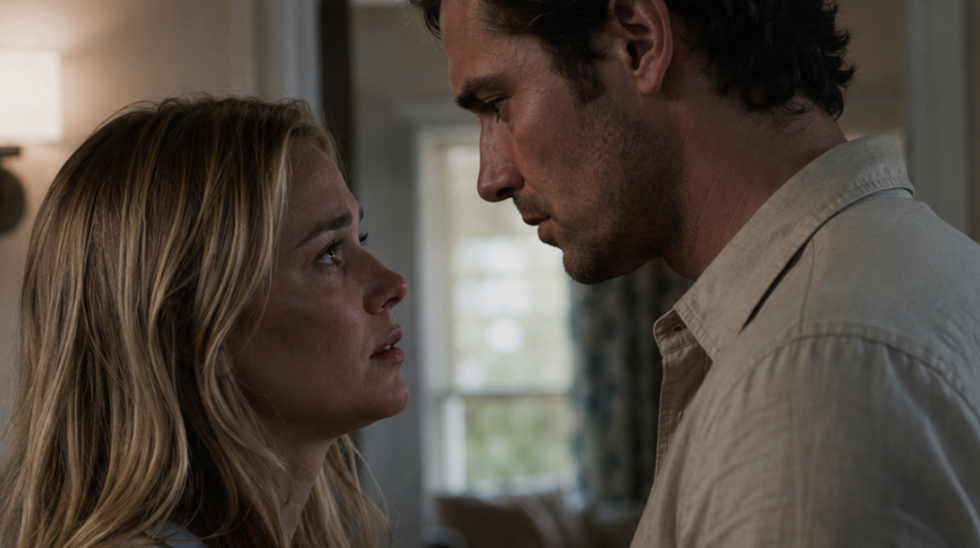
“What do you mean?” Sasha asked again, and genuine surprise mixed with his usual confidence sounded in his voice.
He was standing in the doorway of her apartment, holding a folder with some documents, as if he had come on business and not to see his ex-wife. Inna looked at him and could no longer recognize the man she had lived with for almost twelve years.
She stepped back, letting him in, although everything inside her tightened with reluctance to continue this conversation. The apartment was small, but now, after the renovation she had done on her own, it had become cozy and peaceful. White walls, soft light from a floor lamp, the smell of freshly brewed tea coming from the kitchen — all of it was her space. And Sasha looked like a stranger in it.
“I mean exactly what I said,” Inna replied calmly, closing the door. “Your sister called again yesterday. She asked for help paying for her son’s classes. She said you had promised. And I am no longer obligated to do that.”
Sasha placed the folder on the small cabinet in the hallway and ran his hand through his hair — a gesture she had once found sweet. Now it only irritated her.
“Inna, why are you acting like a stranger?” he began softly, almost tenderly. “We are not enemies. Yes, we divorced, but we have children together, and family is still family. Lena is in a difficult situation, and our nephew needs help. You were always generous. Why have you suddenly changed your mind?”
Inna walked into the kitchen and poured herself some tea, although she did not feel like drinking it. She simply needed to keep her hands busy so he would not see how badly her fingers were trembling. She remembered all those conversations. She remembered how five years earlier, when Sasha’s sister had problems at work, it had been Inna who insisted on helping with money. Then there had been repairs at Sasha’s mother’s place — again, her savings. And when his uncle ended up in the hospital, she organized and paid for a caregiver. All that time, Sasha nodded, thanked her, and said she was a golden woman. And now, after the divorce, he continued behaving as if nothing had changed.
“Because we are divorced, Sasha,” she said, placing the mug on the table. “Officially. The court has made its decision, child support has been assigned, the property has been divided. My obligations to your family ended on the day we signed the papers at the registry office.”
Sasha followed her into the kitchen and sat down opposite her. Irritation flashed in his eyes, but he quickly hid it behind his familiar smile.
“You understand that paperwork is one thing, but being human is another. We lived together for twelve years. You know my relatives. They are used to you. Lena cried on the phone yesterday and said you had always helped. Are you really just going to turn your back on them now?”
Inna looked at him for a long time, attentively. Once, those words would have touched her deeply. She truly had felt like part of a large family. She went to birthdays, cooked for everyone on holidays, listened to her mother-in-law complain about her health. And during all that, Sasha would nod and say, “Innochka will take care of it.” Now she understood that it had never been her family. It was his family, and she had simply paid for the right to be there.
“I am not turning my back on anyone,” she answered quietly but firmly. “I simply stopped being your wife. And I stopped being a wallet for your relatives. I have my own life, Sasha. My own expenses, my own plans.”
He leaned back in his chair and crossed his arms over his chest.
“Plans? What plans? After the divorce, you have barely even gone back to work properly. You sit here alone in your apartment. And we are all one blood. Don’t you feel sorry for your nephew? The boy is only ten, and English lessons cost a lot of money.”
Inna felt a familiar wave of exhaustion rising inside her. She knew this tactic. Sasha had always known how to press on pity, especially when children were involved. But now it did not work anymore. She remembered how during the divorce proceedings, his lawyer had tried to prove that she “had not contributed enough to the family budget,” even though it had been her teacher’s salary and extra side jobs that had fed the whole family in recent years. Sasha had worked very little then, saying he was looking for “his thing.” And she had stayed silent and continued carrying everything.
“I do feel sorry for him,” she said honestly. “But I will not help anymore. Your sister has a husband. Your mother has a pension and savings. And I have a daughter who also needs stability. And my own life, which I am finally beginning to rebuild.”
Sasha was silent for a moment, then took several sheets of paper out of the folder and placed them on the table.
“Here, look. These are the bills for the clubs. And Lena also asked for help with a summer camp voucher. It is not a large amount. For you, it is nothing. You always said children should be given opportunities.”
Inna did not even look at the papers. She simply pushed them aside.
“Sasha, you are not hearing me. I said no. And that is not up for discussion.”
Something new flashed in his eyes — a mixture of surprise and anger. Before, she had never said “no” to him so directly. She had always found a compromise, always given in. And now she sat opposite him, calm and collected, looking him in the eyes without her usual softness.
“You have changed,” he finally said, and there was hurt in his voice. “You used to be different. Kind. Understanding.”
“I used to be your wife,” Inna replied. “And now I am simply Inna. And I have the right to decide whom I help and how.”
He stood up and paced around the kitchen. It was already getting dark outside; lights were coming on in the building across the street. Inna suddenly thought how strange it was to see him here, in this space she had created without him. She had chosen the kitchen furniture herself, sewn the curtains according to her own taste. Even the cups were new — the ones he had once smashed in anger during another argument, she had not replaced with the same kind.
“Inna, let’s do this like decent people,” Sasha began again, stopping in front of her. “We are not strangers. We have a daughter together. Katya is suffering too because we separated. Do you really want her to see her mother refusing to help family?”
That was a low blow. Inna felt everything tighten inside. Katya really was taking the divorce hard. The girl was eleven and still asked when Dad would come home. Inna tried to explain gently, but the child still cried at night.
“Do not use Katya,” she said quietly, but steel appeared in her voice. “She knows that we separated by mutual agreement. And I am not refusing family. I am refusing something that is no longer my obligation.”
Sasha sighed heavily and sat back down.
“Fine. Let’s talk seriously. You know I am going through a difficult period right now. Work is unstable, loans are hanging over me. If you help Lena, you indirectly help me too. We are one family.”
Inna looked at him and suddenly realized that he still had not understood. For him, the divorce was only a formality, a piece of paper that could be bypassed. For her, it was the end of a long road during which she had gradually lost herself.
“Sasha,” she said calmly, “your relatives are your relatives. I am no longer part of that system. I paid for it for twelve years. Now that is enough.”
He wanted to object, but at that moment the sound of the front door opening came from the hallway. Katya had returned from school. The girl entered the kitchen, saw her father, and a joyful smile appeared on her face.
“Dad! You came!”
Sasha immediately switched, hugged his daughter, and began asking her about school. Inna watched them and felt a strange mixture of tenderness and sadness. She was glad Katya saw her father, but every visit like this now required strength from her.
When Katya ran off to her room to do her homework, Sasha turned back to Inna.
“See? A child needs a complete father. And I cannot be complete if I am constantly in debt and under stress. Help, Inna. Just this once.”
Inna stood up and went to the window. Light snow was falling outside — the first of the year. She thought about how beautiful the yard would look in the morning, when everything was covered with a white blanket. About how tomorrow she would sign up for the English courses she had dreamed about for so long. About how her life was finally beginning to belong only to her.
“No, Sasha,” she said without turning around. “Not this time, and not any future time. I will no longer help your relatives. And I will not help you either — beyond what is required by law.”
He was silent. Then he picked up the folder from the table.
“You really have changed,” he said, now without his earlier softness. “You never used to be like this.”
“I used to be married,” she answered simply. “And now I am free.”
Sasha left, slamming the door a little harder than necessary. Inna remained standing by the window, watching the falling snow. Inside, she felt strangely calm. She had taken the first step. Firm, decisive. And although she knew this was only the beginning, and that Sasha would not give up so easily, a quiet but confident feeling was already growing inside her: she would no longer allow herself to be used.
The next day, a call came from her mother-in-law — her former mother-in-law. Lyudmila Petrovna’s voice sounded familiarly offended.
“Innochka, what is going on? Sasha said you refused to help Lenochka. How could you? We were always one family. You know how much I loved you.”
Inna sighed, but her voice remained even.
“Lyudmila Petrovna, I respected you too. But the marriage is over. And so is my help.”
“How can you say that!” her mother-in-law exclaimed. “After everything we did for you!”
Inna said nothing. She knew that “everything they did” mostly meant accepting her help and occasionally praising her at the table. But she did not argue. She simply said:
“I am sorry, I need to go. Katya has extra classes.”
And she hung up.
That evening, while putting her daughter to bed, Inna heard a quiet question:
“Mom, why was Dad so sad today?”
Inna stroked Katya’s hair.
“Dad is having difficulties right now. But we are adults, and we will sort it out ourselves.”
“Will you help him?”
Inna hesitated, then answered honestly:
“I am helping you. And Dad will help himself and his relatives. That will be right.”
Katya nodded, although she clearly did not fully understand. Inna kissed her forehead and turned off the light. Sitting in the dark living room, she thought about how many years she had lived with a sense of duty. Duty to her husband, to his family, to the idea that “we must stick together.” Now that debt had been paid. Fully.
But she understood: Sasha would not give up. He would come again. And his relatives would too. Because to them, she was still convenient, reliable Inna, the one who always came to the rescue.
But she was already different.
And that was precisely what frightened her and at the same time filled her with quiet but strengthening confidence.
The following week, Sasha called again. His voice was no longer so soft.
“Inna, we need to meet. There is an important conversation. It concerns Katya.”
She agreed. But she already knew the conversation would not only be about their daughter. And she prepared herself seriously. Because now she was defending not only her money, but also her right to live as she saw fit. Without constant guilt and obligation toward people who had never considered her their equal.
Inna sat in the café where they had agreed to meet and looked out the window at the passersby. Inside, everything was calm. She was no longer the soft, yielding wife. She was a woman who had finally understood her worth.
And when Sasha walked through the door, she already knew what she would say to him. Firmly. Without hesitation.
Because divorce is not just a piece of paper. It is the end of old obligations. And the beginning of a new life of one’s own.
“Inna, you cannot just cut all of us off like this,” Sasha said, sitting down at a small café table not far from her home.
He had arrived a little earlier and had already ordered her favorite cinnamon latte — a gesture that once would have moved her to tears. Now Inna simply thanked the waitress and pushed the cup aside. She looked at her ex-husband and saw how nervous he was: his fingers drummed against the edge of the table, and his gaze kept shifting away.
“I am not cutting anyone off, Sasha,” she replied calmly. “I am simply living my own life. You asked to meet because of Katya. Let’s talk about her.”
Sasha leaned back in his chair, trying to maintain his usual confident appearance. Outside, snow was falling slowly, covering the streets with a soft white blanket. The café was warm and smelled of fresh pastries and coffee, but the atmosphere between them remained tense.
“Fine, about Katya. She has been sleeping badly lately. She says she misses how we all used to gather at Mom’s on weekends. Remember how you always baked your special pies? Everyone praised them. Lena called yesterday, crying — she says without your help, my nephew will have to quit English. The boy is talented, and we cannot manage it.”
Inna listened and felt exhaustion beginning to rise inside her again. She knew that tone. Sasha had always known how to mix truth with manipulation: yes, Katya really did miss the big family gatherings. Yes, the nephew had ability. But why did the solution to these problems have to fall on her shoulders again?
“Sasha, Katya misses more than just pies,” she said quietly. “She misses stability. She misses the time when we did not argue over money and other people’s problems. As for English — your sister has a husband. Your mother has an apartment and a pension. Why have you all decided that I am the one who has to solve these issues?”
He leaned closer, lowering his voice.
“Because you always did. And you did it well. You know how much Lena respects you. Mom said yesterday, ‘Inna is the only one who truly understood us.’ We are not asking for millions. Just a little help for six months. Then I will get back on my feet, and everything will return to normal.”
Inna looked at him for a long time. She remembered how three years earlier, when Sasha’s “business did not work out,” she had taken on extra hours at school to cover his loan. How she had refused to go to her own mother’s anniversary because they needed to help with repairs at her mother-in-law’s place. How each time she told herself, “This is family.” Now those memories did not warm her; they only caused quiet bitterness.
“Sasha, I helped for twelve years,” she replied. “Not six months, not a year. Twelve. And every time, it was ‘the last time.’ But now there is no marriage. Everything has been fixed by the court. I pay child support for Katya, and so do you. Nothing more is provided for.”
Sasha grimaced, as if she had said something indecent.
“The court, papers… You have become so cold. You used to think with your heart, not with these legal phrases. We are not strangers. We have a daughter together. Don’t you care whether Katya has a normal big family?”
Inna felt everything tighten inside. Katya really was her weak spot. Lately, the girl had often asked why Dad no longer slept at home, why Grandma called and complained about Mom. Inna tried to explain gently, but the child still sensed the tension.
“I do care,” she said honestly. “That is why I do not want her growing up with the feeling that her mother is an endless source of money for all of her father’s relatives. I want her to see that her mother respects herself and her boundaries.”
At that moment, Sasha’s phone rang. He glanced at the screen and winced slightly, but answered.
“Yes, Mom… Yes, I am with Inna. No, we have not agreed yet… Fine, I will tell her.”
He hung up and looked at his ex-wife with renewed insistence.
“Mom asked me to say that if you refuse, she will come to you herself to talk. She is worried. She says you were always like a daughter to her.”
Inna involuntarily smiled — bitterly, without joy. “Like a daughter.” How many times had she heard those words? And how many times had they been followed by requests: “Innochka, help,” “Innochka, save us,” “Innochka, you understand.”
“Let her come if she wants,” Inna replied calmly. “But I have already said everything. I will no longer financially help your family.”
Sasha sighed heavily and took a thin folder out of his briefcase. This time it was not bills, but some statements.
“At least look at this. Here is the calculation of how much is needed for six months. It is not such a big amount. For you, it is nothing — after the divorce, you got the apartment and the car. And Lena and I are barely making ends meet.”
Inna did not even open the folder. She simply placed her hand on it, stopping his gesture.
“Sasha, stop. The apartment and the car are what I earned and what the court left me by law. I did not receive anything extra. And I am not going to give it away for your needs.”
He leaned back, and for the first time during the conversation real irritation flashed in his eyes.
“So now you are going to hide behind the law? Behind ‘mine’ and ‘yours’? What about what we built together? Where is the ‘us’?”
Inna looked out the window. The snow had intensified; people on the street were walking faster, hiding their faces in their scarves. She suddenly thought how good it would be to return home, brew mint tea, and simply sit in silence. Without calls, without requests, without guilt.
“The ‘us’ ended on the day of the divorce,” she said quietly. “I tried for a long time to preserve that ‘us.’ But you continued living as if I were still your wife, obligated to solve your family’s problems. And I am tired.”
Sasha wanted to answer, but at that moment his sister Lena entered the café. Inna had not expected this. The woman approached the table, sat down beside her brother, and immediately began speaking, without truly greeting her.
“Inna, hello. Sasha said you refuse to help. But I do not believe it. You were always the most understanding person in our family. My son… he tries so hard in his lessons. The teacher says he has talent. Are you really going to let him lose this opportunity?”
Lena’s voice trembled, tears standing in her eyes. Inna felt the familiar stab of pity, but this time it was weak, almost unnoticeable. She remembered how a year earlier Lena had asked for help buying a new phone for her son “because the old one had completely broken,” although in reality she simply wanted the latest model. She remembered how her mother-in-law had said then, “Inna will take care of it.”
“Lena, I wish your son all the best,” Inna replied calmly. “But I can no longer help financially. I have my own daughter and my own expenses. You work, and you have a husband. Look for solutions within your own family.”
Lena flared up.
“Within the family? And where are you now? Off to the side? After everything we did for you? You came to us as if we were your relatives, and we welcomed you!”
Inna nodded.
“You welcomed me. And I am grateful. But being welcomed is not the same as endless financial help. I am no longer Sasha’s wife. And I am not obligated to be a financial cushion for all of you.”
Sasha placed a hand on his sister’s shoulder, trying to calm her, but Lena could no longer stop.
“You have simply become selfish! You got divorced and decided everything is only for yourself now? And what about Katya? She needs a big family too — a grandmother, an aunt, a cousin. Or do you want her to grow up alone, like in a cage?”
Inna felt a wave of irritation rising inside her, but she restrained herself. She did not want to make a scene in the café.
“Katya is not growing up alone. She has me, she has her father, she has my mother. And a big family is not only holidays and help. It is also respect for each other’s boundaries.”
Lena wanted to continue, but Sasha stopped her with a look. He clearly had not expected his sister to come and complicate everything. The conversation was becoming more and more tense.
“All right,” he said conciliatorily. “Let’s not argue in front of everyone. Inna, think about it for at least a week. We are not pressuring you. Just… think.”
Inna stood up and put on her coat. Outside, the snow was already lying in a thick layer.
“I have already thought about it, Sasha. The answer is no. And it will not change.”
She left the café, feeling the cold air burn her face. Behind her, she could hear voices — Sasha was saying something to his sister, and she was answering in a raised voice. Inna did not turn around. She walked home, and every step brought a strange relief.
At home, Katya was already doing her homework. The girl looked up from her notebook and smiled.
“Mom, are you tired? Your face looks kind of sad.”
Inna came over and hugged her daughter.
“A little. But everything will be fine.”
That evening, her mother-in-law called. This time the conversation was long and heavy. Lyudmila Petrovna spoke about how she had been ill the previous winter, how Inna had come then and helped. About how “blood is not water” and “family must stick together.” Inna listened silently, occasionally inserting quiet, “I understand.” But when her mother-in-law moved on to a direct request — “just for the beginning, Innochka, we will pay it back” — she answered firmly:
“Lyudmila Petrovna, I cannot. And I will not. Please do not call with such requests anymore.”
Her mother-in-law fell silent, then her voice became cold.
“So that is how it will be now? Fine. We will remember this.”
Inna hung up and sat in silence for a long time. She understood that this was only the beginning. Now they would pressure her from all sides: calls, conversations through Katya, perhaps even attempts to turn her daughter against her. But a quiet confidence was already growing inside her. She was no longer the woman who was afraid to say no.
A few days later, Sasha came without warning. Katya was at school, and Inna was just preparing dinner. He entered as soon as she opened the door and immediately started with the main point.
“Inna, I spoke with a lawyer. He said some aspects of child support and assistance can be reviewed. You understand that if I am under constant stress, I will not be able to communicate normally with Katya.”
Inna wiped her hands on a towel and looked at him calmly.
“Sasha, do not. We already settled everything in court. If you want to change something, go through the official process. But I will not give anything beyond what is required.”
He walked around the kitchen and stopped by the window.
“You have become completely different. Hard. I used to think you would always be nearby.”
“I used to be nearby,” she answered. “Until I realized that being nearby does not mean being a donor with no expiration date.”
Sasha turned to her. In his eyes there was a mixture of hurt and confusion.
“So what now? Are you going to reject all of us completely? You will not even come to birthdays? Katya will be without her mother at family holidays?”
Inna felt a stab of pain, but she did not retreat.
“I am not rejecting Katya. As for holidays… we will decide depending on the situation. But there will be no more financial help from me. Not to you, not to your sister, not to your mother.”
He wanted to say something else, but at that moment the doorbell rang. Inna opened it — Lena was standing on the doorstep with a bouquet of flowers and a box of chocolates. Apparently, they had agreed to act together.
“Inna, may I come in?” Lena asked in a softer tone now. “I brought your favorite chocolates. Let’s talk woman to woman, without men.”
Inna let her in, feeling the tension rise. Now they had come together. Tomorrow, probably, her mother-in-law would join in. And the day after tomorrow, some distant relative.
The conversation dragged on for an hour. Lena cried, Sasha tried to persuade her, and Inna repeated the same thing: “I cannot, and I will not.” When they finally left, she closed the door, leaned her back against it, and shut her eyes.
Inside, it felt heavy. But at the same time — peaceful. She had made a choice. Difficult, but her own.
And the next day, a letter arrived from Sasha’s lawyer. It contained new proposals for “voluntary assistance” and hints at a possible review of the visitation schedule with Katya. Inna read it twice, then carefully folded it and put it in a folder.
She understood: the pressure was only beginning. But she was ready.
Because now she was defending not only her money, but also her right to be free from old debts that had never truly existed.
Inna sat down at the table, opened her laptop, and began searching for information about professional development courses. Life went on. And it finally belonged only to her.
But somewhere deep inside, she knew that Sasha and his family would not stop so easily. And the next step would be even harsher.
She was ready for it.
“Inna, we have filed a claim in court,” Sasha said on the phone, and there was an unfamiliar harshness in his voice. “You are forcing us to take the official route.”
Inna stood by the window of her apartment and watched the snow swirling outside. It was already December, New Year was approaching, but the tension in her life was not easing. She held the phone calmly, although everything inside her tightened.
“Sasha, what claim?” she asked evenly.
“To review child support and additional financial assistance. The lawyer says we have grounds. You earn a good salary, you have an apartment, a car. And I am in a difficult situation. And Katya is suffering.”
Inna closed her eyes for a second. She had known this moment would come. Two weeks had passed since their last meeting in the café and Lena’s visit. Calls from her mother-in-law had become more frequent. Lena sent messages with photos of her nephew and his schoolwork. Sasha came to pick up Katya and every time started a conversation about “family support.” But Inna held firm.
“Sasha, the court already decided everything six months ago,” she answered. “We signed an agreement. If you want to change something, that is your right. But I will defend my interests.”
There was a pause on the line. Then Sasha sighed.
“Inna, why are you doing this? We are not enemies. Just help once, like a human being, and everything will calm down. Lena has already found a cheaper tutor, but they still do not have enough. Mom is feeling unwell, worrying about all of us.”
Inna walked into the kitchen and turned on the kettle. Her movements were measured, calm. She no longer rushed around the apartment after such conversations.
“I understand that you are having difficulties,” she said. “But my resources are not unlimited either. I pay my share of Katya’s expenses, help with her classes and clubs. I cannot do anything more.”
“Cannot, or do not want to?” Sasha’s voice became sharper. “Before, you always found a way. What changed? The divorce? Have you now decided to live only for yourself?”
Inna poured tea and sat down at the table.
“Yes, Sasha. I have decided to live for myself and for our daughter. Without the constant feeling that I owe everyone, always. If the court accepts your claim for consideration, I will come and explain my position. But for now, let’s not ruin the relationship.”
He muttered something in response and hung up. Inna placed the phone aside and looked into her cup for a long time. She knew it was not an empty threat. Sasha rarely bluffed when it came to money. But she was ready.
The next day, an official notice arrived from the court. Inna read it carefully, then called her lawyer — the same woman who had handled her divorce. They arranged a meeting.
That evening, after Katya had fallen asleep, Inna sat down with her laptop and began gathering documents. Work statements, receipts for her daughter’s expenses, old transfers she had made to Sasha’s family during the years of marriage. She was not going to attack. She simply wanted to show the real picture.
A week later, the preliminary hearing took place. Sasha came with a lawyer — a young man in a strict suit. Inna sat opposite them, calm, in a simple dark blue dress. Her lawyer, Elena Sergeevna, conducted the conversation confidently.
The judge — a woman of about fifty — listened attentively to both sides.
“The plaintiff asks to increase the amount of child support and to obligate the defendant to provide additional financial assistance to the former spouse’s relatives,” she read aloud. “Please justify this.”
Sasha’s lawyer began talking about his difficult financial situation, about how Inna had “in fact been the main breadwinner of the family” and was now “evading support.” Sasha sat with his eyes lowered, occasionally nodding.
When it was Inna’s turn, she spoke quietly but clearly.
“I am not evading support for my daughter. I pay child support on time, and beyond that I pay for extra classes, clothing, and vacations. As for assistance to my ex-husband’s relatives — after the divorce, I have no such obligations. During twelve years of marriage, I provided significant financial help to his family. The bank statements confirm this. Now I want to live in accordance with the court’s decision.”
The judge looked at her attentively.
“Do you acknowledge that you previously helped voluntarily?”
“Yes,” Inna replied. “Voluntarily. While we were family. After the divorce, voluntary help ended.”
Sasha raised his head and looked at her with hurt.
“Inna, you know it is not that simple. We all got used to it…”
Elena Sergeevna gently interrupted him.
“Habit is not a legal basis.”
The hearing did not last long. The judge scheduled the main hearing for a month later and asked them to provide additional documents.
After court, Sasha approached Inna in the hallway. He looked tired.
“Are you really ready to fight over this?” he asked quietly.
“I am not fighting, Sasha,” she replied. “I am protecting my life. You can continue pressuring me, but I will not back down.”
He wanted to say something else, but at that moment Lena approached them. She had clearly been waiting outside the door.
“Inna, how can you?” she began immediately. “We are family. Mom felt unwell again yesterday because of all this.”
Inna looked at her former relative and felt a strange pity. Not for herself — for them. They still did not understand that the old time was over.
“Lena, I wish all of you health and well-being,” she said calmly. “But my help is over. Please accept that.”
Lena opened her mouth to object, but Sasha took her by the arm and led her away. Inna remained alone in the court corridor. She felt a slight tremor in her hands, but it was not weakness. It was tension that had finally begun to release.
At home, Katya greeted her with a question:
“Mom, why did Dad call and ask whether you were hurting him?”
Inna hugged her daughter and sat beside her on the sofa.
“Dad and I are solving adult issues. Sometimes that is difficult. But it has nothing to do with you. We both love you very much.”
Katya nodded, but there was anxiety in her eyes.
“Will we still go to Grandma Lyuda’s for New Year?”
Inna stroked her hair.
“We will see, sweetheart. I do not know yet.”
The following weeks passed in tense preparation for court. Inna gathered certificates, met with her lawyer, and sometimes talked to her mother on the phone in the evenings. Her mother supported her, but sometimes said, “Maybe find a way to make peace? For Katya’s sake.” Inna answered that she was doing this precisely for Katya’s sake — preserving calm and her own boundaries.
Her mother-in-law called several more times. One conversation was especially memorable.
“Innochka, I raised Sasha alone,” Lyudmila Petrovna said in a trembling voice. “I did everything for him. And now you have left him and are leaving all of us. Is there no pity in you?”
Inna listened and felt something tighten inside, but her voice remained even.
“There is pity, Lyudmila Petrovna. But pity does not replace each person’s responsibility for their own life. Sasha is a grown man. Lena is a grown woman. All of you can find a way out. I am no longer part of this system.”
Her mother-in-law was silent, then said quietly:
“You have become a stranger.”
“Perhaps,” Inna agreed. “But I have become myself.”
The main court hearing took place in mid-January. The courtroom was small and cold. Sasha came alone, without his sister or mother. Inna sat beside her lawyer and felt a strange calm. She was no longer afraid.
Sasha’s lawyer again spoke about her income, about her past contribution to the family, about how “moral obligations” should be taken into account. Elena Sergeevna objected calmly and with arguments: voluntary help cannot become a lifelong obligation, especially after the dissolution of a marriage. The documents provided by Inna showed exactly how much she had transferred over the years of marriage for the needs of her husband’s relatives.
The judge asked both of them questions. Sasha answered haltingly, sometimes looking at Inna with hope. When they asked her, she spoke simply:
“I am not refusing responsibility toward my daughter. But toward former relatives — yes. The marriage is over. The obligations are over.”
After the arguments, the judge left for deliberation. The wait lasted about forty minutes. Inna sat motionless, looking at her hands. Sasha nervously shuffled papers.
Finally, the judge returned.
“Having reviewed the materials of the case and heard the parties, the court has ruled: the plaintiff’s claims are denied in full. The first-instance court decision regarding child support and division of property remains unchanged. No additional obligations shall be imposed on the defendant.”
Inna felt everything inside her relax. There was no stormy joy — only quiet, deep relief. Sasha sat motionless, looking at the floor. When the judge finished, he slowly stood up and left the courtroom without looking at his ex-wife.
Elena Sergeevna shook Inna’s hand.
“It is over. You held yourself with dignity.”
Inna nodded.
“Thank you.”
That evening she told Katya that the court hearing had taken place and everything had remained as before. The girl hugged her tightly.
“Mom, will Dad not be sad now?”
“I hope not,” Inna answered. “Your dad and I will find a way to communicate calmly. For your sake.”
A few days later, Sasha came to pick Katya up for the weekend. He looked tired, but there was no longer the same aggression in him. They talked in the kitchen while their daughter got ready.
“The judge decided according to the law,” he said quietly. “I understand. But still… it hurts.”
Inna placed a cup of tea in front of him — a familiar gesture that no longer carried its old meaning.
“Does it hurt that I stopped being convenient?” she asked softly.
Sasha looked at her and, for the first time in a long while, smiled — sadly but sincerely.
“It hurts that I did not see earlier how much all of this weighed on you. I thought it was not a burden for you. That you yourself wanted to be so… needed by everyone.”
Inna nodded.
“I thought so for a long time too. And then I realized that there are different ways to be needed. Not only through money and concessions.”
They were silent for a while. Katya ran out with her backpack, and the atmosphere immediately became lighter.
“Dad, let’s go already! I want to go to Grandma’s!”
Sasha stood up and took his daughter by the hand.
“Inna… thank you for not fighting dirty. I will also try not to pressure you anymore.”
She walked them to the door and stood in the hallway for a long time after they left. The apartment was quiet and peaceful. For the first time in many months, she felt that the space belonged completely to her.
A month later, her mother-in-law called herself. Her voice was no longer demanding, but tired.
“Innochka… we understood. Lena found a side job, Sasha got steady work. Do not think we will completely disappear without you.”
Inna smiled into the phone.
“I never thought that, Lyudmila Petrovna. I am glad things are improving for you.”
They talked for a few more minutes — calmly, without requests or reproaches. When the conversation ended, Inna felt that the old chains had finally loosened.
In spring, she enrolled in the very English courses she had dreamed about for so long. Katya began attending a new activity that interested her. On weekends, they sometimes went to visit Inna’s mother outside the city; sometimes Sasha picked up their daughter, and the three of them spent time together — already without tension.
One evening, when Katya was already asleep, Inna went out onto the balcony. The air was warm and smelled of budding leaves. She looked at the lights in the neighboring buildings and thought about how much her life had changed over the past year.
She was no longer the wife who carried all the problems of a large family on her shoulders. She had become a woman who knew how to say no and still remain kind. A woman who protected her boundaries and did not lose her ability to love.
Sasha sometimes called — no longer with requests, but simply to ask how Katya was doing. Lena sent a message thanking Inna for the help she had once given. Even her mother-in-law once invited her and Katya to a birthday party — without any hint of asking for help.
Inna did not refuse. She came with a cake, sat at the shared table, but left early — she had her own plans for the evening.
Life went on. Calm, measured, her own.
Inna closed her eyes and smiled a light, quiet smile. She had finally moved into her own life — completely and without reservation. And that feeling was worth more than any money and any “family obligations” that had once seemed eternal.
Now she knew for certain: divorce is not the end. It is an opportunity to begin again.
And she had begun.