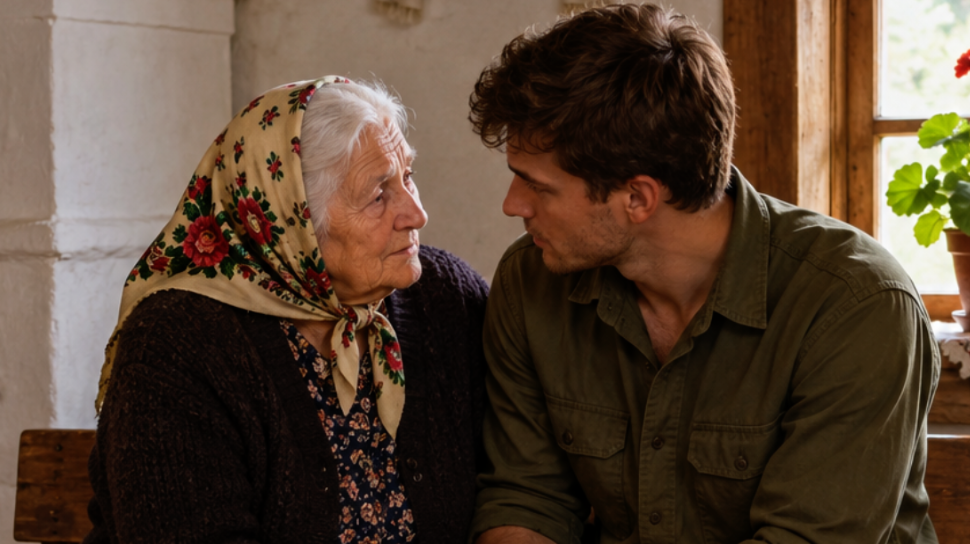
Egor was just three years old when his parents divorced.
Of course, he didn’t remember it. All that lingered in his mind was something faint: yelling in the kitchen, the crash of shattered dishes, his mom stuffing things into an old suitcase, and a stranger’s hand leading him to a different room. That’s it. After that—darkness. As if a door slammed shut.
Grandma Nyura, his mother’s mother, took him in. They lived in a village on the banks of a forest river in the Komi Republic. The house was old and leaning, but it had a stove. There was a cow. A garden. Potatoes.
His mother sent her first letter after a month. The next one came after three months. Then a postcard for New Year’s. After that, silence. His father didn’t write at all.
Grandma Nyura never judged anyone. She was one of those old women who understand everything but never say a word. Only sometimes, looking at Egor, she would sigh:
“He’s just like her. His mother’s eyes. But his character—that’s all his father.”
“What kind of character?” Egor would ask.
“Hush,” Grandma replied. “You’ll understand when you grow up.”
And Egor grew up. Grew up alone. No brothers, no sisters, no neighborhood kids. The village was tiny—maybe ten houses, all filled with old folks. There were no kids his own age.
He walked five kilometers to school in the next village—through the woods every morning, and back again every evening. In winter, he went on skis. In autumn, it was muddy. He did okay in school, not outstanding. Teachers would say he was talented but withdrawn. Always sitting at the back, silent, staring out the window.
“What are you thinking about, Egor?” they’d ask.
“Nothing.”
But he was always thinking. He never stopped thinking about the same things.
Where’s my dad? Where’s my mom? Why did they leave? Why has neither of them ever come, written, or called? Why don’t they need me?
Those questions grew as he did. At ten, he still hoped: any minute now, the door will open and his mom will be there—beautiful, in a pretty dress, with gifts. Or maybe his dad—big and strong, with a mustache like all the good dads.
At thirteen, he stopped waiting. By sixteen, he stopped forgiving.
At eighteen, he finished school and moved to the city. He went to technical college and became an electrician. Got a job. Rented an apartment. Lived alone. He visited Grandma rarely, maybe twice a year. And when she died, the house was sold, and the last thread tying him to his past was snapped.
Egor was twenty-five. He had a job, a beat-up car, a couple of friends, and an emptiness inside—cold as a March wind in the forest.
That’s when he decided: I’ll find them. I’ll find them both. Even if it’s just to look them in the eye. Even if it’s just to ask.
And so he began to search.
It turned out to be tough.
Grandma never spoke about his parents in detail. All she knew was that his mother, Nadezhda, went somewhere after the divorce—maybe to the south, maybe north. South? North? Who knows? His father, Viktor, was from Komi, but nobody knew where he went. Maybe he stayed in the republic. Maybe left to work in the oil fields. Maybe he drank himself away. Who could say now.
Egor started with the archives. He dug up old documents that Grandma had kept. The divorce certificate. A yellowed certificate from the village council. A couple of old photographs where his mother and father, young and laughing, are holding a baby. Egor himself.
From paperwork to the internet. Social media, phone directories, people search websites. He spent his evenings staring at faces on the screen. Nadezhda Sosnina. Viktor Sosnin. Not a single match.
Then came the phone calls. He rang up HR departments, village councils, district offices. Introduced himself as a journalist—lied, said he was writing about family work dynasties. Some turned him away, some promised to call back. No one did.
He searched for two years. Nothing came of it.
And then, fate stepped in.
Egor went on a work trip—to replace wiring in an old school, deep in a remote northern town in Komi. The job was simple: three days, two nights in the local hotel, then home. But there, at that school, an old lady worked as a doorkeeper. Her name was Aunt Klava. She sat by the entrance, knitting socks, looking at everyone as if she knew everything about them.
“Your last name sounds familiar,” she said to Egor on the second day. “Sosnin. We used to have Sosnins here. Long time ago. Viktor and Nadya. Any chance they’re your family?”
Egor’s breath caught.
“Yes, mine,” he said. “Did you know them?”
“Of course. We’re from the same village. They married really young. He was a tractor driver, she worked as a dairymaid. They made a good couple. Then something broke. They divorced and moved on. She went one way, he went the other. So you must be their son?”
“I’m their son.”
“Well, what do you know,” Aunt Klava set her knitting aside. “You’ve grown up. I remember you when you were this small.” She held her palm low toward the ground.
“Do you know where they are now?” he asked.
Aunt Klava paused, glanced around as if making sure no one was listening. Then she spoke quietly:
“I know. Both of them.”
“Where?”
“Here. Not far. In two different villages, on opposite sides of the river.”
Egor couldn’t believe it.
“Two villages? Nearby?”
“Nearby. Ten versts apart, maybe less. Nadya’s in the one on the left bank. Viktor’s on the right. Both alive. Both alone. Just so you know…” she hesitated. “They don’t know about each other. Haven’t seen each other since the divorce. Never asked, never showed any interest. That’s how they live. On opposite banks.”
Egor was silent. He just couldn’t process it.
Twenty-two years. His mother and father lived in neighboring villages—just ten versts apart. He could have walked there in two hours. Swam across the river in twenty minutes. And all that time—not once. No call. No meeting. Not even a chance hello in town.
“What about me?” he whispered. “Did they ever… even once…”
Aunt Klava looked away.
“I don’t know, Egor. I don’t keep in touch with them. Just rumors. Viktor’s turned wild—lives like a recluse, talks to no one. And Nadya—she goes to church. Praying for forgiveness. What sins, only God knows.”
She named the villages. The heads of the village councils. And even told him which locals he could ask for directions.
Egor wrote everything down in a battered old notebook he’d gotten from his grandmother. That night, he lay in his hotel room staring at the ceiling, thinking.
Where to start? Who should I go to first?
And decided: his mother. For some reason, that felt right.
He found his mother in a day.
The village on the left bank of the river greeted him with silence. A few leaning houses. A shuttered clubhouse. An old chapel with a collapsed roof. The rare passerby—mostly elderly women in dark headscarves.
His mother’s house stood alone on the edge—the last one, right by the forest. The darkened log walls, the porch windows boarded up. The only sign of life—a thin wisp of smoke curling from the chimney.
Egor knocked. Waited. Knocked again.
The door opened. A woman stood on the threshold. Short, thin, wearing an old coat over a house dress. Her gray hair was carelessly gathered in a bun. Her face—wrinkled, tired, with sunken eyes. But those eyes—they were his own. Gray, with the slightest hint of green.
“Who are you looking for?” she asked.
“Does Nadezhda Sosnina live here?”
“She does. And who are you?”
He was silent for a moment. Then said:
“I’m Egor. Your son.”
She didn’t gasp. Didn’t cry. Didn’t throw her arms around him. She just stood and looked at him—long, for a very long time. Then she stepped back, holding the door open.
“Come in,” she said. “Since you’re here.”
The house was poor. An old stove, a table, two chairs, an iron bed behind a chintz curtain. The walls—faded wallpaper covered in little flowers. The air smelled of dried herbs and loneliness.
“Sit down,” she said. “Do you want some tea?”
“I do.”
She put the kettle on. Took out two mugs—one with the handle broken off. Sat across from him. And stayed silent.
Egor looked at her. Here she was—his mother. The one he pictured as beautiful and young when he was a child. The one he waited for evenings, watching the road. The one who never came.
“Why?” he asked. “There’s one thing I want to understand. Why did both of you—you and dad—leave and forget about me?”
She was silent for a long time. Then started talking—her voice dull, strained, as if every word was hard to say.
“I didn’t forget, Egor. I remembered. Every single day. Do you think it was easy? I wrote letters. Every week during the first years. Your grandmother never replied. Later, I found out—she never gave them to you. She said: don’t poison his soul. Let the boy forget and live in peace. I wanted to come. So many times, I wanted to come. But then…”—she paused—”then I became ashamed. Too ashamed to look you in the eyes.”
She stopped talking. Then she started to cry. Quietly, without sobs—just tears running down her wrinkled cheeks and dropping onto the table.
“I’m a bad mother, Egor. I know that myself. I don’t deserve for you to come looking for me.”
He sat there, not knowing what to do. All the anger he’d carried for years suddenly vanished. Only tiredness remained. And a strange, unexpected pity—not for himself, but for her. For this old woman who had lived alone for twenty-two years, in a remote village, eaten up from the inside by guilt.
“It’s okay,” he said. “It’s okay, mom. Let’s have some tea.”
She lifted her eyes—wet, red. And suddenly, she smiled. A trembling, hesitant smile.
“You look like your father,” she said. “So much. Right here,” she touched her own forehead with her fingers, “your eyebrows. And your mouth. His mouth.”
“But your eyes,” he said.
“Yes. My eyes.”
They sat drinking tea. His mother asked questions—carefully, not wanting to scare him off with the wrong word. Where do you live? Where do you work? Are you married? Kids? He answered briefly. He didn’t lie. But he didn’t open up completely, either. He still wasn’t sure he had forgiven her. Maybe he hadn’t. But at least he had listened. At least he understood.
Then he asked:
“Do you know that Dad lives just ten versts from here? Across the right bank?”
She flinched. Set her mug down.
“No. I didn’t know.”
“And if you had known?”
She was silent for a long time.
“It wouldn’t have changed anything,” she finally said. “That train already left the station. Long ago. Back when you were three.”
Egor didn’t say anything. They finished their tea. He stood up.
“I’m going to see Dad tomorrow,” he said. “And maybe I’ll come back after. If you don’t mind.”
“Come back,” she said. “I’m always here now.”
And he left. She stayed standing at the doorstep, watching him go—just like she once watched the bus leave, taking her away from her three-year-old son.
He went to see his father the next day.
The right bank was higher, steeper. The village—smaller and poorer. The road—full of potholes. The houses—low-set, half-buried in the earth.
He found his father by the river, sitting on an overturned boat, staring out at the water. A tall, stooped old man in a worn jacket and heavy boots. Wild gray hair stuck out in every direction. His face was shaggy with stubble. Beside him—a bucket, empty, and a fishing rod, forgotten and left on the sand.
“Viktor Sosnin?” Egor asked as he approached.
The old man didn’t turn around.
“Suppose I am. What do you want?”
“I’m Egor. Your son.”
The old man turned his head slowly, very slowly. He looked at Egor for a long time, carefully—as if examining something unfamiliar, trying to figure out where it had come from.
“Egor,” he repeated. “Well, what do you know.”
And he fell silent.
Egor sat down next to him, on the same overturned boat. He pulled out a pack of cookies—he’d bought them in the village store, not knowing what else to bring. He offered them to his father. His father took the pack, turned it in his hands, then set it aside.
“So you found me,” his father said. “I thought you’d forgotten.”
“I haven’t forgotten. I remembered all this time.”
“Yeah. Yeah. I remembered too. But what good is that? Memories are like fish. You think you’ve caught one, but in a minute—it slips away and it’s gone.” He paused. “Is your mother still alive?”
“She’s alive.”
“Where is she?”
“On the left bank. Ten versts away.”
His father gave a little laugh—bitter, joyless.
“Ten versts. Might as well be a thousand. I haven’t seen her since ‘92. Since we split up. She said then: that’s it, Vitia, it’s over. And that was the end.”
“What happened? Why did you break up?”
His father picked a splinter up from the sand, rolling it between his fingers.
“We were young. Foolish. I drank. She wouldn’t forgive. I got jealous. She didn’t understand. I wanted one thing—she wanted another. And you cried at night. And we yelled at each other. She used to say, ‘I’ll leave.’ And one day she did. And half a year later, I left too. Left you with your grandma. Thought: it’ll be better this way. Thought: he’ll figure it out when he’s older.” He turned the splinter and tossed it into the river. “Did you figure it out?”
“I’m still figuring it out,” Egor said.
His father nodded. And again, fell silent.
The river kept flowing past—calm, wide, indifferent. On the other bank the forest loomed dark. Somewhere over there, ten versts away, his mother sat in her house, probably thinking about the same things. And they didn’t know about each other. For twenty-two years—they didn’t know. And now, even knowing, nothing would change.
“Listen,” his father suddenly said, “don’t hold a grudge against me. I get it, you have every right. But try not to. Anger—it’s like this little splinter. Toss it in the river and let it drift away. But if you hold on, it’ll stick in your hand. Fester. Got it?”
“I got it,” Egor replied. “I’ll try.”
They sat together in the boat, watching the water. His father didn’t say anything more. Egor stayed silent too. But in that silence, there was something important. Something they’d both been missing all these years.
Then he stood up.
“I have to go. I’ve got things to do.”
“Go on,” his father said. “Come back if you want. I’ll always be here.”
And he stayed, sitting alone on the empty riverbank. Old, gray-haired, holding an empty bucket and a forgotten fishing rod. Watching—not his son—but the little splinter drifting and spinning down the slow river.
Egor came back a month later.
He arrived for the weekend. First, he visited his mom. They sat and talked. She showed him old photos—the ones where she and his father were young. She told him how they met: at a dance in the club, with the music playing from the radio. How his dad walked her home, carrying her shoes because her feet hurt. How they got married—with no rings, no dress, just signed the papers and drank tea together.
“He was a good man,” she said. “Until he started drinking. Then he changed. And then I changed too. And we forgot how to talk to each other. Do you understand?”
“I do,” said Egor.
Next, he went to see his father. The old man was waiting for him by the same riverbank, just like he’d never left. But this time, he was clean-shaven, wearing a fresh shirt. He’d even flipped the boat over—cleaning it, starting to tar the seams.
“Are you fixing the boat?” Egor asked.
“Yeah,” said his father. “It’s so old now. The wood’s dry and cracked. But if I seal it up, it’ll still float a while yet.”
“Where would you go?”
“Oh, anywhere. Maybe across the river.” He glanced at Egor. “To your mother’s side.”
Egor stayed quiet. He didn’t ask if his father would really go or not. He finally understood: these two—they would never get back together. Too much water had passed under the bridge. Too much had built up over twenty-two years. But something had already changed. Something was already moving.
And as he drove away, leaving the two villages on opposite sides of the river behind, he thought about how strange life is. Ten miles—the kind of distance you could walk in two hours. But sometimes, to cross it, you need a whole lifetime. And sometimes, even a lifetime isn’t enough.
He turned onto the highway. The gray ribbon of road stretched out ahead. On his right, the taiga grew dark; on his left, the river glimmered. On the far bank, in a tiny village, his mother lived. On this side, his father remained. And Egor—he was the bridge. The only bridge between them. And maybe, that was the most important job he’d ever have.
He stepped on the gas. In his rearview mirror, the two villages flashed by—one on each bank. Brief glimpses, and then they were gone. All that lay ahead was the road. Long. Bright. His own.