Polina labeled the boxes with a black marker. “Kitchen. Dishes. Fragile.” “Books.” “Winter Clothes.” “Baking Pans.” Her handwriting was neat and slightly slanted, just like her grandmother’s. Over six years, she had learned to pack so efficiently that every box closed on the first try and not a single plate broke, even when carried down the stairs.
This was their fifth move.
The landlady of their one-room apartment on Enthusiasts Street, a polite woman in her sixties, had called at the end of January to say, apologetically, that she was selling the apartment. Her son was getting married in Moscow, and he needed money for a down payment. They had one month to move out.
“Of course, I understand,” Polina had said before hanging up.
Then she sat in the kitchen for a long time, staring at the wall where her favorite spice shelf hung. She had installed it herself two years earlier, drilling the holes and hammering in the wall anchors. Now she would have to take it down and fill the holes with plaster.
“Don’t worry, Polya,” Roman said that evening. “We’ll find something. It’s not the first time.”
“No, it isn’t,” Polina agreed. “It’s the fifth.”
He shrugged and turned on the television.
Every move left her with the same feeling. As though someone had grabbed her by the scruff of the neck and shifted her from one corner to another. As though she weren’t a person, but an object that could be told to make room at any moment.
Someone else’s wallpaper. Someone else’s pots in the cupboards. Someone else’s rules: no hanging pictures, no cats, no drilling without permission.
And every time a landlord called, her stomach dropped.
“Roma,” she kept saying, “we have to make a decision. Let’s get a mortgage. Even for a studio apartment. Even somewhere on the outskirts.”
“Polya, what kind of mortgage can we afford with interest rates like these? The bank will bleed us dry. Let’s save up a bigger down payment first. Then we’ll buy something. In a year or two.”
A year or two.
He had been saying that every year.
For six years.
Polina worked as a customer service representative at a bank’s contact center, on a rotating schedule of two days on and two days off. On her days off, she baked cakes to order.
It had started by accident. She had once baked a cake for a coworker’s birthday. The coworker posted a photograph online, and orders began pouring in.
Honey cakes, Napoleons, sponge cakes with berries.
Polina baked late into the night in rented kitchens, using unfamiliar ovens that she had to learn to work with all over again after every move.
She saved every single ruble she earned from her cakes.
Roman worked as a window installer and earned around seventy-five thousand rubles a month.
But every month, he sent fifteen thousand to his mother.
“It’s hard for her to pay for the apartment,” he explained. “Three rooms. The utilities alone cost twelve thousand. Mom has to manage everything herself.”
Except his mother wasn’t managing alone.
Roman’s sister, Alla, lived in Nadezhda Pavlovna’s three-room apartment with her nine-year-old son.
Alla had divorced three years earlier and moved back in with her mother. She worked as an administrator at a fitness club, but according to Nadezhda Pavlovna, money simply “slipped through her fingers.”
Alla loved beautiful things.
A new handbag. A new phone. A vacation in Turkey.
And she had loans to pay for all of them.
Between the fifteen thousand rubles Roman sent his mother every month and Alla’s endless pleas of “Romochka, help me out until payday,” the couple’s savings barely grew.
In six years, they had managed to save four hundred and twenty thousand rubles.
Almost all of it came from Polina’s cakes.
Nadezhda Pavlovna had never liked her daughter-in-law.
She didn’t openly cause scandals. No.
She simply made her feelings clear whenever she had the opportunity.
Polina hadn’t changed her surname after the wedding. She remained Vetrova, like her mother and grandmother.
At the time, Roman had said, “I don’t care, Polya. Keep it.”
But Nadezhda Pavlovna had something else to say.
“Well, I suppose that makes you temporary in our family,” she announced at the wedding reception, before the main course had even been served. “You didn’t take our name. Never mind. We’ll see how long you last.”
From then on, she pronounced “Vetrova” as though it were an insult.
Whenever Polina and Roman argued over something trivial and Roman complained to his mother, Nadezhda Pavlovna would say, without caring whether Polina could hear:
“Well, what did you expect? She’s not one of us. She’s a Vetrova. She has her own family and her own ways.”
Roman would laugh it off.
Or remain silent.
Not once did he stand up for Polina.
The only family Polina truly had was her grandmother.
Zinaida Ivanovna had practically raised her alone.
Polina’s mother, Zinaida’s daughter, worked long shifts at a bread factory before leaving to work in the north. After that, she called once a week.
From the age of seven, Polina lived with her grandmother in a small one-room apartment on the ground floor.
Her grandmother taught her to bake.
The honey cake made with her grandmother’s recipe, using a sour-cream custard filling, later became Polina’s most popular cake.
Her grandmother rarely spoke about her own life.
Polina knew only that in 1984, when her mother was five, her grandmother’s husband had left her for another woman.
Their apartment had been part of a housing cooperative and was registered in his name.
He threw his wife and little daughter out onto the street in a single day.
For three years, they lived in a factory dormitory, in a twelve-square-meter room with a shared kitchen down the hall.
“That was when I made myself a promise,” her grandmother used to say. “That I and my girls would always have something of our own. Our own little corner. Our own money. So that no man could ever throw us out onto the street again.”
She worked her entire life.
First as an accountant at a factory, then at a housing management office, and later, even after retirement, keeping the books for a small neighborhood shop.
She spent very little on herself.
Every spare kopeck went into savings.
Polina remembered seeing thick savings passbooks with blue covers on her grandmother’s shelf, held together with a rubber band.
“Who is all that for, Grandma?” she asked once, when she was about twelve.
“For you, Polinka. For an apartment. So you’ll have a home of your own.”
Last autumn, her grandmother grew terribly weak.
Polina visited her every day after work, bringing groceries, washing the floors, and sitting beside her.
Roman visited twice during that entire time.
In the spring, Polina received her inheritance certificate from the notary.
Her grandmother had left the one-room apartment to Polina’s mother.
And the savings account to Polina.
There were three million one hundred thousand rubles in it.
Polina sat in the notary’s office, holding the certificate in her hands, unable to believe it.
Three million.
Her grandmother, who had worn the same coat for years and darned her stockings, had managed to save three million rubles.
For her.
That evening, Polina bought the simplest cake she could find at the neighborhood shop—a wafer cake, her grandmother’s favorite.
She ate a slice alone in the kitchen, looking at the last box she still hadn’t unpacked after their latest move.
The decision came immediately.
She would buy an apartment.
A small one. One room.
No mortgage.
She would pay for it outright.
It would belong to her.
That evening, she told Roman.
She showed him the certificate.
At first, he was delighted.
He hugged her and spun her around the kitchen.
“Polya! This is wonderful! Our own home! Finally!”
He opened a real estate website on his laptop.
They stayed awake until two in the morning looking at apartments.
One-room apartments. Two-room apartments on the outskirts. Studios in new buildings.
Roman wanted a balcony where he could smoke.
Polina wanted a big kitchen where she could bake.
They laughed, argued, and dreamed.
Polina fell asleep happy.
For the first time in six years, she imagined hanging up her spice shelf and knowing she would never have to take it down again.
Three days later, Roman returned from visiting his mother looking thoughtful.
“Polya. Listen. Don’t rush into buying an apartment.”
“Why?”
“Well… Mom says we need to think everything through. It’s a lot of money. We should use it wisely. So everyone benefits.”
“Everyone? Who exactly? Roma, did you tell your mother?”
“What’s wrong with that?” He looked genuinely surprised. “She’s my mother. Of course I told her. She’s so happy for us. She says we should all get together on Sunday and discuss it. As a family.”
Polina wanted to say there was nothing to discuss.
That it was her grandmother’s money, and she had already decided what to do with it.
But Roman looked so hopeful.
And she thought, What harm could it do?
They would sit together, drink tea, and her mother-in-law would congratulate them.
Perhaps, for once in six years, she might even say something kind.
“All right,” Polina said. “Sunday it is.”
On Sunday, Nadezhda Pavlovna’s apartment smelled of freshly baked pies.
The table in the living room was covered with a lace tablecloth.
Nadezhda Pavlovna, a heavyset woman with short hair and glasses hanging from a chain, sat at the head of the table.
Beside her sat Alla, wearing a new sweater, showing off a fresh manicure, and holding her phone.
Alla’s son, Denis, was in the next room with his tablet.
“Come in, dear Polinochka,” her mother-in-law said with unusual sweetness. “Sit down. Would you like some tea? I made cabbage pies.”
Polina sat down.
Roman sat beside her.
For about ten minutes, they talked about nothing important.
The weather.
Denis’s grades.
The downstairs neighbor whose ceiling was leaking again.
Then Nadezhda Pavlovna placed her cup on its saucer and removed her glasses.
“Well, let’s get down to business. Roma told me about the inheritance. You had a good grandmother, Polina. Three million is serious money. I’ve been thinking about how to divide it sensibly. Fairly, so to speak.”
She pulled a folded sheet of paper from the pocket of her housecoat.
She unfolded it.
Polina saw that everything had been written out in a neat column in blue ink.
“Here’s how we’ll do it. One million for me. That’s for raising Roma. I brought him up alone, without a father, from first grade until he went into the army. I fed him, clothed him, sent him to technical college. You could say you owe me a thank-you for that. Well, this will be your thank-you.”
She continued without hesitation.
“One million for Alla. She has loans, you know how hard things are for her. A young woman alone with a child. She needs to pay off her debts and start living properly.”
“And one million for you and Roma. For a mortgage down payment. It should be enough for a two-room apartment on the outskirts. And your interest payments will be lower.”
She folded the paper and looked at her daughter-in-law over the top of her glasses.
Then she smiled.
“Well? That’s fair, isn’t it?”
Alla nodded without looking up from her phone.
“Mom, that’s perfectly fair. I actually checked with the bank. If I pay off my loans early, there won’t even be any penalties.”
Polina looked at her husband.
Roman sat staring down into his cup.
“Roma,” she said. “Did you know about this?”
“Well… Mom talked it over with me.”
“And what do you think?”
Roman raised his head.
He was silent for a moment.
Then he said:
“Polya, it really is fair. Mom raised me. Alla is struggling. And a million will be enough for our down payment. We were planning to get a mortgage anyway. Think about it. Everyone wins.”
Polina looked at him for a long time.
Then she turned to her mother-in-law.
“Nadezhda Pavlovna. My grandmother left that money to me. Not to Roma. Not to you. Not to Alla. To me. In her will. It’s my inheritance. And I want to buy an apartment with it. Pay for it in full. Without a mortgage. Just as my grandmother wanted.”
Nadezhda Pavlovna straightened in her chair.
Her smile vanished.
Her lips tightened into a thin line.
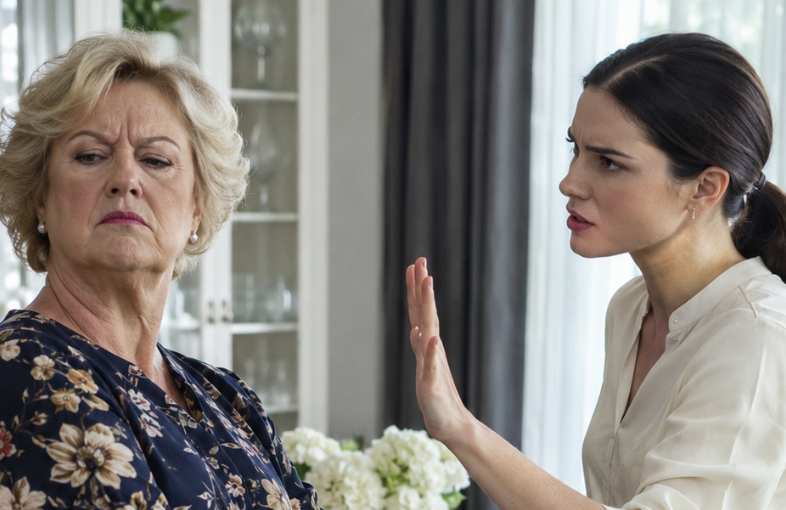
“Well, look at the little princess!” she snorted. “So you’ve decided you’re the only one who needs money! What about us? Aren’t we people too? Is Alla supposed to drown in debt? You married into our family, young lady, so you should live by our rules. Or are you planning to remain a Vetrova forever?”
Alla gave a mocking snort.
Polina remained calm.
Surprisingly calm.
Suddenly, she remembered a story Roman had told her during their second year of marriage, back when they were living in their third rented apartment.
“Nadezhda Pavlovna,” she said, “you inherited something too, didn’t you? Remember? This apartment. From your parents. Three rooms.”
Her mother-in-law blinked.
“What does that have to do with anything?”
“It has everything to do with it. When Roma and I got married and were renting our first room, he asked you for help. Remember? He asked you to give him even a small share of the apartment. Just one room. So we could live here while we saved money instead of paying rent.”
“You told him, ‘The apartment is mine. I inherited it from my parents. You’re a man. Earn your own money.’ Roma told me about it. That was six years ago.”
Nadezhda Pavlovna stared at her in silence.
“So here’s what I suggest,” Polina continued. “Let’s start with your apartment. Since we’re talking about fairness.”
“Three rooms in the city center. It must be worth about nine million rubles. One room for you, one for Alla, and one for Roma. Give him his share. We’ll make it official with a notary.”
“And then, after we’ve divided your apartment, we can talk about my grandmother’s money.”
The room fell silent.
Alla finally looked up from her phone and stared at Polina.
Somewhere in the next room, Denis’s tablet chimed.
Nadezhda Pavlovna turned pale.
First around her temples, then across her entire face.
Her glasses slid down to the tip of her nose, but she didn’t notice.
“That… that’s my apartment,” she said quietly. “Mine. From my mother and father.”
“Exactly,” Polina said. “And this is my money. From my grandmother.”
Roman jumped to his feet.
“What the hell are you talking about? Have you lost your mind? My mother welcomed you into her home, baked pies for you, and now you’re suggesting she divide her apartment? That’s unbelievable ingratitude! Absolutely monstrous! Polya, can you even hear yourself?”
“I can hear myself perfectly, Roma.”
“Apologize to my mother! Right now!”
Polina looked at her husband.
There he stood, towering over her, his face red and his fists clenched.
Shouting.
Not at his mother, who had decided to divide someone else’s inheritance.
Not at his sister, who had already calculated how she would pay off her debts.
At Polina.
And suddenly, all six years of their marriage flashed through her mind.
All five moves.
Every time Nadezhda Pavlovna had called her “temporary” or “not one of us,” while Roman laughed it off.
Every fifteen thousand rubles sent each month because “Mom is struggling.”
All of Alla’s endless requests for money until payday.
The final weeks of her grandmother’s life, when Roman had visited only twice.
And now, the only thing that concerned him was that her grandmother’s money wasn’t going where his mother wanted it to go.
“I won’t apologize,” Polina said.
She stood up and picked up her handbag.
“Thank you for the tea, Nadezhda Pavlovna. The pies were delicious.”
Then she turned to Roman.
“Roma, are you coming with me, or are you staying?”
Roman stood there for a moment.
He looked at his mother.
Then he grabbed his jacket and followed Polina.
He remained silent throughout the drive home.
His grip on the steering wheel was so tight that his knuckles turned white.
But as soon as they entered the apartment and closed the door, he started.
“You humiliated me. In front of my mother. In front of Alla. Do you even understand what you’ve done? Mom will cry for a week now. You’ve broken her heart.”
“Roma…”
“No, you listen to me.”
He paced across the kitchen, from the window to the door and back again.
“Here’s what’s going to happen. Tomorrow, you’ll call my mother. You’ll apologize. Then you’ll transfer two million rubles to her and Alla. Just as she said. One million to Mom, one million to Alla.”
“And that’s it. We’ll forget the whole thing.”
He stopped pacing.
“And if you don’t…”
He looked directly at her.
“If you don’t, Polya, I honestly don’t know how we can go on living together. I’m serious. I can’t stay with someone who treats my mother this way.”
Polina looked at him.
A year earlier, she would have cried.
She would have started explaining, defending herself, promising to think about it.
But now, everything seemed astonishingly clear.
And she felt calm.
“Roma,” she said. “Explain something to me. Just explain why. Why should I give your mother and sister two million rubles from my grandmother’s inheritance?”
“Because we’re family! Because my mother raised me! I owe her! I’ll owe her for the rest of my life!”
“You owe her. Fine. But what does that have to do with me?”
“You’re my wife. That means you owe her too.”
“And my grandmother? Did you owe her anything?”
Roman didn’t answer.
Polina walked into the living room.
From a box she still hadn’t unpacked after their move, she took an old photo album with a brown cover.
She opened it halfway through and removed a photograph.
It was small and black-and-white, with scalloped edges.
A young woman in a cotton-print dress and headscarf held a little girl in her arms.
The child wore a sunhat and squinted in the sunlight.
Behind them stood a gray five-story building with a sign that read:
“Red Proletarian Factory Dormitory.”
Polina placed the photograph on the table in front of her husband.
“That’s Grandma, Roma. With my mother. In 1984.”
“Her husband threw her out of their apartment with a little child in her arms. She spent three years living in that dormitory, in a room measuring twelve square meters.”
“Then she worked her entire life. Her entire life, Roma.”
“She wore the same coat for twenty years. She darned her stockings. She saved ruble by ruble so I could have something of my own. So that what happened to her would never happen to me.”
“She told me that a hundred times.”
Roman looked at the photograph.
Then he looked away.
“So what?”
Polina turned the photograph over.
On the back, in her grandmother’s handwriting, written in faded purple pencil, were the words:
“Dormitory, June 1984. Starting over.”
“That was her final wish, Roma. For me to have an apartment of my own.”
“And your mother, your sister, and you want to erase that wish.”
“People Grandma didn’t even know. People who never once asked how she was doing. People who haven’t said a single kind word to me in six years.”
“We’re not strangers. We’re your family.”
“No,” Polina said.
She placed her hand on the photograph.
“This is my family.”
“And in six years, none of you have ever made me feel that I was part of yours.”
The next morning, Polina arranged to leave work and went to see a lawyer.
A colleague from the bank’s contact center had recommended her.
The lawyer was a woman of about forty-five, dressed in a strict gray suit.
She received Polina in a small office on the third floor of a business center.
She listened carefully.
Then she examined the documents.
“Everything is clear,” she said. “An inheritance is personal property. It isn’t considered jointly acquired marital property.”
“Your husband has no claim to that money. Not to half of it. Not to a single ruble.”
“If you buy an apartment using those funds, it will also be considered your personal property, even if you’re still married.”
“The important thing is to keep all the documents: the inheritance certificate, the bank statement, and proof of payment to the seller.”
“You need to be able to show that the apartment was purchased with those exact funds. Then it won’t be divided in a divorce.”
“And what if I divorce him before buying the apartment?” Polina asked.
“Even simpler. No questions. No need to prove anything.”
Polina left the lawyer’s office and sat on a bench outside the business center for about twenty minutes.
Then she took out her phone and opened the government services website.
She thought for a moment.
Then closed it.
Roman would never agree to confirm a mutual divorce application.
She knew that.
So during her lunch break, she went to the magistrate’s court and filed for divorce.
She made no claim for division of property.
The only significant jointly owned asset was the four hundred and twenty thousand rubles in their shared account.
But Polina decided not to fight over it.
Roman knew nothing.
That evening, he stomped around the apartment in a sulk, rattled the dishes, and sighed loudly.
Before going to bed, he asked:
“Well? Have you thought about it? Are you going to call Mom?”
“I have thought about it,” Polina said. “And no, I’m not calling her.”
“Fine. Don’t say I didn’t warn you.”
He assumed she was bluffing.
That she was being stubborn, as usual, and would give in after a week.
He even told his mother so over the phone.
Polina heard him from the kitchen.
“She’s not going anywhere, Mom. She’ll get over her tantrum. She’ll call you herself in a week.”
One week later, Roman received a court summons.
He stood in the hallway holding the envelope, staring at Polina as though he were seeing her for the first time.
“What’s this?”
“It’s a divorce, Roma.”
“Are you serious? You filed for divorce? Over money?”
“Over six years, Roma. The money just revealed everything.”
He shouted.
Then he called his mother.
Then he shouted some more.
Finally, he packed a bag and went to Nadezhda Pavlovna’s apartment, slamming the door behind him and declaring that Polina would regret it.
Polina didn’t regret it.
That very evening, she opened the real estate website again.
The same website where she and Roman had once searched for apartments until two in the morning.
Only now, she was searching alone.
She spent three weeks looking at apartments.
Carefully.
On her days off.
After nights spent baking cakes for customers.
One apartment was on the seventh floor and smelled of cats, while the upstairs neighbor played the drums.
Another was in a new building on the outskirts, but reaching the nearest bus stop meant walking half an hour across an empty lot.
There was also a tiny studio in the city center, with a kitchenette built into a wall recess so small that there wasn’t even room for an oven.
And then she found it.
A one-room apartment in a brick building beside an old park.
Fourth floor.
Thirty-nine square meters.
A ten-square-meter kitchen with a large window overlooking linden trees.
The owners, an elderly couple, were moving to Krasnodar to live near their son.
The price was two million nine hundred and fifty thousand rubles.
Nonnegotiable.
But the apartment came with a gas stove and an oven, which the owner, Valentina Andreyevna, promised to leave behind.
“She’s like family to me,” Valentina Andreyevna said, gently stroking the oven door.
“I’ve been baking with her for thirty years. She’s never let me down.”
Then she looked at Polina.
“You bake, don’t you? I can tell by your hands.”
“I do,” Polina said with a smile.
They scheduled the purchase for the following week, after the real estate agent had checked the documents.
Polina transferred the money directly to the seller from her inherited savings account.
She kept every document.
The inheritance certificate.
The bank statement.
The purchase agreement.
She placed them all in a separate folder.
The court dissolved her marriage a month after the summons was issued.
Roman didn’t attend the hearing.
He sent only a short message:
“Happy now? Mom ended up in the hospital with high blood pressure because of you.”
Polina didn’t reply.
Valentina Andreyevna handed over the keys three weeks later, after she and her husband had moved out their belongings.
Exactly two months had passed since that Sunday when Nadezhda Pavlovna had spread out her sheet of paper and attempted to divide Polina’s grandmother’s millions.
Polina heard about Roman from a mutual acquaintance.
He was still living with his mother.
In the same three-room apartment.
Together with Alla and Denis.
They had given him the former storage room, which had once been converted into a small study.
There was a foldout sofa inside.
Alla was still paying off her loans.
And Nadezhda Pavlovna, people said, told anyone who would listen that her son had made an unfortunate marriage and that his former wife had turned out to be greedy and heartless.
Polina listened.
Then changed the subject.
She moved on a Saturday.
For the sixth time.
And the last.
The boxes were labeled with the same black marker.
“Kitchen. Dishes. Fragile.”
“Books.”
“Baking Pans.”
The movers carried everything up to the fourth floor in half an hour.
That evening, after the movers had left, Polina unpacked her toolbox.
She took out her drill, wall anchors, and spirit level.
And she hung the spice shelf in the kitchen.
The very same shelf she had carried with her through six moves.
She drilled carefully, checking that everything was perfectly level.
Then she arranged the jars on the shelf.
Cinnamon.
Vanilla.
Cardamom.
Nutmeg.
Next, she placed her grandmother’s photograph in a frame on the windowsill.
The photograph taken outside the dormitory in 1984.
Then she went downstairs to the mailboxes.
Hers was number thirty-two.
An old paper label bearing the previous owners’ surname was still stuck to it.
Polina peeled it off.
She took the marker and a strip of white tape from her pocket.
In neat capital letters, she wrote:
“VETROVA P.”
And stuck it to the mailbox door.
She stood there for a moment, looking at it.
The letters were neat and slightly slanted.
Just like her grandmother’s handwriting.
Then Polina went back upstairs to her apartment.
She switched on Valentina Andreyevna’s oven and let it warm up.
There was already sour cream in the refrigerator for the filling.
Her grandmother’s honey cake took a long time to make.
Each layer had to be baked separately.
And Polina was in no hurry