The apartment was passed down to Anastasia from her grandfather. He was old, grumpy, but fair, and he didn’t trust anyone except his only granddaughter. The building stood on the third row near the metro, with windows overlooking a courtyard where the noise of garbage trucks echoed and in the summer, flowerbeds bloomed so wildly that even the rocks seemed to develop allergies. Still, Nastya was happy. Because now she finally had something of her own. Real. No mortgages, no guarantors, no tears in Sberbank.
She started the renovations with enthusiasm, as if she wasn’t just painting the walls, but repainting her whole life. The floors creaked so loudly that the downstairs neighbors used to bang on their radiators, wondering if she was hosting a fire drill or a wedding up there. Anastasia blushed, apologized, and kept going—because she knew it was only temporary. Soon everything would be beautiful, clean, and, most importantly, hers.
“Don’t you think you’re doing all this with just… a bit too much enthusiasm?” asked Ilya, her husband, lounging with his legs stretched out on the old couch. He loved to say “excessive enthusiasm” to sound smart. Normally, it only worked on the cashiers at Pyaterochka, and only if they were having a good day.
Anastasia was standing on a stepladder trying to install a curtain rod. Not for any fancy words, just regular blinds. But the screwdriver kept turning the wrong way. Or maybe her hands were shaking.
“Yes, Ilya. I just adore getting paint in my hair, numb legs, and the smell of solvent. It’s my thing. And what have you accomplished?” she retorted, looking down at him—literally and figuratively.
He smirked and handed her a mug of coffee.
“Calm down. I was just joking. Maybe you shouldn’t do everything by yourself? My mom said she knows a good handyman. He did the neighbor’s ceiling—nice work, and didn’t charge much. But you, you want to do everything alone…”
The word “mom” had been heard in their house lately more often than “love” or “are you hungry?” Yekaterina Petrovna showed up in their lives like fog—at first unnoticed, then she was everywhere. Ilya listened to her as if his brain was actually a radio stuck on a single station: ‘Yekaterina FM’. She called in the morning, in the evening, and recently she even started dropping by unexpectedly, bringing jars of pickles and casting her “subtle” glances around.
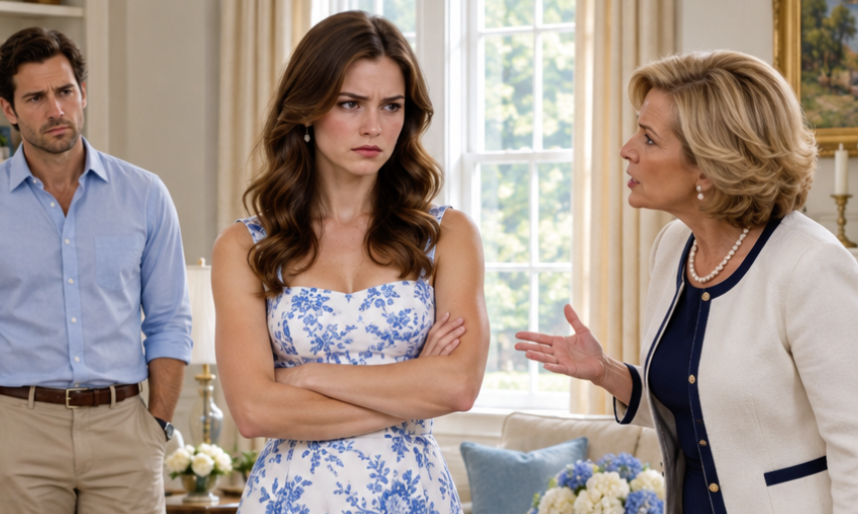
“What’s going on here? Still renovating? Oh, Nastya, you’re such a dreamer. You really should trust men more and stop running around with a screwdriver in your hand. A woman with a tool is like a cat in the shower: you feel sorry for her, but it’s kind of scary too,” Yekaterina Petrovna giggled when she poked her head in once again without knocking.
“Better with a tool than on the couch with the remote,” Anastasia grumbled as she scrubbed a spot of putty off the wall.
“Who are you hinting at, sweetheart?” her mother-in-law pursed her lips as if she’d swallowed vinegar. “Your husband works, you know. He can’t run after your whims all day.”
Anastasia didn’t say anything. She had a habit of falling silent when she felt like screaming. Because once you scream, you end up screaming for the rest of your life. And she didn’t want to live in a world of shouting.
As the renovations finally drew to a close, Anastasia had stopped smiling. Her hands ached, her hair had become brittle, and her nails looked like they belonged to a miner. She’d lost weight, picked up chronic insomnia, and could now distinguish primer from acrylic paint just by smell. She even developed an allergy to the word “wallpaper”—especially when it came from Ilya.
He seemed to have changed somehow. Softer, but in a strange way. He started speaking in syllables, as if she was stupid. And his sentences turned oddly… rehearsed. Scripted. It didn’t feel heartfelt—more like it was coming from some basement full of questionable plans.
“Nastya, let’s talk. My mom’s got an idea… well, basically, here’s the deal: we could make the apartment ours, but add her, so it would be in all three of our names. You, me, and her. For peace of mind, you know. Just in case…” he said one day, almost casually, as he dumped dumplings into boiling water.
Anastasia looked up at him. There was no anger in her eyes. Only exhaustion.
“Are you out of your mind?”
“It’s for stability. So no one tries to pull the rug out from anyone else later. Mom’s getting older, she needs a place to stay. And here it’s perfect: you’re right next door, I’m not running between two homes…”
“So you’re planning to leave me alone with her?” she didn’t even laugh. It would have been funny if it wasn’t so sad.
“Well, not exactly leave you. It’s just… she’s freezing in Protvino. Here, it’s warm, cozy, everything’s yours. Honestly, you did such an amazing job!” Ilya spoke like he really didn’t grasp what he was doing.
Anastasia stepped closer, leaned against the windowsill, and quietly, without any drama, asked:
“Tell me the truth, Ilya. Was this your plan from the beginning?”
He pressed his lips together. Silent. And in that instant, she understood everything. There was no need to ask further.
Late that night, when Ilya had gone off to ‘work’—at least according to Yekaterina Petrovna, who claimed there was a night shift at the office—the main character herself showed up at the apartment. No warning, and with keys in hand. She had “accidentally” copied them back when Nastya left her bag at their dacha.
“Hello, sweetheart. I just brought you some soup, you’ve lost so much weight—it’s scary!” Yekaterina Petrovna cooed, taking off her shoes. “Oh, and can I crash here for the night? My water’s been shut off, but it’s warm at yours. What a gorgeous apartment! Like something from a magazine. My favorite style: clean, minimalist, and expensive. You’ve done so well. Really. Now we just need to make sure it’s handled properly…”
“Excuse me?” Anastasia stood in front of her. Not aggressive, just direct. “What are you doing here, Yekaterina Petrovna?”
“I’ve come home,” she sighed, tossing off her coat. “You and Ilya made the decision. I’m moving in.”
Ten minutes later, Anastasia was standing barefoot in the hallway, face flushed and heart heavy. She’d kicked her out. Yes. Literally. Shut the door behind her. And locked it.
Then she leaned against the wall and cried. Quietly. Choking back sobs. Almost ashamed that she’d fought for what was hers.
And just at that moment, the doorbell rang. She looked up.
“What?” Her voice was hoarse now.
“It’s Ilya. Open up. We need to talk.”
Anastasia didn’t move.
“You have exactly five minutes. And only if you start with: ‘I was a jerk.’ Otherwise, I’m not even looking at you.”
Silence.
“Well?”
“I… was a jerk,” he muttered. “Shall we keep going?”
She wiped her nose and smirked.
“Come in. You still have a chance to explain why I haven’t filed for divorce yet.”
Ilya stepped inside. He looked far too calm, like he still believed he could talk his way out of this.
He was wrong. Loudly and irreversibly.
Anastasia sat on the windowsill, wrapped up in a blanket. The window was cracked open—May air whispering in with the scent of bird cherry and burnt buns from downstairs. Her head was buzzing, as if a symphony orchestra had taken up residence in her ears and only rehearsed at midnight.
Ilya lingered in the hallway, fidgeting with his leather backpack—the one she’d given him long ago. For some reason, it annoyed her to see him still using things she bought with her own money.
“Come in,” she said without turning. “And take your shoes off. Every speck of dust is precious to me now, you know.”
He went to the kitchen, picked up a mug, filled it with water from the filter. At first he thought about sitting down, but then changed his mind and stood by the wall. He didn’t speak.
Anastasia gave him exactly forty seconds.
“Well? Where are your explanations? Where’s your remorse? Where, for heaven’s sake, is even a hint of intelligence on your face?”
“Nastya…” Ilya scratched his head. “I didn’t want things to turn out like this. We thought, well… that you’d figure it out yourself.”
“Oh, sure. Of course. I was supposed to guess that you and your precious mother decided to freeload at my expense. What am I to you? A migrant worker with golden hands and no rights?”
“That’s not it at all!” he snapped. “You’re always doing everything yourself. Yourself! Yourself! As if I’m nobody at all!”
“Did it ever occur to you that maybe you actually are nobody?” she replied calmly. “You’re not a helper, not a partner, not a support. You’re just furniture. And not even sturdy—scratched up and creaky at that.”
He went silent. The comparison must have hit hard. Furniture—especially creaky furniture. Ilya’s self-esteem reacted like an automatic door at a shopping center: it tried to shut but got stuck.
“Mom and I just thought since you couldn’t handle it all alone, we could… you know, join forces. Pool our resources.”
“I’m a resource, huh?” Her voice turned icy. “You and her are the strategists, and I’m just a location. Square meters with hands and a nervous system.”
“That’s not what it’s about! We’re family…”
“Oh wow! The word ‘family’ coming from you sounds like a brain clearance sale. Did you ever think about me—even once? When I was scraping radiators until midnight? When I had to bargain with a plumber who called me ‘sweetie’? When I slept on the floor because the couch hadn’t been delivered yet?”
Ilya looked away. He couldn’t take it.
“You’ve changed. You’re angry. Hardened.”
“I grew up, Ilya. Meanwhile, you’re still stuck where your mother left you back in eighth grade.”
He slumped onto a stool, as if he’d been nailed to the floor.
“So what now?” he asked. “You won’t kick me out, will you? This is my home now too. We’re married. Everything’s supposed to be shared.”
“Exactly what we’ll discuss,” Anastasia said, standing up. “Because now, my dear, you’re about to begin the most exciting quest of your life: ‘Divorce and Maiden Name.'”
The next morning, at dawn, she woke up to a strange sound. It was like someone screaming in the stairwell—not just shouting, but putting on a concert, with an intro, a chorus, and a meltdown encore. Continued in the comments.
She walked up to the door, cracked it open—and practically growled. There was no other way to describe it.
Standing on the landing was Ekaterina Petrovna. She wore a bathrobe with leopard-print trim, carried a bag, and was accompanied by her friend—the very same one who once shouted that ‘your internet is the devil’s work.’
“I’m here for my son!” Ekaterina Petrovna announced proudly. “I have every right!”
“Are you out of your mind?” Anastasia croaked, unable to believe what was happening. “How exactly did you think you’d just show up here?”
“As his mother!” her mother-in-law declared with dramatic flair. “He’s my son, he’s coming with me. You kicked him out, so I’m taking him back. This apartment—is in dispute. I’ve consulted people.”
“Consulted with whom? The administrator of the ‘Evil Mothers-in-Law of Russia’ Facebook group?” Nastya shot back. “Get out. Ilya’s still here. But not for long. He’s packing his things.”
“I’m not leaving!” her friend screeched. “We’ll call the police! This is an illegal eviction!”
“What I’m dealing with here is illegal entry,” Nastya replied calmly. “And you know what’s funniest? The apartment is registered only to me. The inheritance paperwork is done. I’m the sole owner. Just me—not ‘us,’ not ‘we,’ and definitely not ‘moms.'”
The silence was so thick you could cut it with a knife.
“What?” Ekaterina Petrovna stammered. “But… how… Ilya said…”
“Ilya says plenty of things. Especially when he’s been drinking. And when he’s sober—he just lies. That’s it. Your game is over.”
Ilya left the same day. With two suitcases and a look like he’d just been fired from life itself. Ekaterina Petrovna called and showed up three more times. Once she brought a notary with her—who turned out to be her distant cousin and promptly lost his ID right at the doorstep.
Anastasia withstood it all. She stayed polite—but firm. Like they say in the movies: an ‘Iron Lady.’ Only, no lords and no parliament needed. Just a woman who was betrayed—and refused to let herself be devoured.
That evening, she switched on the light, walked barefoot across the new tiles, and opened a bottle of wine. The kitchen was quiet. There was no rustling of chip bags, no clicking remote, no one saying things like “but mom said…”
“To myself,” she said aloud, raising her glass. “To a woman who knows how to build not just walls, but also boundaries. And knows how to take down anyone trying to break through.”
That night, she fell asleep peacefully for the first time in a long while. No anxiety. No fear. No knocking at the door.
Three weeks after Anastasia showed Ilya the door, her life was filled with… silence. Not happiness. Not euphoria. Not some triumphant march across the new floor in her bathrobe. Just silence. Thick, dense, as if someone had stuffed cotton in her ears.
No calls. No texts. Even Ekaterina Petrovna—the family fleet’s own siren—fell silent. Nastya even checked to see if anything happened to her, maybe she was sick or hit by a tram. Turns out, it was much simpler: the old woman went to a spa ‘to recover from stress.’ Apparently, the stress of not snagging a three-room apartment in Sokol.
Anastasia stared out the window and felt… nothing. Of course there was happiness—about fifteen minutes of it the day she received her certificate of ownership. Then reality kicked in. The renovations were finished, the apartment nearly settled, furniture arranged, even the plants somehow survived. But inside? Just emptiness. She had won, technically, but victory somehow didn’t feel that sweet.
“So, Nastya, does freedom not warm your heart?” smirked her neighbor, Galina Lvovna, as she sat in the kitchen with a cup of chicory. “It happens, dear. The war ends, but the habit of fighting lingers.”
“Maybe,” Nastya sighed. “You know, I really thought it would get easier without them.”
“And it did. You just haven’t gotten used to the new you yet—without them. Now you’re truly alone. Not ‘alone, but married’ like before. Honestly alone. Now it’s time to learn how to live again.”
Alone, but honestly. That phrase stuck in her head like a nail in the wall—one that no picture ever hangs from, just there, sticking out.
On Saturday, the doorbell rang. She figured it must be a delivery—a forgotten order, or maybe a neighbor got the wrong door. She opened up and froze in shock.
Standing on the threshold was Ilya.
His beard had gotten a bit scruffy, eyes sunken, wearing a jacket that was at least ten years old. In his hands—a sports duffel and a plastic bag from the pharmacy. He looked like an ad for misfortune in human form.
“I just want to talk,” he said softly. “Ten minutes. I’m not here to beg. I’m not here to plead. I just want to say my piece, then I’ll go.”
Nastya nodded, letting him in. She looked him over as he walked slowly, as if every step in this apartment was now some kind of personal test.
“You know, I thought…” he began, sitting down on the edge of the couch. “I thought it would be easier. Like, new life, freedom, my mom nearby… Then one day I woke up and all I had was the smell of cat food and the TV playing ‘Field of Wonders.’ And I realized: this is it. This is where you live when no one’s waiting for you anymore.”
“So, were you waiting for me?” Nastya asked, with irony in her voice, leaning against the doorframe.
“I wasn’t waiting, I… got used to it. Used to you being around. Everything just moved forward, like it was all automatic. But then I realized—it’s not automatic. It was you. You did everything. I just thought, if you could carry so much, I might as well just ride along.”
“And it was comfy, huh? Flexible neck, strong back.”
“Yeah,” he nodded. “But I broke it. With my own hands. You know, I can’t even listen to my mom anymore. She keeps talking and talking… and I just want to turn her off, like the radio on the bus.”
Nastya stayed silent. Everything inside her churned—not from pity, but from anger. Because he spoke with that look like he was just unlucky. Not a traitor. Not a liar. Just—well—circumstances didn’t work out.
“What do you want, Ilya?”
“I signed the papers,” he said, placing two sheets on the table. “The divorce. No splitting things up, no claims. Everything you put in—it’s yours. I even thought… about offering alimony, but then I realized—we’re not kids, right?”
“We’re not kids, but someone’s acting worse than a teenager.”
“I deserve that,” he nodded. “Just… if it’s possible,” he stood up, “forgive me. Not as an ex. As a person. For everything.”
Nastya looked at him. For a long time. No anger. No forgiveness. She just gazed at him, like someone who is already beyond return. Not because he’s a bad person. But because the road has ended. There’s nowhere left to go back.
“Leave, Ilya.”
He nodded. No drama. No unnecessary words. He picked up his bag and left. Calmly. Almost silently.
Two days later, she called a locksmith.
“Changing the locks?” he asked business-like, pulling out his tools.
“Yes,” she replied. “On the front door and the balcony. And in the shower, if possible.”
The man laughed.
“Well, the shower’s a bit more complicated, but I can give you some advice.”
An hour later, everything was done. The new lock clicked with a satisfying sound.
Anastasia closed the door, turned to face her apartment, took a deep breath, and said:
“That’s it, now it’s truly mine. Not just on paper. I can feel it.”
She took her light jacket from the rack, slipped it on, and headed outside. The May sun hit her face. Life didn’t feel paused anymore. It felt real. A little cold, slightly lonely—but hers.
And the final touch.
A notification popped up on her phone:
“Your divorce application has been accepted. Wait for a summons from the registry office.”
Anastasia smiled. For the first time—for real. Not with sarcasm. Not wearily. But with a light, playful sense of something new beginning.
She tapped “delete contact.”
And in that moment she felt it: freedom is when you’re not afraid of being alone. Because you know—you’ve got yourself.
The apartment stayed with her. And everything unnecessary—was gone.