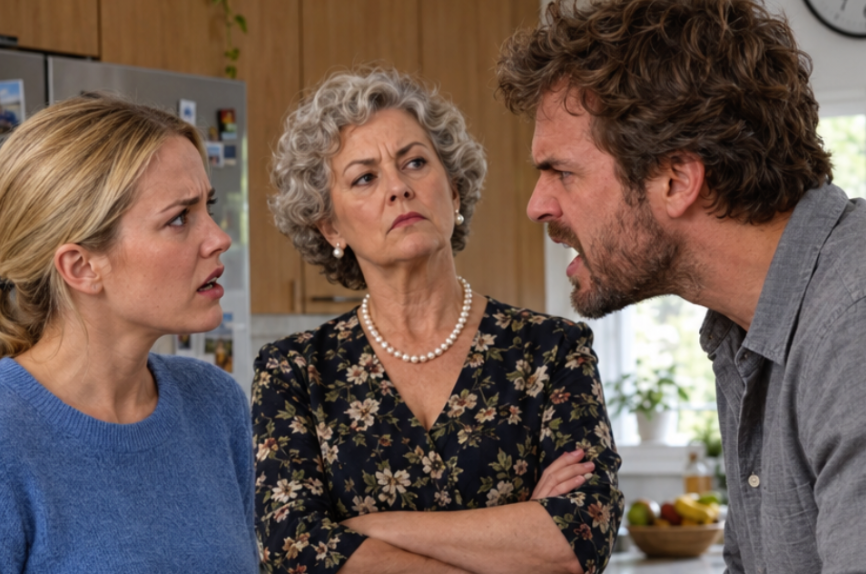
“Tomorrow we’re going to the notary, you’ll give my mom the inherited apartment! If you won’t sign—you’re out of the house!”
Igor flung the folder onto the kitchen table. The plastic cover smacked loudly against the tablecloth, bounced, and almost knocked over a mug of unfinished tea before settling back down. I stood at the sink, my hands lathered in suds, and watched as water dripped from my fingers to the floor. My head felt empty. It wasn’t fear or resentment—just pure emptiness, as if someone had pulled a plug and everything inside me had drained away.
“Did you hear me?” Igor stood in the kitchen doorway, arms folded across his chest. His shirt collar was unbuttoned, and his tie hung loosely around his neck like a noose. “Tomorrow at ten. Mikhail Lvovich is waiting for us.”
I wiped my hands on the towel, slowly, as if it was the most important thing I’d ever done. Then I took the folder. I opened it. On top was the deed of gift. Simple, two pages, a big title and tiny lines of text I didn’t have time to read. Underneath was another document. Also a contract, but slimmer, stamped by some company. I reached for it, but Igor stepped forward and put his hand over the folder.
“You can read it tomorrow,” he said. “No need to clutter your head with it right now.”
“Why tomorrow?” I asked. My voice was even—almost too calm. “I want to know what I’m signing.”
“It’s my mother, Vera. Don’t you trust her?”
He looked at me, and there was something new in his eyes. Not anger, not the irritation I had grown used to over the last three years. It was something like fear. As if even he was scared of what he was doing, but just couldn’t stop himself.
“It’s not about trust,” I said. “It’s about the paperwork. I’m an accountant, Igor. I know the most important things in documents are in the fine print.”
He smirked, but it came out crooked.
“You always make everything complicated. Mom just wants to feel secure about the future. She’s sixty-seven. She’s alone. And we… we’re a family.”
“And what about me?” I asked. “I want to feel secure, too. That was my parents’ apartment.”
“Your parents died twelve years ago,” he said, and it sounded like a verdict. “The apartment’s just sitting there. You don’t live in it. We live here. But Mom is stuck in a tiny one-bedroom on the outskirts. It’s hard for her.”
I looked at him and didn’t recognize the man standing before me. Twelve years ago, he was the one holding my hand at the cemetery, promising he’d never hurt me. That rainy April day, he was a different person. Or maybe I just thought so then.
“I won’t sign,” I said. “Not until I’ve read absolutely everything. Down to the last comma.”
Igor took his hand off the folder, but he didn’t hand it over to me. Instead, he picked it up from the table and clutched it to his chest, like a child who doesn’t want his toy taken away.
“Then start packing your things,” he said quietly. “I’m serious, Vera.”
He left the kitchen. I heard the bedroom door slam and the lock click. The apartment went silent. Only the fridge was humming its steady note, and the hallway clock ticking away the seconds of the new life that had just begun for me.
I sat down on the stool and stared at the empty table. Twelve years. For twelve years, I lived with this man, cooked him dinners, washed his shirts, went to the seaside with him twice, and then stopped—there wasn’t enough money. Twelve years I stayed quiet when his mother would say, “Verochka, you should put on some weight” or “Igoryok, you need to rest more, you’re always working.” For twelve years I believed this was what a family was. And now, I was being shown the door.
I didn’t cry. For some reason, I just couldn’t. Maybe it was because my tears had already run out—three years ago, when the loans started, when his mom ‘got sick’ and demanded money for medicine, when Igor first raised his voice at me. Back then, I cried at night, into my pillow so he wouldn’t hear. But after a while, I stopped. It’s like something inside me just clicked off, like a switch, and everything went dark.
Now I sat there thinking about the second document. What was it? Why was Igor so anxious? Why wouldn’t he let me read it?
I remembered how three years ago, his mother asked just to ‘take a look at the apartment documents.’ She said, ‘Verochka, I’m not claiming anything, I just want to be sure Igor has something to fall back on.’ I refused, politely but firmly. I told her the documents were safe with me, and I didn’t see any need to show them to anyone. She pursed her lips but didn’t reply. A week later, things started happening. First Igor took out a loan for renovations, even though the apartment didn’t need it. Then his mother was suddenly bedridden with hypertension, and Igor took a large sum to her. Then another loan—this time for a car, which he had to sell six months later because we couldn’t keep up with the payments.
Back then, I found it odd how everything coincided. But eventually, I just brushed it off. Life happens. Everyone has tough times.
Now I realized: it was all a setup. They were waiting. For three years, they waited for me to break. And now they finally did—only it wasn’t how they expected.
I didn’t sleep that night. I lay beside Igor, listening to his breathing. He slept peacefully. Even in his sleep, he was sure he was right. Meanwhile, I stared at the ceiling, with just one thought spinning in my head: “What’s in that second document?”
In the morning, I got up first. Made some coffee, but didn’t drink it—just held the cup to warm my hands. Igor came out of the bedroom, dressed in a suit, shaved and put together, as if nothing had happened last night.
“Are you ready?” he asked.
“I’m ready to talk,” I replied. “But I’m not ready to sign anything I haven’t seen.”
— Vera, don’t start.
— I’m not starting. I’m finishing. Give me the folder. Just five minutes. I’ll read the second document, and then we’ll go.
He hesitated. Then he pulled the folder out of his briefcase and put it on the table.
— Five minutes, — he said. — And don’t make a scene.
I opened the folder. The donation agreement was on top. I pushed it aside and grabbed the second document. It wasn’t another contract. It was an appendix to the agreement, a single sheet, with such tiny print I couldn’t make it out at first. I brought the page to the window. And began to read.
“The gift takes effect on the condition that the donor (Vera Nikolaevna S.) must live together with the recipient (Alla Dmitrievna K.) and provide care for the recipient. If they stop living together at the recipient’s initiative or for other reasons not dependent on the donor, the contract may be terminated at the request of the recipient. In this case, the donor loses ownership of the gift and must vacate the property within ten days of termination.”
I read it three times. Then again. Over and over. The letters wouldn’t form words. Or rather, they did—but in words that made my fingers go cold and took my breath away.
So, I am giving my apartment to my mother-in-law. But I still have to live there. Like someone just allowed to stay. With the obligation to care for her. And if she decides I’m not good enough at it, she can terminate the agreement—and kick me out of my own home. And I’ll be left with nothing. Absolutely nothing.
I looked up at Igor. He was standing by the window, his back to me, pretending to be watching the street.
— Did you know about this? — I asked.
— About what? — He turned around. His face was unreadable, but I could see a vein twitching in his neck.
— About the clause about care and termination. Did you know what you were signing?
— It’s just a formality, — he said quickly. — Mom just wants to be sure you won’t kick her out later. It’s to ease her mind.
— And how about my peace of mind? — I put the sheet on the table. — Igor, this isn’t a formality. It’s a noose. I’m giving away the apartment, but I only get to stay as long as she allows. She can throw me out at any moment. Do you get that?
— You’re exaggerating. Mom isn’t like that.
— Mom isn’t like that? — I stood up. — The same mom who, three years ago, just wanted to ‘look at the papers’? The mom who started demanding money for medicine when I said no? The mom who talked you into taking out three loans even though we’re struggling to make ends meet? You really think she isn’t like that?
Igor was silent. He looked at me with something like confusion in his eyes. As if he was seeing the real me for the first time—and had no idea what to do about it.
— Give me the folder, — I said. — I’m going to take photos of this sheet. Just in case.
— Why?
— Because I’m not signing paperwork I don’t understand. And I don’t advise you to, either.
He handed me the folder. I took out my phone and snapped a picture of the second sheet. Then the first. Then every page of the donation agreement. Igor watched in silence as I did it. When I finished, he said:
— You don’t trust me.
It wasn’t a question. It was a statement. I looked at him and replied:
— Is there a reason to?
He didn’t say anything. He just picked up the folder and headed for the door. At the doorway, he turned back:
— Ten o’clock. Don’t be late.
And he walked out.
Now I was alone. Sitting in the kitchen with a cup of cold coffee, and my phone, which held photos of a document that could either destroy my life—or save it. I still had no idea which.
I called Sveta. She picked up after the third ring, her voice sleepy but worried.
— Vera, why are you calling so early? Is something wrong?
— Sveta, do you know a good lawyer? — I asked. — I really need some urgent advice.
— What happened? — Sveta immediately sounded more awake. — Igor? Your mother-in-law?
— My mother-in-law. And Igor. All of it together. I’ll tell you everything later—just give me the number.
She dictated the number. I jotted it down on a napkin even though my phone would have saved it anyway. Then she said:
— Sveta, I think I’ve really messed up. But I don’t know quite how badly yet.
— Hang in there, — Sveta said. — I believe in you. You’re the smartest one out of all of us.
I smirked. The smartest. I stayed quiet for twelve years, and now all of a sudden, I’m the smart one.
Sveta was my colleague, working in the next department. We’d been friends since university, though we rarely saw each other—work, home, life getting in the way. She was blunt, divorced, with two kids, and always spoke her mind—sometimes too directly. But right now, I needed that honesty.
I dialed the lawyer’s number. A man answered, his voice calm and businesslike. I briefly explained the situation. He listened without interrupting. Then he said:
— Come in. I’ll send you the address. And bring all the documents you have—anything related to the apartment and your husband’s loans.
— I don’t have any loan documents, — I replied. — Only some bank statements I found among his papers.
— That’s something. Come in.
I got ready quickly. Threw on the first things I found—jeans and a sweater. Pulled my hair into a ponytail, didn’t even look in the mirror. I couldn’t care less about how I looked right now.
The lawyer, Artyom Sergeyevich, was about forty, with tired eyes and a sharp gaze. He listened to me, looked through the photos I showed him. Then he leaned back in his chair and said:
— You’re in a tough spot, Vera Nikolaevna, but it’s not hopeless. This clause, — he tapped the screen, — makes the contract exploitative. In fact, it’s void from the start, because it violates article 572 of the Civil Code. A gift can’t be conditional on the donor providing care for the recipient. That’s not a gift anymore, it’s a rent agreement. But they tried to disguise it as a gift. If you sign, you could challenge the deal in court, but it’s better not to sign at all.
— I’m not planning to, — I said.
— That’s the right choice. But you have another issue—your husband. He’s putting pressure on you. He might try to kick you out of an apartment that belongs to you. On what grounds?
— Because we’re married. And the apartment is marital property, right? No, I inherited it. So it’s mine alone.
“That’s true. But he can make your life unbearable—psychological pressure, threats. That’s a form of abuse, too. If he tries to evict you, call the police. And document everything. Every outburst, every threat. Record things on your phone. It might not feel nice, but it works.”
I nodded. Artyom Sergeyevich went on:
“And one more thing. You said your mother-in-law asked to see your documents three years ago. Then the loans started. Do you have any proof that she was behind those loans?”
“Just account statements. And my memories.”
“That’s not enough. But if you have messages or something that shows her pressure—collect it. Anything might help later.”
I left the lawyer’s office feeling like I’d just been doused in cold water. But it wasn’t despair—this time it was anger. For the first time in ages, I didn’t feel afraid, just furious. At Igor. At my mother-in-law. At myself, for letting them manipulate me for so long.
I got home at nine. Igor was waiting in the hallway, already wearing his coat.
“Where have you been?” he asked.
“With a lawyer,” I replied.
He turned pale.
“What lawyer?”
“A good one. Igor, I’m not signing that agreement. Not today. Not tomorrow. Never.”
“Are you out of your mind?” He raised his voice. “Mom is already at the notary office! We agreed!”
“You agreed. Not me. And if you go tell her I’m not coming, that’s your problem. If you try to kick me out of my own apartment, I’ll call the police. And a lawyer. Do you understand me?”
He stared at me, and I could see fear in his eyes turning into confusion. He’d never seen me stand up to him. For twelve years I was soft. For twelve years I gave in. But not anymore.
“Vera,” he started—but I cut him off:
“Let’s go. I’ll tell her myself.”
The notary’s office smelled like old paper and coffee. Mikhail Lvovich, a thin man with glasses, sat at the table sorting through documents. Alla Dmitrievna was across from him, wearing a new dress and a smile that was supposed to be friendly. But her eyes were cold as ice.
“Verochka, finally!” she exclaimed as we walked in. “We were starting to worry.”
“You shouldn’t have,” I said. “I came to tell you I won’t be signing the agreement.”
The smile froze on her face. She looked at Igor, then at me.
“What do you mean, you won’t sign?” she asked. “We discussed everything.”
“You discussed it. Not me. I read the agreement. Including point 3.2. About cohabitation and care. And your right to terminate the agreement whenever you want.”
Alla Dmitrievna turned pale. But she quickly composed herself.
“It’s just a formality, Verochka. I’m not doing this for myself. I just want Igor to have a safety net. And you… you understand, I’m old, I need care.”
“You need care. But not at my expense. And not at the cost of my parents’ apartment.”
Mikhail Lvovich looked up from his documents.
“Excuse me, have you reviewed the terms?” he asked.
“I reviewed them,” I said. “And I think they’re oppressive. In fact, I think this isn’t a gift but a disguised annuity contract. I’ve consulted with a lawyer.”
Alla Dmitrievna stood up.
“This is outrageous!” she said. “Igor, say something!”
Igor was silent. He looked at me, and there was something different in his eyes. It wasn’t anger—it was fear. He was afraid. Not of me, but of what I might say next. Of what I could reveal that he never expected.
And I did reveal it.
“I have a folder,” I said. “I’ve kept it for three years. Now it’s time.”
I opened my bag and took out a thin folder. I placed it on the table in front of the notary. Mikhail Lvovich looked at it with curiosity.
“What is that?” Alla Dmitrievna asked, her voice trembling.
“These are proofs,” I said. “Three years ago, when you, Alla Dmitrievna, asked to ‘just see the documents,’ I refused. But I wasn’t foolish. I visited a lawyer, and he advised me to gather anything that might be useful. I never planned to use them. I was just keeping them—just in case. And now, the case has come.”
I opened the folder. Inside were printed copies.
“Here are Igor’s loan statements. Three loans. One overdue. All three taken within six months after I refused to show the documents. Here’s the correspondence. Alla Dmitrievna, you wrote to a realtor. Here’s your message: ‘Apartment on Stroiteley, two rooms. Owner is a woman, thirty-eight years old. After the gift, I plan to sell it in six months. Price—six million. Negotiable.’ This is your email, Alla Dmitrievna. I got access three years ago when you asked me to set up your computer. You never changed your password.”
Alla Dmitrievna gasped. Igor stepped forward.
“Vera, stop,” he said.
“No,” I said. “Now you listen. Here’s another document. This is a transcript of a phone call. Three years ago, I called you, Alla Dmitrievna, pretending it was about repairs. You didn’t know I was recording. You said: ‘The main thing is to get the documents. Then we’ll figure out what to do with her.’ Those are your words. I kept the recording.”
Alla Dmitrievna sat back down. Her face turned gray.
“That’s a fake,” she whispered.
“No,” I said. “It’s real. And the notary can confirm that the recording hasn’t been edited. Mikhail Lvovich, you can check it.”
The notary looked at me, then at Alla Dmitrievna. Then he said:
“I have to suspend this transaction. There are signs of fraud here. I am obliged to report this.”
“You don’t have to,” I said. “I’m not going to court. I just want you both to know: I’m not giving up the apartment. And I want a divorce.”
Igor looked at me, and in his eyes there was so much—fear, anger, confusion, resentment. And something else. Maybe regret. But I no longer believed in his regrets.
“You planned this all along,” he said quietly. “You knew we’d end up here.”
“No,” I replied. “I didn’t plan this. I just didn’t throw away what you yourselves left me. You left me the evidence. I kept it.”
He turned away. Alla Dmitrievna sat still, staring at the table. Mikhail Lvovich carefully put the documents back in the folder.
“I think you need to talk,” he said. “Without me.”
We went outside. It was cold. Igor walked beside me in silence. I was silent, too. We reached the car. He opened the door, but didn’t get in.
“I had no idea she was planning to sell,” he said. “I really thought she wanted to live with us.”
“You didn’t know because you chose not to know,” I replied. “That’s easier for you. All your life you’ve chosen what’s convenient. Mom says something—you agree. Mom asks for something—you give. And me… I was convenient too. For twelve years.”
“That’s not true.”
“It is true. And you know it.”
He got into the car. I sat beside him. We drove home in silence. I stared out the window, thinking that a year from now, I would be living alone. In that very apartment. And I wouldn’t be afraid.
At home, Igor tried to talk to me. He said he would fix everything. That he’d talk to his mother. That they’d figure something out.
“You’ll talk to her,” I said. “But not for me. For yourself. Because if you don’t, you’ll stay exactly the way you are now. And I don’t want to live with someone like that.”
He fell silent. Then he said:
“All my life I’ve heard her say, ‘You’re nothing without me.’ I don’t know how to stop.”
“I do,” I said. “Just stop. All at once. Just do it, like I stopped being afraid.”
He didn’t answer. That night, he slept on the couch. I slept in the bedroom. Alone. And for the first time in twelve years, I wasn’t afraid.
A week later, I filed for divorce. Igor didn’t object. He moved in with his mother. Alla Dmitrievna, as Sveta said, ‘took to her bed’—but really, it was for her own advantage. She lay on the couch, demanded tea, and complained about the daughter-in-law who ‘ruined the family.’ Igor brought her tea and said nothing.
I stayed in the apartment. My apartment. I did some renovations—not much, but it was mine. Painted the walls a light gray, bought a new couch, hung up a photo of my parents. Mom and Dad looked at me from the picture, and I felt like they were with me. Like they approved.
A year passed. I lived alone. Worked, met up with Sveta, went to the sea—alone, for the first time in my life. And I liked it. Not everything was perfect. Some nights I’d wake up and listen to the silence, thinking I heard Igor’s breathing. But it was just silence. My silence.
One day, I ran into a former colleague at the store. She asked:
“Vera, don’t you have regrets? After all, twelve years. So much time lost.”
I looked at her and said:
“I do regret. That I didn’t do it sooner.”
She was surprised. And I smiled. For the first time in a year—truly smiled.
At home I found a letter in my mailbox. A paper envelope, no return address. The handwriting was familiar—large, slightly slanted. It was from Alla Dmitrievna.
I opened it. Inside was a single sheet of paper. On it—just a few lines.
“Verochka, forgive me. I didn’t want to drive you out. I was afraid of being alone. I’ve been afraid my whole life. First my husband left, then my apartment burned down, then my son grew up and became yours. I didn’t know how else to keep him. You were the only one who wasn’t afraid. Forgive me.”
I read it. Then I read it again. Then I sat on my bed and looked out the window for a long time. It was snowing outside. Slow, quiet snow. Just like on the day I met Igor.
I didn’t cry. I didn’t call. I didn’t write back. I just got up, grabbed that very folder—the one with the documents, the photos, the evidence. I slipped the letter inside, closed the lid, and put it away on the top shelf.
I didn’t forgive. But I did understand. Sometimes, that’s enough to keep moving forward.