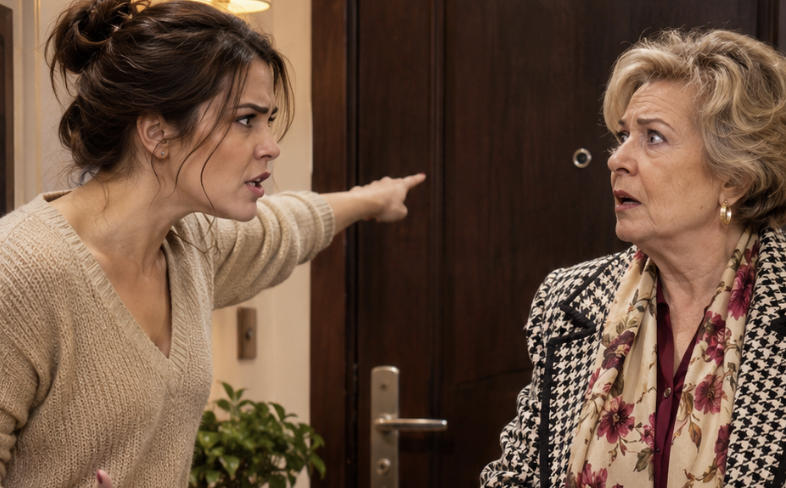
Valentina Stepanovna appeared in the doorway without warning—as usual. She never called ahead. Why would she? After all, this was her son’s home.
Katya heard the key turn in the lock and froze for a moment, standing over the kitchen sink with an unwashed cup in her hands. The key. She had told Igor a thousand times that he should never have given his mother a key. A thousand times. And every time, he gave her the same answer:
“Katya, she’s my mother. She feels more comfortable knowing she has a key. What if something happens?”
What exactly might happen remained a mystery.
“Is Igor home?” Valentina Stepanovna walked into the hallway without taking off her boots and looked around with the expression of someone who had discovered something out of order where everything should have been perfect.
“Hello, Valentina Stepanovna,” Katya said evenly. “No, Igor’s at work. Until six.”
“I see.”
Her mother-in-law pursed her lips and continued into the kitchen. She sat down in the chair Katya had always considered her own and placed a large shopping bag on the table.
“I brought him some borscht. Homemade. You never make any.”
“I do make borscht.”
“Really?” Valentina Stepanovna raised an eyebrow. “And how does it turn out?”
Katya placed the cup on the drying rack and wiped her hands with a towel. Three years. For three years, she had been drying her hands with that same slow, deliberate movement to keep herself from saying something she might regret.
“Igor likes it,” she replied.
“Igor is a polite boy. He wouldn’t tell you if he didn’t like it.”
Katya remained silent. This was their usual routine: her mother-in-law would make a cutting remark, Katya would say nothing, and Valentina Stepanovna would interpret her silence as agreement before delivering another blow.
Three years of this dance.
For three years, Katya had convinced herself that patience was a virtue, that family was more important than hurt feelings, that Igor was a good man, and that his mother, generally speaking, meant well.
It was just that her good intentions seemed to come with thorns.
“I wanted to talk to you,” Valentina Stepanovna said, resting her elbows on the table. “Since you’re here anyway.”
“I live here,” Katya remarked quietly.
“Exactly.” Her mother-in-law gave her a long look. “You live here. Katya, please understand me correctly. I’m not your enemy. I’m Igor’s mother, and I want him to be happy.”
“We are happy.”
“You’re happy,” Valentina Stepanovna repeated in a tone that turned the statement into a question. “You’ve been married for three years, you have no children, you work late, and he… I see what he looks like when he comes to visit me. Exhausted. Somehow lost.”
“He works two jobs, Valentina Stepanovna. Anyone would be exhausted.”
“He works two jobs because he’s paying off the mortgage,” her mother-in-law paused. “On this apartment.”
Katya felt something shift inside her. Just slightly. Like a tectonic fault—almost imperceptible at first.
“Valentina Stepanovna,” she said calmly, “Igor isn’t paying a mortgage on this apartment. I bought it before our wedding. With my own money. There is no mortgage.”
“I know that’s what you say.” Her mother-in-law nodded as though she had expected precisely that answer. “But the fact is, he lives here and maintains this household. He pays the utility bills, the repairs…”
“We both pay the utility bills. We split them equally.”
“Well, that’s not important.” Valentina Stepanovna waved her hand dismissively. “That’s not what I’m getting at. Katya, I’ve been thinking that perhaps you two should come and live with us. I have a large apartment with three rooms. I could help with the housework and cooking. It would be better for Igor.”
Katya slowly turned toward her.
“Move in with you?”
“Well, perhaps not permanently. Just to try it.” Her mother-in-law spoke persuasively, using that particular kind of maternal logic that was impossible to challenge without causing offense. “And you could rent out this apartment. Extra money never hurts.”
“Rent out my apartment?”
“Yours, yours,” Valentina Stepanovna readily agreed, as though the word meant nothing. “I’m not arguing about that. But since you’re not really making proper use of it…”
“I live in it.”
“Exactly. You could live with us, and the apartment could generate income. It makes sense, doesn’t it?”
Katya stared at her mother-in-law. At her confident face, at the shopping bag containing the borscht, at the boots she still hadn’t removed.
And for the first time in three years, she felt something inside her coming to an end. It wasn’t snapping or exploding. It was simply, quietly and with dignity, reaching its conclusion.
“Valentina Stepanovna,” she said, “I’ll think about what you’ve said.”
“That’s a good girl.” Her mother-in-law stood up, pleased with herself. “I’ll speak to Igor too. He’ll understand.”
“Yes,” Katya nodded. “Please do.”
Igor came home at half past six. He took off his jacket, kissed Katya on the temple, and looked into the pot on the stove.
“Oh, borscht. Mom’s?”
“Your mom’s,” Katya confirmed. “Igor, we need to talk.”
He sat down at the table with the expression of someone who already knew the conversation would be unpleasant. Perhaps he did. Over three years, he had learned to recognize the different tones in her voice.
“Did Mom call?”
“No. She came over.” Katya sat across from him. “She suggested that we move in with her and rent out this apartment.”
Igor picked up his spoon and dipped it into the borscht.
“Well, that’s Mom’s idea. She’s been thinking about it for a while.”
Katya stared at him.
“You knew?”
“She mentioned it. I didn’t take it seriously.” He looked up. “You shouldn’t either.”
“Igor, she came into my apartment using her own key, without calling, and suggested that I move out of my own apartment and rent it out.” Katya spoke evenly, almost without emotion. “Do you think that’s normal?”
“Katya, come on, it’s Mom…”
“I’m not asking about your mother. I’m asking about you. Do you think that’s normal?”
He fell silent and ate a little more. Katya waited.
“No,” he finally said. “I don’t. I’ll talk to her.”
“Good.” Katya stood up. “And one more thing. The key, Igor. I’m asking you to get it back.”
“Katya…”
“This is my apartment. I bought it before I met you. I have the right to know who’s coming into it.”
He remained silent for a long time. Then he nodded.
“All right. I’ll ask her.”
But he never asked for the key. Not the following day, not a week later.
Katya noticed and said nothing. Deep inside, she carefully collected, one by one, all those little promises of “all right” that were never followed by action.
Valentina Stepanovna returned ten days later. This time, she brought her sister.
Her sister’s name was Nina Stepanovna, and she was practically a copy of Katya’s mother-in-law, only slightly louder and somewhat less diplomatic.
“What a lovely apartment!” Nina exclaimed from the doorway, looking around. “It’s nice and bright. Did you renovate it yourself?”
“I did,” Katya replied. “Hello.”
“Hello, hello.”
Nina was already walking down the hallway, peering into the rooms.
“And where’s the bedroom? Is this it? Oh, that’s a big bed. Do you both fit comfortably in here?”
“We do.”
“And where will the children’s room be?”
“Nina.” Valentina stopped her sister with a gesture. “That’s not why we’re here.”
“Then why are you here?” Katya asked, looking at both of them.
“To talk. In a friendly way.” Valentina Stepanovna once again chose the same kitchen chair, which she apparently already considered her own. “Katya, I’ve been thinking about our conversation. And I realized that perhaps I didn’t explain myself properly. I’m not suggesting that you give up your apartment. I’m suggesting that you manage your property more rationally.”
“It’s my property,” Katya said.
“Of course. But surely you understand that in a marriage…”
“In a marriage, property acquired before the wedding remains the personal property of the spouse who acquired it. That’s Article 36 of the Family Code.”
Valentina Stepanovna blinked.
“Are you a lawyer?”
“No. But I’ve read the Family Code.” Katya placed a teapot in front of them. “Would you like some tea?”
“Yes, please,” Nina replied, looking at her sister with a newfound interest.
“Katya,” Valentina began in a different tone, “I understand that you’re an intelligent woman. I can see that. And I understand that the apartment legally belongs to you. But Igor is my son. And he deserves…”
“What does he deserve?”
“Respect. To feel that he’s the man of the house.”
Katya poured the tea, set down the cups, and sat.
“Valentina Stepanovna, Igor is the man of this house. We’re both in charge here. We make decisions together. We chose this sofa, these curtains, and these dishes together. We decide together where to go on vacation and what car to buy. What exactly are you unhappy about?”
“The fact that the apartment is registered in your name.”
“Should it be registered in his name?”
“It should belong to both of you.”
“All right.” Katya wrapped her hands around her cup. “Suppose I transfer the apartment into joint ownership. Then, in the event of a divorce, Igor would receive half. Would that satisfy you?”
“What does divorce have to do with anything?” Nina frowned.
“I don’t know. You’re talking about property, and so am I. If you want the apartment to become jointly owned, there will be consequences for both parties. I’m not against it. But then the risks must be shared as well.”
Valentina Stepanovna fell silent.
It was a different kind of silence—not the kind Katya had grown accustomed to maintaining herself. It was the silence of someone who had received an answer she hadn’t anticipated.
“You’re very calculating,” she finally said.
“I’m practical,” Katya agreed. “I bought this apartment when I was twenty-eight, entirely on my own, without anyone’s help. That requires a certain amount of calculation.”
Igor learned about the visit that evening. Katya told him everything calmly, without tears or accusations.
As he listened, his face slowly took on the expression she had learned to recognize over the past three years—a mixture of guilt, exhaustion, and the desperate hope that everything would somehow resolve itself.
“I’ll talk to her,” he said.
“You said that last time.”
“Katya…”
“Igor, I’m not angry.”
It was true, and that seemed to frighten him more than anger would have.
“I simply want to understand something. Are you on my side?”
“I’m not on anyone’s side. I’m trying to…”
“That’s not an answer.”
He stood up and walked around the kitchen.
“She’s my mother. I can’t tell her to get out and never come back.”
“No one’s asking you to. I’m asking for boundaries. The key is a boundary. Coming over without warning is a boundary. Discussing my property without involving me is a boundary.”
“You want me to choose between the two of you.”
“No,” Katya said quietly. “I want you to be my husband. That’s not a choice. It’s a role you took on three years ago.”
He didn’t respond.
He went to bed early, turning toward the wall. Katya remained in the kitchen for a long time, looking through the window at the winter courtyard, the streetlamp, and the illuminated windows of other people’s homes.
Somewhere out there, behind each of those windows, someone was living their own life.
Perhaps someone was living a life just like hers.
Everything fell apart in February.
Katya returned home earlier than usual. A meeting had been canceled, so she caught a taxi, took the elevator upstairs, opened her front door—and discovered unfamiliar shoes in the hallway.
Not just one pair. Three.
Valentina Stepanovna, Nina Stepanovna, and an unfamiliar woman of about sixty-five were sitting in the kitchen. The stranger was saying something while the other two nodded.
There were cups and plates on the table—Katya’s plates, taken from her cupboard—and a serving dish containing a pie Katya hadn’t baked.
“Oh, Katya’s home,” Nina said. “You’re early today.”
“Good evening,” Katya replied.
She stood in the kitchen doorway, still wearing her coat, with her bag over her shoulder, looking at the three women sitting around her table. The stranger regarded her with assessing curiosity.
“Let me introduce you,” Valentina Stepanovna said somewhat tensely. “This is Lyudmila Ivanovna, my neighbor. We just… stopped by for a little while.”
“For a little while,” Katya repeated.
“We brought a pie.” Nina pointed toward the serving dish. “Cabbage filling. You like cabbage pie, don’t you?”
“I’ve never told you that I like cabbage pie.”
“Well, Igor likes it.”
“Is Igor home?”
“Not yet. We’re waiting for him.”
Katya slowly hung her bag on the hook. Slowly unbuttoned her coat. Took it off and hung it up.
Throughout all of this, the three women remained silent, watching her.
“Valentina Stepanovna,” Katya said, turning around, “are you aware that I never gave you a key to this apartment?”
“Igor gave it to me.”
“Igor had no right to give you a key to my apartment without my permission.”
“Katya, what’s with that tone?” Nina threw up her hands. “We’re family!”
“Lyudmila Ivanovna isn’t family.”
The unfamiliar woman choked on her tea.
“Katya!” Valentina Stepanovna stood up. An expression of wounded dignity appeared on her face—the same expression Katya had seen whenever she said something her mother-in-law didn’t want to hear. “That’s terribly rude!”
“What’s rude is entering someone else’s home without permission and bringing guests along.” Katya spoke evenly. “What’s rude is using a key that I never gave you. What’s rude is discussing my property behind my back for months.”
“Nobody’s discussing anything!”
“Lyudmila Ivanovna,” Katya addressed the stranger, “I’m sorry this is happening. You probably didn’t know that Valentina Stepanovna isn’t the owner of this apartment?”
Lyudmila slowly shook her head.
“No. She told me her son lived here…”
“Her son does live here. With me. This is my apartment. I bought it seven years ago, before I even met Igor.”
Katya paused.
“Please, finish your tea. I’m not throwing you out immediately. But next time, Valentina Stepanovna must call ahead and ask permission.”
“This is too much,” Valentina hissed. “In my own son’s home…”
“This is not your son’s home.” Katya’s voice didn’t tremble. “This is my home. And I’m asking you to respect that.”
Lyudmila Ivanovna was the first to stand up. She thanked Katya for the tea, picked up her bag, and whispered something to Valentina Stepanovna, who didn’t respond.
Nina gathered her belongings with the expression of someone who had found herself caught in somebody else’s argument and desperately wanted to leave.
They left.
Katya closed the door behind them. She stood in the hallway for a moment, then went into the kitchen, put the kettle on, and began clearing away the other women’s cups.
Igor called an hour later. She didn’t answer.
Twenty minutes later, he was home.
“Mom called,” he said as soon as he walked through the door.
“I know.”
“Katya, you shouldn’t have spoken to her like that…”
“Igor.” She turned toward him. “I’m tired.”
“She’s upset…”
“I’m tired,” Katya repeated. “I’ve been putting up with this for three years. For three years, I’ve been talking to you about the key, calling ahead, and respecting boundaries. For three years, you’ve been saying ‘all right’ and doing absolutely nothing. Today, I came home and found three other people in my apartment, one of whom I’d never seen before in my life.”
“Mom didn’t think…”
“Mom did think. This is exactly what she thinks. She thinks this isn’t my apartment. She thinks she has the right to do whatever she wants here. This isn’t an occasional lapse in manners. It’s her attitude. And you’re supporting that attitude by remaining silent.”
He said nothing.
“Igor, I’m going to ask you one question. Just one.” Katya looked directly at him. “If I went to your mother’s apartment using my own key, without calling, brought a friend along, and decided to have a little tea party, what would she do?”
He didn’t answer.
But the answer was written all over his face.
“Exactly,” Katya said. “Now think about why it’s considered acceptable when it happens the other way around.”
He sat down and stared at the table for a long time.
“What do you want?” he finally asked, quietly, almost helplessly.
“I want you to get the key back,” Katya said calmly. “Today. Call her and tell her that she needs to return it. Tell her she has to call ahead. Tell her that this is my home and that you respect that.”
“She’ll be offended.”
“I know.”
“She won’t understand.”
“I know. But that doesn’t change the fact that it’s the right thing to do.”
He fell silent again.
Then he took out his phone.
The conversation was short. Katya couldn’t hear the words—she was standing in the other room, looking out the window.
She could hear only the tones of their voices: Igor’s quiet voice, followed by his mother’s—first surprised, then offended, then loud.
Then silence.
Igor entered the room and placed his phone on the table.
“She said she’ll bring the key tomorrow.”
He paused.
“And she said I’ve betrayed her.”
“I’m sorry,” Katya replied.
She meant it.
“She’ll talk to Dad too. He’ll probably call.”
“All right.”
“Katya.” He walked over to her. “I should have done this a long time ago. I know that.”
She didn’t answer immediately. She looked at the winter courtyard and the same familiar streetlamp.
Then she turned toward him.
“Yes,” she said simply. “You should have.”
It wasn’t Valentina Stepanovna who returned the key.
It was Boris Nikolaevich, Igor’s father—a quiet, somewhat bewildered man who had spent his entire life standing in the background of his energetic wife’s life.
He rang the doorbell. Katya opened the door.
“Hello, Katya.” He held out the key. “Here. I was asked to give this to you.”
“Thank you, Boris Nikolaevich. Would you like to come in?”
“No, no. I’m just dropping this off.” He shifted awkwardly from one foot to the other. “Don’t be too angry with Valya. She… she loves Igor. Very much. Sometimes a little too much.”
“I understand.”
“She’s devoted her entire life to him. Sometimes it’s…” He searched for the right word. “Difficult to let go.”
“I understand,” Katya repeated. “Boris Nikolaevich, I don’t wish anything bad upon your family. I simply want this to be my home.”
He nodded and stared at the key in her hand for a long moment.
“Valya has never really had an apartment of her own,” he suddenly said. “We lived in government-owned housing all our lives. Eventually, we privatized it, of course. But that’s different.”
He paused.
“She probably doesn’t understand what it means to have your own apartment. Something that’s truly yours, something you earned from nothing.”
Katya looked at him.
“Thank you for telling me.”
“Well, goodbye.”
He turned toward the elevator, then looked back.
“Make borscht more often. Igor’s losing weight.”
“All right,” Katya replied, genuinely smiling for the first time in a long while.
Valentina Stepanovna called two weeks later.
On her own. Without Nina.
“Katya, I’d like to come over.”
She paused.
“If that’s all right.”
“Of course,” Katya replied. “Saturday, around three?”
“Saturday at three. All right.”
She arrived without a pie. Without a shopping bag.
She rang the doorbell and waited for someone to open it.
Katya showed her into the kitchen and put the kettle on.
“Please, have a seat, Valentina Stepanovna.”
Her mother-in-law sat down. She looked around the kitchen as though seeing it differently than before.
Then she looked at Katya.
“There’s something I’d like to say,” she began.
Her voice was different. The old confidence was gone.
“I suppose I haven’t behaved… very well lately.”
Katya poured the tea and moved the sugar bowl closer.
“I suppose not,” she quietly agreed.
“I didn’t mean to hurt you.”
Valentina wrapped her hands around her cup, exactly as Katya usually did. Both women noticed it.
“I just… I’ve always been accustomed to thinking of Igor as mine. To believing that I know what’s best for him.”
“That’s understandable.”
“It’s probably not right anymore. Now that he’s grown up.”
She remained silent for a moment.
“Boris told me about the apartment. That you bought it yourself.”
“Yes.”
“That’s…” Her mother-in-law searched for the right word. “That’s quite an accomplishment. I hadn’t really given it proper thought.”
Katya said nothing. She waited.
“I won’t come over without calling anymore,” Valentina Stepanovna finally said. “I promise.”
“Thank you.”
“And I won’t bring up renting out the apartment again. That was foolish of me.”
“It happens.”
Her mother-in-law looked up at her.
There was something new in her eyes—perhaps curiosity. It was as though she were only now beginning to see Katya as a person in her own right.
“How did you manage to buy it? All by yourself? At twenty-eight?”
“I saved money for six years,” Katya explained. “Starting with my first job. I worked two jobs. I rented a single room to keep my expenses down.”
She paused.
“It was important to me. Having something of my own.”
“I see,” Valentina Stepanovna said quietly. “Now I understand.”
They sat together a little longer and finished their tea.
The conversation was no longer strained. It was simply peaceful, like the quiet that follows a long rainstorm.
“Igor loves you,” her mother-in-law said at the door. “I can see that too.”
“I know,” Katya replied.
“And you… do you love him too?”
“Yes.”
Valentina Stepanovna nodded and put on her coat.
“I could bring you some borscht sometime. If I call ahead and ask first.”
Katya looked at her.
And smiled again.
“Call ahead and ask first.”
Igor heard about their conversation that evening. He sat down on the sofa, listened, and remained silent for a while.
Then he said:
“I never thought she’d come over on her own.”
“Neither did I.”
“That’s…” He shook his head. “That means a lot. For her, it really means a lot.”
“I understand.”
He took her hand.
“I’m sorry. About the key. About taking so long.”
“It’s all right now,” Katya said.
“No, seriously. I should have done it sooner. You’d been asking me for three years.”
“Three years,” she agreed. “But you finally did it.”
He looked at their intertwined hands.
“This is your home,” he said. “I know that. And I’m happy to live here.”
“Our home,” Katya corrected him.
“Ours?”
“Ours.” She looked at him. “There’s a difference between ‘yours’ and ‘ours.’ I bought it before I met you. But we live here together. That makes it our home. There are simply certain rules that I get to establish.”
“What rules?”
“Who comes in. Who doesn’t. And who gets a key.”
He nodded slowly.
“That’s fair.”
“Yes,” Katya agreed. “It is.”
Outside, darkness was falling. The streetlamp in the courtyard came on, as always, a little earlier than necessary.
Katya looked at it and thought that three years was a long time. But sometimes, that’s exactly how long it takes to understand that a boundary isn’t a wall.
It’s simply the place where one thing ends and another begins.
And maintaining that boundary isn’t cruelty.
It’s respect.
Respect for yourself, for the other person, and for what exists between you.
She stood up and went into the kitchen. She put some water on the stove to prepare dinner.
Her phone rang.
An unfamiliar number.
“Hello?”
“Katya?” The voice sounded somewhat guilty. “It’s Nina. Nina Stepanovna. I wanted to… well, anyway. I’m sorry. About what happened last time.”
Katya leaned against the kitchen sink.
“It’s all right, Nina Stepanovna.”
“You’re a strong woman. That’s what Valya told me.”
There was a pause.
“And I agree.”
The water began to boil.
“Thank you,” Katya said. “Goodbye.”
She put down the phone and looked at the boiling water.
Strong?
Perhaps.
Or perhaps she was simply someone who had grown tired of remaining silent and had finally stopped.
Sometimes, that’s enough.