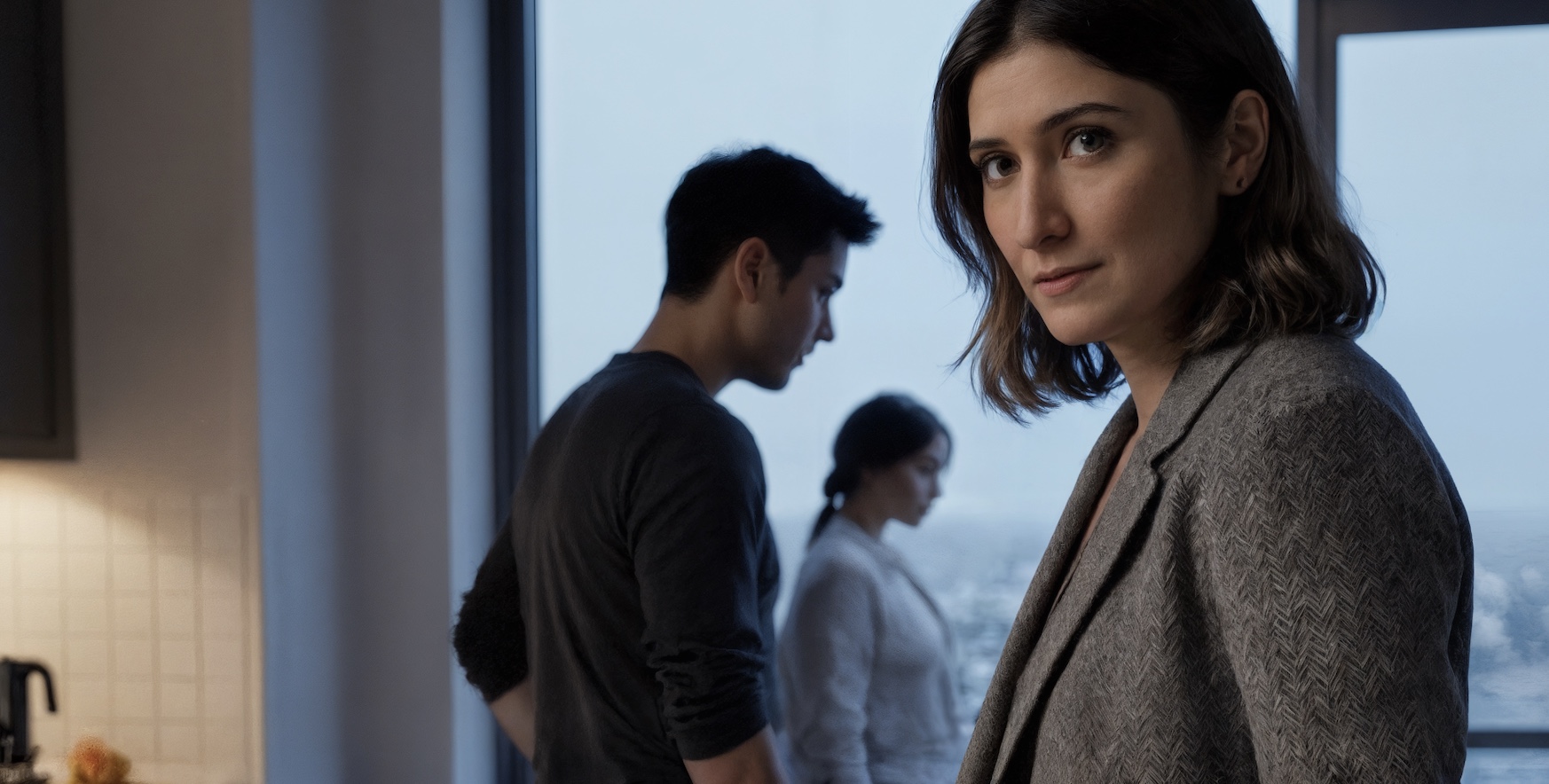
The silence in the kitchen was thick—viscous and strangely musical. The shards of an expensive porcelain vase rang faintly as they lay scattered across the tiled floor. They were still exactly where they had fallen an hour earlier; no one had rushed to sweep them up. It wasn’t just debris. It was a monument to their latest fight. A gift for their tenth wedding anniversary.
“Like two swans,” Olga had said back then, admiring the delicate pattern.
Now the swans had been beheaded.
Mark sat at the table, staring at his laptop. He acted like he was checking work emails, but Olga knew he was simply hiding. Every so often his fingers pecked the keys with an irritated rhythm. He was waiting for her to break first—to shatter the oppressive silence, to start cleaning, to cry, to yell.
Like always.
But today Olga didn’t yell.
She stood by the sink, gripping the countertop so hard her fingers had gone pale, and looked into the black window. In the glass, a surreal scene hovered: her face, his back, and a heap of broken porcelain between them. The cause of the argument was absurdly ordinary. He’d forgotten again to pick up Alisa from practice.
“Got stuck on a call, you know how it is,” he’d tossed back after her frantic text.
You know how it is. His signature line. He truly believed the entire world was supposed to understand him. Forgive a late dinner. Forgive ruined weekends. Forgive the fact that for the past year she hadn’t been living with a husband at all, but with a well-paid lodger who tossed her condescending “tokens” in the form of expensive gifts.
She turned slowly. Mark’s back remained armored, unreachable.
“That’s it,” Olga said softly. Her voice sounded hoarse, as if she were sick, but she wasn’t. What tightened her throat was despair that had been accumulating for years. “I’ve had enough.”
He didn’t turn around. Only his shoulders moved slightly forward, betraying tension.
“I’m not doing this anymore,” she continued, and her voice steadied. “Your indifference. Your contempt. Your… arrogance. I’m tired of being air.”
At last Mark lifted his eyes from the screen and turned toward her with theatrical calm. His face was a mask of cold mockery.
“Ol, spare me the drama. We’ll glue the vase. We’ll buy our daughter a new jacket—whatever she wants. Just calm down.”
That “calm down” was the final drop.
It overflowed the cup she’d been carrying for years, hunched beneath its weight.
“I’m filing for divorce,” she exhaled—and there was no hysteria in it, no threat. Only a verdict, icy and measured to the millimeter.
For a second the air froze. Mark stared at her, and his mask began to crack. The corner of his mouth twitched. He hadn’t expected that tone. He’d been waiting for screaming, tears, flying dishes—something familiar he could dismiss and shove back into its place. But this… this was frighteningly calm.
So he switched to his last, favorite weapon: humiliation.
He leaned back in his chair, and a crooked, fake smirk crept across his face.
“Bluffing again,” he snorted, pretending to look back at the screen. “Fine. Go file. You’ll come crawling back. I’ll carry you in my arms—like I did from the maternity ward.”
He said it like a trump card—our shared pain, his private victory. He was sure it would break her. Make her crack open, rush to him in tears: I’m sorry, I didn’t mean it…
But Olga didn’t move.
She only looked at him for a long moment—absolutely empty. No love left, no hatred either. Just endless exhaustion. Then she turned and, without another word, walked out of the kitchen. Her footsteps in the hallway were quiet and decisive.
Mark sat and listened as a lock clicked in the bedroom. The smirk slid off his face, exposing confusion—and beneath it, the first tiny hairline fracture of fear.
The bedroom felt like чужая территория—his territory. Everything in there breathed “him”: his expensive watch on the nightstand, his shaving cream in the bathroom, his confidence soaked into the walls. Olga couldn’t stay there. She went into Alisa’s room, washed in cold moonlight. White walls, posters of bands she didn’t care about, a neatly arranged desk. It smelled of childhood, innocence—everything Olga had been trying to protect all these years.
Alisa was spending the night at a friend’s place. Thank God. She hadn’t seen this circus.
Olga sat on the edge of the bed, and the silence struck her ears. She waited for him to come in, to pound on the door, to shout. But beyond the door there was dead quiet. His tactic was always the same: ignore it until the problem dissolved on its own. He was sure she’d come to her senses. In the morning she’d make him coffee, and everything would go back to normal.
But morning wouldn’t come.
Not for them.
She stood, moving slowly as if through thick syrup, and went to the closet. From the top shelf she pulled down an old, dusty rolling suitcase. The rasp of the zipper sounded like a gunshot in the stillness.
She began packing. Not her best dresses, not her heels. She chose the simplest things—the familiar ones: soft sweaters, jeans, T-shirts. Each item was a piece of a puzzle called life after. Her hands shook. A lump sat in her throat. But there were no tears. The tears had run out a month ago—half a year ago—maybe a year. She couldn’t even remember.
She opened a dresser drawer for underwear, and her eyes landed on a small carved box. A gift from Mark, from a business trip to Istanbul, a hundred years ago. She opened it. Inside was a pile of little keepsakes: Alisa’s first ultrasound printout, a dried flower, movie tickets from that one film. And beneath it all—a photograph.
She pulled it out. They were young and sun-kissed, wet with sea spray. He was holding her so tightly it looked like he would never let go. They were laughing, and in their eyes was the whole future. She flipped it over. His handwriting—less confident then, more romantic:
“To my everything. 15.08.2007.”
Her chest clenched so sharply she gasped.
My everything. Where had that gone? When had his “everything” turned into a burden? When had pride become that condescending smirk? After Alisa was born? After his meteoric climb? He rose—and he forced her into a little box labeled “convenient wife.”
She almost gave in. Almost. Ready to snap the suitcase shut, go back to the kitchen, and say, “Fine. Let’s try again.”
Like she always did.
But then she saw his face in her mind—not the one in the photo, but today’s: cold, superior, that twisted grin.
“Go file. You’ll come crawling.”
No.
She shoved the photo into her jeans pocket without looking, yanked the zipper closed. The sound was final—like a safety catch clicking into place.
She picked up her phone. Her hand wasn’t shaking anymore. She dialed her sister.
“Svetа, it’s me,” her voice came out flat and unfamiliar. “I’m done. Completely. Can I stay with you tonight?”
A stunned silence hung on the line.
“Oh my God, Ol… Of course, of course—come. What happened?”
“I’ll tell you later.”
She ended the call, grabbed the suitcase handle, and rolled it out. In the hallway she paused and listened. From the kitchen came the muffled sound of a TV. He was watching soccer. He had a ritual: beer and sports after a fight. Everything on schedule. Her leaving was just another part of the performance—an intermission.
Olga crossed to the front door on tiptoe, put on her coat, and left her favorite scarf behind—because it was his gift. She opened the door.
Frosty air hit her face, sharp and liberating. She stepped out of their warm, dead fortress onto the dark landing and closed the door quietly—without a slam.
The last thing she heard as she left was the ecstatic shout of a commentator through the door: his team had scored.
Morning barged into the apartment with stubborn winter sunlight, illuminating dust motes dancing above the shards of the vase. They were still on the floor—mute evidence of yesterday’s war. Mark walked into the kitchen, trying not to look at them. The apartment was filled with an unfamiliar, coffin-like quiet. No smell of coffee. No clacking at the entryway as Olga usually fussed with her bags before heading out.
He went to the coffee machine—expensive, complicated, his latest “buy-off” gift—and frowned at the control panel. Olga always made the coffee. Perfectly. He pressed a few buttons at random. The machine coughed ominously and spat a thin stream of dark sludge into a cup. Mark grimaced.
His ritual had been broken. Every morning he used to bring a ready cup—her favorite, with the logo of some Paris boulevard—and set it in front of her with, “For the queen—the best.” Their little joke, long since turned stiff and hollow. Today the cup stood clean and empty, impatient, reproachful.
He sat at the table, took a sip of his bitter mess, and the sour taste matched his mood. Where was she? In the bedroom? Sulking? He listened. Nothing. For the first time in years, his “calm down” and “she’ll get over it” hadn’t worked instantly.
Her sentence echoed in his head, spoken in that icy, unfamiliar voice:
“I’m filing for divorce.”
His phone vibrated and made him flinch. On the screen was the grinning face of his younger brother, Igor.
“So, boss man,” Igor boomed without preamble. “Any progress? Has the woman thawed out?”
Igor’s usual crudeness normally got on Mark’s nerves, but now it dragged him back into the familiar world where women were simply problems to solve—like a bug in a program.
“It’s fine,” Mark muttered, forcing confidence. “A tantrum. It’ll pass.”
“Of course it’ll pass!” Igor snorted. “Tell her you’ll buy a new fur coat. Or take her to Paris. They love that. What else do they want our money for?”
“No… Olga’s not like that,” Mark shot back, surprising even himself. “She’s… actually doing something. She left.”
A short, stunned silence.
“Left where? To her mom? To a friend?” Igor didn’t believe it. “Come on. She won’t go anywhere. Especially with a kid. Her whole life is you and the house. She’s just pulling the leash, trying to prove who’s in charge. Don’t fall for it.”
Mark stared out the window at snowy rooftops. His brother’s words were as “correct” and as empty as his morning coffee.
She won’t go anywhere. That mantra had always worked. It had worked with his mother—she used to storm off to the neighbor once a month, and his father would say, “She won’t go anywhere. She’ll come crawling back.” And she did.
But Olga wasn’t his mother.
With a painful clarity, he recalled her face yesterday. Not twisted with rage, not wet with tears. Empty. Drained. The face of someone who had already decided everything.
“Don’t worry,” Igor said, pulling him back. “I’ll swing by tonight, bring a bottle of cognac. You’ll relax. She’ll come crawling, apologizing—watch.”
They ended the call. Mark took another sip of cold coffee. His hand reached for his phone to call her. He wanted to say… what?
Where are you?
When are you coming back?
Stop acting stupid.
He dialed. Long rings. One, two, three—then a click and a robotic voice: “The subscriber is temporarily unavailable.”
He didn’t believe it. He called again. Same result.
Something inside him turned to ice.
Olga never turned her phone off. Never. Because of Alisa, because of work, because of him.
He hurled the phone onto the sofa. It bounced and dropped to the rug with a dull thud.
“Idiot!” he hissed into the empty apartment. “You’ll suffer for this yourself!”
But his voice sounded unconvincing, and no smirk came. He was alone with the silence, the shards on the floor, and a sticky, unfamiliar feeling spreading through him—fear.
Svetlana’s apartment smelled of cinnamon and comfort, the kind of warmth their sterile home never had. Olga sat at the kitchen table, holding a mug of tea with both hands, but she couldn’t warm up. Inside her was permafrost. She told her sister everything—leaving out only Mark’s most humiliating line about the maternity ward. Some things were too private, even for a sister.
Svetlana listened, frowning, shaking her head now and then.
“Ol, honey, I get it. I really do. But maybe you’re reacting in the heat of the moment? Divorce is so… final. What if you just stay here a week, get some distance? You’ll both cool off. Mark’s basically a good man—he doesn’t drink, doesn’t hit you, he loves the kid, he brings money home. He’s just gotten full of himself, it happens.”
Olga stared into her tea as if it could tell her the future.
“Good people don’t break others from the inside, piece by piece,” she said softly. “I became his shadow. An add-on to his success. A convenient accessory. He doesn’t love me—he loves his idea of a wife. And that idea gets narrower every year. I don’t fit inside it anymore.”
“But there were good times!” Svetlana insisted. “Remember how he courted you? Drove up under your window with flowers! Quit his old job when you went on maternity leave so he could earn more! Wasn’t that love?”
“It was,” Olga nodded. “And then it ended. Love isn’t a monument you put up once and forget. You have to rebuild it every day. And he doesn’t build. He only demands I keep the façade of his perfect life polished.”
At that moment the lock clicked in the hallway. Light, fast steps. Alisa burst into the kitchen, cheeks red from the cold, a huge backpack on her shoulders.
“Mom! What are you doing here?” she blurted when she saw Olga. Her eyes flicked over her mother’s face, and her childlike ease instantly turned into wary alertness. She felt it. Kids always do.
“I… I’m staying with Auntie for a bit,” Olga began uncertainly.
Alisa dropped her backpack and walked up to the table, looking from her mother to her aunt.
“Did you and Dad fight again?” she asked bluntly. There was no surprise in her voice—only tired resentment. Resentment for the years she’d lived inside a quiet cold war.
Olga nodded. She couldn’t lie.
“This time it’s serious, sweetheart.”
“Again because he didn’t pick me up?” Alisa frowned. “I’m not a baby—I got home just fine!”
“No, not only because of that,” Olga said. “It’s more complicated.”
Alisa went quiet, thinking. Then her face twisted as if she were wrestling with something inside. She wanted to say something important—she was afraid, but she couldn’t hold it back.
“Alisa, what is it?” Svetlana asked gently.
Alisa looked at Olga, and tears filled her eyes.
“Mom… I don’t want to make things worse between you and Dad. But… I can’t keep quiet. I know everything.”
A shock went through Olga like electricity.
“What do you know?”
“About Dad’s assistant. About that… Lena.”
The air turned razor-sharp. Olga froze, unable to move. Her heart sank to her heels and stopped there.
“What Lena?” her voice came out dull, чужой.
“The one who’s always with him at company parties,” Alisa said. “I saw them at the mall a month ago. I was there with Katya, and they… they were together. He bought her those earrings. Gold with turquoise. The ones you wanted. I remember—you showed them in a magazine.”
Every word fell like a hammer, driving nails into the lid of their marriage. Olga felt her face go bloodless, her fingertips turn cold. Everything snapped into place—his late “meetings,” his distance, his constant irritation.
Classic.
“Are you sure?” she barely breathed.
“Completely,” Alisa nodded, tears rolling down her cheeks. “I wanted to go up to him, but I felt so ashamed and sick that I ran away. He’s lying to us, Mom. He’s a liar.”
Olga stood up slowly. Now there was no exhaustion in her—no confusion. Only a clean, crushing clarity. His mockery, his jabs, his attempts to make her the guilty one—it had all been projection. He felt his own guilt and tried to bury it by humiliating her.
She went to her daughter and hugged her tight, feeling her small body trembling.
“It’s okay, sweetheart,” she whispered. “You did the right thing telling me. Thank you.”
She looked at Svetlana. Horror and helplessness were written all over her sister’s face.
“See?” Olga said quietly. “Now you understand why I can’t just ‘cool off.’ My marriage isn’t just routine. It’s a lie. And I’m not going to be a permanent extra in it.”
She let her daughter go, grabbed her bag, and headed toward the living room—toward the door.
“Where are you going?” Svetlana asked, frightened.
“I have,” Olga answered without turning, and for the first time steel entered her voice, “something important to do today. The first important thing I’ve done just for myself in years.”
Mark paced the empty apartment like a tiger in a cage. His calls to Olga still wouldn’t go through. His thoughts tangled into a knot of fear and anger. He tried to work, but lines of code blurred into her empty, detached stare. In fury, he tossed his laptop onto the couch.
He needed to talk. Not to Igor, who saw everything as a cheap domestic script. He needed someone who knew them both. Someone who knew their history.
He called Sergey—an old friend from university. Sergey and his wife were that rare couple you could actually look up to.
“Sergey, hey,” Mark’s voice broke with strain. “Are you free? Can I come over?”
“Mark? What happened?” Sergey’s tone sharpened immediately.
“Yeah. Olga left.”
Half an hour later Mark sat in Sergey’s cozy living room, gripping a heavy crystal shot glass of cognac. He wasn’t drinking—just staring at the golden light in the liquid.
“She said she’s filing for divorce,” he began without looking up. “Because of some stupid little thing. I forgot to pick up Alisa from practice. It happens! It’s not like I did it on purpose. I have work!”
Sergey listened in silence, studying him.
“And she just went straight to divorce? No discussion?”
“We talk all the time,” Mark snapped, then stopped, hearing himself. “Well—she talks, and I…” He swallowed. “I’m tired, Sergey. I come home and I’m met with complaints. I feel like I’m just background noise, a provider, a function—not a man.”
“And what are you to her?” Sergey asked softly.
Mark looked up, bewildered.
“I’m her husband.”
“Husband isn’t just a stamp in a passport, Mark. It’s a verb. It’s action. What have you done for her lately—as a woman? Not as the household manager.”
Mark took a swallow of cognac. The burn helped.
“I do everything for her! The apartment, the car, the money. She doesn’t lack anything.”
“She does,” Sergey said quietly. “And you know it.”
Mark shut his eyes. The mask of the smug cynic cracked and fell away, exposing an exhausted, frightened face.
“I got scared, Sergey,” he breathed, and the confession cost him. “I became mean and sharp because I got scared.”
“Of what?”
“Of her seeing what I really am—empty, insecure. That I’m not good enough for her. Honestly.” He rubbed a hand over his face. “You know my family. My father drank, my mother always ‘came crawling back.’ It got into me like rust. I hated it… and now I’ve become the same. I tried so hard to look tough, successful, untouchable… and she saw through me. And that terrified me even more. So I got louder, just to drown out my own fear.”
He paused and poured more cognac; his hand shook.
“And then there was that trip to St. Petersburg in November,” he said quietly. “The new assistant came with me—Lena. Young, bright. She flirted openly, stroked my ego, hung on every look. And I… I bit. It felt good. To be admired again, not just the tired husband who’s always failing at something.”
Sergey didn’t interrupt; his silence was the best response.
“On the last night we went to dinner. Had some drinks. Talked about nothing. Then she invited me up to her room to ‘go over the presentation.’ I understood how it looked. I went.” Mark crushed the glass in his fist as if he could break it. “We were in her room. She came closer. And I… I pictured Olga’s eyes. Not angry—just tired. And I felt so ashamed and sick I turned around and left. I went outside and I was shaking. Like a schoolboy.”
He lifted eyes wet with shame.
“And those earrings… Olga wanted ones like that. I bought them for her. That same day. Lena just helped me choose—she has decent taste. I meant to give them to Olga—as an apology, as a way to start over… but I never did. Then I saw how indifferent Olga was and I thought, ‘What’s the point? She won’t appreciate it anyway.’ I’m an idiot, Sergey. A complete idiot.”
He dropped his head into his hands. His shoulders shook.
“She figured it out. She must have felt it. And now she left for real. And I know I deserve it. But I don’t know what to do. I can’t lose her.”
Sergey exhaled slowly.
“Stop being a fortress that has to be stormed. Fortresses are lonely. Be a person. Show her you can be weak. That you can be wrong and ask for forgiveness—not with gifts, but for the pain you caused.”
“But she won’t even answer!” Mark cried.
“Then find another way,” Sergey said. “But first deal with yourself. Decide who you’re trying to get back—your wife, or your comfortable ego.”
Olga walked out of the courthouse. In her hand she held a blue folder of documents. Filing the petition had been simpler than she expected: a few forms, a signature, a stamp. Now there was only waiting. The air was full of needle-sharp frost that cut straight through to the bone. She buttoned her coat up to her throat, but it didn’t help. Inside her was the same icy emptiness.
She walked along the slippery sidewalk, barely seeing anything around her. A monologue ran in her head: how to talk to Alisa, how to split property, where to find a new job. The thoughts were heavy as lead, each one thudding into her temples.
Her phone vibrated in her pocket. Unknown number. She usually didn’t answer those, but today—she didn’t know why—she did.
“Hello?”
“Hello. This is City Hospital No. 15,” a woman’s voice said—official and gently sympathetic. “I’m calling from the intensive care unit. Are you connected to Mark Dmitrievich?”
The world slowed and drifted. Street noise—cars, voices—fell away into a dull roar. Olga leaned against the cold wall of the building, afraid her legs would give out.
“Yes… that’s me. His wife. What happened?” Her voice sounded like it came from far away.
“Don’t panic—his life is not in danger. Mark Dmitrievich was in a traffic accident. A mild concussion, bruises, shock. He’s conscious and in a room.”
Olga closed her eyes, forcing herself to breathe. Concussion. Bruises. Not fatal.
“How did it happen?”
“According to the patient, he was distracted while driving, lost control on an icy road, and hit a barrier. No one else was hurt—he was very lucky. He insisted we find you. You’re listed as his emergency contact.”
“I… I’m coming,” Olga said automatically. “Tell him… tell him I’m on my way.”
She ended the call. Her hand trembled. All her resolve—her cold anger, her certainty—evaporated, replaced by a raw, animal fear. He could have died. And their last conversation would have been that awful kitchen scene.
She flagged the first free car and, fighting nausea, gave the driver the hospital address.
The admissions hall smelled of disinfectant and medicine. And fear. Someone pointed her to a room on the second floor. Her legs were heavy, her heart pounding in her throat.
She opened the door a crack.
He lay on a white hospital bed, pale, with a bandage wrapped around his head and an abrasion on his cheek. His eyes were closed. He looked so vulnerable, so broken—nothing like the untouchable titan who’d smirked at her barely a day ago.
She stepped inside. The floor creaked. He opened his eyes—clouded at first, then focusing. When he recognized her, what flashed there wasn’t relief, but shame and fear.
“Ol…” His voice was rough, weak. “What are you doing here? Who told you?”
“The hospital called,” she said softly, stopping beside the bed. “I… I was nearby.”
He tried to sit up, then groaned and sank back.
“Sorry,” he breathed, staring at the ceiling. “I didn’t want you to find out like this. It’s so… stupid. I just wasn’t watching the road.”
“And what were you watching?” she asked, and that judging edge slipped into her voice before she could stop it.
He was quiet for a moment, then slowly turned his head toward the bedside table. His personal things sat in a clear plastic bag: phone, keys, wallet. On top—folded paper and a printout with a bright airline logo.
“Give it to me,” he asked.
Olga handed him the bag without thinking. With difficulty he pulled the papers out and offered them to her.
She unfolded the sheet. A request for an unscheduled unpaid leave—dated today, signed. And on the printout: two tickets.
Moscow — Antalya.
For the day after tomorrow.
She stared, not understanding, then looked up at him.
“What is this?”
“I wanted to fix it,” he whispered, and his eyes filled with tears—for the first time in years. “To remember who we were. No work. No phones. Just the sea and us. Like then. I’ve canceled it now, of course… I just wanted to make it right.”
The hospital room held its breath. The air was dense with pain, shame, and words that had been piling up for years. Olga stood there, gripping the cursed tickets; the paper felt rough and cold.
“Fix it?” Her voice was quiet, but clear, as if from inside fog. “You thought you could fix everything with three days in Turkey? Like repairing a car?”
Mark looked at her without blinking. No mockery left. No confidence. Only naked truth.
“No,” he said. “I wanted to start. To ask for your forgiveness. Not to justify myself, not to make empty promises—just to get on my knees and say, ‘I’m sorry. I was blind. I was an idiot.’ But I didn’t know how to do that here. I thought we had to break everything to build it again. To go somewhere we were happy.”
Olga sank slowly into the chair by his bed. Her strength was leaving her.
“What stopped you here?” she asked. “The apartment? This life? Or did I become so unbearable?”
“Me,” he said fiercely—and flinched, grabbing his head as pain struck. “It was me. My own fear. Olga… I grew up in a family where love was measured in screaming and bruises. Where Mom always ‘crawled back’ because she had nowhere else to go. And I… I was terrified of becoming my father. And I did. Maybe worse. He was openly cruel—while I hid behind money and status. I thought if I looked perfect from the outside—good job, expensive gifts—no one would see how empty and insecure I am inside. But you saw. And I hated you for it. I hated that you wouldn’t play along.”
He paused, breathing hard. Talking clearly hurt.
“That assistant… Lena. Her attention flattered me. I wanted to feel young again, wanted again—not just the tired husband who’s always failing. But that night in her room…” His throat worked. “I looked at her and understood—it was an escape. Cowardice. And I’m sick of being a coward. I ran because I pictured your eyes. Not angry. Just tired. And I was so ashamed I felt sick. Those earrings… I bought them for you. That same night. As a sign I was choosing you. Choosing us. But then… I saw the way you looked at me and I got scared. I hid them. I thought you wouldn’t understand anyway.”
Olga listened without interrupting. Something solid and frozen inside her began to crack. She could see how hard this was for him. How every word cost him. This wasn’t the slick, smug Mark. This was a wounded man.
“And I…” she began, her voice trembling. “I just wanted you to see me. Not the perfect mother, not the household manager—me. To ask how my day was and actually listen. To take my hand sometimes for no reason. Not only when you wanted something. I was so tired of being invisible in your life, Mark. I honestly thought you hated me.”
“I hated myself,” he said quietly. “And you… I just forgot how to love you. Forgot it’s work, too. The most important work.”
He reached toward her; his fingers shook. She didn’t pull her hand away.
“I’m not asking you to forgive me right now,” he said. “I don’t deserve it. I deserve those papers.” He nodded toward the blue folder she’d set down. “And I’ll accept any decision you make. But give me a chance. Give us a chance to try again. Not fast. Not tomorrow. Slowly—stone by stone. I’ll learn. I’ll learn every day. To listen. To see you. I promise.”
Olga looked at their intertwined fingers. At his pale face, twisted with pain and sincerity. She believed him—because for the first time in years she wasn’t looking at a fortress. She was looking at a person. Weak, lost, but finally ready to speak.
“I don’t know if I can forget all the hurt right away,” she said honestly. “It will take time.”
“We have time,” he said, squeezing her fingers. “A whole life.”
The next day he was discharged. They walked out of the hospital together. The frosty air stung their cheeks. Mark—still pale, still unsteady—took a step and awkwardly tried to lift her into his arms the way he used to, joking, long ago.
“So, wife… should I carry you? Like from the maternity ward?”
Olga smiled through sudden tears and gently slipped out of his embrace.
“Idiot,” she said softly, almost tenderly. “Let’s start with just getting to the car. Together.”
And they went—slowly, carefully, him leaning on her shoulder. They didn’t know what tomorrow would bring. They didn’t trade grand promises. They simply walked side by side.
And that short path—only a few meters—was their first, hardest, most important step.
Together.