If you’ve never tried to get a six-year-old ready for school while living in a family shelter, I can summarize the experience for you: it’s like running a small airport where the passengers are perpetually mid-meltdown, the security line is paved with shame, and the baggage is entirely emotional. Oh, and you’re doing it all with one sock missing.
That morning, the casualty was Laya’s left sock.
“Mom,” she whispered, her voice carrying that devastatingly mature tone kids use when they realize their parent is about to break. “It’s okay. I can wear different socks. It’s a trend.” She held up one neon pink unicorn sock and one dingy white one that had long ago given up on being white.
I looked at her, my heart a bruised knot in my chest. “A bold fashion choice,” I managed to say. “Very avant-garde.”
“I do what I want,” she chirped, flashing a smile that, for a fleeting second, made the sterile, bleach-scented walls of St. Bridg’s disappear.
Then the heavy steel door groaned open, and the winter air slapped us back into the reality of 6:12 a.m. The sky was a bruised, heavy gray. The sidewalk was damp with the kind of cold that feels metallic, like the world had been scrubbed with steel wool. Laya adjusted her backpack—a pink monstrosity that looked like it might tip her backward—and we stepped out under the sign.
Family Shelter.
The word “Family” always felt like a mocking label, as if we had been sorted into a bin of broken things. We stood there, waiting for the bus, until a black sedan slid to the curb. It didn’t belong here. It was the kind of car that looked like it was made of shadows and old money.
The door opened, and out stepped Evelyn Hart. My grandmother.
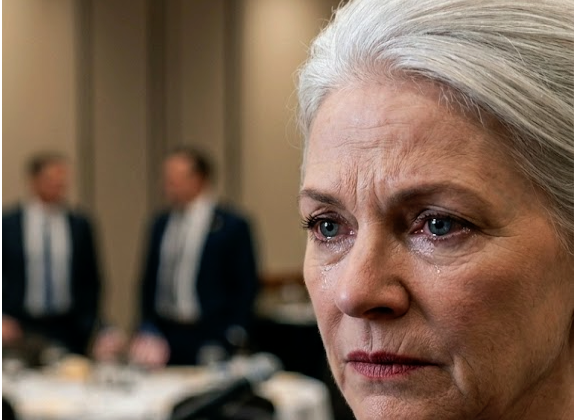
Evelyn was a woman who could end a boardroom coup with a single twitch of her eyebrow. She looked exactly as she had a year ago: tailored, midnight-colored wool, hair like spun silver, and an aura of absolute composure. She looked at me, then at the sign, then at Laya’s mismatched socks. A crack appeared in her porcelain expression—not pity, but something sharper.
“Maya,” she said, her voice cutting through the morning fog. “What are you doing here?”
I did what exhausted women do: I lied. “We’re fine, Grandma. It’s just temporary.”
She didn’t buy it. Her eyes scanned my red, raw hands and the way I was shielding Laya. “Maya,” she said, her voice dropping to a terrifyingly calm register. “Why aren’t you living in your house on Hawthorne Street?”
The world tilted. I blinked at her, certain I had misheard. “What house?”
Evelyn’s face went very still. In the Hart family, “still” was the precursor to an explosion. She didn’t repeat herself. Instead, she did something I’d never seen her do: she crouched. Evelyn Hart did not crouch for anyone, yet there she was, eye-to-eye with my daughter.
“You’re Laya, right?”
“Yes,” Laya whispered, hiding behind my leg.
“Get in the car,” Evelyn said, standing up and looking at me. It wasn’t a request.
As we slid into the leather interior—a silence that smelled like expensive perfume and safety—Evelyn didn’t drive. She stared straight ahead, her hands resting lightly on the wheel. “By tonight,” she said, “I will know who did this.”
She tapped her phone. “Call Adam. Get the property manager for Hawthorne Street. I want to know who has the keys, who is living there, and who has been collecting the rent.”
My blood ran cold.
Six months ago, I was a nursing assistant at St. Jude’s, working twelve-hour shifts until my feet felt like lead. When my life hit a snag, my parents—Diane and Robert—offered “stability.”
“Family supports family,” Diane had said with that soft, practiced smile. It was a beautiful sentiment that turned out to be the fine print on a predatory loan. They moved us into their small apartment, and the erosion began. It started with “organize your life better” and ended with “if you were a good mother, you’d be independent.”
The night of the eviction is a blur of neon streetlights and shivering. I had come home after midnight to find two cardboard boxes in the hallway. My boxes. The door was locked. When Diane finally opened it, she didn’t look like a monster; she looked like a woman who had just finished a very productive day of “tough love.”
“Plans change,” she had whispered, pointing to Laya, who was asleep on the floor by the shoe rack, her jacket folded into a makeshift pillow. “Don’t make a scene.”
I had driven for hours that night, Laya curled like a question mark in the back seat, wondering how my own parents could look at their grandchild and see a logistical inconvenience.
Three days after the encounter at the shelter, Evelyn took us to a diner. She made a call to my mother on speakerphone. I sat there, watching Laya color a pancake purple, while Diane’s voice filled the booth—bright, airy, and utterly fraudulent.
“Oh, Maya is doing great,” Diane chirped. “She loves the Hawthorne house. She’s so settled.”
Evelyn didn’t correct her. She just hung up. “She knew enough to lie without thinking,” Evelyn remarked.
The truth was a surgical strike: Evelyn had purchased a home for me and Laya. She had given the keys to my parents to manage the transition. Instead, Diane and Robert had listed the house as a luxury rental, pocketed the monthly checks, and thrown us to the wolves to keep their “investment” a secret.
Three days later, we arrived at the “Hart Collins Family Dinner.” It was one of those events my mother loved—heavy on the catering, light on the soul.
Evelyn had me enter the room first. I wore a simple dress and a level of dignity I hadn’t felt in months. When Diane saw me, her wine glass caught the light as her hand began to shake. Her “loving mother” mask didn’t just slip; it shattered.
Then came Evelyn. She didn’t bring a guest; she brought a projector.
The room went silent as the first slide hit the screen: Hawthorne Street Property Records.
“Diane,” Evelyn said, her voice like a velvet hammer. “You told me Maya was living here.”
“She—well, there was a misunderstanding—” Diane stammered.
The next slide appeared: Rental Agreement & Payout Account. It showed the rent being deposited directly into Diane and Robert’s personal account. The gasps from the extended family were audible.
“You displaced a child for profit,” Evelyn said. The words hung in the air, heavier than the chandeliers. “Starting now, Diane and Robert receive nothing. No transfers, no inheritance. I am done funding your choices.”
Robert tried to bark about “family privacy,” but it was over. A uniformed officer stood by the door—a silent reminder that while this was a family matter, the fraud was very much a legal one. I didn’t stay to watch them crumble. I walked to the private side room where Laya was happily eating crackers and watching cartoons.
“Mom, can we go home?” she asked.
“Yes,” I said, and for the first time in six months, it wasn’t a lie.
Today, we live on Hawthorne Street. The house has high ceilings and a kitchen that always smells like toast. Laya’s mismatched socks are now a choice, not a necessity. I’m finishing my RN certification, and Evelyn visits on Sundays with pastries, pretending she isn’t checking the locks to make sure we’re safe.
My parents tried to call once to “negotiate.” I blocked them. You can’t negotiate with people who saw your child’s homelessness as a business opportunity.
A Note on Boundaries: True family doesn’t just share a bloodline; they share a duty of care. When that care is traded for a check, the bond isn’t just broken—it’s liquidated.