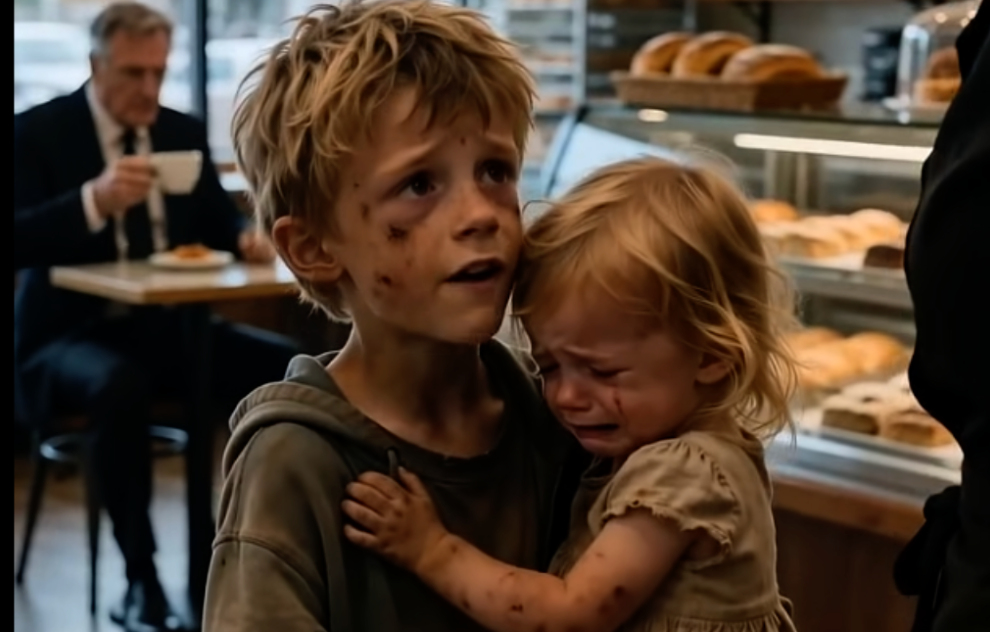
The bakery smelled like butter, cinnamon, and warm bread.
It was the kind of place where people came for soft music, expensive coffee, and pastries they barely finished.
And in the middle of all that warmth stood a skinny homeless boy, no older than eight, holding a crying toddler girl against his chest.
His hoodie was too big for him.
Her little beige dress was dirty at the hem.
Both of them looked exhausted.
The toddler buried her face in his shoulder and whimpered, “I’m hungry…”
The boy swallowed hard and stepped closer to the pastry case.
He looked up at the woman behind the counter with the kind of hope that already expected to be hurt.
“Do you have any bread from yesterday,” he asked quietly, “that you sell for less?”
The worker hesitated.
For one second, it looked like she wanted to help.
Then professionalism came back to her face.
“We don’t sell leftovers here.”
The boy went still.
That answer landed harder than shouting.
He didn’t argue.
Didn’t beg.
Didn’t even look angry.
He just lowered his eyes and held the toddler tighter as she cried harder into his shoulder.
At a small table near the window, an older man in a black suit slowly lowered his coffee cup.
He had been watching the entire thing.
Something in the boy’s voice had already unsettled him.
Then he stood up.
His chair scraped the floor loud enough to make everyone in the bakery look.
He walked to the counter, calm, composed, expensive.
“Pack everything,” he said.
The worker blinked. “Sir?”
“Everything.”
The whole bakery went quiet.
The worker stared at him, confused, then began hurriedly turning toward the bread shelves and pastry case.
The man stepped closer to the children.
“Come with me,” he said gently.
The boy instantly took half a step back and pulled the toddler tighter into his arms.
His eyes changed.
Not grateful.
Suspicious.
“Why?” he asked.
The man opened his mouth—
then froze.
His gaze had fallen to the toddler’s face.
At first it was just her eyes.
Then the shape of her mouth.
Then, when she turned her head slightly through tears, he saw a tiny crescent-shaped birthmark near her temple.
His whole expression cracked.
Shock.
Pain.
Recognition.
He lifted one trembling hand toward her face—
but stopped just before touching her.
Like he was afraid of the answer already forming in his mind.
The boy noticed.
His voice sharpened.
“What?”
The man looked at him as if he had forgotten how to breathe.
“What’s her name?”
The boy hesitated.
He looked at the man.
Then at the bakery worker.
Then at the door, like escape might still be possible.
Finally he answered.
“Lily.”
The older man’s face went white.
That had been his daughter’s favorite name.
Years ago, before she disappeared from his life, she used to laugh and say, If I ever have a little girl, I’ll name her Lily.
His throat tightened.
“And your mother?” he asked.
Now the boy went completely rigid.
That question hurt.
He looked down at the toddler, then back at the stranger in the suit.
The bakery felt too small now.
Too silent.
Finally the boy whispered, “She’s gone.”
The man’s eyes filled instantly.
“Gone… how?”
The boy’s jaw trembled, but he forced the words out.
“She got sick in the winter.”
The older man closed his eyes for one second like something inside him had just broken.
The toddler cried softly and clung to the boy’s neck.
The man stared at her again.
Then at the boy.
And now he saw it.
Not just the hunger.
Not just the dirt.
Not just the fear.
He saw his daughter in both of them.
The worker stopped moving behind the counter.
Even she could feel that whatever was happening now was bigger than bread.
The older man tried to steady his voice.
“What was your mother’s name?”
The boy looked at him for a long moment.
Then he answered.
“Elena.”
The man’s knees nearly gave out.
Elena.
His daughter.
The daughter he had thrown out of his life five years earlier when she fell in love with a poor musician he disapproved of.
The daughter who had screamed through tears, One day you’ll have all your money and no one left to love you.
He had never seen her again.
His hand started shaking openly now.
The boy saw it.
And something changed in his own face.
Not trust.
Recognition.
Slowly, carefully, he shifted the toddler onto one hip and reached into the inside pocket of his oversized hoodie.
He pulled out a crumpled folded envelope.
It was old.
Worn soft at the edges.
Protected for a long time.
He held it out, but didn’t release it yet.
“Mom said,” the boy whispered, “if we ever got too hungry… and if a man looked at Lily like he knew her… I should give him this.”
The older man stared at the envelope.
On the front, in faded handwriting, were four words:
For my father.
His fingers trembled as he took it.
The whole bakery was silent now.
He unfolded the letter.
His eyes dropped to the first line.
And his face collapsed.
Because it read:
Dad, if you’re reading this, hunger reached your grandchildren before your pride did.
For a moment, the older man could not move.
The letter trembled so badly in his hands he had to grip it with both of them.
The boy stood frozen, still holding Lily.
He looked like he wanted to run, but hunger, fear, and hope had pinned him to the floor.
The man forced himself to keep reading.
I don’t know if this letter will ever reach you.
I know you stopped being my father the day I chose love over your approval.
But these children are innocent.
Sam has tried to protect Lily the way I protected him. He is only a child, but life made him older.
If I am gone, and they ever come to you, please don’t punish them for being mine.
Lily is the granddaughter you never met.
Sam is the boy who stayed when everyone else left.
If you still have any love for me, feed them first. Ask questions after.
By the time he reached the end, tears were running openly down his face.
No one in the bakery spoke.
Not the worker.
Not the customers.
Not even the toddler.
The older man lowered the letter and looked at the children as if he had been handed back the only part of his daughter that still remained in the world.
The boy’s voice came out small, guarded, and tired.
“Are you him?”
The man couldn’t answer at first.
He nodded once, then twice, like he hated himself for how late it was.
“Yes,” he whispered. “I’m her father.”
The boy tightened his hold around Lily instantly.
Not because he was emotional.
Because he was protective.
Because life had taught him that adults could say beautiful things and still leave.
The man saw that too.
And that hurt even more.
“What’s your name?” he asked.
“Sam.”
“And Lily is your sister?”
Sam nodded.
The toddler finally lifted her tear-streaked face and looked at the man properly.
He stared at her like she was a miracle and a punishment at the same time.
Then Lily reached one tiny dirty hand toward him and asked the question that destroyed whatever pride he had left.
“Did you know my mommy?”
The man covered his mouth.
A broken sound came out of him — half sob, half breath.
“Yes,” he said. “She was my daughter.”
Lily blinked.
Sam went still.
The whole bakery seemed to hold its breath.
Then Sam asked, very quietly, “If she was your daughter… why were we hungry?”
That question hit harder than the letter.
Harder than the memory.
Harder than guilt.
The older man had no defense.
No excuse that didn’t sound disgusting.
“I was wrong,” he said, voice shaking. “And I was too late.”
Sam didn’t answer.
But he didn’t walk away either.
The older man turned to the worker, and when he spoke again, his voice had changed.
Not louder.
Just absolute.
“Pack bread. Soup. Fruit. Milk. Everything hot. Everything fresh.”
The worker rushed into motion.
Then he looked around the bakery, around the polished floors and shining pastry case, and seemed disgusted by the whole place for the first time in his life.
He turned back to Sam.
“You don’t have to ask for old bread again,” he said.
Sam’s lips trembled, but he still didn’t trust the promise.
The man slowly crouched until he was at eye level with him.
“I can’t undo what I did to your mother,” he said. “I can’t bring her back. But if you let me… I will spend the rest of my life trying to be better to both of you.”
Lily leaned toward him then, small and unsure.
He opened his arms carefully, as if he didn’t deserve to.
She looked at Sam.
Sam hesitated.
Then, very slightly, he nodded.
Lily reached across and wrapped her arms around the older man’s neck.
The man broke completely.
He held her like something sacred, crying into the dirty little shoulder of a child who should never have known hunger.
Sam stood there for one second trying to stay strong.
Then the older man lifted one arm toward him too.
Sam resisted.
Only for a second.
Then he stepped in.
And in the middle of the bakery, surrounded by warm bread and stunned strangers, the three of them held each other and cried for the years that had been lost.
A few minutes later, as bags of food were being packed, the older man asked softly, “Where were you sleeping?”
Sam looked down.
“Behind the pharmacy some nights. Bus station when it rained.”
The man shut his eyes like the words physically hurt him.
Then he took off his coat and wrapped it around Sam’s shoulders.
When the food was ready, he did not hand them a bag and send them away.
He took Sam’s hand.
He carried Lily himself.
And before they walked out, he turned to the bakery worker and said something that changed more than just that day:
“From now on, no child leaves this bakery hungry. Ever.”
Then he looked down at his grandchildren.
His grandchildren.
Children his daughter had trusted him with even after everything.
And with tears still in his eyes, he whispered the words he should have said years earlier:
“I’m taking you home.”