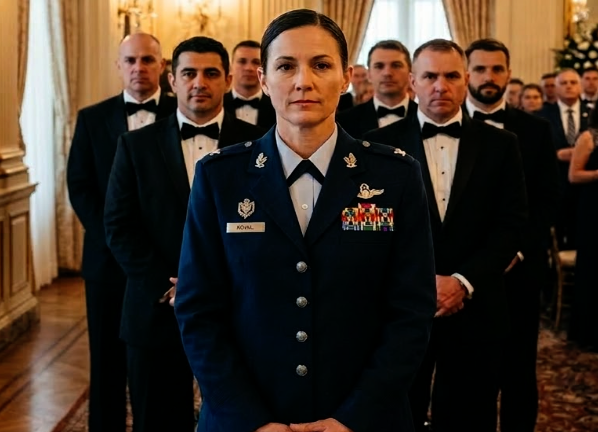
The air inside the Grand Hyatt’s ballroom was a thick, cloying cocktail of expensive roast beef, overworked floral centerpieces, and the unmistakable scent of old money—Chanel No. 5 mixed with an air of unearned entitlement. I stood at the center of this gilded cage, a brigadier general in the United States Air Force, feeling less like a military powerhouse and more like a fortress made of glass. My mess dress uniform was a study in precision: a midnight-blue shell, stiff with starch and tradition, adorned with a silver star that represented twenty years of grit. But beneath that wool, I was still June—the girl who just wanted her father to look at her without apologizing for his existence.
The temperature in the room plummeted before I even saw her. Lynn entered like a heat-seeking missile in a dress that was too red, too tight, and too loud for a military gala. Behind her trailed my father, Thomas, fumbling with his cufflinks as if they were foreign objects. He gave me a small, flickering smile—the kind a man gives when he’s about to let you down.
“You look like a man in that getup, June,” Lynn hissed, her voice sugared for the benefit of the nearby colonels. “Honestly, it’s embarrassing. Your mother would be ashamed to see you looking so… hard. So unlovable.”
The strike was surgical. She knew my armor was thick, so she aimed for the ghost of my mother. But the evening was just beginning. When a senator approached to praise my speech on sacrifice, the narcissistic injury hit Lynn like a physical blow. She couldn’t stand the light being on me.
“Proud?” she shrieked, her voice cutting through the jazz music. “She’s a fraud!”
Then, she lunged. Her crimson-nailed hand didn’t go for my face; it went for my chest. She grabbed the one item on my uniform that wasn’t standard issue—a gold wing brooch that had belonged to my mother. The sound of the pin ripping through the heavy wool was sickening. The metal drove into my shoulder, and a hot bloom of blood began to spread across my chest.
I looked at my father. He stood five feet away, saw the blood, saw my humiliation, and then did what he had done for fifteen years: he looked at the floor. He studied the pattern of the carpet as if it held the secrets of the universe, while his daughter bled in front of a room full of dignitaries.
To understand how I ended up bleeding in a ballroom while my father studied the floor, you have to understand the man he used to be. My father was a mechanic—a man who breathed motor oil and orange Gojo hand cleaner. After my mother died of ovarian cancer, the house became a silent museum of medical bills and grief. It was just the two of us, bound together by gaskets, spark plugs, and the quiet rhythm of the garage.
I remember leaving for basic training in his rusted ’98 Chevy Silverado. He didn’t have words for love, so he shoved a crumpled, oil-stained twenty-dollar bill into my hand. It was his lunch money for the week. That twenty felt heavier than my duffel bag because it was the only currency he had to express a love he couldn’t verbalize.
Years later, I came home to find him fading away in a recliner, eating rubbery Salisbury steak in the blue flicker of the television. Out of a misguided sense of duty, I pushed him to find a companion. I thought I was saving him from loneliness; in reality, I was unlocking the door for a predator.
Lynn arrived with Tupperware containers of meatloaf and a smile that acted as a mask for a deep, hungry void. The love-bombing was textbook. She praised my rank, straightened my collar, and made the house smell like apple pie. I let my guard down, thinking he was safe. But safety with a narcissist is never free—it’s a subscription service with ever-increasing fees.
The financial drain started with a water heater. Then a roof repair. Then new tires for the truck. Each check I wrote felt like I was being a “good daughter,” but I was actually paying a “protection fee” to be allowed access to my own father. The turning point occurred in a hospital room after Dad collapsed from exhaustion. I had just paid a three-thousand-dollar deductible so he could receive a life-saving stress test.
Instead of gratitude, Lynn complained that I hadn’t “sprung” for a private room. “If you really cared about his recovery, you’d want him to have peace,” she huffed. I looked at my father, waiting for him to defend me. Instead, he whispered those four soul-crushing words: “Just let it go.”
In that moment, I realized I wasn’t helping my father; I was subsidizing a hostage situation. He wasn’t a protector; he was a man so terrified of the silence of that house that he would let his daughter be bled dry to keep the noise of a toxic woman in his ears.
Exhausted and spiritually bankrupt, I found myself in a base chapel at 2100 hours. Chaplain Mara, a woman who possessed the stillness of holy ground, sat with me. I confessed my shame—that I was a general to the world but a “nobody” at home who took abuse because I thought “honoring my father” meant being a human sacrifice.
Mara’s response reframed my entire existence. “When you send pilots into a storm, do you send them in naked, or do you make sure they have protection?” she asked. She pointed to Ephesians 6:11, explaining that the “schemes of the devil” often look like guilt trips and financial abuse.
“Honoring your parents means respecting the role they played in giving you life,” Mara said. “It does not mean letting them destroy the life you were given.”
She told me I needed a physical reminder of who I was. I went home and pinned my mother’s gold wing brooch to my uniform. It wasn’t regulation, but it was a shield. By the time I walked into the Grand Hyatt that night, I wasn’t just wearing a uniform; I was wearing boundaries. And as I soon learned, nothing infuriates a narcissist more than a victim who has grown a backbone.
Back in the ballroom, the silence after Lynn’s “thief” accusation was suffocating. She stood there clutching my mother’s wings, her face flushed with the triumph of a bully who thinks she has finally won.
The silence was broken by the rhythmic clack-clack-clack of an oak cane against marble. Sergeant Major Daniel Cross, an eighty-two-year-old legend of Korea and Vietnam, stepped forward. He didn’t look at Lynn as a woman; he looked at her as an enemy combatant.
“Give me that pin,” he growled.
He snatched the brooch from her shaking hand and held it up for the entire room to see. “This woman calls this jewelry,” Daniel roared, his voice filling the cavernous space. “These are the pilot wings of Captain James Miller—this officer’s uncle. He died in Normandy, keeping his burning plane in the air so his crew could bail out. These wings were cut from his uniform before they buried him.”
The social tide didn’t just turn; it became a tsunami. The senators and generals who had been confused a moment ago now looked at Lynn with pure, unadulterated disgust.
“You didn’t know because you don’t care,” Daniel told her, his voice dropping to a deadly whisper. “You are a small, petty woman standing in the shadow of giants.”
The room erupted. Not in applause for the drama, but for the truth. Security escorted Lynn out as she scurried like a rat caught in a pantry light. My father, in his final act of cowardice for the night, followed her out—a beaten man trailing his master.
But as Daniel pinned the wings back onto my torn, bloody uniform, he winked at me. “Stand tall, General. Your armor’s a little dented, but it held.”
I caught up with them at the valet stand. The cold night air was a relief after the stifling perfume of the ballroom. My father stood by his sedan, smoking a cigarette—a habit he’d quit a decade ago.
“I’m sorry, June,” he rasped. “I didn’t think she’d do that.”
“You didn’t think,” I replied. “You chose her comfort over my safety. Again.”
I told him the truth he’d been avoiding for fifteen years: The Bank of June was closed. Permanently. I was cutting off the credit cards, the house repairs, and the insurance supplements. I was done subsidizing the woman who hated me.
“You have a choice, Dad,” I said. “You can get in that car and live in that misery on your own dime. Or you can walk away. But I will not help her anymore.”
I watched him wrestle with the ghost of his fear. He looked at the car where Lynn sat, stony and silent. Then he looked at me. For the first time, he saw the woman I had become, not the fixer he used to exploit.
“I’m staying,” he told her through the glass.
I opened my banking app right there in the parking lot. I tapped “Manage authorized users,” found Lynn’s name, and hit Delete. It was the most powerful I had ever felt. The cord was cut. The enabler had finally awakened, and the vampire had lost its source of blood.
The next morning, I didn’t wake up with a “hangover” of guilt. I woke up with a mission. I systematically canceled every auto-pay, every landscaping service, and every premium cable package I had been paying for.
Then, the “flying monkeys” arrived.
In psychology, a narcissist who loses control will recruit others to do their dirty work. My phone vibrated with texts from Aunt Becky and Cousin Mike, accusing me of “elder abuse” and being “greedy.” They told me I was a “bad daughter” who would be judged by God.
I wanted to scream the truth back at them. I wanted to send photos of the blood on my uniform. But I remembered Mara’s words: Your silence is a boundary. I didn’t argue. I didn’t explain. I simply hit Block.
Aunt Becky: Blocked. Cousin Mike: Blocked. Neighbors and distant cousins: Blocked.
I built a digital fortress. I realized that I didn’t owe an explanation to anyone who was committed to misunderstanding me.
When my father and I returned to his house later that day, we found it trashed. Lynn had looted the place, taking the TV, the silver, and even my dad’s tools. She had fled the moment the money stopped. Dad stood in the wreckage of his kitchen, cracked a beer, and took his first deep breath in fifteen years. The shadow was gone.
Rebuilding didn’t happen in a day. It happened over hickory-smoked ribs on the back patio and quiet Sunday afternoons. The most profound moment came a year later at a VFW Memorial Day dinner.
My father was asked to speak. He stood at the podium, threw away his index cards, and told a room full of veterans that he had been a coward.
“I watched a war happen in my own living room,” he said, his voice cracking. “I watched the woman I married tear down the person I love most, and I stood there because I was afraid of being alone. My brother died fighting enemies abroad, but my daughter June fought a war in her own home. She fought for her dignity when I was too weak to defend it.”
He pointed at me and told the room I was the toughest soldier he knew. In that VFW hall, the wound finally closed. I didn’t need the world to know I was right; I just needed my father to know I was worth fighting for.
Fifteen years have passed since that night at the Grand Hyatt. Today, I stood in the Hall of Heroes at the Pentagon, receiving my third star. My father, now eighty-nine and using a wheelchair, was the one who pinned the silver stars to my shoulders. His hands shook with Parkinson’s, but his eyes were clear.
“You did good, June Bug,” he whispered.
As I left the ceremony, I saw a ghost in the hallway. It was Lynn. She was stooped, gray, and dressed in mismatched clothes from a donation bin. She had seen the news of my promotion and had come to the Pentagon to play her final card.
“I miss him, June,” she croaked, smelling of mothballs. “I made mistakes, but we’re family. Don’t I deserve a second chance? I’m living in state housing… the heater doesn’t work…”
She reached for my sleeve, her eyes searching for the old June—the one who could be guilted into writing a check.
“I forgive you, Lynn,” I said.
Her face brightened for a split second.
“I forgive you for my own peace,” I continued, “but forgiveness is not the same thing as access. You lost your seat at our table fifteen years ago. You don’t get to come back just because you’re hungry.”
I walked away. I didn’t look back. I didn’t feel a flicker of spite, only the profound weight of my own freedom. I returned to my father, wheeled him into the golden afternoon sun, and watched the sunset over the Potomac.
The lesson was expensive, but it was absolute: You teach people how to treat you. Setting a boundary isn’t an act of war—it is an act of self-respect. Your peace is worth more than their approval.