Oksana looked at her son across the kitchen table, and in her head an invisible metronome automatically clicked, counting off the seconds of silence. Artyom broke first: he looked away and began tugging at the edge of his stale T-shirt. Classic. The subject had cracked under the simplest visual contact. At fourteen, he thought he had learned how to lie, but to a mother who had spent ten years in the Federal Drug Control Service and had seen far more serious “actors,” he was as transparent as a government-issued glass.
“Mom hit me!” Artyom shouted, and the phrase — memorized, rehearsed clearly for more than one evening — struck the silence of the kitchen. “That’s exactly what I’ll tell the judge. And I’ll show the bruises. Dad said they’ll photograph them and attach them to the case.”
Oksana slowly took a sip of cold coffee. The bitter liquid burned her throat in a familiar way. She did not flinch. She did not rush to justify herself. Her mind was already producing a complete scheme. Vitaly, her ex-husband, who owed betting offices more than his kidney was worth, had decided to go all in. The plan was primitive: turn the teenager against his mother, take him to live with him, sue for fixed alimony, and, if he got lucky, bite off a share of her three-room apartment — bought with combat pay and savings before their marriage.
“Bruises, then?” Oksana tilted her head slightly, noting the micro-tremor in her son’s hands. “And where are you going to get them, Tyoma? Surely Dad isn’t going to ‘help’ draw them?”
“It doesn’t matter!” the teenager snapped, jumping up from the chair. “I’m going to him. Right now. He understands me. He doesn’t interrogate me every day like a criminal! I’m sick of your control, your checks! Dad said you owe us for life now, after everything you did.”
He flew out of the kitchen, and a minute later the front door slammed. Oksana remained sitting in the silence. On the table lay a fast-food receipt Artyom had forgotten: 2,480 rubles. Strange. Vitaly was officially unemployed, and Oksana gave her son exactly 500 rubles a week for pocket money.
“The factual basis is beginning to accumulate,” she noted to herself.
At that very moment, a notification arrived on her phone. Vitaly.
“Oksana, the boy is with me. He won’t be coming back to you. Get your lawyers ready. We’re filing for determination of his place of residence and alimony. By the way, Tyoma has told me a lot of interesting things about your parenting methods. Article 156, nothing less. Think about it — maybe you’ll simply transfer your share of the apartment to him and we’ll part peacefully?”
Oksana smirked. Vitaly had always been a poor strategist. He had made the main mistake: he revealed his cards too early, believing that maternal love would blind her. But he had forgotten that Oksana had been an officer first, and only afterward a mother.
She stood up, walked over to the ventilation grille above the stove, and carefully adjusted the edge of the plastic. There, deep in the shadow, a barely visible blue light winked. A hidden camera with a motion sensor and audio recording had been working there for eight days — ever since Artyom had first mentioned “moving out.”
“Well then, Vitalik,” she whispered, looking at the screen of her tablet, where the cloud archive of video recordings was opening. “You wanted to play ‘justice’? You’ll get your show.”
Oksana opened her laptop and began entering data into a spreadsheet. Round one: lying to her face. Recorded. Round two: property blackmail. Recorded. She knew Vitaly did not need a relationship with his son. He needed money. The 34,000 rubles in alimony he expected to receive every month amounted to two of his average football bets. To him, his son was simply “goods,” a courier who was supposed to deliver the ransom.
Two hours later, Oksana was already sitting in her car across from her ex-husband’s building. She watched Vitaly and Artyom come out of the entrance. Her son was carrying a heavy backpack, while Vitaly was rapidly whispering something to him, glancing around every now and then. At one moment, Vitaly shoved a small bundle wrapped in black electrical tape into the boy’s hands, and Artyom quickly hid it in the pocket of his hoodie.
“Dangerous, Tyoma. Very dangerous,” Oksana thought, switching the dashcam to maximum resolution. “Dad isn’t just teaching you to lie. He’s turning you into an accomplice.”
She waited until they disappeared around the corner and dialed a number.
“Pasha, hi. It’s Oksana. Remember how you owed me for that story with the drug drops in Khimki? I need a favor. Unofficially. I need you to run one SIM card through billing and see who my ‘subject’ has been in contact with over the last forty-eight hours. The factual basis is burning, Pash. A living person is at stake.”
Three days later, Oksana was sitting in Vitaly’s lawyer’s office. The air smelled of expensive paper and cheap ambition. Vitaly lounged arrogantly in a leather chair, showing off his new watch — the very one that cost three months of her service pension. Artyom sat beside him. Her son carefully avoided looking his mother in the eyes and studied the toes of his sneakers.
“Oksana, let’s do this without formalities,” Vitaly smirked, baring teeth darkened by coffee. “The child wants to live with me. You heard him yourself. Plus, we have a report from a paid psychologist. The boy is under stress from your ‘barracks’ regime.”
“And how much does this stress cost?” Oksana’s voice was level, like a report at a morning briefing.
“Forty thousand rubles in alimony,” Vitaly’s lawyer said, sliding a document toward her. “Plus your voluntary waiver of claims to the car that you bought during the marriage but registered in Vitaly’s name. Otherwise, Artyom will confirm every episode of… assault in court.”
Artyom flinched but said nothing. Oksana noticed how convulsively he clenched his fists. On his right hand, just above the wrist, there was a fresh purple mark.
“Mom hit me!” the teenager suddenly shouted, as if on command. “Look! You gave me this when you dragged me by the arm into the room on Tuesday!”
Oksana leaned forward. Her professional gaze caught the details: the shape of the hematoma was too regular, oval. Marks like that are not left by a yank — they are made deliberately, by pressing with the thumb for a full minute.
“On Tuesday,” she repeated, making a note in her notebook. “At 7:42 p.m., to be precise. Artyom, are you sure?”
“Yes! I’m sure!” the boy’s voice cracked into a falsetto.
“Factual basis accepted,” Oksana stood. “We’ll meet in court. I’m not signing anything.”
After leaving the business center, she did not go home. Her path led to a small electronics repair workshop. Pasha was already waiting, twirling a flash drive in his hand.
“Oksana, you were right. Your ‘ex’ is a complete idiot. He communicated with Tyoma through a gaming chat — thought they wouldn’t find anything there. I pulled a month of correspondence. There are instructions: how to provoke you into shouting, how to press the skin properly so a bruise appears. And the sweetest part — Vitalik promises the kid a new gaming computer for a ‘successful performance’ in court.”
“And what about the billing?” Oksana took the flash drive.
“As for the billing, our Vitaly visited an underground gambling club on the outskirts three times in one week. And judging by the transactions from his card, he’s gotten into debt with people who don’t go to court. They come with rebar. He needs those forty thousand a month like air, so they don’t smash his head in.”
Oksana nodded. The puzzle was complete. Vitaly had involved a minor in a fraudulent scheme, under Article 150 of the Criminal Code, to cover his gambling debts. This was no longer merely a family dispute. This was an “episode” ready for implementation.
That evening, she opened the very kitchen recording. On the screen, Artyom, left alone, carefully applied a cold soda can to his forearm and then squeezed his own skin with his fingers, hissing from the pain. He was practicing.
“Well, son,” Oksana looked at the screen, and there was not a drop of warmth in her brown eyes. “You chose a side. Now you’ll learn how the system works with those who go against the law.”
She took an old folder with contacts from Internal Security and the Guardianship Department out of the safe. She did not need to “save” Artyom in the usual sense. She needed to secure her position so firmly that no commission would doubt it: the teenager was socially dangerous and under the influence of a criminal.
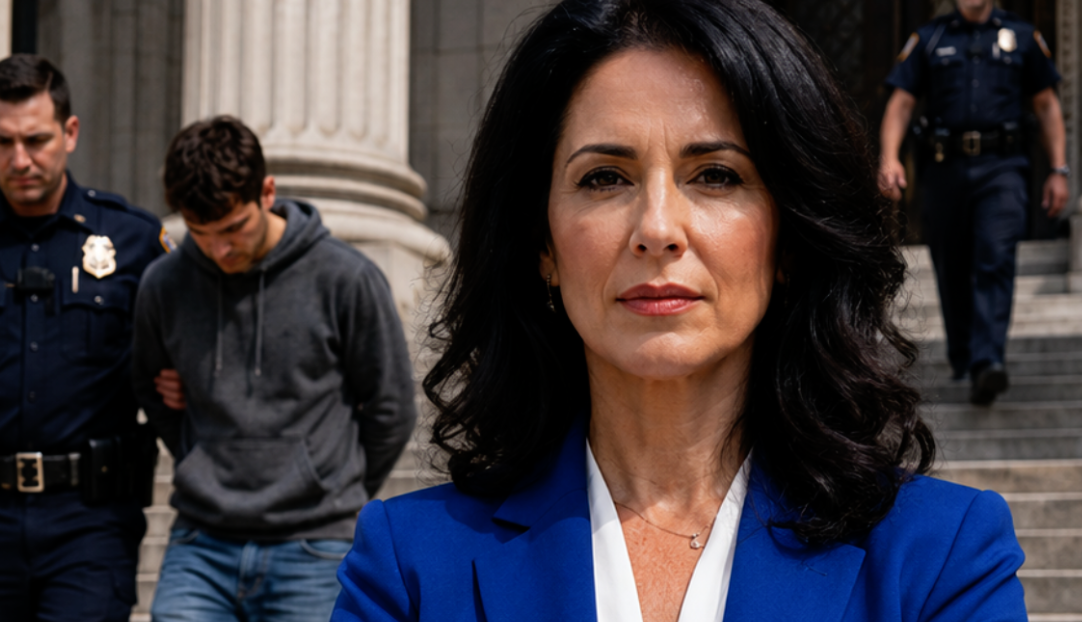
On the morning of the court hearing, Oksana put on a strict dark-blue suit. Her hair was pulled into a tight bun — not a single unnecessary detail. She saw Vitaly in the courthouse corridor. He was beaming, patting his son on the shoulder. Artyom looked pale and nauseous — classic somatic symptoms when giving knowingly false testimony.
“You can still fix everything,” Vitaly threw at her as she passed by. “Just hand over the apartment keys and sign the waiver. Tyoma will be better off with me.”
“He’ll be better off where he learns to answer for his words,” Oksana cut him off.
The hearing began in the standard way. The judge, a tired woman with a heavy gaze, listened to Vitaly. He sang like a nightingale about maternal cruelty. Then Artyom stood up.
“She… she hit me. Constantly. And humiliated me. I’m afraid to go home,” the boy trembled. “Here’s the bruise. She gave it to me on Tuesday evening.”
The judge looked at Oksana.
“Plaintiff, do you have anything to add?”
Oksana slowly rose. She held a tablet in her hands.
“Your Honor, I ask that a video recording and the results of an independent metadata examination be attached to the case. As well as a notarized witness statement.”
She pressed play. On the courtroom monitor, the scene of the bruise “preparation” in the kitchen unfolded. The room froze. Vitaly began to slowly turn pale; his eyelid twitched nervously.
“It’s edited!” he shouted.
“The metadata confirms there are no cuts,” Oksana said coldly. “And now I ask the court to review the correspondence between my ex-husband and my son in the gaming messenger, where the father gives instructions on committing a crime under Article 307 of the Criminal Code — knowingly false testimony. And Article 159 — attempted fraud on an especially large scale.”
Artyom covered his face with his hands and slid down in his chair. He understood: his mother would not pity him. She was “closing” him.
Such silence hung in the courtroom that the hum of the old air conditioner beneath the ceiling could be heard. Oksana was not looking at the judge. She was looking at Vitaly. He opened and closed his mouth like a fish thrown onto shore. His polished confidence slid away, revealing the gray, sticky skin of a loser who had just realized he was not on a date with his ex-wife — he was under interrogation.
“This… this is a violation of privacy!” Vitaly finally forced out, his voice breaking into a squeal. “She was spying on her own son! Your Honor, she’s insane!”
“Private life ends where the elements of a crime begin,” Oksana said quietly, but with weight. “The video recording was made in my apartment, where I am the sole owner. Artyom, stand up.”
The teenager rose, swaying. His face was blotchy with horror and shame.
“Tell the court,” Oksana took a step toward her son, and he instinctively pulled his head into his shoulders. “Tell them what was in the black bundle Dad gave you near the entrance. And why you went to the pawnshop on Sadovaya yesterday at three in the afternoon.”
“How do you…” Artyom broke off.
“I’m not just your mother, Tyoma. I am your past — the one you decided to betray for the promise of cheap plastic. Did you think I wouldn’t check the billing and go through the Safe City cameras?”
The judge, whose face now resembled a granite mask, turned to the bailiffs.
“Call a juvenile affairs representative and an investigative team. We have signs here of a minor being involved in the commission of a serious crime and perjury.”
Vitaly lunged toward the exit, but a tall man in civilian clothing blocked his path — the same Pasha who had “accidentally” stopped by to support a friend.
“Where are you going, Vitalik?” Pasha placed a heavy hand on his shoulder. “Your creditors are already waiting for you outside. But I think you’ll be safer in pretrial detention. They don’t beat people with rebar there. Only according to regulations.”
Artyom suddenly sobbed and rushed toward Oksana.
“Mom, forgive me… He said you didn’t love me, that all you cared about was work… I didn’t want to!”
Oksana did not hug him. She only coldly straightened the collar of his hoodie, making the boy freeze.
“Love, Artyom, is when you are taught to be a human being, not a tool for extortion. You crossed the line. Now you’ll go to a juvenile reception center until all the circumstances are clarified. And then — to a cadet corps. They’ll teach you discipline there, since I failed.”
“To a cadet corps?!” Vitaly howled, realizing that his “gold mine” had vanished. “You have no right! I’m his father!”
“You are a subject in a case under Article 150, Vitalik. You no longer have rights. Only obligations under the Criminal Code.”
When they were led out — Vitaly in handcuffs, and Artyom under the escort of a guardianship inspector — Oksana did not even turn around. She slowly gathered the papers into a folder. Her hands were dry and warm. There was no pain inside. There was only a deep feeling of professional satisfaction from a cleanly closed case.
Vitaly looked through the bars of the prison transport van, and there was no longer any of his former arrogance in his eyes. Only gray, suffocating fear of what awaited him beyond the threshold of a new reality, where his connections no longer worked and his debts remained free outside. He understood that Oksana had not merely defended herself — she had methodically erased him from her life, leaving only an article number in his personal file as a keepsake.
Oksana stepped onto the courthouse porch and squeezed her eyes shut against the bright sun. She understood that many would condemn her for “turning in” her own son. They would say, “A mother must forgive.” But Oksana knew another truth: impunity breeds monsters. She had not betrayed Artyom — she had cut out the tumor Vitaly had implanted in him, even if it meant cutting away a piece of living flesh along with it.
She got into the car and deleted the folder titled “Subjects” from her phone. Now her home was once again her fortress. Quiet, empty, and absolutely safe. Months of court hearings lay ahead, but the result had already been determined. She had secured herself with facts — and facts, unlike people, do not know how to lie.
Reader support is the very fuel that allows the author to conduct new investigations in the thickets of human souls and search for justice where others try to hide it behind beautiful words. Your empathy helps me find the strength to describe such difficult endings. If this story resonated with you, you can thank the author by supporting their work.