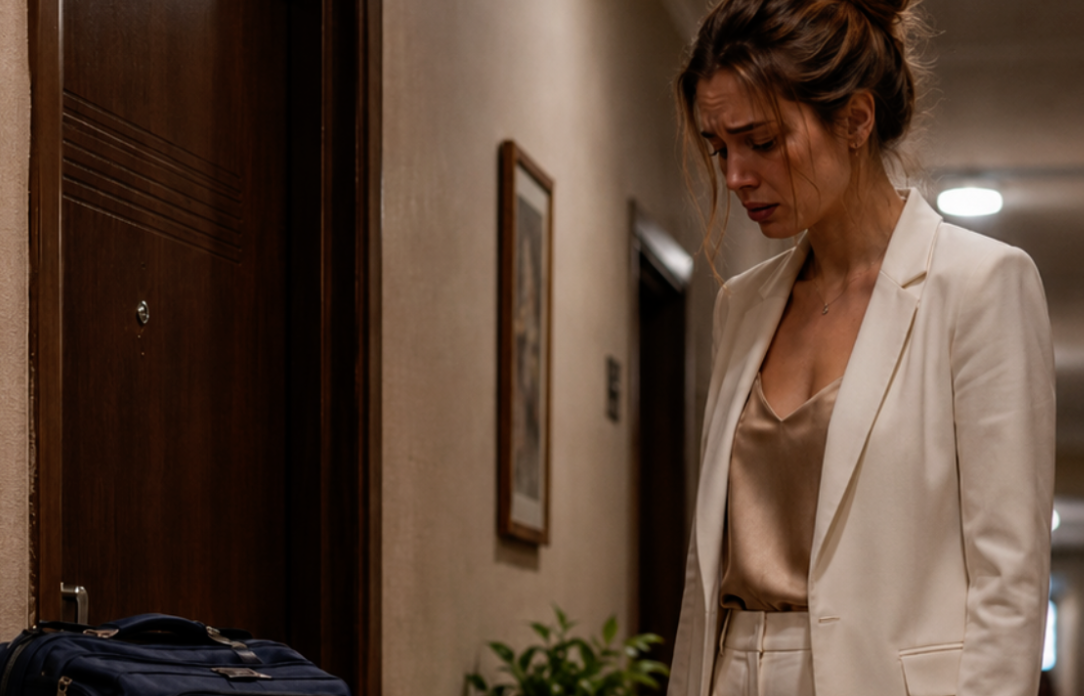
Marina couldn’t open the door with her key. She turned it again, pressed her shoulder against the door, then stepped back.
She lowered her gaze and saw the suitcases. Her suitcases, with a scratch on the blue side, with the torn tag from Anapa.
On top lay a piece of cardboard covered in purple marker. Marina recognized her mother-in-law’s handwriting immediately — large letters leaning to the right, pressed so hard that the marker had bled through the paper.
“My nephew will live here. You have your parents’ dacha. Go live there.”
Marina read the note three times. Then she took out her phone, turned on the camera, and began filming.
A close-up of the door, the keyhole, the suitcases with the tag, the cardboard with the message. She said the date and time aloud — March fifteenth, two twenty-two in the afternoon — and her own voice sounded strange to her, too steady for what was happening.
The meeting had been canceled two hours earlier. She had planned to come home early, sort out the storage shelves, and cook borscht from the vegetables that had been sitting in the refrigerator for three days.
Instead, she was standing on the stairwell landing of a nine-story panel apartment building in Biryulyovo, documenting her own eviction.
She dialed Dmitry’s number. The rings stretched out one after another, long and empty, until a mechanical voice announced that the subscriber was not answering.
Marina ended the call, opened the taxi app, and entered the address of a hostel on Varshavskoye Highway — the only place that came to mind.
Squatting down, she unzipped the nearest suitcase. Sweaters, jeans, underwear — everything was crumpled, shoved in any way possible, as if someone had been in a hurry to get rid of evidence.
She kept her documents in her work bag, and that saved her. But her work laptop was still inside the apartment.
And her mother’s photo album, the one with the velvet cover.
The taxi arrived six minutes later. The driver got out, silently helped her load the suitcases, and did not ask a single question.
Marina sat in the back seat and watched the gray buildings of Biryulyovo drift past the window, the kiosks near the metro station, people carrying bags from Pyaterochka. The March sun struck the glass. The snow had already melted, exposing all the winter filth — cigarette butts, dog tracks, forgotten gloves.
She had lived in that apartment for four years. Every month she transferred forty-seven thousand rubles to the mortgage account, paid the utilities, and bought furniture on installment plans.
Dmitry had promised to find a job — first after New Year’s, then after the May holidays, then after the summer. Her mother-in-law used to say, “Dima is a creative person. He needs time.”
His sister Oksana would add, “You earn decent money, don’t you? What, are you sorry to help?”
Marina regretted nothing. She had only waited for things to change, for Dmitry to get himself together, for her mother-in-law to stop looking at her like a servant.
Three years ago, at a family dinner, Raisa Petrovna had told her directly, “You’re temporary here, until Dima finds someone better.” Dmitry had kept silent, his sister-in-law had giggled, and Marina had smiled and poured herself more tea.
Now she was on her way to a hostel with three suitcases, and her husband was not answering her calls.
Her phone vibrated. A message from her sister-in-law: a photo of a new manicure with the caption, “My brother spoils me.”
Geolocation — the apartment on Bulatnikovskaya.
Marina locked the screen and leaned back against the seat.
A room in a communal apartment near Nagatinskaya cost twenty-three thousand rubles a month. The narrow space held an iron bed with a mesh frame, a table made of swollen particleboard, and a built-in wardrobe whose door would not close all the way.
The window faced an enclosed courtyard where even during the day the light had to be turned on.
Marina paid for the first month, left a deposit, and unpacked her things. On the third day, she requested bank statements.
She had worked as an auditor for eight years, and she trusted only numbers.
The truth looked like this: over the last twenty-four months, Marina had transferred one million four hundred thousand rubles to the mortgage account. Dmitry had transferred nothing.
Utility payments over that same period amounted to one hundred eighty-seven thousand — all from her card. She had deposited three hundred twenty thousand into the joint account intended for household expenses.
Dmitry had withdrawn three hundred ninety-two.
She checked the dates of the last transactions. Two weeks earlier, he had withdrawn fifty thousand in a single transaction.
Marina remembered that conversation. She had been getting ready for work, buttoning her coat, while Dmitry stood in the kitchen doorway saying the car needed repairs, something with the suspension.
“How much?” she had asked then.
“About fifty thousand. Maybe more, but I’ll check.”
“All right. Take it from the joint account.”
She had not checked. She had not asked for a receipt. She had not even asked which service center he had gone to.
Her husband still wasn’t answering. Marina stopped calling after the twelfth attempt — not out of pride, but because she understood he could see her calls and was deliberately rejecting them.
She opened Oksana’s social media page. Over the last three days, Oksana had posted fourteen updates: photos of cosmetics, videos of unboxing packages, selfies against the background of a familiar window.
Marina recognized the windowsill of her apartment, her curtains, her ficus, which she watered every Sunday.
Under one of the posts, Oksana had written: “My brother was generous today — a palette for nine thousand, mascara for six, brushes for twelve. I love it when family isn’t greedy.”
Marina took a screenshot. Then another, and another.
She created a folder on the desktop of her old personal laptop — the one she kept at her parents’ house — and named it “Evidence.”
On the fifth day, the management company called her.
“Marina Sergeyevna? This is regarding the apartment on Bulatnikovskaya.”
“The residents are complaining about noise. We are trying to contact the owners.”
“What residents? I don’t live there anymore.”
“The apartment is being rented out by the day through an online service. Are you aware of this?”
Marina closed her eyes and counted to five.
“No. I did not give my consent. Who arranged the rental agreement?”
“We cannot disclose personal data, but the payment shows it is a booking service. Utility payments are coming from another account.”
“Thank you. I’ll look into it.”
She opened the service’s website and entered the address. The listing appeared immediately: photographs of her apartment, her furniture, her dishes.
Price — four thousand rubles per night. Fifty-three reviews, rating — four point seven out of five.
In one of the photos, in the corner of the frame, Marina noticed a vase. Blue, with white flowers.
She had bought it last autumn at the flea market in Izmailovo. She had planned to give it to her father for his birthday but had forgotten to take it to him.
The host profile was registered under the name “Raisa P.” The avatar was a photo of her mother-in-law from an anniversary celebration three years ago.
Marina took screenshots of the listing, the reviews with dates, and the profile. She added everything to the folder.
Then she opened Oksana’s latest post, published an hour earlier. A video: Oksana was sitting on Marina’s sofa, holding a glass of wine, and saying into the camera, “Girls, easy money from rentals is real. If you have an extra apartment, it’s a sin not to use it.”
Marina saved the video to her desktop.
The consulting company’s office occupied the fourteenth floor of a business center near Paveletskaya. Panoramic windows covered an entire wall, workstations were divided by low partitions, and the meeting rooms had glass doors.
Marina loved this place because it was impossible to hide there — everything was visible, every action, every conversation.
She was sitting at her desk, checking a quarterly report against primary documentation, when she heard voices near the elevator.
“Where is she? I know she works here!” Raisa Petrovna’s voice rose above the hum of the air conditioner and the clicking of keyboards.
Marina lifted her head. Her mother-in-law was marching through the office, shoving past managers, knocking someone’s papers over.
Behind her hurried Oksana in a pink down jacket, her heels clicking across the tile.
Colleagues turned around and exchanged glances. Marina noticed intern Lyosha reaching for his phone and shook her head — no.
Raisa Petrovna stopped at her desk and slapped her palm down on the keyboard.
“You thought you could run away and that would be it? You thought we wouldn’t get to you?”
“Raisa Petrovna, you are on the premises of a private company. People work here. They do not settle family matters.”
“Don’t you dare tell me what to do!” Her mother-in-law leaned forward, and Marina caught the smell of sweat and cheap perfume. “Dima crashed the car because of you! The day after your stunt!”
“Two hundred thousand for the repair, and you will pay!”
“I don’t understand what relation I have to an accident that happened without my involvement.”
“The most direct relation! You left him, he was upset, he couldn’t concentrate!”
“He crashed into a pole! It’s your fault, and you’ll answer for it!”
Oksana walked around the desk from the side and reached for the work laptop.
“Maybe we should see what she has here? Some accounts? Money?”
Marina did not move the laptop away. She lowered her hand under the desktop and pressed the small red button — a security panic call issued to every employee after an incident with an unstable client two years earlier.
“Take your hands off my work equipment.”
“And if I don’t, what will you do? Call your alcoholic daddy?”
“Or mommy? Oh, wait, you don’t have a mommy, she’s been dead for…”
The elevator doors opened, and two security guards in black uniforms entered the office. They moved quickly, confidently, professionally.
“Did these women come with you?” the first guard asked Marina.
“No. They entered the office without passes and are behaving aggressively.”
“I’m not aggressive!” Raisa Petrovna tried to push the guard away. “I demand justice! This woman robbed my son, deprived him of his home!”
The second guard took her by the elbow.
“Please come with us to the exit.”
“Don’t touch me! You have no right! I’ll complain to every authority! You’ll regret this!”
While they were being led toward the elevator, Marina opened Oksana’s page on her phone and took a screenshot of the latest post — a selfie with a new bag and the caption: “When your brother loves you, money just comes on its own.” The bag cost eighty thousand rubles; Marina checked the item number on the manufacturer’s website.
The department head, Andrey Viktorovich, came over to her desk and sat down on the edge.
“That was unexpected. How are you?”
“I’m fine. Sorry for the mess.”
“Don’t apologize. You’re not guilty of anything. Security will draw up a report. If necessary, we’ll provide camera footage.” He paused. “Is this connected to your move?”
Marina nodded.
“My husband evicted me from the apartment while I was at work. His mother is renting out our jointly owned property by the day without my consent. His sister is spending money from the joint account. I’m gathering documents for court.”
“If you need a consultation in family law, I have contacts for trusted lawyers.”
“Thank you, Andrey Viktorovich. I’ll manage.”
She returned to the report, but she could not concentrate. Not because of tears — she did not feel like crying — but because she realized how far everything had gone.
For four years she had endured, kept silent, waited. Dmitry would find a job.
Her mother-in-law would soften. Oksana would grow up.
Nothing had changed. They had simply waited for the right moment to throw her out.
Her phone vibrated. A message from her father: “Come this weekend. We need to talk.”
She had not been to the dacha in two months. She needed to go.
The commuter train from Paveletsky Station to Vostryakovo took forty-three minutes. Marina sat by the window and looked at gray fields, dacha settlements, stray dogs along the tracks.
March was ending, the snow had finally melted, and the earth looked exhausted after winter — black, wet, with tufts of last year’s grass.
Her father was waiting on the platform. He had lost weight over those two months, or perhaps Marina had simply not noticed before how loosely his jacket hung on him, how thin the hair at his temples had become.
“Come on,” he said, hugging her briefly and awkwardly. “I’ll put the kettle on.”
They walked along a dirt road past boarded-up houses and crooked fences. The settlement had never been beautiful, but Marina’s childhood had passed here, and she knew every pothole, every apple tree, every bench by other people’s gates.
“Something happened here,” her father began slowly, choosing his words. “Your husband came two days ago.”
Marina stopped in the middle of the road.
“Dmitry was here?”
“He was. With a crowbar.”
“He wanted to break into the shed. Kept saying his things were inside. What things of his, I don’t know.”
“Your mother’s trimmer, the cultivator we bought ten years ago… what does he have to do with any of it?”
“What happened next?”
“I came out of the house and asked what he wanted. He started yelling that you had robbed him, that he had invested money, and you had taken everything for yourself.”
“I told him to get off my property. He didn’t leave.”
“He went to the shed and started picking at the lock.”
They reached the gate. Marina noticed immediately: the lock on the shed was twisted, the hinges were bent, and there were metal scratches on the door.
“Did he manage to break in?”
“No. I called the police. The district officer arrived twenty minutes later.”
“They took your husband to the station.”
Marina stepped into the yard and examined the shed. The door was still holding, though the lock would have to be changed.
Inside, everything was in place: the trimmer, the cultivator, her father’s toolbox, cardboard boxes with her mother’s books.
“Did they draw up a report?”
“Yes.” Her father took a folded sheet of paper from his jacket pocket. “They gave me a copy. The original is at the station.”
Marina unfolded the report and read: “Citizen Voronov D.A., born in 1989, was detained while attempting unlawful entry onto private property. Ownership rights to the land plot and buildings belong to citizen Serov V.M. The detained individual explained his actions as an intention to retrieve personal property, however he was unable to provide evidence of ownership of any items located on the premises.”
“Was he drunk?”
“Sober. Angry, twitchy, but sober.”
“His eyes were red, as if he hadn’t slept for a week.”
Her father sat on the porch step, took out his cigarettes, and lit one. Marina sat beside him.
“Daughter, what is going on? He seemed like a normal guy when you got married.”
“He worked, seemed to joke, smiled.”
“He never really worked properly, Dad. In four years of our marriage, he changed six jobs and never stayed anywhere longer than three months.”
“He said his bosses didn’t value him, that his colleagues were jealous, that he was meant for something greater. I believed him.”
“Or pretended to believe him.”
“Your mother said from the very beginning that he was the wrong person. I didn’t listen. I thought she was nitpicking.”
“Mom saw a lot of things we didn’t notice.”
Her father stubbed the cigarette out against the step.
“What are you going to do?”
“I’ll get an official divorce and divide the property through court. The apartment is registered in both our names, but I paid the mortgage alone all these years. I have statements for every month.”
“His mother is renting out the apartment without my consent — that violates my rights as a co-owner. The attempted break-in here also helps my case. Now there is an official report.”
“And if he doesn’t agree to your terms?”
“Then the court will decide. I’ve worked with documents for eight years, Dad.”
“I know how to build an evidence base.”
Her father nodded and stood up.
“Let’s go inside. It’s getting cold.”
Marina lingered on the porch. She took out her phone and photographed the shed: the bent hinges in close-up, the scratches on the door, the boot prints in the damp ground.
She added the photos to the evidence folder.
Her phone vibrated. A message from an unfamiliar number: “This is the representative of Voronov D.A. My client is ready to discuss the terms of a settlement agreement. Contact me for details.”
Marina read the message twice and put the phone back into her pocket.
Let him wait.
The courtroom at the Nagatinsky District Court turned out to be cramped: yellow walls, a portrait of the president above the judge’s bench, and three rows of wooden benches for the parties. Marina sat on the left beside her lawyer, Elena Vladimirovna — a woman of about fifty, with a graying short haircut and a gaze that made one want to look away.
Dmitry sat on the right next to a young man in a suit that strained at the shoulders.
The judge — a heavyset woman of about sixty — leafed through the case materials.
“The plaintiff demands recognition of ownership rights to three-quarters of the apartment located at 7 Bulatnikovskaya Street, Apartment 147. The basis is that the defendant did not participate in paying the mortgage loan.”
“The defendant, in turn, claims that he contributed half of the down payment with funds received as a gift from his mother. Am I stating the essence of the dispute correctly?”
Dmitry’s lawyer stood up.
“Absolutely correct, Your Honor. My client is prepared to provide testimony from his mother, Voronova Raisa Petrovna, who will confirm the fact that eight hundred thousand rubles were given as a gift toward the purchase of the housing.”
“Testimony from close relatives is not sufficient evidence in the absence of documentary confirmation,” the judge said, removing her glasses and looking at the lawyer. “Do you have a receipt confirming receipt of the funds? A notarized gift agreement?”
“A bank statement confirming that the donor possessed such an amount?”
“The funds were transferred in cash, Your Honor. In the family, it is not customary to formalize such things in documents.”
“I see.” The judge turned to Marina and her lawyer. “Plaintiff?”
Elena Vladimirovna stood, straightening her jacket.
“Your Honor, we would like to draw the court’s attention to a number of circumstances. First: the defendant’s mother, Voronova Raisa Petrovna, at the time of the alleged gift — August of two thousand twenty — did not have official income that would have allowed her to accumulate eight hundred thousand rubles.”
“According to the certificate from the Pension Fund, her pension was seventeen thousand rubles per month. Second: at present, the aforementioned Voronova is illegally renting out the spouses’ jointly owned property through an online booking service, receiving income that she does not declare.”
“Third: the defendant’s sister, Voronova Oksana Alekseyevna, has repeatedly mentioned in her public social media posts — I quote — ‘easy money from rentals.’ We are providing the court with screenshots showing the publication dates.”
The judge accepted the stack of printouts and began looking through them.
“Defendant, were you aware that your mother was renting the apartment out to strangers?”
Dmitry turned red from his neck to the roots of his hair.
“It was… a temporary measure. While we were sorting out financial issues.”
“My mother was trying to help.”
“Did you give your consent to this as an owner?”
“The apartment is partly mine. I have the right to dispose of it.”
“And the consent of your spouse, who is the second owner? Did you obtain it?”
“She left on her own! She abandoned me, ran away like…”
“She did not leave,” Marina spoke for the first time during the entire hearing. “I was forcibly evicted. I came back from work and found my things on the stairwell landing beside the garbage chute.”
“The lock on the door had been changed. I have a video recording.”
Elena Vladimirovna handed the judge a flash drive. While the clerk connected the equipment to the monitor, Dmitry leaned toward his lawyer and whispered something quickly, incoherently.
The lawyer shook his head.
The image appeared on the screen: a close-up of the apartment door, the key that would not enter the keyhole. Marina’s voice behind the camera: “Today is March fifteenth, two thousand twenty-four, two twenty-two in the afternoon. I have returned home from work and cannot enter my own apartment.”
The camera lowered to the suitcases, to the note with purple letters. “My nephew will live here. You have your parents’ dacha. Go live there.”
The judge turned off the monitor.
“Defendant, can you explain the origin of this note?”
“I didn’t know! My mother did that without my knowledge!”
“So your mother independently decided to evict your spouse from jointly owned property, change the locks, and throw her things out onto the stairwell landing?”
“She wanted what was best… She thought that…”
“In addition,” the judge took the next document from the folder, “I have before me a report from the police station of the Vostryakovo settlement. On March twenty-eighth of this year, you were detained while attempting unlawful entry onto private land belonging to the plaintiff’s father.”
“With a crowbar in your hands. You attempted to break into an outbuilding.”
“My things were there!”
“What things specifically?”
Dmitry opened his mouth and closed it. His lawyer intervened:
“My client was in a state of emotional shock after the breakdown of the family. His actions were ill-considered, but they did not contain malicious intent.”
“Malicious intent is established by the investigation,” the judge said, setting the report aside. “I am interested in the overall picture of what happened.”
“So: the defendant did not participate in the payment of the mortgage loan throughout the entire marriage.”
“His mother, without the consent of the second owner, evicted the plaintiff from the apartment and began renting the housing to strangers.”
“His sister publicly boasts about income from this illegal rental.”
“The defendant himself attempted to enter someone else’s private property in order to take possession of property to which he had no rights.”
“At the same time, the defendant’s side demands two hundred thousand rubles from the plaintiff for repairs to a vehicle damaged in a traffic accident to which the plaintiff has no connection whatsoever.”
She looked at Dmitry over her glasses.
“Do you understand how this looks from the outside?”
Dmitry was silent. His face had taken on an ashen shade.
“The court withdraws to render its decision. Recess for forty minutes.”
Marina went out into the corridor and leaned against the wall. Only now did she notice that her hands were trembling — slightly, barely visibly, but trembling.
Elena Vladimirovna stood beside her.
“You held yourself well. You didn’t shout, didn’t break down, spoke to the point.”
“He will appeal the decision, whatever it is.”
“Let him. We have documented everything.”
“Every transfer, every post, every report. An appeal will change nothing.”
Forty minutes later, they returned to the courtroom. The judge read the operative part of the decision: the marriage was dissolved, the apartment was to be divided in a ratio of three-quarters to one-quarter in favor of the plaintiff, taking into account the actual participation of the parties in fulfilling the loan obligations.
The defendant was obliged to pay the plaintiff compensation for income from the illegal rental of the housing for the period from March to June. The counterclaim for reimbursement of car repair expenses was dismissed in full.
Marina gathered the documents, put them into her bag, and left the courtroom. She did not turn around, did not look at Dmitry, did not say a word.
Everything that needed to be said had been said by the numbers.
The bailiffs arrived in the first days of July, when the temperature in Moscow had settled near thirty degrees Celsius. Marina was not present during the enforcement of the court decision — her lawyer had explained that it was not necessary and even undesirable, to avoid conflict — but that same evening she received a detailed report with photographs on her phone.
In the first picture: bailiffs at the apartment door, one holding the writ of execution, the other holding a lock-opening tool. In the second: Raisa Petrovna in a stretched-out robe, with disheveled hair, shouting something into the stairwell security camera.
In the third: Oksana carrying cardboard boxes toward the elevator, her face twisted with rage.
Three weeks later, Marina signed a contract with a company specializing in buying out problematic real estate. The representative — a gray-haired man wearing glasses with thick frames — came to her rented room on Nagatinskaya and spread the papers out on the particleboard table.
“We are offering two million eight hundred thousand for your share. That is about twenty percent below market price, but you receive the money within three business days, without auctions, without additional proceedings.”
“And what will happen to the remaining quarter?”
The man smiled a professional smile.
“We move in as co-owners. We settle our people there — legally, everything is clean. They have the right to live there.”
“These people behave within the limits of the law, but… let’s say, they are not very comfortable neighbors. Loud music until the permitted time, guests, complaints over any little thing.”
“Usually, after three or four months, the other owners themselves come to us with an offer to sell their share. For a sum significantly lower than the original.”
“And you consider that ethical?”
“I consider it business. You were married to a man who lived off your money for four years.”
“His mother threw your things onto the stairwell. His sister publicly mocked you online.”
“They tried to rob your father.” He shrugged. “We merely create certain inconveniences for them. Within the law.”
Marina signed the contract.
With the money she received, she bought a one-story house in a settlement near her father’s dacha. Old, but solid: timber walls, the roof had been replaced the previous year, gas heating.
A veranda, an apple tree in the yard, a fence that would need patching by autumn.
In August, she resigned from the consulting company and arranged to handle bookkeeping for several small businesses in the area — remotely, with a visit once a week. The money was less, but so were the expenses.
There was no mortgage anymore. There was no rent anymore.
Dmitry no longer existed.
In mid-September, Oksana wrote to her. Marina had not blocked her number — she had simply forgotten.
“Are you proud of yourself? The three of us are living in one room, nine square meters, while in the other two rooms some freaks with speakers scream until midnight.”
“Mother cries every day. Dima started drinking.”
“You did this. You’ll answer for it.”
“Bitch.”
Marina read the message, took a screenshot just in case — a habit developed over the past months — and blocked the number.
Then she opened her contact list and went through it completely. Dmitry.
Raisa Petrovna. Oksana.
Mutual acquaintances who, in six months, had not called once, had not written, had not asked how she was. She deleted them all, one by one.
The list became shorter: her father, Elena Vladimirovna, three former colleagues, her friend Natasha from Saint Petersburg.
Enough.
The first snow fell at the end of October — early, wet, heavy. Marina woke at seven in the morning because of the silence.
Not because of a sound — because of its absence. She lay under the cotton blanket and listened to the settlement keeping quiet, pressed down by a white cover.
Then she got up, lit the stove — gas was gas, but the stove warmed the soul better — put the kettle on, and stepped out onto the veranda.
Snow lay on the branches of the apple tree, on the roof of the shed, on the boards of the fence. By noon it would melt and turn into dirty slush, but now, in the morning light, everything looked new, clean, newly created.
The kettle whistled. Marina returned to the house, brewed tea — the very same tea with thyme that her mother used to gather in the meadow beyond the settlement and dry in the attic — and went back out onto the veranda.
Her father appeared an hour later. He came every weekend, bringing firewood, though Marina told him she could manage herself.
He needed an excuse to see his daughter, and she did not argue.
“Early snow,” he said, climbing onto the porch. “Last year it didn’t fall until November.”
“Sit down. I’ll pour you some tea.”
She brought a second cup, and they sat beside each other on the steps, watching as snow slowly slid from an apple-tree branch and fell to the ground in a silent lump.
“Has anyone called?” her father asked.
“No.” Marina took out her phone and showed him the contact list. “See? Five people.”
“I deleted the rest.”
“And how does that feel?”
She thought about the answer. How did it feel?
Unfamiliar. Quiet.
Empty, but not painful. She woke up in the mornings and knew that today no one would demand, reproach, or complain.
She went to bed in the evenings and knew the morning would be just as peaceful. No shouting from the kitchen, no notes full of accusations, no “you must.”
“I feel good, Dad. Truly good.”
“For the first time in many years.”
Her father nodded and lit a cigarette. Marina did not remind him that he had promised to quit.
“Your mother would have been happy,” he said after a long pause.
“Mom always said I endured too much for too long. That a person needs to know how to leave in time.”
“I thought she meant work. Or friends.”
“It turned out she meant everything.”
“She knew you well. Better than you knew yourself.”
Marina sipped her tea and closed her eyes. Snow continued falling from the branches, a dog barked somewhere in the distance, and from the forest came the smell of dampness and rotting leaves.
Silence.
She had been thinking about that word for the last month. Silence as a value.
Silence as an investment. Silence as something that cannot be bought, but can be earned — through patience, work, and the determination to cut away everything unnecessary.
The apartment in Biryulyovo had cost five million. The divorce had cost two hundred thousand in legal fees.
The house in the settlement — one and a half million with repairs.
Silence was worth more than all of that combined.
And at last, she could afford it.