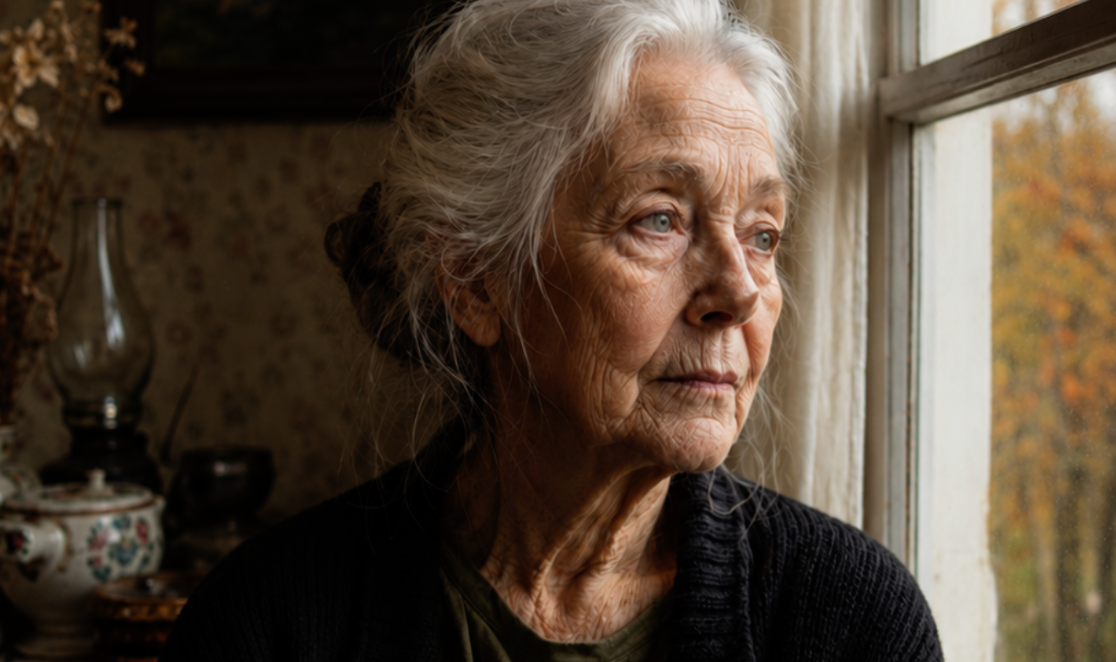
I’m 74 Years Old. I Fell in the Kitchen and Couldn’t Get Up from the Floor for Forty Minutes
The hardest thing is cooking borscht for one person. It seems like such a small, ordinary thing, yet I still haven’t learned how to do it. I put a pot on the stove, and out of habit my hand reaches for the large one—the same green pot that used to hold enough food for the whole family. Then I remember that I no longer need to cook for everyone, so I transfer the ingredients into a smaller one. For some reason, it is at that exact moment that the apartment feels especially empty.
I am seventy-four years old. I live alone in an old apartment. There was a time when we desperately needed more space—three children, a husband, a clothes-drying rack stretched across the hallway, schoolbags, boots piled by the entrance, and constant noise that made it impossible to hear your own thoughts.
Now there is too much air here. Too many rooms. And such deep silence that I can hear the relay clicking inside the refrigerator.
Out of habit, we still call my daughter’s room “Marta’s corner,” even though Marta is already forty-nine, lives in the capital, and has children and worries of her own. In my sons’ room, the old writing desk is still standing—the one where they did their homework and argued over a single unfortunate drawing compass.
I must have decided at least ten times to throw that desk away. But every time, I lose the strength to do it. It feels as though, together with the desk, I would also have to throw away part of the life in which my children were little and everyone was still at home.
My husband died twelve years ago. It happened suddenly, without any warning. That morning, he sat on the edge of the bed and said he was having trouble breathing. By lunchtime, my entire world had become completely different.
After he was gone, I gradually learned to manage on my own: calling repairmen, sorting out utility bills, arguing with bank employees over the phone, and shutting off the water when a pipe unexpectedly began leaking beneath the sink. I learned how to do almost everything.
Everything except one thing—cooking borscht for one person.
Please do not think that my children are bad people. They are not. They are neither heartless nor indifferent. They are simply living their lives—truly living them, completely absorbed in their own concerns: work, their own children, illnesses, renovations, traffic jams, and messages they need to answer while doing a dozen other things.
I understand all of it. Once, I was the same way. Marta calls me every Sunday. Almost always at exactly three o’clock. She has had it written as a separate reminder in her phone for years: “Call Mom.”
Our conversation resembles a warm song whose words we both learned by heart long ago.
“Mom, how are you doing? Did you check your blood pressure?”
“I did, sweetheart. One-thirty over eighty—as healthy as an astronaut.”
“Did you go to the store? Do you have bread at home?”
“I have everything. Don’t worry.”
Then she tells me about the children, her work, and some new extracurricular activity she drives her youngest daughter to across the entire city. I listen and smile into the phone, even though she cannot see me.
About twenty minutes later, I hear the words I have already been unconsciously waiting for:
“Mom, I have to run, okay? I’ve got something on the stove.”
“Go, sweetheart. Of course. Go.”
My eldest son is Taras. He calls less often, but when he does, he speaks loudly and cheerfully, as though he is trying to compensate for the rarity of his calls with the volume of his voice.
There is always some kind of noise in the background—a car, a television, or children shouting. I can tell from his voice that he is calling between two errands and has already mentally checked another task off his list.
Mom is alive. Mom answered the phone. He can continue with his day.
My youngest, Bohdan, usually writes instead. He sends voice messages. I listen to them two or three times because I do not always manage to understand everything the first time.
When I send him long messages that take me ten minutes to type with two fingers, he replies with a heart.
One heart.
I am not offended.
Well, almost not offended.
My grandchildren are already grown. They do not have much time for their grandmother now, and intellectually, I understand that. But sometimes I pick up my phone for no particular reason and look at the screen.
Nothing.
I put it back down.
Ten minutes later, I pick it up again, as though something might have changed during that time. Last Tuesday, I fell in the kitchen.
I slipped on that cursed mat beside the sink—the small, worn-out one I should have thrown away a long time ago. My foot suddenly slid sideways, and I struck my hip hard against the tiled floor.
For several seconds, I could not even understand where I was. I simply lay there, staring at the lower door of the kitchen cabinet. In forty years of living with that kitchen, I had never seen it from that angle before.
Then I tried to get up.
I could not.
The tiles were cold. My heart was pounding so hard that I could hear it beating in my ears. My phone was lying on the table.
Far away.
Unbelievably far away.
In reality, it was only two metres from me, but it seemed like an entire kilometre.
I crawled toward the chair. I am ashamed even to remember it. I pushed myself forward with my elbow, dragged my leg behind me, stopped to catch my breath, and then moved again.
At least three times, I thought, “Well, that’s it, Anna. You are never getting up again.”
But eventually, I did.
Forty minutes later.
I sat down on the chair and stared at my own hand for a long time. It was trembling as though it belonged to someone else.
Thank God, I did not break anything. I only had an enormous bruise on my hip, which still hurts whenever I lie on that side.
That was all.
Marta called me that same evening. Sunday had been the day before…
No, it was Tuesday. She had called for no particular reason, something she rarely does.
“Mom, how are you?”
“Everything is fine, sweetheart. I drank some coffee and watched a television series. The sun even came out here today.”
I did not tell her about the fall.
I did not tell anyone. Because I already know exactly what will happen.
Marta will begin trying to persuade me to move in with her. She will mean it sincerely, with love and tears in her voice. But I have already stayed in their apartment for a while.
There are teenagers, my son-in-law, laptops, backpacks, and a completely unfamiliar rhythm of life in which I would become an unnecessary detail.
Of course, they would find a room for me.
There would be a room, but there would be no real place for me.
I would spend my days walking on tiptoe and pretending that I was comfortable. They would pretend that I was not inconveniencing anyone. Within a week, all of us would be exhausted by the performance.
Taras would suggest hiring a caregiver. He likes solutions that sound sensible and expensive. He would calculate the cost, find an agency, and send me three suitable options through a messaging app.
And Bohdan would write:
“Mom, why didn’t you tell us?!”
Then he would send me a forty-second voice message because he would not know what to do with my old age.
None of them knows.
And neither do I.
In the end, I would be the one who had to comfort all of them. I would say that everything was fine now, that I would be more careful, and that nothing like this would happen again.
That is why it is easier to remain silent from the beginning.
Yesterday, I bought a new mat—one with rubber suction cups so it would stay firmly attached to the floor.
I walked to the household goods store by myself.
I chose it by myself.
I carried it home by myself.
I placed it on the floor by myself.
As usual. This morning, I sat in the kitchen drinking coffee. Sunlight formed a bright patch across the table. The lift doors slammed somewhere in the building, and the neighbours’ Yorkshire terrier began barking upstairs.
Ordinary morning sounds that make the apartment come alive, at least for a few moments.
I thought about my children.
They are good people. They truly are, no matter how much I may complain here.
Then I caught myself thinking something foolish, something almost childlike: I wished that someone would call me today.
Not on Sunday at exactly three o’clock.
Not according to a schedule.
Not because they “need to check on Mom.”
Just because.
For no special reason.
They could ask whether the ficus I almost drowned last year had finally bloomed. They could tell me about some insignificant little thing. We could laugh together.
No one has called yet.
But the day is still long.
I will wait.
I know how to wait.
And I would like you to think about something.
Perhaps there is someone in your life—a mother, a father, a grandmother, or an elderly neighbour—who always answers every question with the same words:
“Everything is fine.”
They say it so confidently that you believe them.
Not because everything truly is fine.
But simply because they do not want to become a burden to you.
Call that person today.
For no particular reason.
Do not wait until Sunday.
Do not check your schedule.
Sometimes, it is precisely a five-minute conversation about nothing that helps a person keep standing on their feet.