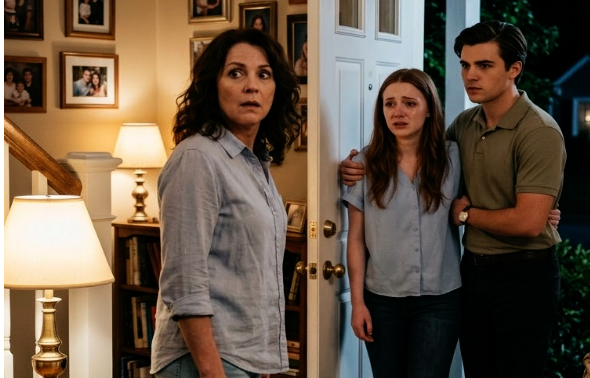
The fracture began on a Saturday morning that should have been unremarkable. In many families, Saturday is a day of leisure, but in our house, it was defined by the rhythm of labor. I was at work, covering a shift that would help pay for the very soccer cleats Ray used to coach Mia’s team. When I returned, the house felt chemically altered—colder, hollower. Ray was gone, leaving behind a suitcase-sized hole in our lives and a note on the kitchen counter that was a masterpiece of emotional equivocation. He needed to “find himself.” He did not say goodbye to Mia, who was then twelve—a fragile age where the world transitions from black-and-white to terrifying shades of gray.
When he finally called three weeks later, he didn’t offer an apology. Instead, he offered a narrative. He told a twelve-year-old girl that mommy was “controlling” and “cold.” He painted himself as a man who had tried to build a cathedral of a family, only to be pushed out into the rain by a heartless architect.
Mia believed him. Why wouldn’t she?
In the taxonomy of parenting, Ray had always been the “Fun Parent.” He was the purveyor of Sunday ice cream, the late-night movie conspirator, and the coach who cheered from the sidelines. I was the Enforcer. I was the one who insisted on the drudgery of algebra homework, the discipline of bedtimes, and the reality of nutritional boundaries. To a child, the person who says “no” is easily cast as the villain when the person who says “yes” suddenly disappears. Her grief needed a target, and I was the only one standing in the room. The first time Mia screamed at me, it felt like a physical blow. She was fourteen, and the vitriol she leveled at me was sophisticated in its cruelty. She criticized my cooking, the state of our modest house, and my general lack of “warmth.” She compared me to the idealized version of Ray—a man who, in reality, called once a month and canceled half his visits.
I did not defend myself. This was perhaps my greatest tactical error, born of a martyr’s complex. I believed that telling a teenager her father had abandoned her for another woman’s bed would be more damaging than letting her hate me. I thought I could absorb her anger like a lightning rod, grounding the electrical storm of her trauma so it wouldn’t burn her from the inside out.
While Mia framed his late birthday cards and $100 bills as tokens of a hero’s struggle, I was performing a different kind of math. Ray’s child support was a ghost—appearing sporadically, if at all. To keep us in that house, I took on a second job at a diner, working double shifts that left my feet swollen and my mind numb. I became the “tired mother,” the “boring mother,” the mother who couldn’t afford the designer labels her friends wore. I didn’t take him to court. I didn’t want the legal papers to be the thing that shattered her illusion. I thought silence was a shield; I didn’t realize it was actually a wall.
By the time she reached college, our relationship was a transaction. She called Ray for emotional validation and called me for money. I sent what I could, often skipping meals or deferring my own needs to ensure her “grocery money” was actually enough for a social life. I never told her. In the biography of our family she was writing in her head, Ray was the tragic hero in exile, and I was the small-minded gatekeeper of a life he was lucky to escape. The shift began with the promise of a wedding. Mia was twenty-three, engaged to Oliver—a man whose stability and kindness were the antitheses of Ray’s flighty charm. Mia wanted the “perfect” wedding, which in her mind meant Ray walking her down the aisle. When she called to tell me he had agreed, her voice held a warmth I hadn’t felt in a decade.
But two months before the ceremony, the old pattern reasserted itself. Ray called with a “work conflict” in Seattle. He couldn’t make it.
The fallout was predictable. Mia cried for hours, her grief quickly curdling into the familiar defense of her father. She explained to me—and to herself—that his career was paramount, that he was under immense pressure, and that surely my “negativity” over the years had made him feel unwelcome at family events.
Oliver, however, was not blinded by eleven years of mythological conditioning. He saw the circles Mia was running in. He saw a woman attacking the mother who showed up every day while defending the father who couldn’t be bothered to board a plane for his daughter’s wedding. He asked me, quietly and with genuine concern, if there was something he should know.
I held the line. “We grew apart,” I told him. It was a practiced lie, a reflex. But Oliver’s suggestion—that the truth might be the only way to save Mia from building her own marriage on a foundation of lies—stayed with me. Mia decided she needed to see Ray in person. She needed to look into the eyes of her hero and understand why he was choosing a business conference over her wedding. She and Oliver flew to Arizona, and I spent that weekend in a state of suspended animation. I knew what they would find. Ray was an expert at the “Old Money” aesthetic—the country club memberships, the professional landscaping, the two new cars in the driveway. He had built a life of luxury while his child support checks bounced back in our old zip code.
Oliver sent me a photo of Ray’s suburban oasis. The caption was a cold realization: “Interesting lifestyle for someone who could never afford child support.”
The truth, however, didn’t come from the cars or the pool. It came from Felicia, Ray’s third wife. In a moment of conscience sparked by Ray’s casual dismissal of the wedding, Felicia pulled Mia aside. She revealed the existence of a ten-year-old child in California—a product of the affair that had ended our marriage. She revealed that Ray paid support for that child religiously, but had lied to Felicia about me, using the same “cold and controlling” script he had used on Mia.
When Mia returned, she was a person I didn’t recognize. The fury was gone, replaced by a hollow, ringing silence. The confrontation occurred in my living room at 10:00 PM. Mia asked the question that had been trapped in my throat for eleven years: “Is it true he left because he got a coworker pregnant?”
I nodded. The room felt like it was losing oxygen.
I went to my closet and retrieved the box. It was a physical archive of my silence. I laid it on the coffee table:
The Bank Statements: Highlighted lines showing my transfers to her college account, contrasted with the months where Ray’s support was zero.
The Correspondence: Birthday cards sent weeks late, containing generic messages that lacked even a trace of paternal intimacy.
The Letter: The original note Ray left on the counter. In it, he hadn’t just said he needed to find himself; he had explicitly blamed me for his affair, claiming my “coldness” drove him to another woman’s bed. He had called his departure an act of “self-preservation.”
Mia read the letter twice. I watched her face as she processed the reality that her hero had blamed her mother for his own infidelity. She realized that the “grocery money” she thought was a pittance from a “cheap” mother was actually the result of my skipped meals. She realized that every time she had insulted my home, my clothes, or my choices, she had been mocking the very sacrifices that kept her afloat.
She saw that I hadn’t protected her; I had protected him. And in doing so, I had allowed her to become a person who treated her only ally like garbage. The conversation that followed was the most painful and honest of my life. I had to admit that my silence wasn’t entirely noble—it was also rooted in fear. I was afraid that if I told her the truth, she would think I was a bitter ex-wife trying to ruin her father. I was afraid of the very rejection I ended up living through anyway.
Oliver, ever the pragmatist, pointed out the “Hero-Villain” dynamic we had both participated in. I had made myself smaller so Ray could stay big. Mia had built her identity on a lie of paternal abandonment caused by maternal failure. To move forward, we both had to stop playing our assigned roles.
Mia’s call to Ray that night was a finality. She didn’t scream; she spoke with the cold, hard clarity of someone who had finally seen the man behind the curtain. She told him he was no longer invited to the wedding. She told him that a father is defined by consistency, not by a monthly phone call and a late check. Ray, true to form, tried to blame me one last time, calling me “unforgiving.”
Mia simply hung up. On the day of the wedding, the air felt different. There was no Ray in the back row, no lingering shadow of his “work conflict.” When the officiant asked, “Who gives this woman to be married?” I stood tall. My voice didn’t shake. I said, “I do.”
In that moment, it wasn’t just about giving her away to Oliver; it was about the reclamation of our relationship. I was no longer the villain of her childhood; I was the mother who had survived it with her.
The months following the wedding have been a period of “restructuring,” to use a business term. Mia and Oliver are looking for houses closer to me. They want their future children to grow up with a grandmother who represents the “Old Money” of the soul—values like reliability, truth, and endurance.
Our relationship is no longer a transaction. It is a conversation. Mia calls me on Tuesdays just to talk about her lunch or a boring meeting. We are learning to navigate the grief of the lost years. My “bookish” tendency to over-analyze the past is met with her new-found desire for transparency. We discuss the “finance” of our emotions—how much we owe each other in honesty, and how to pay it forward. We cannot get back the eleven years we lost to the myth of Ray. I still wake up some mornings feeling the phantom ache of those insults she used to hurl at me. But then the phone rings, and it’s Mia, asking for a recipe or telling me she loves me, and I realize that the truth didn’t destroy her. It set us both free. We are finally building something real, and for the first time in a decade, the house feels full.