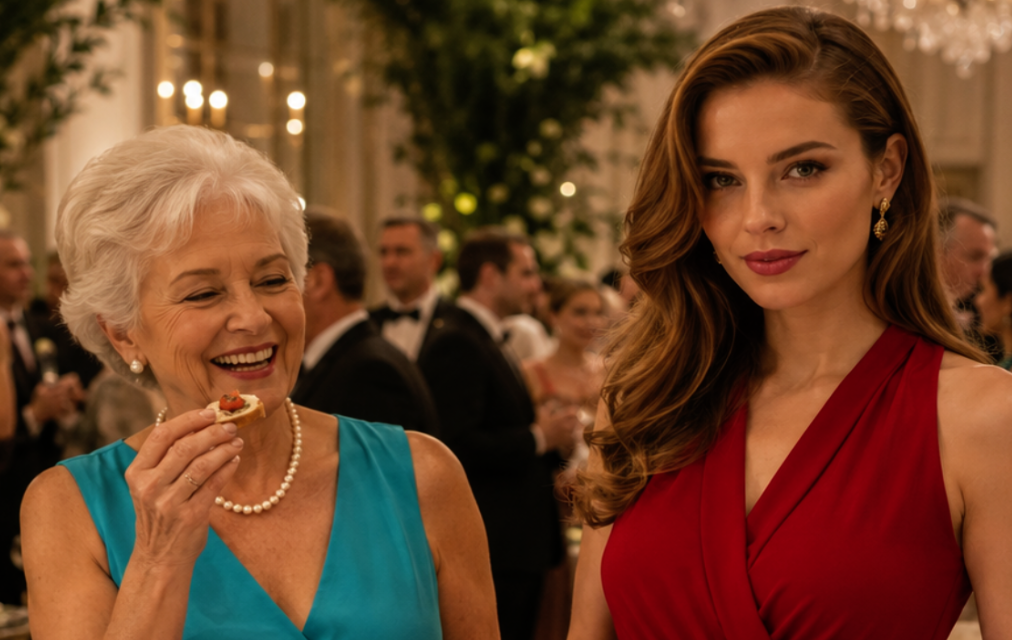
“Well then, I suppose we’ll tolerate guests like these too,” my mother-in-law smirked in front of everyone. But the evening did not go according to her plan at all.
My mother-in-law always said that my lineage smelled of manure, while hers smelled of French perfume and true blue blood.
Too bad she forgot one small law of physics: blue blood freezes in the cold just as quickly as ordinary blood, and expensive perfume reveals itself horribly in pouring rain.
Especially at the moment when restaurant security politely but firmly throws you out into the street from a restaurant that, as it suddenly turns out, is owned by my “uncultured” father.
But let’s take it from the beginning.
My husband, Eduard, considered himself a fifth-generation intellectual. His mother, Eleonora Genrikhovna, worked as a deputy director at an insurance company, but behaved as if she personally reviewed parades on Palace Square.
My parents, on the other hand, had lived their whole lives in Siberia. Yes, they were farmers. But for some reason Eleonora Genrikhovna had decided that a farmer was a man in a padded jacket tossing hay to cows with a pitchfork, not the owner of the largest agricultural holding beyond the Urals, exporting grain to three dozen countries.
I never flaunted my parents’ money. I came to the capital, studied, got a job as an analyst, and married for love. Or rather, I thought it was for love.
Edik courted me beautifully, read Brodsky, and seemed like a delicate soul. I only found out after the registry office that this “delicate soul” couldn’t pay the utility bills without his mother’s approval.
There was no lavish celebration. Edik, as a truly elevated nature, had no money for a restaurant, and I, in the foolishness of youth, decided to protect his fragile male ego and insisted on a modest civil ceremony.
My parents couldn’t fly in then — such a snowstorm was raging in Siberia that the airports were closed for three days. They transferred a substantial sum to our card as a gift, but when Eleonora Genrikhovna saw the amount, she only snorted contemptuously.
“Would you look at that. They scraped together the last crumbs from their garden beds so they wouldn’t embarrass themselves before the capital.”
It never occurred to her that this was half a day’s income from my father’s holding. And Edik never once flew to visit my homeland. At the mere word “taiga,” my mother-in-law would start drinking Corvalol and wailing that bears would surely eat her boy there.
From the very first day of our marriage, Eleonora Genrikhovna set out to eradicate my “village” origins.
“Alinochka, who cuts cheese like that?” she would sigh, arriving at our place early on a Saturday morning — with her own key, of course.
“You can immediately tell that in your taiga region no one has ever heard of gastronomic culture. Brie should be cut like a fan, not chopped like firewood!”
She stood in the middle of my kitchen, her chin lifted so high it seemed she could scratch the ceiling with it.
“Eleonora Genrikhovna,” I replied calmly, without looking away from the coffee machine, “historically, in France, peasants broke pieces of brie off with their hands right in the field. The tradition of cutting it ‘like a fan’ appeared in Soviet restaurants out of ordinary product-saving concerns. Read culinary archives sometime. It’s fascinating.”
My mother-in-law was outraged. Her perfectly drawn eyebrows crawled upward, her lips trembled, but she had no comeback. She nervously tugged at the silk scarf around her neck, muttered something about “the ignorance of modern youth,” and retreated into the living room.
Edik, instead of supporting me, merely giggled guiltily from around the corner, puffed up like a turkey that had forgotten to be fed.
“Come on, Alina, Mom means well. She’s introducing you to refinement…”
The conflict slowly but surely gained momentum until Eleonora Genrikhovna’s anniversary arrived. Fifty-five years old. It was decided that the celebration would be held at the Grand Imperial — the most pompous, expensive, and pretentious restaurant in the city. Golden chandeliers, stucco molding, waiters in tailcoats.
“I invited all the right people,” my mother-in-law declared over the phone, pacing around our apartment.
“And, so be it, Alinochka, let your parents come too. They should see at least once in their lives how decent society relaxes. Just tell them to leave their felt boots in Siberia.”
I only smirked. My parents, Ivan Stepanovich and Nina Andreevna, were simple people in conversation, but their “felt boots” came with a personal driver and handmade suits of Italian wool.
On the day of the banquet, the restaurant glittered. The entire local “elite” had gathered: mid-level officials, Eleonora’s superiors, and some pale ladies in rented diamonds.
My parents arrived on time. Dad — tall, imposing, with a thick mustache and a sly squint — hugged me warmly. Mom smiled her soft, all-understanding smile.
But when we entered the hall, I froze.
Eleonora Genrikhovna had seated the guests according to her own internal hierarchy. My parents’ table was in the farthest corner, in the cheap seats, neatly placed between the kitchen door and the passage to the restrooms. Drafts carried over the smell of garlic and the clatter of dirty dishes.
I turned sharply to my husband.
“Edik, what is this?”
He stupidly scratched the back of his head, avoiding my eyes.
“Well, Alina… Mom decided they’d feel more comfortable there. Closer to, so to speak, a working atmosphere, so they wouldn’t feel awkward among the intelligentsia…”
I wanted to make a scene right there, but Dad gently placed a hand on my shoulder.
“Leave it, daughter,” he whispered, and a dangerous, steely glint flashed in his eyes.
“The view is better from here. Let’s give the intelligentsia a chance to show themselves.”
We sat down. The celebration went on as planned. Expensive champagne flowed like a river, false toasts were made. Eleonora Genrikhovna fluttered between the tables, gathering compliments like a hungry bee collecting nectar.
And then came the climax. My mother-in-law took the microphone. Silence settled over the hall.
“My dear guests!” she began in the tone of a prophet descending from Mount Sinai.
“I am so happy to see the flower of our society here! The true elite!”
She held a theatrical pause and glanced toward our little table by the kitchen.
“And, of course, our guests from the… deep provinces. You know, I sincerely pity those who still don’t know how to hold an oyster fork, apparently preferring a pitchfork instead.”
A restrained chuckle rolled through the hall. Edik, sitting beside me, smiled smugly, like a polished copper basin in which jam had never been cooked.
“But we, as true metropolitan intellectuals, are indulgent toward villagers. We are ready to tolerate them beside us in order to bring them the light of civilization!”
“Mom is on fire today, isn’t she?” Edik whispered to me, without even thinking to be outraged.
That was the limit. I felt everything inside me boiling with icy fury. But before I could open my mouth, my father calmly stood up.
Ivan Stepanovich leisurely dabbed his mustache with a snow-white napkin, placed it on the table, and walked with a firm step toward the center of the hall. He did not go to my mother-in-law.
He approached the pale, sweaty maître d’ standing near a column and quietly said something to him, taking some kind of business card from the inside pocket of his jacket.
The maître d’s eyes widened so much they nearly fell into someone else’s salad. He began bowing frantically. The live music instantly fell silent, breaking off in mid-note.
My father calmly approached the stunned Eleonora Genrikhovna and carefully took the microphone from her.
“Good evening, respected representatives of the ‘elite,’” Dad’s voice was deep, velvety, and heavy as a Siberian frost.
“I would like to make a small correction to today’s menu. The oysters here really are rather poor. And that is a shortcoming of my agricultural holding, which, as it happens, is the sole owner of this historic building and the Grand Imperial restaurant itself. And at the same time, the main creditor of the firm where our esteemed birthday lady works.”
Such a ringing silence hung in the hall that one could hear the bubbles popping in the champagne glasses. The smile slid off Eleonora Genrikhovna’s face.
“Unfortunately,” Dad continued, without raising his voice, “the banquet is over. We ‘villagers’ care deeply about cleanliness.”
“And this establishment has accumulated far too much… toxic mold. The restaurant is closing for full sanitary treatment right now. I ask everyone to vacate the premises.”
Eleonora Genrikhovna went numb and looked as though the world had suddenly stopped obeying her orders.
“What… how dare you! This is outrageous! Edik, say something to them!” she shrieked, losing all her aristocratic polish.
Edik jumped up, blinking in confusion.
“Alina! Your father has lost his mind! Stop him!”
I slowly stood up, feeling an incredible, intoxicating calm. I took the wedding ring off my ring finger. It flashed in the chandelier light and dropped with a melodic clink straight into my mother-in-law’s half-finished glass of champagne.
“Enjoy your meal, Eleonora Genrikhovna,” I smiled.
“Just be careful. Metal is heavy. Don’t choke on it on your way to the light of civilization. And you, Edik, don’t bother seeing me out. I’ve developed an allergy to your breed.”
Five minutes later, strong, perfectly polite young men from the restaurant’s security service were escorting the outraged, fussing guests to the exit.
My parents and I left through the VIP entrance and got into a warm car. And as we drove away, through the tinted glass, I saw a magnificent scene.
A downpour had started outside. Eleonora Genrikhovna stood on the sidewalk, trying to catch a taxi. Her elaborate hairstyle had collapsed, mascara ran down her cheeks in black streams, and beside her, Edik was jumping around, soaked through, unsuccessfully trying to shield his mother with his ridiculous designer scarf.
At that moment, there was not a single drop of aristocracy in them — only the pathetic, confused malice of people whose cardboard pedestal had been kicked out from under their feet.
The next day, Edik was fired from the company, which, as it turned out, really had only stayed afloat thanks to contracts with my father’s holding.
My mother-in-law took early retirement so she wouldn’t disgrace herself in front of colleagues who had learned about the grand fiasco. And I filed for divorce, packed my things, and moved into my new, happy life, where there is no room for someone else’s arrogance.
And if someone tries to humiliate you with their “noble origins” and loudly shouts about their elitism, there is no need to cry or stoop to marketplace shouting. Do not try to outshout a pompous fool. After all, more often than not, those who shout the loudest about their crown live in a castle that belongs to the “villagers.”