The “I’m-a-Mother” in the Compartment Threw My Bag off the Lower Bunk: “A Child Will Ride Here.” I Calmly Dialed a Number and Told the Conductor My Last Name
“Mam, you’re not in your seat.”
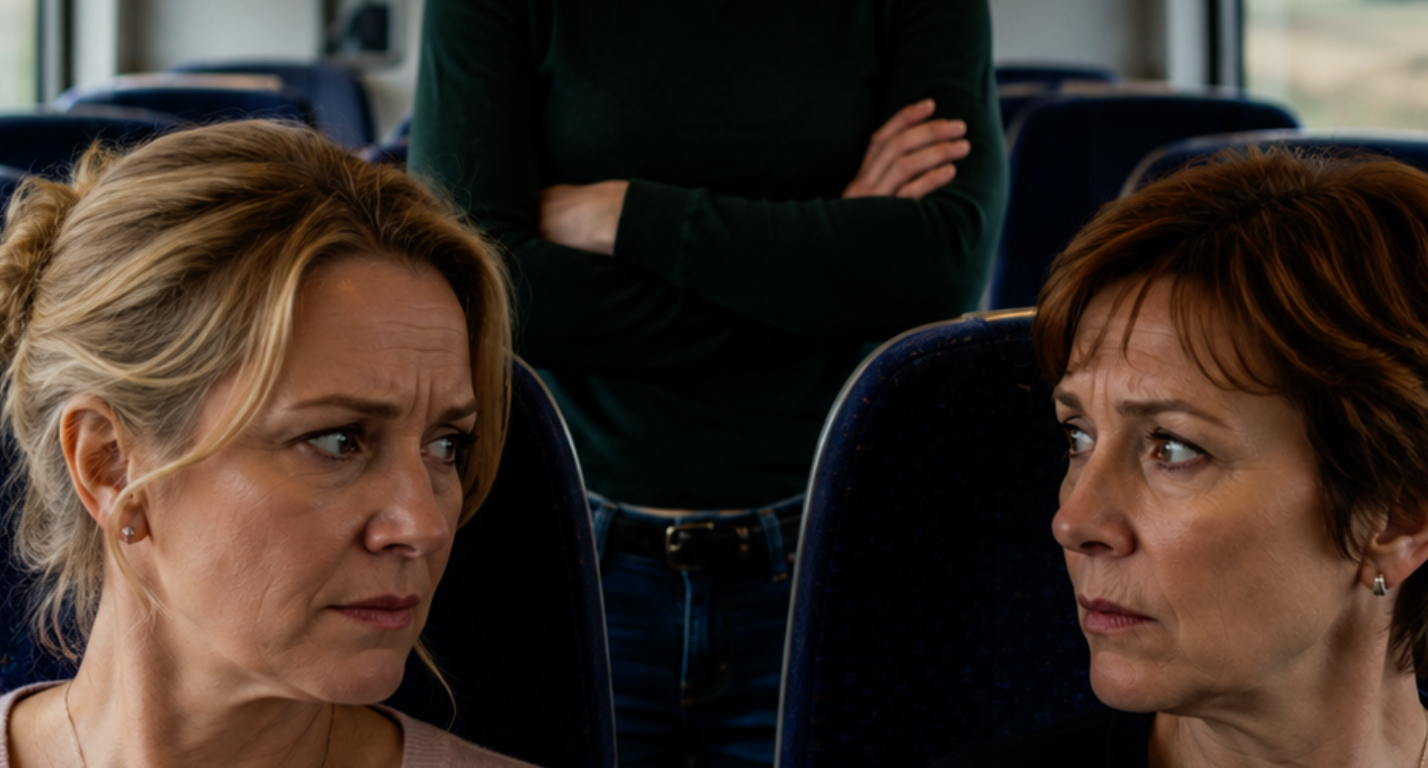
I looked up. In the doorway of the compartment stood a young woman in her early thirties, with glittery acrylic nails, a tracksuit with a gold logo, and furry slides on her feet. Behind her shuffled a boy of about six, holding a tablet.
“I am exactly in my seat,” I replied, showing my ticket. “Seat three. Lower bunk.”
“So what?” She was already dragging a huge wheeled suitcase into the compartment. “I have a child! He needs to be down below. You’re an adult. You can climb up.”
My name is Iraida. I am fifty-two years old. For twenty-six of those years, I have worked in the railway system. For the last six, I have headed a regional center for branded transport services. I know every regulation, every instruction, every complaint book from the inside.
And I know that a lower bunk is a lower bunk. It costs more. It is assigned to the passenger. And no “child” gives anyone the right to someone else’s berth.
But I stayed silent. Not because I was afraid. Simply because in twenty-six years I had learned one thing: on a train, there is no need to argue right away. You need to wait until the person shows everything themselves. And they always do.
“Artyom, sit here,” she ordered the boy and tossed his backpack onto my bunk. It was dirty, stained with juice.
I moved the backpack to her upper bunk. Calmly. Silently.
“What are you doing?” She turned around. “I told you—the child is riding down below!”
“Your ticket is for the upper bunk,” I said. “A child under ten does not necessarily need a separate seat. He can ride with you upstairs.”
“Are you serious?” She put her hands on her hips. “Are you seriously going to fight a child over this?”
Artyom did not even look up from his tablet. He did not care where he sat. He was six, and some cartoon was playing at full volume.
I placed my travel bag on the bunk, took out my phone, and put it on the table. I took off my shoes and put them in a bag. Fourteen hours on the road. I had planned to travel peacefully.
Snezhana—that was how she introduced herself later, while shouting in the corridor—had no such plans.
For the first twenty minutes, she fussed around: moving things, rustling bags, feeding Artyom chips right on my pillow. Crumbs scattered over the sheet. I stayed silent. I waited until she finished, brushed off the crumbs, and turned the pillow over.
“So you’re disgusted, are you?” Snezhana said.
I did not answer.
“That explains everything,” she snorted. “Childless women are always like that.”
I have two grown sons. One is already twenty-eight, the other twenty-five. Both have long lived separately. But I was not obligated to report that to her.
Half an hour later, Snezhana went out into the corridor and returned with the conductor. A tired-looking man of about forty-five, wearing a badge that said “Gennady.”
“Here,” Snezhana immediately pointed at me. “She refuses to give up the seat to a child. The lower bunk. My son is six. He can’t go upstairs. It’s very dangerous.”
Gennady looked at me. Then at her. Then at me again.
“Ma’am, maybe you could understand?” he said quietly. “It’s a child, after all.”
I took the ticket from the pocket of my cardigan.
“Seat three. Lower bunk. Paid for. Eight thousand four hundred rubles.”
“I understand, but…”
“According to the rules for passenger transportation services, a passenger occupies the seat indicated on the ticket,” I said. “You know that.”
Gennady knew. It was obvious from the way he looked away. He really understood everything—but it was easier for him to persuade me than her.
“All right,” he turned to Snezhana. “Your ticket is for the upper bunk. Technically…”
“Technically?!” Snezhana raised her voice. “I have a child! A small child! Do you want him to fall from the top at night?!”
“There are safety straps,” I said.
“What safety straps?! Are you even a mother?!” she was already shouting.
Gennady raised his hands.
“Ladies, let’s stay calm. I’ll check, maybe there’s a free lower bunk in another compartment.”
He left. Snezhana sat opposite me and stared straight at me.
“Aren’t you ashamed?” she asked. “An older woman, and you behave like…”
“Like a person who paid for her ticket,” I finished.
“Just so you know,” Snezhana lowered her voice to a hiss, “I’m going to file a complaint against you. Online. Everywhere. With your photo.”
I shrugged.
Gennady returned ten minutes later. There were no free lower bunks. He only spread his hands and left. He did not even try to apologize. Snezhana watched him go as if he were personally responsible for the design of the carriage.
Artyom was sitting on my bunk. His sneakers were on the sheet.
“Artyom,” I said to him, “please take your feet off my bed.”
“Don’t boss my child around!” Snezhana lunged toward me, grabbed Artyom, and pressed him against herself. “Don’t you dare!”
The boy did not even flinch. He only switched cartoons.
An hour later, I went out into the corridor to stretch my legs. I stood by the window, looking at the fields. June, evening sun, greenery to the horizon. Fourteen hours of travel, and only one had passed.
When I returned, my bag was on the floor. In the passageway. Between the compartments.
Artyom was lying on my bunk. With his tablet. On my pillow. Snezhana was covering him with my blanket—the one I had brought from home.
“What are you doing?” I asked.
“The child is tired,” Snezhana said without turning around. “He needs to lie down. You climb up. Your things are up there.”
I looked at the upper bunk. My cardigan, my makeup bag, my bag with slippers—everything had been thrown up there, carelessly, in a heap.
“You moved my things?”
“What’s the big deal?” She finally turned around. “I put the bag down carefully. Nothing’s missing. Don’t dramatize.”
The bag was standing in the passageway. Inside it were my work laptop, documents, and official ID. Anyone walking past could easily bump into it, knock it over, or take it.
I picked up the bag and put it back on my bunk. Next to Artyom.
“Are you completely insane?!” Snezhana jumped up at once. “Next to a child? A bag?! It could fall on his head!”
“This is my seat,” I said.
“What difference does it make! The child needs to sleep!”
“Your child can sleep on your bunk. The upper one. As indicated on your ticket.”
Snezhana grabbed my bag and threw it into the corridor. She really threw it—with both hands, with a swing. The bag hit the opposite wall, fell to the floor, and the zipper opened.
My laptop in its case, a folder of papers, and a bag of sandwiches I had made that morning spilled out.
Four people in the corridor saw it. No one said a word.
A woman from the neighboring compartment looked out, saw what had happened, and carefully closed her door. The lock clicked.
A man by the window turned toward the glass, as if something outside had suddenly become urgently interesting.
An elderly couple from compartment six walked past. They stepped over my folder. They did not bend down. They did not stop. The wife tugged her husband by the sleeve—hurry up, don’t get involved.
I stood in the corridor, looking at my things on the floor. The laptop was for work. Government property. The documents were marked “for official use.” The sandwiches—well, forget the sandwiches.
It seemed to me that this was no longer about the bunk. It was about the fact that she was allowed to do anything, while I was only expected to give in.
My hands were calm. They were not shaking. Twenty-six years in the system—I had seen worse. I had seen bosses screaming, inspectors digging through everything, entire trains standing still because of someone’s mistake.
But to have your things thrown in your face because someone had a child—that was a first.
I gathered my things. Slowly. I put the laptop back. Checked it
—the screen was intact. I collected the papers. Zipped the bag.
Snezhana stood in the doorway of the compartment, arms crossed.
“Satisfied?” she asked. “Will you give up the seat now?”
I looked at her. Then at Artyom—he had finally torn his eyes away from the tablet and was watching us with round eyes. He was not scared yet. He was curious.
“No,” I said.
I entered the compartment. I lifted Artyom off the bunk—carefully, under the arms—and placed him on the floor. He did not cry. He was not even surprised; he only hugged the tablet to his chest.
“Don’t touch my child!” Snezhana immediately rushed to him and shoved me with her shoulder. “Are you crazy? I’ll call the police too!”
“Call them,” I said. I was not shouting. I was not whispering. I had already made my decision—and because of that, I became very calm.
I sat down on my bunk. Put my bag beside me. And did not move again.
Snezhana grabbed Artyom and stormed out into the corridor.
For the next twenty minutes, I heard her voice through the wall. She walked up and down the carriage, from vestibule to vestibule and back again.
“There’s a woman there! Childless! She dragged my son off the bunk! With her hands! A six-year-old child!” That was her telling someone in the vestibule.
“Her seat matters more to her than a child! An older woman, and no conscience!” That was to the neighboring compartment. I heard someone click their tongue sympathetically.
“Gennady! Gennady, come here! She grabbed my son with her hands! You are required to draw up a report!”
Once, she passed by my compartment carrying Artyom in her arms. The boy was chewing a cookie and staring at the ceiling. He was bored. He wanted to get back to his tablet.
I heard everything. The walls were thin. The carriage heard too.
No one came. No one stood up for me, or for her. The carriage stayed silent. Maybe everyone thought: not my business. And yet half an hour earlier, these same people had seen her throw my bag. And they had stayed silent then too.
Gennady appeared ten minutes later. He looked into the compartment.
“Did you really… do that to the child?”
“I moved him from my bunk onto the floor. Onto his own feet. He was standing. Calmly.”
“She says you threw him.”
“She says many things.”
Gennady rubbed his chin.
“Listen,” he lowered his voice, “maybe you could still go upstairs? Just for the sake of peace? She won’t calm down. She’ll go on all night…”
“Gennady,” I said, “do you understand that what you are actually suggesting is that I give up a paid seat because another passenger is making a scene?”
He immediately fell silent.
“That is encouraging rudeness,” I said. “If I move now, the next passenger will move too. And the next one. Because shouting becomes profitable.”
Gennady left.
Snezhana returned five minutes later. Very red. Angry. Artyom walked behind her, picking his nose.
She immediately entered the compartment and sat on the upper bunk—not climbed up, but sat on the edge, legs dangling.
“You know what?” she said. “You’re sitting here, clinging to your bunk like it’s the last thing left in your life. Maybe it is. No children, no husband—just one bunk.”
I did not answer.
“I’ll take a picture of you and post it,” Snezhana continued. “Let people see. Let them know what kind of… women there are.”
She took out her phone and pointed the camera at me.
I did not cover my face. I did not even turn away.
“Take it,” I said. “Just don’t be surprised later.”
She took a photo. Maybe several.
While she was photographing me, Artyom climbed onto my bunk. Casually, habitually—as if it were his own home. It was clear he was not stopped at home. He crunched chips, and crumbs once again scattered over my sheet.
Forty minutes. That was how long she had been acting like she owned my place, throwing my things, insulting me, photographing me. And all that time, the carriage had stayed silent.
And then Snezhana did one thing she should not have done.
She took my phone from the table. Simply picked it up—carelessly, with one hand—and put it on the upper bunk.
“So you don’t call anyone,” she said. And she even smiled.
I understood there was nothing more to wait for. Inside me, everything became quiet. Not empty—quiet. The way it gets when a decision has been made and only the action remains.
I stood up. Took my phone from the upper bunk. Unlocked it. I opened my contacts. Found the right number.
“Who are you calling?” Snezhana grew wary. “The police? Call them! I have nothing to fear! I’m a mother!”
I pressed call.
“Boris Alexeyevich? Good evening. This is Iraida Vasilyevna Nenasheva. Yes, from the regional center. Forgive me for disturbing you. I am on your train, carriage nine, compartment four. I have a situation here with a passenger.”
Snezhana fell silent. Not because she understood. Because the tone had changed. She heard that I was not speaking like a victim making a complaint. I was speaking like a person who was used to being listened to.
“Yes, the passenger from the upper berth is refusing to take her own seat, throwing other passengers’ belongings, obstructing the passage. The conductor Gennady is aware, but he could not resolve it. Yes. Yes, I am asking you to look into it.”
I hung up.
Snezhana stood in the doorway. Her phone with my photo on it was lowered in her hand.
“Who… are you?” she asked.
“The passenger in seat number three,” I replied.
Four minutes later, the train manager came into the compartment. With him were a second conductor and Gennady. Gennady was pale.
“Iraida Vasilyevna,” the train manager said in a restrained voice, “we will resolve everything. Please accept our apologies for the inconvenience.”
He turned to Snezhana.
“Your ticket, please.”
Snezhana handed it over. Her hands were trembling. Her glittery nails shook slightly.
“Seat fourteen, upper berth,” the train manager read. “You have been occupying someone else’s lower berth for quite some time. The passenger has complained. The passenger’s belongings were damaged.”
“I didn’t damage anything!” Snezhana flared up. “I simply asked to switch! My child is six! It’s dangerous for him upstairs!”
“There are safety straps on the upper berths,” the train manager said. “But if you need a lower berth, we have one free in the reserved-seat carriage.”
“In the reserved-seat carriage?!” Snezhana grabbed Artyom by the hand. “Are you joking?”
“No.”
“I paid for a compartment! Eight thousand!”
“For an upper berth in a compartment. The lower berth is occupied. You may return to your upper berth or move to a lower berth in the reserved-seat carriage. At no extra charge.”
Snezhana looked at me. Then at the train manager. Then back at me. Her eyes became very angry.
“This is because she’s some kind of boss, isn’t it?” Her voice trembled. “Because she has a last name? And I’m just an ordinary mother with a child, so I get sent to the reserved-seat carriage?”
The train manager did not answer.
“Say it!” Snezhana shouted. “If she were just an ordinary woman, would you have come?”
Silence.
She was right. If I had been an ordinary passenger, perhaps nothing would have happened. Gennady would have persuaded me to move. Or I would have given up myself. Fourteen hours later, I would have gotten off the train with clenched teeth and forgotten it.
But I am not an ordinary passenger. And I am tired of the person who shouts getting the seat, while the person who stays silent gets an upper bunk with someone else’s crumbs.
Snezhana packed her things for twelve minutes. I counted. The wheeled suitcase rattled down the corridor. Bags rustled. She deliberately zipped things loudly, deliberately dropped things, deliberately sighed.
“This is how it is,” she said into the air, addressing no one. “This is how it is in this country. The bosses stay in compartments, and a mother with a child goes to the reserved-seat carriage.”
Artyom walked behind her, clutching his tablet. The battery had long since died, the screen was dark, but he still carried it in both hands. Of course—the only toy he had for the whole train ride. At the threshold, he turned around and looked at me.
“Bye,” he said.
“Bye,” I replied.
Snezhana said nothing. She only tugged his hand. “Come on!”
The compartment became empty. On the upper bunk, there was a chips packet and a crumpled wet wipe. On my pillow, there was a dent from Artyom’s head.
I turned the pillow over. Straighten the sheet. Put my bag against the wall.
I sat on my bunk. The lower one. The one I had paid eight thousand four hundred rubles for.
It was quiet. The train clattered along the rails. Darkness was falling outside the window.
I brewed tea from a teabag. Ordinary tea, in a glass with a metal holder. My hands did not shake. Inside, it was empty and quiet—not joyful, not proud. Just quiet.
Ten minutes later, Gennady looked in. He stood in the doorway. He had seen everything too—and had done nothing.
“Iraida Vasilyevna,” he said quietly, “you could have just shown your ID. Why call Boris Alexeyevich right away?”
I looked at him.
“Gennady,” I said, “I came to you. Twice. You suggested that I give in.”
He lowered his eyes and left.
At night, two more people joined the compartment from an intermediate station—a man and a woman. Quiet, calm. Upper berths. They settled in within five minutes and wished me good night.
I lay below. In my own seat. I looked at the ceiling—at the spot where, seven hours earlier, a dirty backpack had flown onto my pillow.
I fell asleep quickly. For the first time that evening, the carriage was calm.
Three days later, I was traveling back. A new train, an unfamiliar carriage. The conductor was a woman named Valentina.
On the second hour of the trip, she brought me tea. She placed it on the table and lingered.
“You’re Nenasheva?” she asked. “Iraida Vasilyevna?”
“Yes.”
“Gena told me. From the ninth carriage. He said a passenger was throwing your things, and then it turned out…”
“It turned out,” I nodded.
Valentina hesitated.
“That woman rode with me,” she said. “In the reserved-seat carriage. She filed a complaint. In the comments book and on the website. She says management used its position to evict an ordinary mother with a child from a compartment.”
I took a sip of tea.
“And what are people writing?” I asked.
“Different things. Some write that it was right, that rude people shouldn’t be allowed to behave that way. And some…” Valentina faltered. “Some write that you used your position. That if you had been an ordinary passenger, no one would have come.”
She left. I sat there with the glass holder in my hands.
Outside the window were fields. June. Greenery.
Snezhana was rude. She threw my bag. She photographed me without permission. She took my phone. In fact, she did something else too—she showed the whole carriage that you can do anything you want to a stranger, and no one will interfere.
But she was right about one thing. Only one.
If I had not been Nenasheva from the regional center, but simply Iraida, fifty-two years old, in a cardigan, with a travel bag, Gennady would already have persuaded me to move. Or he would not have persuaded me, but he would not have helped either. And I would have ridden for fourteen hours listening to talk about “childless old women,” wiping crumbs off my pillow.
I finished my tea. Put the glass on the table.
After all, a complaint book has no field for “where does the passenger work.” The transportation rules do not either. Seat three, lower bunk—it is the same for everyone. For Nenasheva and for any other woman.
And yet they came to me in four minutes. To “any other woman,” they would not have come at all.
I do not regret making that call. She threw my things—I threw her out of the compartment.
But sometimes, when the train clatters evenly and darkness falls outside the window, I think: what if another woman had been sitting in my place? Without a last name, without the train manager’s number in her phone? What would she have done?
She would have climbed up. Silently. Like thousands had done before her.
She threw my things, and I threw her out of the compartment. But I had a last name to do it with. That other woman would have had nothing.
Which one of us was wrong—I or Snezhana? Or maybe the wrong one is the person who comes in four minutes only for the right last name?