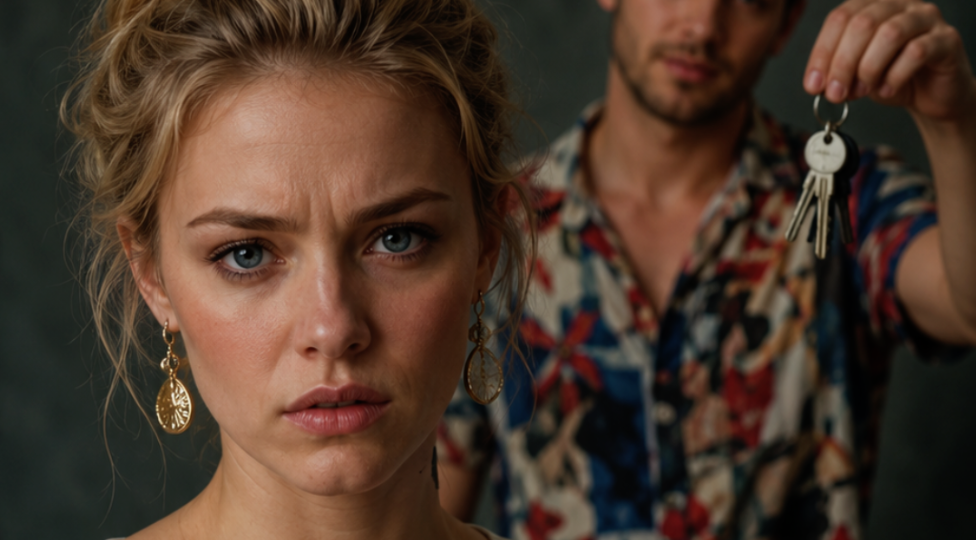
“My mother will have a key to our apartment!” my husband declared. Too bad he thought I would agree silently
“My mom’s copy of the key is already ready. We’ll give it to her this evening,” Igor announced, fastening his jacket with the look of a man who had just sold my personal space at a family discount.
His statement did not sound like something open for discussion. It sounded like an inevitable weather forecast: accept it, Lena, a cyclone named Tamara Borisovna is heading our way.
I looked at the shiny piece of metal in his hand. Brand-new. Sharp-toothed. Just like the idea itself.
I did not throw a tantrum. Hysteria is the weapon of the weak, and shouting in family arguments only proves that you have run out of arguments. I simply froze with a towel in my hands and began analyzing the situation.
You have to understand one thing: my mother-in-law never comes over “just because.” The last time, she “accidentally” rearranged my spices alphabetically, threw away a jar of expensive sauce because “the color looked suspicious,” and spent three days telling Igor that the food in our freezer had “no system.”
Her visits are like an inspection from the health department, tax office, and child protective services all rolled into one. Until that day, the boundary of our territory had been protected by the need to ring the intercom, which gave me at least three minutes to prepare for defense. Now they had decided to demolish that boundary.
“She won’t come alone,” Igor added casually, not looking me in the eye. “She’ll be with Nina Sergeevna. They’re going to some exhibition and will stop by for five minutes on the way.”
Sure. An exhibition. Nina Sergeevna was Mom’s neighbor, the owner of the longest tongue in our residential district and the honorary announcer of the local stairwell radio.
The choice of witness was strategic, and I even mentally applauded Igor for it. The calculation was as transparent as a baby’s tear: in front of an outsider, especially such a talkative one, the polite daughter-in-law Lenochka would not dare assert her rights, would be too embarrassed to say no, and would obediently swallow the intrusion.
“Family concern is like a bulldozer: if you don’t step aside in time, you’ll be rolled flat in love until you completely lose your pulse and your personal boundaries,” I thought philosophically.
They solemnly burst into our hallway exactly at six in the evening. Tamara Borisovna was glowing like a polished samovar at a merchant’s wedding. Nina Sergeevna modestly hovered behind her, playing the role of extra in a historical triumph.
The moment my mother-in-law stepped over the threshold, her gaze began working like a barcode scanner. It swept over the shoe rack — were the shoes standing crookedly? — glanced at the mirror — were there any stains? — and then aimed toward the living room.
In her hands rested a gigantic handbag, from the depths of which she immediately pulled out, like a magician producing a rabbit, a massive owl-shaped keychain and a plump spiral notebook, skillfully holding them in one hand.
The owl apparently symbolized the all-seeing eye. The notebook symbolized the coming repressions.
“Igorechka said you prepared a surprise for me!” my mother-in-law sang, not even trying to take off her coat. “I worry so much about you two, I can’t find peace. You’re at work all day. What if you leave the iron on? What if a pipe bursts? And in general, a household needs a watchful eye!”
She paused so Nina Sergeevna could fully appreciate the scale of this maternal sacrifice, then continued her offensive:
“I’ll stop by during the day, cook some fresh soup, sort through the cupboards. You always have some receipts lying around on the table, and it’s impossible to tell whether they’ve been paid or not. Food spoils in your fridge because someone doesn’t check expiration dates.”
Tamara Borisovna narrowed her eyes affectionately and delivered her main argument:
“Our Lenochka is a good girl, but she’s young and absent-minded. A little supervision won’t hurt her,” she said, smiling as though she had just wrapped me in cotton wool and placed me on a shelf for defective goods. “Right, Ninochka? Young people need constant watching!”
Nina Sergeevna obediently nodded like a bobblehead.
“Oh, a spare key with the mother is sacred! What help it is! My daughter-in-law also…”
Igor, straightening his shoulders and feeling at least like the biblical Solomon, reached into his pocket and pulled out the duplicate.
“Here, Mom. Take it. So you’ll feel calmer.”
He held the key out to her. My mother-in-law looked at me triumphantly. Checkmate, Lenochka. In front of witnesses.
But I did not smash any dishes. I calmly walked over to the cabinet, opened the top drawer, and took out a bunch of my old spare keys. With one quick movement, I removed an empty plastic keychain with a car dealership logo from them.
“What a wonderful idea, Tamara Borisovna!” My voice sounded softer than cashmere, but with a slight metallic clang hidden inside. “Igor, you’re simply a genius. In our time, we can’t do without total mutual assistance.”
I stepped right up to my mother-in-law. She was already reaching her free hand toward Igor’s key, but my wide, absolutely icy smile made her freeze.
“I believe family care should work both ways,” I continued, looking Tamara Borisovna straight in the pupils. “Safety is mutual. Your blood pressure jumps, you’re of a respectable age, and the pipes in your Khrushchev-era apartment are old. Anything could happen! So let’s exchange keys right now. You give us your key, and we will solemnly give you ours.”
My mother-in-law blinked. The scanner in her eyes produced a system error. Nina Sergeevna stopped breathing behind her.
“Why would you need my key?” Tamara Borisovna creaked suspiciously, lowering her hand.
“Why?” I exclaimed joyfully. “To take care of you! You’ll come to us during the day and check our fridge, receipts, and order in the linen closet. And I’ll go straight to your place after work! I’ll drop by without calling, like family.”
I’ll check your medicine cabinet — are all the pills still within their expiration dates? I’ll see what’s lying around on your shelves, whether junk has piled up. I’ll throw away old jars from the balcony, because you’ve been collecting them for years, and the dust mites have probably already built a civilization there. I’ll count your supermarket receipts in case you’re overpaying and Igor later has to help you financially. We’re one family, after all! No closed doors, only total control… I mean, excuse me, care! Right, Nina Sergeevna?
I turned sharply toward the neighbor. She swallowed nervously, widened her eyes, and instinctively took half a step back toward the saving exit door.
Igor’s face began rapidly losing color, taking on the shade of last year’s plaster. It had finally dawned on him what kind of trap he had walked into. He had wanted to look like the man of the house, but instead it turned out that he had brought his wife to a family inspection like a tenant assigned a supervisor.
Tamara Borisovna clutched her bag to her chest as if I were already reaching to throw away her precious jars and count her pension.
“Lenochka, are you out of your mind?” she breathed, losing all of her sugary, performative tone. Her face turned blotchy red. “That is my personal space! My documents are there, my underwear, my money! Strangers have no business rummaging through my cupboards without permission!”
I held the pause for exactly three seconds. Long enough for every word of hers to hang in the air and reach the neighbor’s ears.
“Strangers?” I raised my left eyebrow ironically. “How interesting. A minute ago, I was part of a ‘young family’ that desperately needed a watchful eye in the linen cupboards. And now, apparently, I’m a stranger? So your personal space is sacred and must be respected. But Igor’s and my apartment is just a passageway and a branch of your storage room for surprise inspections?”
The hallway became so quiet that the monotonous hum of the refrigerator in the kitchen could be heard. Nina Sergeevna, for whose sake this entire demonstrative visit had been staged, suddenly looked at her friend very carefully.
“Tamara, well, you said it yourself: personal space. Don’t the young people have personal space too?” the neighbor spoke up.
There was no sympathy in her eyes. There was a clear, working-class understanding of how cheaply and hypocritically her friend had tried to gain a subscription to someone else’s life under the cover of concern.
Igor tried to save the remnants of his authority by making an indistinct sound.
“Lena, why are you exaggerating? Mom just…”
“She just confused help with supervision,” I cut him off. My voice lost the last traces of feigned softness. Only logic and facts remained.
I took a step toward my husband and, carefully but very firmly, extracted the new key from his numb fingers. I turned around and placed it on the shoe cabinet. Not in front of my mother-in-law. In front of him.
We paid the mortgage equally. Therefore, unilateral decrees about third sets of keys did not exist in this apartment.
“The rule in this house is very simple, Igor,” I said, enunciating every word so both spectators could hear. “Only the people who live here have keys to this apartment. Everyone else comes by invitation and rings the doorbell. There will be no exceptions for anyone.”
I shifted my gaze to the reddening Tamara Borisovna. Her prepared wise-owl keychain jingled pitifully as it sank to the bottom of her bottomless bag. The notebook for inspection notes was never opened.
“Have a good evening, Tamara Borisovna. And you too, Nina Sergeevna. I’m sure you’ll enjoy the exhibition.”
My mother-in-law could not find a reply. Twice she silently gulped air with her lips, but the necessary words never came. She turned around without a word, yanked the door handle, and rushed out onto the stairwell, even forgetting to say goodbye.
Nina Sergeevna slipped out after her, clearly anticipating how she would retell this phenomenal scene to the entire courtyard, though now in completely different colors.
The lock clicked. My husband and I were left alone.
Igor stood in the middle of the corridor, staring blankly at the key abandoned on the cabinet.
“You threw my mother out in front of a stranger,” he finally forced out. His tone was offended, but he was clearly afraid to argue.
“I closed the door on her shameless curiosity, Igor. Those are different things.”
I paused, looking straight at him.
“Today, you weren’t giving your mother a key, Igor. You were giving her the right to treat me like furniture in my own apartment. That is what we are going to deal with now. Next time, before making duplicates, learn to do the most important thing first — ask your wife.”
I picked up the shiny duplicate from the cabinet and tossed it into the junk drawer. The clink was loud and final.
“Tomorrow, in front of me, you will take this duplicate back to the locksmith and ask him to grind it down into a blank. If you want a souvenir, we’ll turn it into a keychain with the inscription ‘Ask your wife first.’ And until you understand the difference between ‘my mother is worried’ and ‘my mother gets access,’ you will not give anyone keys to our apartment. Not even theoretically.”
I turned around and went into the room. The apartment became quiet.
Because a duplicate can be made in ten minutes. But respect for someone else’s boundaries cannot be carved in a workshop.