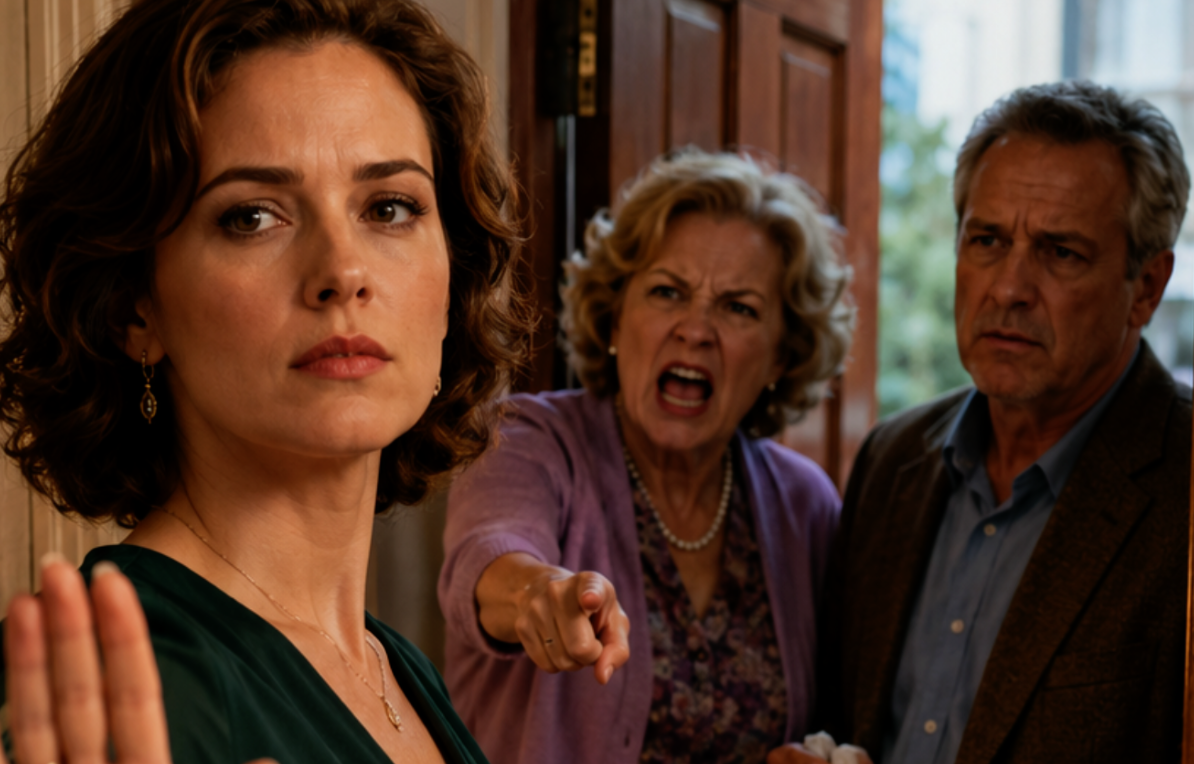
My Mother-in-Law Calmly Blamed Everything on Me — Until I Pretended Not to Notice
“Valeria, you could at least pay back part of the debt to Zinaida Petrovna. I’m already physically ashamed to go down the stairs past our neighbor,” Nina Stepanovna’s voice sounded so mournful, as if she were reading me a death sentence from a firing squad.
She stood in the middle of my hallway like an ancient martyr, clutching a brand-new massage cape to her chest, one that still smelled of factory plastic.
I froze with a boot in my hand. The statement was delivered with such reinforced-concrete certainty that for a second I even tried to remember whether, in some blackout, I had taken out a mortgage from the neighbor on the third floor. But my memory remained crystal clear. I silently placed the boot on the mat.
Nina Stepanovna, my precious mother-in-law, had always possessed a talent for making me guilty of any household catastrophe. Her iron burned out? Lera must have looked at it with the evil eye yesterday. Her wallet balance didn’t add up? That meant she was “spending too much on the young ones,” even though her last contribution to our family had been a kitten calendar for ninety rubles. But an actual debt was something new. This was no longer household folklore. This was a financial charge.
“What debt, Nina Stepanovna?” I asked evenly, looking straight at the bridge of her nose.
“Oh, don’t give me that face!” my mother-in-law rolled her eyes with theatrical outrage. “When it comes to borrowing, everyone is brave, but when it’s time to pay back, suddenly memory disappears. Zinaida called and asked. Of course, I covered for you and said you were having temporary difficulties. But you could at least bring her five thousand!”
She turned around with the grace of a loaded barge and sailed off to the kitchen, leaving me to digest this blatant insolence. I did not run after her and fall into hysterics, proving my innocence. Hysteria is the weapon of the weak. I prefer to observe.
The puzzle began to come together the next day. By the elevator, I ran into that very Zinaida Petrovna. The neighbor looked at me the way a bailiff looks at a malicious alimony dodger — with disgusted pity.
“Well then, Lerochka, is your breadwinner washing properly?” she hissed, pursing her lips. “Does it no longer rattle during the spin cycle?”
“Ours washes perfectly, Zinaida Petrovna. German assembly,” I replied with a polite smile.
“Well, of course, after repairs that cost that much!” the neighbor snorted. “Nina Stepanovna was so worried about you, begged so much! She said Andryusha already had enough trouble, so at least the washing machine should work.”
I nodded, keeping an expression of radiant serenity on my face, although my inner investigator was already rubbing her hands together with joy.
Three days later, my husband’s aunt, Aunt Tamara, called. She poured out a stream of family affection, and then, as if casually, slipped in:
“Lerochka, have you paid off the appliance repair yet? I’d like to get my fifteen thousand back by the end of the month. You understand, getting dental work these days is like buying a cast-iron bridge.”
I thanked Aunt Toma for her concern, hung up, and quietly laughed.
Family charity is a truly astonishing phenomenon: the louder relatives shout about helping you, the faster their own pockets empty in favor of a third party.
Nina Stepanovna’s scheme was genius in its shamelessness. She collected tribute from relatives and neighbors under the pretext that my washing machine had broken, begging them “not to tell Andryusha so as not to upset the boy.” And then she put the money into circulation. New velvet curtains, that very massage cape, and delicacies for her upcoming jubilee magically appeared in my mother-in-law’s apartment.
She was sure of her invulnerability. After all, who in their right mind would arrange a confrontation over a broken washing machine? An intelligent daughter-in-law would be afraid of a scandal and silently swallow the insult, and if anything happened, one could always say, “I was only trying for your sake, I simply mixed things up!”
But I had no intention of arguing with her one-on-one in the kitchen. Performances like that require a big stage and a full audience.
The stage was ready on Saturday. Nina Stepanovna’s birthday. Around the table, collapsing under the weight of salads clearly sponsored by Aunt Toma and neighbor Zinaida, sat the finest representatives of our family tree. My husband Andrei, unsuspecting and peacefully chewing julienne; Aunt Tamara; neighbor Zinaida Petrovna; and a couple of my mother-in-law’s friends.
Closer to the main course, the birthday woman decided it was time to perform her signature number. She stood up, solemnly raised a glass of homemade liqueur, and swept a damp gaze over the guests.
“You know, girls… How important it is nowadays to have reliable support behind you! We, the older generation, are always ready to give our last to our children. It’s just a pity that some young people take from their elders and forget to be grateful. They forget that debts must be repaid!”
She looked at me meaningfully. Conversations around the table stopped at once, and the room became so deafeningly silent and uncomfortable that it felt as if we were sitting in a crypt.
“Lerochka,” my mother-in-law continued in a syrupy sweet little voice, in which metal suddenly rang through, “I understand everything. Pride. But let’s settle the washing machine issue right now. People are waiting.”
The calculation was mathematically precise: corner me in front of witnesses. I was supposed to blush, lower my eyes, and mumble apologies.
I carefully placed my fork on the edge of my plate. Wiped my lips with a napkin. Looked at Nina Stepanovna with a light, sincere smile.
“A wonderful toast, Nina Stepanovna. But let’s clarify the details so we don’t resemble the characters of Ivan Andreevich Krylov: ‘You are guilty simply because I want to eat.’ Zinaida Petrovna,” I turned my gaze to the neighbor. “Please tell me, what amount did I personally ask you to lend me?”
The neighbor suddenly coughed, unexpectedly choking on mineral water.
“What do you mean… You didn’t ask. Nina asked. Ten thousand. She said you were crying, that you had nothing to wash with, and that you were afraid to tell Andrei.”
“Noted,” I nodded and turned to my husband’s aunt. “Tamara Ilyinichna, and you?”
“Fifteen… I gave it to Nina, right into her hands. We met in the park,” Aunt Toma had already stopped chewing and narrowed her eyes at the birthday woman in a very unpleasant way.
“That makes twenty-five thousand,” I summarized clearly. “Andrei, darling, please remind me, when did our washing machine break?”
Andrei, who until that moment had been shifting his stunned gaze from his mother to me, finally put down his fork. His face slowly began to darken with anger.
“Ours? Never. I bought you a new Bosch a year ago; it’s still under warranty. There were no repairs. Mom, what kind of cheap tricks are these?”
The guests froze, and the atmosphere became so dense and heavy that you could have cut it with an axe.
Nina Stepanovna’s face flushed in uneven burgundy blotches from her neck all the way to the roots of her hair. Her eyes darted across the table, searching for salvation in the salad bowls.
“You… you misunderstood! I wanted… It was for the common good! Lera simply forgot!”
“Respect is not paid for with other people’s loans, Nina Stepanovna,” I cut her off coldly and quietly. “I never asked your friends for anything, never took a single kopeck, and have no debts. All financial claims should be addressed to the cashier.”
The finale of that scene exceeded all my expectations. Aunt Tamara, a determined woman hardened by the nineties, silently stood up, went to the chest of drawers where the birthday woman’s gift envelopes lay, and imperiously drew her brows together.
“Well, if it was for the common good, Ninok, then let’s conduct an audit. Return my fifteen. Right now. I don’t need anyone else’s common good. I need to get my teeth fixed.”
Zinaida Petrovna immediately jumped up after her, demanding her ten.
The celebration collapsed like a house of cards under a fan. Nina Stepanovna, with trembling hands and a sweaty, reddened face, was forced in front of everyone to open her own gift envelopes. She pulled out crisp bills that had been meant for her jubilee and shamefully handed them over to the deceived “creditors.”
Every rustle of a returned bill sounded like a slap to her inflated ego.
When the last bill had moved into the neighbor’s hands, Andrei rose from the table. He did not shout. But there was such arctic cold in his voice that goosebumps ran down my back.
“Here’s how it will be, Mom,” my husband said, striking out every word. “If I ever again hear from anyone that my wife is borrowing money, complaining about life, or asking for help through your hands, you will never see us here again. If you want to borrow money, borrow it in your own name and answer for it yourself. You will not say Lera’s name again. Get ready, Lera. We’re leaving.”
We left the apartment in the deathly silence of the stunned guests. No one stopped us.
Nina Stepanovna had wanted to publicly make me look like a guilty debtor, but in the end, she was left sitting at a ruined table, with empty envelopes and the reputation of a petty swindler.
And you know what the most pleasant part is? Now, if her iron really does break, no one will believe a single word she says. Even if she brings a certificate from a notary.
And my washing machine works absolutely wonderfully.
German assembly, after all.