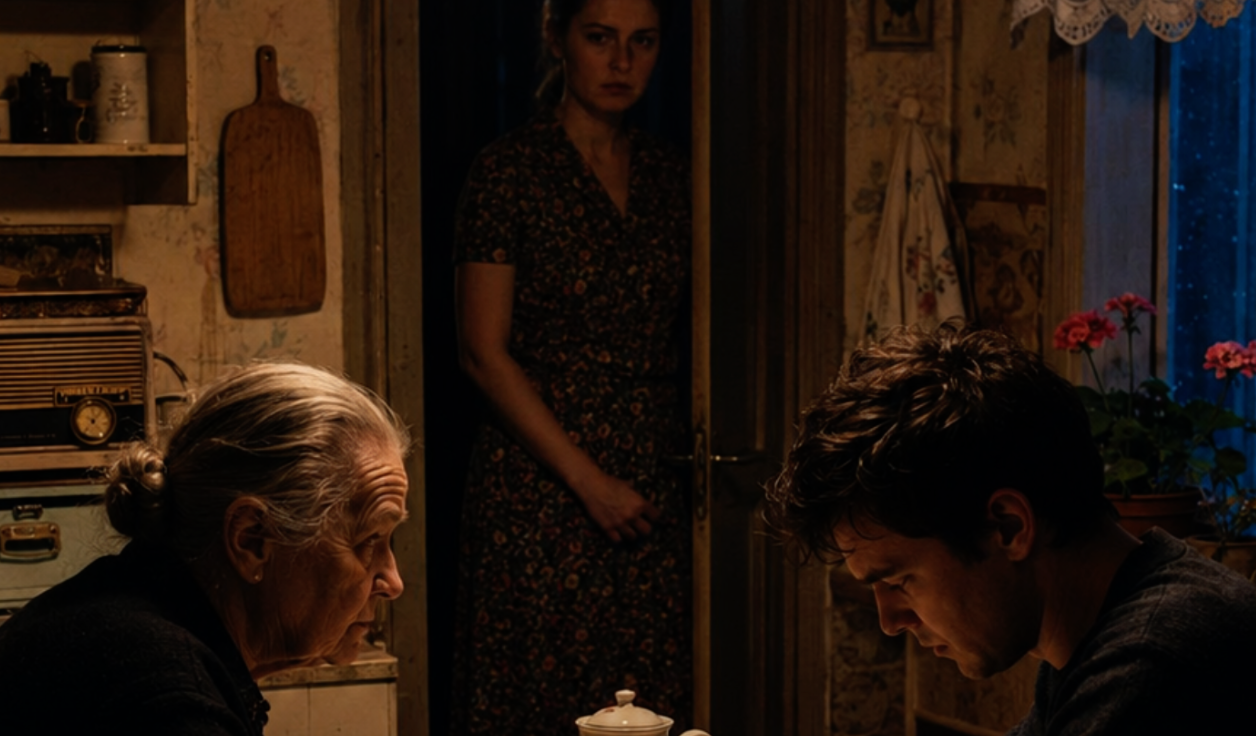
“— I’ll throw her out before evening,” the mother-in-law promised her son, not knowing that her daughter-in-law had already pressed “record.”
“I’ll throw her out before evening,” Zinaida Pavlovna said, stirring sugar into her cup. “Just don’t interfere. By dinner, everything will be settled.”
Alexey put his mug down on the table. He looked at his mother. Then at the kitchen door, checking whether it was closed.
“Mom, what if she doesn’t leave?”
“She’ll leave. Where else can she go? No decent job, no relatives in Kalinov. I’ll explain to her that the apartment is ours. That we tolerated her long enough. Calmly, without scandal. I’ll simply tell her the truth.”
She took a sip of tea. Calmly. Like a person who had made the decision long ago and was now discussing only the technical details.
“She can pack her things into a bag. Call a taxi. She has that friend, some Svetka. Let her go there.”
Alexey did not object. He had not objected to his mother in a long time. Since childhood, he had been used to Zinaida Pavlovna making decisions, and he simply carried them out. School, university, his first job in the administration, even his marriage. Everything had been coordinated with her. Everything except one thing: his wife had turned out not to be what his mother expected.
Marina Dorokhova married Alexey Kozhin three years ago. She was thirty-two. He was thirty-five. They met at the birthday party of a mutual acquaintance. At that time, Marina had just moved to Kalinov, a small town in Sverdlovsk Region, with sixty thousand residents, two factories, and a station square that was always icy in winter.
The wedding was quiet, held at the Beryozka restaurant for twenty people. Zinaida Pavlovna sat at the head of the table and smiled as if she had swallowed something bitter but had decided not to ruin the photographs.
After the first toast, she leaned toward the woman sitting next to her and said under her breath, “We’ll see how long this lasts.”
The neighbor nodded. Marina heard it. She said nothing.
Marina worked as an economist at the municipal cultural institution of Kalinov. The position sounded modest. The salary was thirty-eight thousand. But behind that position stood something Zinaida Pavlovna neither understood nor wanted to understand: Marina knew numbers. All numbers. Budgets, subsidies, cadastral values, market appraisals, mortgage rates, tax deductions. She lived in a world where every number had legal force, and every document had weight.
Before Kalinov, Marina had worked for six years at Rosreestr in Nizhny Tagil. She processed transactions, checked encumbrances, and uncovered forged powers of attorney. She had seen people lose apartments because of one wrong signature. She had also seen apartments returned because of one signature too, but the right one. She knew the articles of the Housing Code by heart the way other people knew the recipe for Olivier salad.
She did not like loud words. She did not like scandals. At work, people called her “quiet Marina,” not because she was timid, but because she spoke only when there was something worth saying. And when she did speak, people listened. Her boss, Valentina Sergeyevna, once said, “Marina, you’re like an auditor. You stay silent and silent, and then you place a paper on the table, and everyone realizes they should have listened earlier.”
When Marina moved in with Alexey, the apartment was already there. A three-room apartment on Michurina Street, building 14, in a nine-story building constructed in 1978. Ceilings two meters seventy, herringbone parquet floors, cast-iron radiators that heated so strongly that the windows had to be opened in winter. Zinaida Pavlovna called it “our apartment.” She said it often and with emphasis, as if repetition could turn words into legal fact.
Marina said nothing the first time. And the second. And the tenth. She did not argue. She simply went to the Rosreestr website, entered the address, and looked up the extract from the Unified State Register of Real Estate.
Owner: Kozhin Alexey Dmitrievich. Sole ownership. Basis: purchase and sale agreement dated 12.04.2019. No encumbrances.
Alexey had bought the apartment. With his own money. Two years before the wedding. Zinaida Pavlovna had not invested a single ruble, not in the mortgage, not in the renovation, not even in the wallpaper that Alexey had hung himself in the evenings after work. But she had invested something else: the conviction that everything belonging to her son belonged to her.
The first year passed relatively peacefully. Zinaida Pavlovna lived in a one-room apartment on Lenina Street, building 40, the same apartment she had received back in the Soviet Union from the factory where she had worked as a storekeeper for thirty-one years. She visited two or three times a week. Checked the refrigerator. Commented on how clean the floors were. Asked why there were no children yet. Touched the laundry on the line to see whether it had been wrung out enough. Counted the jars of jam. Marina nodded, poured tea, and remained silent.
In the second year, Zinaida Pavlovna began coming every day. Then she began coming with belongings. First it was an orthopedic pillow. Then a terrycloth robe. Then a rolling suitcase.
“It’s hard for me to be alone,” she explained to her son. “My blood pressure jumps. My knee hurts. What if something happens at night? Who will help me? Waiting for an ambulance takes forty minutes. And Marina is home after six anyway. What would it cost her to keep an eye on me?”
Marina was not home after six. She came home at seven, sometimes at eight, because every quarter she prepared a report for the treasury, and numbers did not forgive haste. But that did not matter. Zinaida Pavlovna had already moved in. Without discussion. Without asking. Without an end date. Like a natural disaster — it does not ask permission.
Alexey said, “Mom, this is temporary, right?”
Zinaida Pavlovna said, “Of course, temporary.” And hung her winter coat in the wardrobe. And her summer coat. And two demi-season coats.
By the third year, Zinaida Pavlovna controlled everything. What to cook for dinner. When to do laundry. Which curtains to hang in the bedroom. How much money to spend on groceries. Marina bought cottage cheese for one hundred twenty rubles; her mother-in-law said decent cottage cheese cost sixty. Marina bought butter for two hundred; her mother-in-law said people used to manage with margarine and grew up healthy anyway. Marina bought a new towel; her mother-in-law asked what was wrong with the old one and hung the old one back up.
But the main thing was something else. Zinaida Pavlovna wanted Marina gone. Not because she hated her — no, hatred requires energy, and Zinaida Pavlovna spent energy only on what she considered important. She simply did not think of Marina as a person with a will of her own. Marina was an obstacle. An unnecessary element in a structure where there were only mother and son. A third person was always one too many.
Zinaida Pavlovna applied pressure slowly. Like water wearing down stone. Remarks every day. Sighs at breakfast. Silence at dinner — deliberate, heavy. Conversations with Alexey in low voices in the kitchen after ten, when Marina had already gone to bed. “She doesn’t appreciate you.” “She’s using you.” “You deserve better.” “Remember Olya Seryogina? Her daughter is pure gold, not like this one.”
Alexey listened. He did not argue. He was a good son. That is, obedient.
Marina saw everything. Heard it through the wall. Felt how the home stopped being a home. How the air thickened. How her mother-in-law’s words settled between her and her husband, forming a wall — at first thin as paper, but thicker with every passing day.
She did not cry. She did not complain to friends on the phone. She did not write posts on social media. She did what she knew how to do best: she gathered information.
On Wednesday, March twelfth, Marina came to work as usual. At eight fifty. She hung up her coat, turned on her computer, and opened the spreadsheet with the budget for the second quarter. At lunch, at twelve forty, Sveta Yermolina called. She was Marina’s only friend in Kalinov, a former colleague from the MFC, where Marina had handled documents during the first months after moving.
“Marin, I don’t know how to tell you this. But this morning I was at Tamara Andreyevna’s birthday. You remember her, she works in social services on the first floor, and she has that ginger cat.”
“I remember.”
“Your mother-in-law was there. And in front of everyone — everyone, Marin, there were about eight people sitting there — she said she would drive you out of the apartment by the weekend. That Alexey had already agreed. That you would leave with one bag. She was laughing. She said you weren’t registered anywhere and had no rights.”
Marina was silent. Ten seconds. Twenty. Outside the window, a tram passed by — the old number three, heading to the station.
“Thank you, Sveta.”
“Are you okay?”
“Yes. I need to check something.”
She hung up. Closed the budget spreadsheet. Opened the Rosreestr website. Checked. She did have permanent residence registration — Alexey had arranged it through Gosuslugi back in September 2021, a week after the wedding. Zinaida Pavlovna did not know that. Or had forgotten. Or did not consider it important. To her, papers were something like the weather: they existed, but they did not affect life.
Then Marina opened Consultant Plus. The Family Code, Article 31. The rights and obligations of spouses living in a residential property. She read it twice. Then the Housing Code, Article 35. Then the Civil Code, Article 292.
She wrote three points on a sheet of paper. In neat handwriting, with a blue pen. She tucked the sheet into her planner.
That evening she came home. Zinaida Pavlovna was watching television in the living room — a talk show about family scandals, loud, with shouting. Alexey was still at work; he worked as a manager at the construction company Granit-Stroy and usually returned around nine.
Marina walked past her mother-in-law. Said, “Good evening.” In return, she received silence and a look over the top of glasses. She went into the bedroom.
In the bedroom, she took out her phone. Opened the Voice Recorder app. Pressed “Record.” Put the phone into the pocket of her house dress — a deep, convenient pocket, screen facing down.
She returned to the kitchen. Began making dinner. Put water on for pasta. Took out an onion.
Zinaida Pavlovna came in five minutes later. She stood in the doorway. Crossed her arms over her chest.
“You don’t have to bother. By the weekend, you won’t be here.”
Marina sliced the onion. She did not turn around.
“Alexey agrees. We discussed everything yesterday. He doesn’t need you. Nobody here needs you at all. You came from your Tagil and latched onto someone else’s apartment. You think I don’t see it?”
Marina moved the onion into the frying pan. Quietly. The oil hissed.
“I’ve already called a lawyer. An acquaintance, Gennady Petrovich. He said that in a divorce, you won’t get anything. The apartment was bought before the marriage. You’re nobody here. A guest who overstayed her welcome.”
“I see,” Marina said.
“What do you see?” Zinaida Pavlovna stepped closer. “That you’re unnecessary here?”
“That you called a lawyer.”
Zinaida Pavlovna smirked. Shook her head. Went back to the television. Turned up the volume.
Marina stopped the recorder. Twenty-three minutes of audio. Saved it. Copied it to cloud storage.
The next day, she recorded another conversation. Zinaida Pavlovna repeated all the same things, but added new details. She said she would tell the neighbors that Marina drank. That she would call her workplace and tell her boss that her daughter-in-law was stealing money from the family budget. That she would change the locks while Marina was at the institution.
“The keys are mine,” Zinaida Pavlovna said, standing in the hallway. “Alexey gave me a duplicate. I’ll change the locks, and that’s it. You’ll come home from work, and the door won’t open. Where will you go?”
Marina nodded. Recorded it.
The third day. The fourth. Zinaida Pavlovna spoke more and more, louder and louder. She felt she was winning. That Marina was giving up. She mistook her daughter-in-law’s silence for obedience. For surrender. For an admission of defeat.
She did not know that in four days Marina had collected six recordings with a total length of two hours and forty minutes. Each one with a date, start time, and end time. She did not know that Marina had taken screenshots of Alexey’s messages with his mother — he had left his phone unlocked on the kitchen charger, and Marina had seen the messenger conversation. “Mom, let’s do it after the weekend. I’ll tell her myself.” To which Zinaida Pavlovna had replied, “No. I’ll do it myself. You’ll drag it out again. You always drag things out.”
She did not know that Marina had obtained an up-to-date certificate of her residence registration from the MFC — with a stamp and signature. She did not know that Marina had had a copy of her marriage certificate certified by a notary on Sovetskaya Street. She did not know that in Marina’s planner lay a printout of a Constitutional Court ruling on the admissibility of recording a conversation in which the person making the recording is a participant.
Four days. Six recordings. One blue folder.
On Friday evening, Alexey came home earlier than usual. At seven. Zinaida Pavlovna had already set the kitchen table. On the table were his favorite cutlets — made with minced meat and bread crumb, just like in childhood. Tea in a large teapot. Yubileynoye cookies. Marina’s belongings were not in the hallway — Zinaida Pavlovna had packed them into a large black bag and placed it by the front door.
“Sit down,” she said to her son. “We’ll talk to her together. I’ll start, you support me.”
Alexey sat down. He looked as if he wanted to be anywhere else on earth.
Marina came out of the bedroom. She saw the bag of belongings by the door. She looked at it — three seconds, no more. Then at Alexey. Then at her mother-in-law.
“Sit down, Marina,” Zinaida Pavlovna said in the tone used for a guilty child. Hands folded on her knees. Back straight. Voice even.
Marina sat down. She placed a folder on the table. An ordinary blue office folder with plastic corners.
Zinaida Pavlovna paid no attention to it. A folder meant papers. Papers were not important.
“Marina, Alexey and I have decided that it’s better for you to leave. The apartment belongs to him. You are not registered here. We are not obligated to support you. Pack your things — I’ve already started, the bag is over there by the door — and leave. You can go to your friend, that Sveta of yours. Or back to Tagil. I don’t care. The main thing is by tomorrow.”
Alexey stared at the table. At his hands.
Marina opened the folder. Took out the first sheet. Placed it in front of Alexey. Carefully, evenly, the way documents are placed for signing.
“Extract from the Unified State Register of Real Estate. The owner is you, Alexey Dmitrievich Kozhin. Sole ownership. Basis — purchase and sale agreement dated April twelfth, two thousand nineteen. Your mother has no rights to this apartment. Not as an owner. Not as a co-owner. Not as an heir — you are alive. She is a guest here.”
Silence. Zinaida Pavlovna blinked.
The second sheet.
“Certificate of my residence registration. City of Kalinov, Michurina Street, building 14, apartment 57. Registration date — September eighteenth, 2021. I am registered here. Legally. Through the Gosuslugi portal. You submitted the application yourself, Alexey. Here is the confirmation screenshot — from your personal account and with the date.”
Zinaida Pavlovna opened her mouth. Closed it. Opened it again.
“That’s not true. He couldn’t have…”
The third sheet.
“Article 31 of the Housing Code of the Russian Federation. Paragraphs one and two. The spouse of an owner has the right to use the residential premises on equal terms with the owner. I can be evicted only through court. Only after the marriage is dissolved. And even then, the court may preserve my right to live here for a certain period if I have no other housing and no means to acquire it.”
She spoke evenly. Without raising her voice. Without trembling. As if at a work meeting, reading out a budget conclusion.
The fourth sheet.
“Article 139 of the Criminal Code of the Russian Federation. Illegal entry into a dwelling. If someone changes the locks in the apartment where I am registered while I am at work, that is a criminal offense. A fine of up to forty thousand rubles. Or compulsory labor of up to three hundred sixty hours. Or corrective labor for up to one year.”
Zinaida Pavlovna turned pale. She remembered what she had said about the locks. But she did not remember exactly when, or in whose presence.
Marina took out her phone. Placed it on the table. Pressed “Play.”
Zinaida Pavlovna’s voice filled the kitchen. Clear, confident, unmistakably recognizable: “The keys are mine. Alexey gave me a duplicate. I’ll change the locks while she’s at work. She’ll come back, and the door won’t open. Where will she go?”
Marina pressed “Stop.” The silence became thick.
“I have six recordings like this. Total duration — two hours and forty minutes. Threats of eviction. Threats of slander — you promised to tell the neighbors that I drink and call my workplace. A plan to change the locks. Everything is dated. Everything is saved in cloud storage. A copy is on a flash drive with a notary in a sealed envelope.”
Zinaida Pavlovna stood up. The chair creaked. Her hands were shaking.
“You… you were recording? Me?!”
“Yes.”
“That’s illegal! That’s a violation of my rights! I did not give consent to be recorded!”
The fifth sheet. Marina placed it in front of her mother-in-law. Calmly.
“A ruling of the Constitutional Court of the Russian Federation. Recording a conversation in which you are a direct participant does not require the consent of the other party. This is not wiretapping. This is not hidden surveillance. This is the recording of a conversation in which I personally took part. Courts accept such recordings as admissible evidence. On the next page are three examples from court practice. Two appellate rulings and one district court decision. All have entered into force.”
Zinaida Pavlovna turned to her son. Her eyes wide open.
“Alexey! Say something! Don’t you see what she’s doing?”
Alexey slowly raised his head. He looked at the documents spread out on the table like cards in a game of solitaire. At the extract from the real estate register. At the screenshot of his own application from Gosuslugi. At the wife he had considered quiet and defenseless for three years.
“Mom,” he said quietly. “You said she wasn’t registered here. You repeated that to me every week.”
“Well, I thought so! I didn’t check!”
“But I checked. Back in 2021. And I registered her. Because she is my wife. And this is her home too.”
Zinaida Pavlovna sat back down. Heavily. As if the air had been let out of her. A cup stood in front of her — cold tea with sugar, the same tea she had stirred that morning while planning someone else’s life.
Marina closed the folder. Fastened the plastic button.
“I am not going to file a report. Not with the police, not in court. For now. But if the threats happen again, I will file one. If the locks are changed, I will file one. If anyone at my workplace hears slander that I drink or steal, I will file one. And I will attach all six recordings.”
She stood up. Went to the door. Picked up the black bag with her things. Carried it back to the bedroom. Put everything back in its place. Carefully, item by item.
Zinaida Pavlovna sat motionless. The cutlets cooled on the plate. A film formed over the tea.
“I thought you were just…” she began.
“Just what?” Marina asked from the hallway.
Zinaida Pavlovna did not answer. For the first time in three years, she had nothing to say.
Alexey raised his head. Looked at his mother. For a long time. As if seeing her for the first time.
“Mom, it would be better for you to go back to your place. On Lenina Street. To your apartment.”
Zinaida Pavlovna looked at him as if he had struck her.
“You’re throwing me out? Your own mother?”
“No. I’m asking you to live in your own apartment. Like before. I’ll come visit. Help. Buy your medicine. But we will live separately.”
“I did everything for you! Everything — for you!”
Alexey said nothing. Marina said nothing either. The silence answered for both of them.
Marina went into the bedroom. Closed the door. She did not slam it — she closed it quietly, until it clicked. On the nightstand lay her planner, opened to the page with three points written in blue pen. She turned the page. A blank sheet. Tomorrow, a new day would begin.
On Saturday morning, Zinaida Pavlovna packed her suitcase. The same rolling suitcase she had arrived with a year and a half ago. She took her pillow, robe, winter coat, and two demi-season coats. A box of medicine. Slippers. A mug with the words “Best Mom.”
Alexey called a taxi. Helped carry her things to the car.
At the entrance door, Zinaida Pavlovna stopped. Turned around. Looked at the third-floor windows — their windows.
“I am a mother,” she said. “I wanted what was best.”
No one answered. Alexey stood beside her, holding the suitcase. Waiting.
The taxi drove away.
Alexey returned to the apartment. Marina was standing by the kitchen window. Looking out into the courtyard. The March snow was already melting, turning into gray slush. Water dripped from the cornice — steady, measured, like a metronome.
“How long had you known?” he asked. “That you had all this? The documents, the recordings?”
“I started gathering it on Wednesday. When Sveta called.”
“Four days. You did all of that in four days.”
“After six years at Rosreestr, you learn quickly.”
He sat down at the table. In the same place where the documents had been lying yesterday. The table was clean. Marina had already wiped it with a damp cloth.
“Why didn’t you tell me earlier? Before… before all of this.”
Marina turned away from the window. Looked at him. Without reproach. Without resentment. Without triumph. She simply looked at him the way one looks at a problem that has been solved, though there is no joy in the solution.
“Because you would have asked me to wait. To endure it. To give her another chance. And then another. And another. I endured it for three years.”
Alexey wanted to object. But he could not. Because she was right. And they both knew it.
“I don’t want a divorce,” he said.
“I don’t want one either. But if you choose her again, I will choose myself. That is the only promise I made to myself.”
He nodded. Slowly, heavily. But he nodded.
Marina put the kettle on. Took out two cups. The one with cornflowers for herself. The plain white one for him. As every morning. She added tea leaves. Poured boiling water over them.
On the windowsill stood a pot with a violet. Marina had bought it during the first week after the wedding, at the flower shop next to the MFC, for one hundred fifty rubles. Zinaida Pavlovna had once said that violets were useless flowers. They did not smell, did not really grow, only took up space. Marina had said nothing.
The violet was blooming. Small purple flowers, stubborn like everything that grows not because it is forced to, but because it can.
A month passed. Zinaida Pavlovna called Alexey on Sundays. The conversations became short — about ten minutes. About her health, her blood pressure, pharmacy prices. Not a word about Marina. As if Marina did not exist. But there were no more threats. No uninvited visits. No rolling suitcases.
The apartment became different. Not because the furniture had changed — everything remained in place. But the air became lighter. The silence became different. Not oppressive, where every sound was controlled and judged. But peaceful. The kind in which one could breathe and not think that even breathing would be criticized.
Marina took out a box from the wardrobe, the one she had brought from Tagil three years ago and had never opened. Inside the box were books. Twenty-three of them. She placed them on the shelf in the living room. The shelf changed. It began to look like the shelf of a person who lived there, not someone hiding there.
That evening Alexey came home. He saw the books. He said nothing. Only walked past the shelf and lightly touched the spines with his fingers. As if greeting them.
Marina was making dinner. Ordinary, everyday dinner. Potatoes with dill, cucumber and tomato salad, cutlets — her own, not according to her mother-in-law’s recipe. Not festive. Not victorious. Just dinner on a Friday evening. The first in a long time when she did not have to wait for a remark about too much salt, wasted butter, or how she was doing everything wrong in general.
She placed two plates on the table. Two forks. Two glasses. Laid out the napkins. Looked at them.
Two. A good number. Honest. Enough.
There are people who confuse love with power. They sincerely believe they are protecting someone, when in reality they are taking something away. They believe they are caring, when in reality they are subjugating. The quietest weapon against such people is not shouting and not scandal. It is knowledge. Precise, documented, with a date, a signature, and an article number.
The person who counts on someone else’s weakness rarely checks what stands behind someone else’s silence.