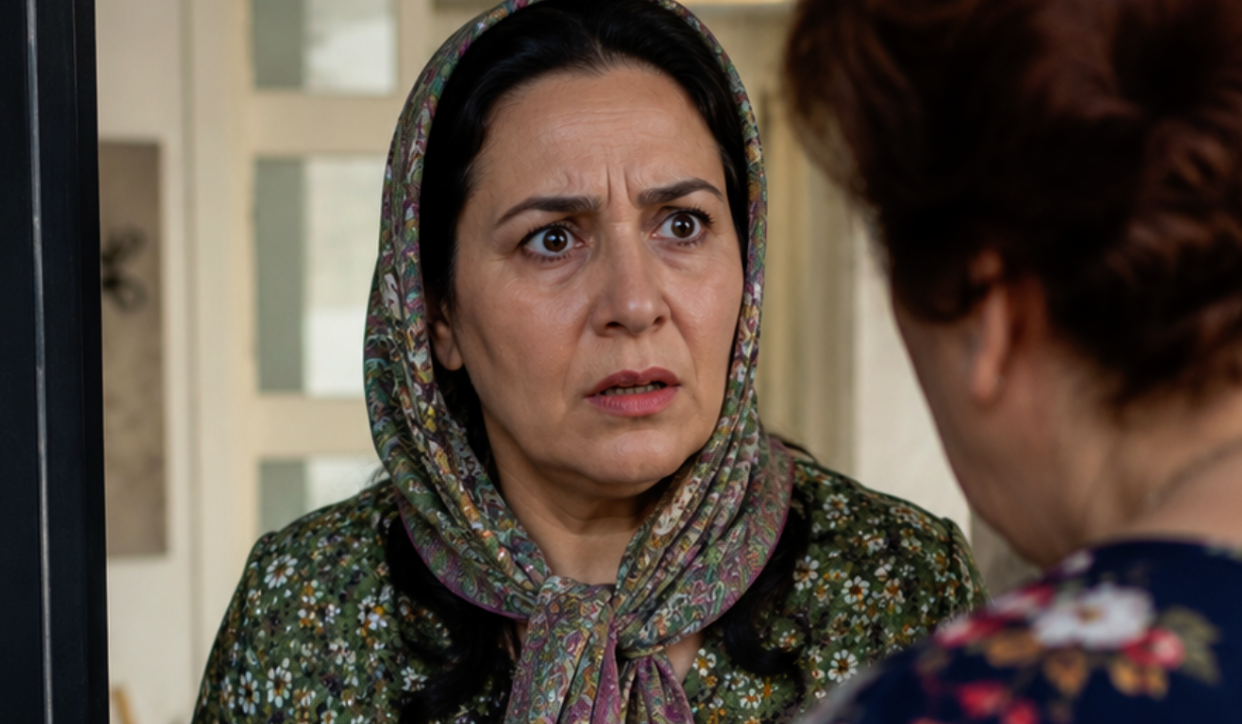
“I heard some money came your way,” my mother-in-law said from the doorway, demanding the entire amount for repairs.
“Faina, open up. I’m not here for tea. I’m here on business.”
I hadn’t even managed to turn the key yet, but I already understood: this day was going to have character.
The stairwell smelled of dust, mandarins, and someone’s soup with bay leaf. Zinaida Petrovna stood at the door with such confidence, as if I hadn’t lived here for twenty-two years, but she had merely stepped out for a minute and had now returned to take the apartment back.
In one hand she held a bag, in the other, gloves. Her lips were pressed tight. Her gaze was practical.
Not even angry, exactly. It was the kind of look that made people open their cupboards, sideboards, and, if they weren’t careful, their wallets all by themselves.
“I heard some money came your way. Let’s not beat around the bush. Give me the whole amount for repairs.”
I silently opened the door wider.
“Good morning, Zinaida Petrovna.”
She entered the way a person enters when she hasn’t come with a request, but to inspect her territory.
“My day will be good if you don’t start pretending you don’t understand anything.”
Arkady looked out from the room, wearing a tank top and the face of a man who had already heard everything but still hoped the conversation was coming from a neighboring apartment.
“Mom, this early?”
“And when else should I come, if by evening both your money and your conscience will be hidden away? I’m not asking for myself, by the way. My walls are crumbling.”
“Your walls?” I asked.
“Whose else? The Pope’s?”
That was exactly why I appreciated Zinaida Petrovna. If she needed someone else’s ruble, she presented the matter as if she were saving not herself, but the cultural heritage of the nation.
The kettle in the kitchen hadn’t even boiled yet, and she was already sitting at the table, having removed her scarf and folded it beside the sugar bowl. That was her special manner. A person settled in thoroughly so the conversation would also proceed thoroughly.
On the windowsill stood a jar of buttons. Outside, rare March snow rustled, and the stove smelled of yesterday’s fried potatoes.
A perfectly ordinary day. Only with the aftertaste of money.
I put the kettle on.
“Where did you hear that?”
“Good Lord, Faina, you don’t live on the moon. Money came to Arkady’s card, so I heard.”
Arkady coughed awkwardly.
“It didn’t ‘come.’ It was transferred.”
“Don’t confuse me with words. Money is money. I need repairs now. Urgently.”
The kettle began to hum.
I turned to my husband.
“Arkady, did you tell your mother?”
He looked out the window, as if the answer were urgently being displayed there.
“Well… I said I got a bonus.”
“A bonus?” Zinaida Petrovna perked up. “That’s a modest way to put it. A sum like that doesn’t come around every day nowadays.”
And that was when I became truly curious.
We hadn’t told anyone the amount. Not our daughter, not the neighbor from the eighth floor who knew all the news before the postman, not even Arkady’s cousin, a passionate lover of family accounting.
We had planned to replace the windows and the wiring. We simply wanted to live without that circus where you turn on the kettle and the chandelier in the hallway winks like a woman at a dance in 1987.
I placed a cup in front of my mother-in-law.
“And what amount would that be, I wonder?”
She took the tea confidently.
“Oh, don’t nitpick. Lyuba told me it was decent.”
Arkady frowned.
“What Lyuba?”
“Just Lyuba. From the office.”
She said it and immediately lowered her eyes into her cup. As if she had mentioned some trifle. But I had noticed long ago: when a person pretends they have said something insignificant, that is usually where the most important thing is hiding.
“From what office?” I asked.
“The renovation office. The one that does estimates. I already found out. They calculated everything. If it’s done properly, you have to take everything at once and do it all together. Bathroom, kitchen, hallway. Otherwise you’ll stretch every penny, then say it’s too expensive.”
“You’ve already had it calculated?” I sat down across from her.
“Of course. What did you think, that I came here just like that? I’m a serious person.”
That was the pure truth. It was just that Zinaida Petrovna’s seriousness always ran ahead of the facts.
Arkady sat sideways at the table.
“Mom, whose name is the estimate under?”
The spoon softly clinked against the saucer.
“What difference does it make?”
“A big one,” I said. “I trust everyone when there’s paperwork.”
“Oh, really? So now I can’t be trusted without papers?”
“You can. But not for the entire amount.”
Arkady quickly nodded, delighted that the conversation had moved into the world of objects rather than family feelings.
“Yes, Mom. Show us the estimate, and that’s it.”
She pressed her lips together.
“Let’s go. Right now, if you want. Only don’t say afterward that I didn’t invite you.”
While we were getting ready, she managed to sigh twice by our old windows, look at the chandelier once with such reproach that it seemed personally guilty of family stinginess, and note that this apartment could also use repairs.
It was almost touching. Like a person who had come to take your pie and, in passing, showed concern for your oven.
On the bus, she sat by the window with a bag of mandarins on her knees. The bag rustled at every turn, as if it too wanted to express an opinion.
Arkady was silent. So was I.
Only the driver sneezed nervously at the stops, and some schoolgirl behind us ate crackers so loudly it was as if she were taking part in the musical accompaniment of our trip.
The office was on the ground floor of an old building. The hallway smelled of fresh paint, old paper, and that official dust which, I think, is issued to institutions together with their stamp and door sign.
Tile samples hung on the wall. All cheerful, glossy, with such an expression that one square meter could solve a marriage, blood pressure, and relationships with relatives all at once.
Lyuba turned out to be a short woman in glasses, with a folder under her arm and such a businesslike face that even Zinaida Petrovna lowered her volume slightly.
“Zinaida Petrovna, hello. You’re here with your family already?”
“With family,” my mother-in-law replied. “Because apparently we have an audit at home.”
Lyuba smiled politely.
“And that’s right. It’s always better to clarify everything at once now.”
“Wonderful,” I said. “Please show us the estimate.”
“Of course.”
She opened the folder, placed the papers on the table, and the smell of paint seemed to grow stronger in my nose.
Because the address on the estimate was not Zinaida Petrovna’s.
At first, I thought I had simply looked wrong. It happens. When a person prepares to hear one thing and sees another, their eyes, for a second, become like those of someone without glasses in a pharmacy.
But no.
Different street. Different building. Different apartment.
Arkady leaned over.
“Mom… what is this?”
Her cheek twitched. Slightly. But I saw it.
“This is… for example.”
Lyuba raised her eyes.
“Why for example? This is Irina Anatolyevna’s apartment. We calculated the kitchen and hallway for her. She also wanted the balcony glazed, if it fit into the budget.”
“What Irina Anatolyevna?” I asked, although I already understood everything.
Lyuba adjusted her glasses.
“Zinaida Petrovna’s daughter. She said money had been transferred to her son, and now they would decide quickly while the workers were available.”
In the hallway, someone moved a stepladder, and the metal scraped across the floor so sharply that the pause became almost theatrical.
Arkady slowly straightened up.
“Mom, you said your walls were crumbling.”
“And what, do you think Ira has marble everywhere?” Zinaida Petrovna immediately went on the offensive. “She has children. Her husband is completely useless. Who is supposed to help? The neighbors?”
Lyuba awkwardly moved a sheet of paper from one side of the folder to the other.
“We thought everyone knew. You spoke so confidently, saying your son would bring the money and we’d start right away.”
After that phrase, there wasn’t even a thin curtain left.
In front of us lay an estimate. Someone else’s apartment. Someone else’s kitchen. Someone else’s hallway.
And our money, which Zinaida Petrovna had already mentally turned into tiles, wallpaper, and a glazed balcony for her daughter.
Her scope was impressive. Truly family-sized. Only the wallet she had chosen was not her own.
“So what?” she said. “Ira needs it too. It’s not like I’m asking for a fur coat for myself.”
“You came and demanded all our money for Ira’s renovation?” Arkady asked slowly.
“Not all. As much as there is.”
“No,” I said. “You said: the whole amount.”
She turned to me.
“Because there’s no other way to get anything from you. You would drag it out for months. And it needs to be done now.”
“We aren’t allowed to think about our own windows?” Arkady asked.
“Your windows won’t run away.”
“So the money, apparently, is supposed to run away to Ira?” he said quietly.
Lyuba pretended she urgently needed to look for a stamp. Smart woman. When family truth takes off its coat in a room, it’s better not to stand in the doorway.
Zinaida Petrovna squared her shoulders.
“I am a mother. I wanted what was best.”
“For whom?” I asked.
She opened her mouth. I could practically see the long speech already being built inside her about children, duty, help, and heartless times.
But instead of a beautiful speech, the truth came out.
“For Ira, of course. She needs it more.”
She said it and ended everything herself.
No shouting. No scandal. No public display of hurt.
Just an ordinary phrase after which nothing else needed to be explained or untangled.
Even the tiles on the display seemed to lose their shine. Though perhaps that only seemed so to me.
Arkady ran a hand over his face.
“I see.”
Zinaida Petrovna suddenly seemed to shrink at once. She didn’t become pitiful, no. She was not one of those people.
But that sweeping confidence with which she had entered our apartment that morning disappeared from her. When a person walks too confidently down someone else’s road and then suddenly sees the signpost, the effect is always similar.
I pushed the papers back toward Lyuba.
“Thank you. We don’t need anything calculated.”
“All right,” Lyuba said quietly. “Contact us if anything comes up.”
It was damp outside. The bus hadn’t arrived yet.
Zinaida Petrovna stood with the bag of mandarins, and it hit her knee in rhythm with her irritation.
“So that’s how it is,” she said.
For the first time that day, Arkady did not look away.
“That’s exactly how it is. We are not giving our money anywhere.”
“You begrudged it for your sister?”
“I didn’t begrudge it. But you didn’t ask. You decided for us.”
She adjusted her scarf.
“And what now, should I beg on my knees?”
“No,” he said. “Just talk normally.”
I didn’t add anything then. Sometimes, when a man finally says what he should have said long ago, it’s better not to interfere, not even with sympathy.
At home, the kitchen was quiet and warm. I turned on the kettle.
It hummed calmly, without drama, and the chandelier in the hallway didn’t even blink this time. Apparently, it too had decided not to interfere in family matters.
Arkady took out the mugs himself. For our household, that was a big gesture. Almost a state-level one.
“I’m sorry,” he said. “I thought she really meant her own place.”
“At first, I thought so too.”
“I should have asked right away.”
“We did ask.”
He gave a crooked smile.
“Yes. But Lyuba made it more convincing.”
I took the mandarins out of the bag. One was soft, two were good, and at the bottom lay a pharmacy receipt. Zinaida Petrovna had evidently shoved it in there together with the fruit in her haste.
And suddenly I could picture the morning so clearly: how she got ready, how she weighed her words, how she had already mentally chosen tiles for her daughter, as if the matter had already been settled.
Sometimes a person settles into your tomorrow in advance. Without invitation.
Arkady walked over to the window.
“Shall we go look at windows tomorrow?”
“We shall.”
“And wiring.”
“And wiring.”
He was silent for a moment.
“I’ll talk to Mom myself.”
I only nodded.
A week later, a handyman appeared at our place, a funny mustached man named Boris, who said from the doorway that our wiring was being held together by memories.
I wasn’t even offended. That was exactly how it was.
Then the windows were delivered. The apartment began to smell of foam, dust, and change.
Zinaida Petrovna didn’t come. Once, she called Arkady and asked dryly:
“Have you done it already?”
“We’re doing it.”
“I see.”
And she hung up so abruptly, as if she were saving not minutes, but family strength.
But life, as I had noticed long ago, loves not loud scenes, but quiet continuations.
On Saturday, she came after all. This time without a bag, without an attacking stride, without the morning battle shine.
She stood in the hallway, looked at the new frames, and said nothing. Then she took off her coat.
“It’s brighter now.”
“It is,” I replied.
Arkady came out of the room.
“Mom, will you have tea?”
“I will.”
The three of us sat in the kitchen. The tea smelled of bergamot. The jar of buttons still stood on the windowsill.
Zinaida Petrovna held the cup in her hands and suddenly said, without looking at us:
“I told Ira that if she needs anything, she should speak to you herself.”
Arkady said nothing. He only nodded.
She added more dryly:
“Better yet, she should speak to her husband.”
I looked out the window so I wouldn’t meet her eyes. Not because I felt sorry for her.
It’s just that there are moments when a person has already punished themselves with awkwardness more strongly than anyone else could have.
“Her balcony really is bad, by the way,” she muttered.
“I believe you,” I said.
And then Arkady unexpectedly smiled.
“We believe you. But our kettle also has a character of its own.”
Zinaida Petrovna snorted. Very slightly. Almost imperceptibly.
But it was already her ordinary, human sound, not the voice of a person who had come to command someone else’s bank transfers.
After tea, she walked around the apartment, touched the new windowsill, looked at how the frame closed, and said at the door:
“You need different curtains now, though.”
I closed the door behind her and finally laughed.
Arkady laughed too.
And that was how it turned out.
The money, as Zinaida Petrovna puts it, did not fly away anywhere. It stayed exactly where it belonged.
We replaced the windows. The wiring too.
And Arkady also learned to tell his mother a short “no” without his eyes fleeing into the scenery.
Perhaps that turned out to be the most useful repair in the house.