Grandmother Quietly Sent Money for Her Grandson Until One Sentence from Her Daughter Broke the Silence
Raisa Pavlovna always sorted through her utility bills on Friday evenings. The habit had remained from the days when people paid at the post office and worried about missing the deadline. Now everything was paid through an app, but she still kept the paper receipts in a separate bag because it made her feel more at ease.
That evening, a receipt slipped out of the stack.
It was not for utilities.
It was printed on thick paper with a bank logo. The date was March, the amount was 11,400 rubles, and the payment description read: “Advance payment for graduation event, School No. 17.” Her surname was printed at the bottom.
She turned the receipt over in her hands.
She remembered that day. Veronika had called around lunchtime, speaking quickly and distractedly.
“Mom, they’re collecting money for Timofey’s graduation. They need an advance payment, and I won’t have the money before Friday. Could you transfer it to the class teacher’s card?”
Raisa Pavlovna had sent the money that same hour. Veronika replied with a simple “thanks,” without even a period, and never mentioned it again.
The receipt had been lying there for six months.
That evening, Timofey called her. He sounded cheerful. He told her about soccer practice, their new goalkeeper, and the city tournament that would take place after the holidays. He also mentioned that he needed new cleats.
Then Raisa Pavlovna heard Veronika’s voice in the background.
“Tim, your grandmother only knows how to make promises. You’d better ask your father about the cleats.”
The boy fell silent for a second.
Then he said, “Grandma, okay, I have to go.”
The call ended.
Raisa Pavlovna remained seated at the table, holding the receipt.
Eleven thousand four hundred rubles.
March.
School No. 17.
Her surname.
She did not call back. She did not write to Veronika. She folded the receipt in half and slipped it into the pocket of her robe.
She could not sleep that night.
Not because she felt offended.
Because of one question: How long had this been going on?
The next morning, she opened her message history with her daughter. Not the conversation filled with “good morning” messages and photographs of Timofey with the cat.
The other one.
The conversation in which Veronika asked for money.
The messages appeared one after another, as orderly as monthly bills.
January of the previous year:
“Mom, Timofey needs a winter coat. My account is overdrawn right now. Could you send some money?”
Raisa Pavlovna sent 7,000 rubles. A week later, Veronika sent a photograph of the coat without any comment.
April:
“Mom, the class is going to Suzdal. It costs 4,800. I can’t manage it this month.”
She transferred the money.
Veronika replied, “Okay.”
September:
“Mom, there’s a robotics club. Enrollment costs 3,200.”
She paid.
December:
“New Year’s school performance, costume, 2,500.”
She paid.
And then March.
Graduation.
11,400 rubles.
Raisa Pavlovna added everything up.
Over the previous two years, she had sent her daughter almost 50,000 rubles for her grandson. That did not include ordinary birthday and New Year’s gifts. It did not include the groceries she brought every other Thursday.
And not once—not a single time—had Veronika told Timofey where the money came from.
The coat was “bought by Dad.”
The trip to Suzdal was “paid for by Mom and Dad.”
The robotics club was “something Mom enrolled him in.”
The graduation celebration had apparently been paid for by someone else too.
And Grandma only knew how to make promises.
Two days later, it was Thursday.
Raisa Pavlovna went to her daughter’s apartment as usual, carrying a bag filled with apples, chocolates, and cottage-cheese pancakes that Timofey liked to eat cold, straight from the container.
Veronika opened the door, took the bag, said, “Thanks, Mom,” and went into the kitchen.
Timofey was in his room doing homework. Raisa Pavlovna looked in and gently ruffled his hair.
“Grandma, will you come to the tournament?”
“I will.”
“And what about the cleats?”
She looked at him.
He was eleven years old, with long legs and elbows already sticking out from his sleeves. He was growing faster than the adults around him could notice.
“We’ll sort out the cleats,” she said.
In the kitchen, Veronika was talking to a friend on the phone. Raisa Pavlovna caught part of the conversation.
“No, no one helps me. I handle everything myself. You know that…”
Raisa Pavlovna put the kettle on and waited until her daughter finished the call.
“Veronika.”
Her daughter turned around.
“I need to talk to you.”
“Mom, I’m tired. Let’s not do this right now.”
“Right now.”
There was something different in Raisa Pavlovna’s voice.
Veronika sat down.
Raisa Pavlovna took out her phone and began showing her the payments.
“This is January. Timofey’s coat. Seven thousand rubles transferred by me. This is April. Suzdal. Four thousand eight hundred. This is the robotics club. This is the school performance. This is the graduation.”
Veronika stared at the screen.
“So what?”
“So the day before yesterday, you told your son that I only know how to make promises.”
There was a pause.
“Mom, that isn’t what I meant.”
“What did you mean?”
Veronika rubbed the bridge of her nose. It was a familiar gesture. She always did that when she did not want to admit something uncomfortable.
“Well, sometimes you promise to visit and then you don’t come. That’s what I meant.”
“I failed to come once because my blood pressure was 160. But I never missed a single payment.”
Veronika said nothing.
“You never told Timofey that I paid for his coat. Or that I paid for the trip. Or that I paid for his graduation. Not once.”
“Mom, why does a child need to know who pays for what?”
“Because the child thinks his grandmother has forgotten about him. But his grandmother has simply been paying quietly because you asked her to.”
Veronika stood up. She poured herself a glass of water, drank it, and sat down again.
“Do you want me to report every payment to him?”
“No. I want you to stop lying. Not to me. To him.”
That was the hardest word.
Lying.
Raisa Pavlovna saw her daughter’s jaw tighten.
“I’m not lying.”
“You tell people that no one helps you. You say it in front of your friends and in front of your son. Meanwhile, I have twenty-three transfers on my phone from the past two years. Isn’t that a lie?”
Veronika stared at the table.
“It’s difficult for me, Mom. You have no idea how difficult it is.”
“I do. I raised you alone. But I never told you that Grandma Zina didn’t help us, because she did. And you knew it.”
That was when Veronika began to cry.
Quietly and angrily, the way adults cry when they realize they have no argument left.
Raisa Pavlovna did not comfort her.
Not because she did not want to.
Because comforting her at that moment would have erased what she had just said.
She waited for a minute.
“I’m not going to stop helping. Timofey is my grandson, and I will help him for as long as I can. But I will no longer transfer money to you without leaving a trace.”
“What does that mean?”
“It means I will buy the cleats myself. With Timofey. At the store. And he will know they came from me. If his club membership needs to be renewed, I will pay for it directly. Not through you. Not to your card.”
Veronika raised her head.
“You don’t trust me?”
“Not with money. Not after what I heard.”
They sat in silence for another five minutes. The kettle grew cold.
Raisa Pavlovna stood up and put away her phone.
“I’m going home.”
“Mom…”
“Call me when you’re ready to talk. Not make excuses. Talk.”
She was tying her shoelaces in the hallway when Timofey came out of his room.
“Grandma, are you leaving already?”
“I am.”
“What about the cleats?”
She looked at him and, for the first time in two years, gave him a direct answer.
“We’ll go together on Saturday. You can choose them yourself. They’ll be from me, for the tournament.”
The boy smiled the way eleven-year-olds smile: instantly, with his entire face.
“Really?”
“Really.”
She left the apartment, walked down two flights of stairs, and stopped on the landing.
She took the receipt out of her robe pocket.
Eleven thousand four hundred rubles.
March.
School No. 17.
She folded it again and put it back.
Not as evidence.
Simply to remember the moment she had made her decision: the help would continue, but no one would have the right to dismiss or erase it anymore.
Veronika called four days later.
She did not apologize directly.
She only said, “Mom, Timofey is asking what time we’re going on Saturday.”
“Ten o’clock,” Raisa Pavlovna replied.
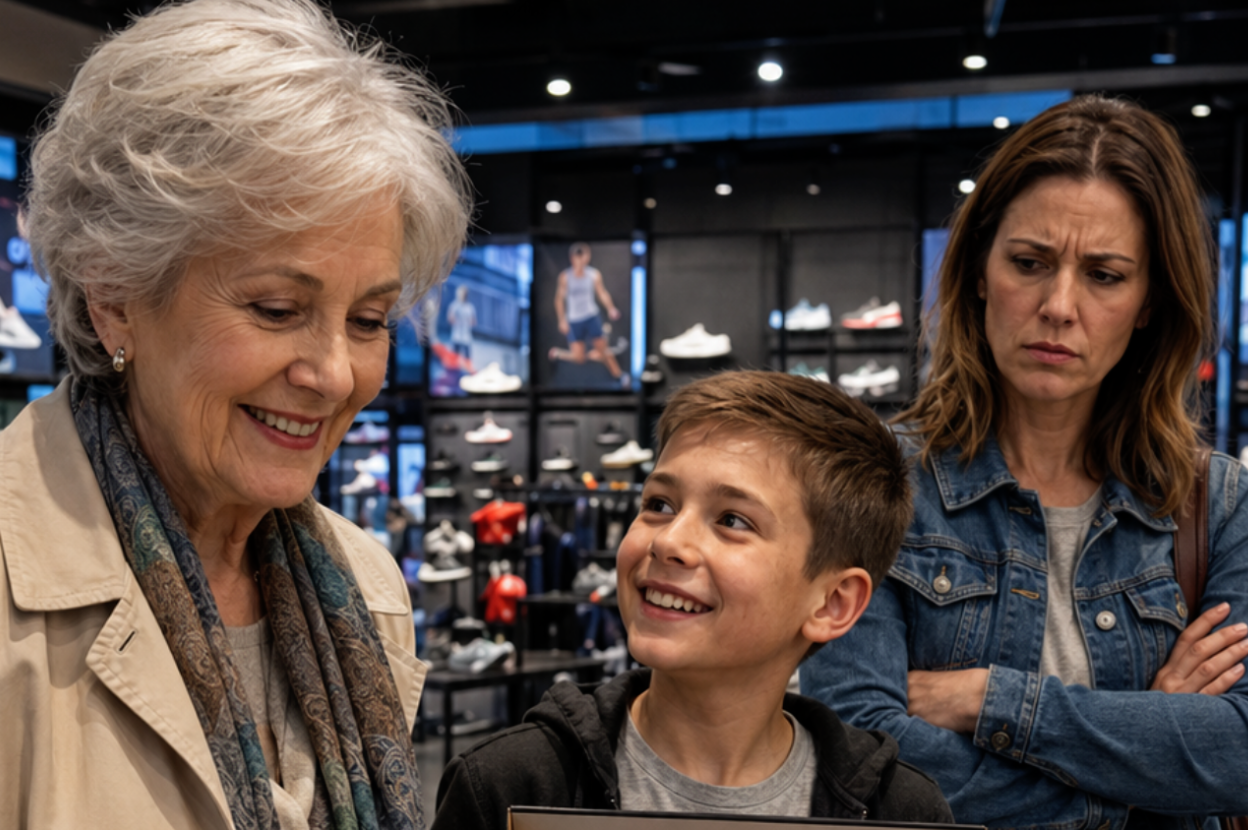
That Saturday, the three of them stood inside a sporting goods store. Timofey was trying on a second pair of cleats. Veronika silently looked at the price tag.
“Mom, these are expensive.”
“They are soccer cleats. For the tournament. From his grandmother.”
Veronika looked at Raisa Pavlovna, then at her son, and nodded.
Timofey chose a black pair with a green stripe.
Raisa Pavlovna paid with her own card and asked for the receipt to be placed inside the bag.
On the way home, Timofey walked ahead of them, holding the box against his chest like a trophy.
Veronika fell slightly behind.
“Mom.”
“What?”
“I’ll tell him about the coat. And about Suzdal. Not now, but I’ll tell him.”
Raisa Pavlovna did not rush her.
“All right.”
She knew one conversation would not be enough. Veronika might easily fall back into her old habits: it was easier to remain silent, easier not to explain, easier to say, “I do everything myself.”
Habits did not disappear in a single Saturday.
But now the cleats stood in her grandson’s hallway, with the receipt inside the box.
And the boy knew who had given them to him.
From that day on, Raisa Pavlovna never transferred money to her daughter’s card.
Whenever Veronika asked for something for Timofey, Raisa Pavlovna asked where she could pay directly.
Once, her daughter became offended and asked again, “What, you don’t trust me?”
Raisa Pavlovna answered briefly:
“I trust you. But I’ll make the payment myself.”
One day, Timofey’s class teacher, Oksana Vladimirovna, called to clarify the payment for a school excursion.
Raisa Pavlovna transferred the money directly to her and asked her to write in the payment record: “Paid by grandmother.”
“Of course, Raisa Pavlovna. No problem at all,” Oksana Vladimirovna replied.
It was only a small line in a school payment record.
But to Raisa Pavlovna, it carried more weight than the fifty thousand rubles she had given over two years.
The help had not disappeared.
Only one thing had disappeared—the possibility of pretending it had never existed.