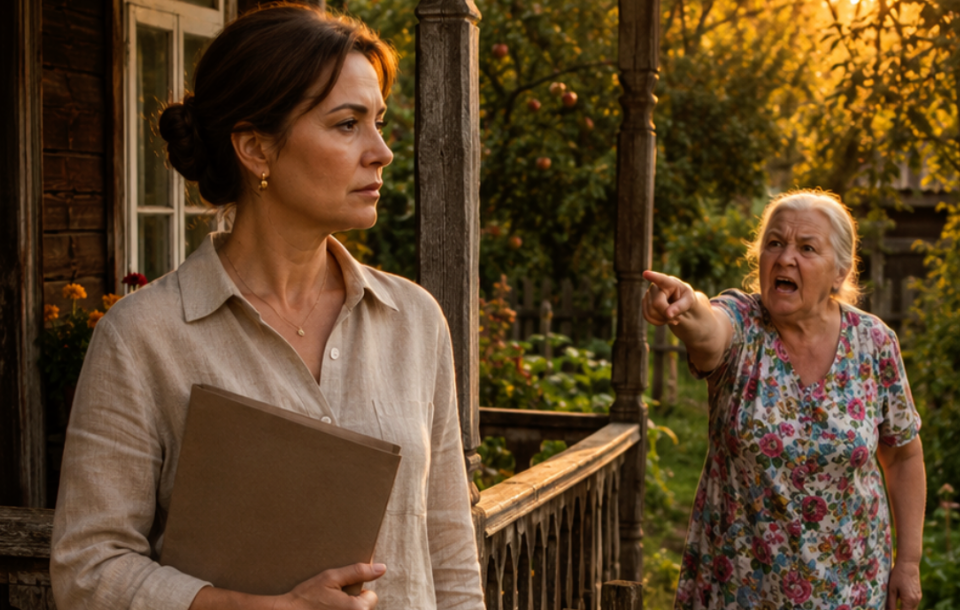
“Get Off My Dacha!”—So I Left, Taking the Deed of Gift with Me
Her mother-in-law shouted those words every summer. Tamara endured it because the country house was legally registered in her name. But that August, her patience finally ran out—and she did something no one expected.
Tamara stood on the porch, counting the boards. The third one from the left had dried out so badly that she could fit her little finger into the crack. She had noticed it the previous summer, but she still had not found the time to repair it.
Zinaida Pavlovna came out of the house, slammed the door, and placed an enamel basin filled with wet laundry on the railing.
“Why are you standing around? The tomatoes aren’t going to water themselves.”
“I only sat down for a moment.”
“She sat down, she says. Seryozha has been on his feet since six in the morning, and you’re sitting.”
Tamara did not argue. She stood up, slipped her feet into rubber sandals, and walked toward the vegetable beds. The soil was soft after yesterday’s rain and clung to her soles. The air smelled of dill and something sour, like an old barrel of water.
She squatted down, pulled the hose toward her, and opened the tap. The water hissed, spat out a stream of rust, and began to flow.
Seryozha really had been awake since six. But not because he was working. He was sitting in the car in the driveway, talking on the phone. Tamara had stopped asking who he was speaking to a long time ago. Not because she no longer cared, but because the answers had stopped changing anything.
Sergey’s parents had bought the dacha in 1992. Six hundred square meters of land, a prefabricated wooden cottage, and a well filled with cloudy water. Zinaida Pavlovna spoke about it as though it were a grand ancestral estate.
“Your father and I built every board with our own hands. Every single one.”
His father, Pavel Ignatyevich, had died in 2012. Quietly, in his sleep, at that very dacha, on a folding bed beside the window. After his death, Zinaida Pavlovna changed. She did not exactly become crueler. She became harder, as though tenderness had been a luxury she had allowed herself only while her husband was alive.
Sergey was her only son—and the only person capable of tolerating his mother for longer than two hours at a time. He had learned how to do it as a child: nod, agree, and retreat to the garage. He was five feet ten, with broad shoulders, but he hunched as if he were trying to make himself smaller. Tamara noticed it every time her mother-in-law raised her voice.
And she raised it often.
In 2014, they decided to transfer ownership of the dacha. Zinaida Pavlovna herself suggested it.
“We’ll put it in Tamara’s name. Sergey can never deal with documents properly, and you’re the one who takes care of everything here anyway.”
At the time, Tamara had not understood whether it was an act of trust or simply another responsibility being placed on her shoulders. But she went to the notary. The deed of gift was issued in her name.
It was now 2023. The original six hundred square meters had become twelve hundred. Tamara had personally negotiated with the neighbors and bought half of their abandoned vegetable garden. She installed a new fence, replaced the roof, and arranged for water to be brought in from a borehole instead of the old well. Every nail, every pipe, and every meter of plastic sheeting for the greenhouse had been paid for with her money.
She worked as an accountant for a construction company. Her salary was not enormous, but it was steady. She saved methodically, as she had always done: one envelope for the dacha, one for her daughter’s school expenses, and one marked “just in case.”
Sergey earned more, but money slipped through his fingers like water leaking from that old barrel. Where it went, Tamara tried not to think about.
Their daughter, Liza, was fourteen. She was slender and long-legged, with freckles scattered across the bridge of her nose and a habit of chewing the cap of her pen. She was desperately bored at the dacha, but she came every summer because her grandmother demanded it and her mother asked her to.
It all began in July, on the day Tamara brought home four cherry-tree saplings. Each one was wrapped in burlap, its roots still damp. She had spent two hours choosing them at the market, feeling the trunks, smelling the soil, and questioning the seller about the variety.
She wanted to plant them along the new fence, in the place where the gooseberry bushes had once stood.
“Who gave you permission to pull out the gooseberries?” Zinaida Pavlovna stood by the gate with her arms crossed. She wore a robe covered in large flowers, a scarf over her head, and her mouth was pressed into a thin line.
“Nothing has grown there for three years, Zinaida Pavlovna. There were only dry branches left.”
“Nothing grew because you didn’t look after them properly. Your father planted those gooseberries.”
Tamara said nothing. She placed the saplings beside the porch and went to get a shovel.
“I’m telling you not to touch that spot!”
Her mother-in-law had the kind of voice that could be heard two properties away. Their neighbor, Valentina, froze with a watering can in her hand as she tended her strawberries.
Tamara did not turn around. She drove the shovel into the ground and pressed down with her foot. The soil was dense and clay-like. The blade entered with difficulty.
“Seryozha! Tell your wife!”
Sergey came out of the house holding a mug of coffee. He looked at his mother, at Tamara, and at the saplings. Then he did what he always did: shrugged one shoulder and went back inside.
Tamara kept digging. Sweat ran down her temples, and her arms ached, but she continued. Each hole was neat and deep—exactly forty centimeters. She knew because she had measured them with a tape measure.
Zinaida Pavlovna went inside. She slammed the door. Then she slammed it again.
By evening, the cherry trees stood in a row like soldiers. Tamara watered each sapling, pressed down the soil, and tied the trunks to stakes. Her arms were black with dirt up to the elbows, soil had lodged beneath her fingernails, and her back hurt so badly that she could not straighten up on the first attempt.
Liza sat on the porch, drawing something in a sketchbook.
“Mom, it’s going to look beautiful.”
“They’ll blossom in three years.”
“I’ll already be in tenth grade.”
“You will.”
Tamara sat beside her and stretched out her legs. Her sandals were covered in clay. The sky was turning pink, and somewhere in the distance a grasshopper chirped.
For one brief moment, it seemed that everything was all right. That this was what life was supposed to be: cherry trees, an evening sky, and her daughter sitting beside her.
Dinner put everything back in its proper place.
Zinaida Pavlovna remained silent at the table. It was worse than shouting. She cut bread, moved plates, and poured soup, making every movement loud. The ladle struck the edge of the pot. A glass knocked against the table. The knife landed on the cutting board with a sharp tap.
Sergey ate quickly without looking up.
“The soup is hot, Liza. Blow on it,” Tamara said.
“I’m not a little girl.”
“I know.”
Zinaida Pavlovna put down her spoon.
“So, you pulled out the gooseberries.”
“I planted cherry trees.”
“I’m not talking about the cherry trees. I’m talking about the gooseberries. Your father planted them with his own hands.”
“They were dead, Zinaida Pavlovna. There were only dry sticks left.”
“They were sticks to you. They were memories to me.”
Silence fell.
Liza stopped eating. Sergey scooped up some soup and lifted the spoon to his mouth.
“Seryozha,” Zinaida Pavlovna turned toward her son, “you let her take over as though this were her dacha.”
He swallowed and wiped his lips.
“Mom.”
“What do you mean, ‘Mom’? She has dug up everything, put up her own fence, and now she’s planting trees. Soon she’ll throw me out.”
“No one is throwing you out,” Tamara said, trying to keep her voice even, though beneath the table her fingers clutched the edge of the tablecloth.
“Not yet. But what about later? The documents are in your name.”
There it was.
Tamara had been waiting for those words. Not because she had prepared herself, but because she had known that sooner or later they would be spoken.
“You were the one who suggested signing the deed of gift.”
“I suggested it because I thought you were a decent person. But you behave as though you own the place.”
“I do own it. Legally.”
Liza quietly stood up and left the table. Her footsteps echoed down the hallway, followed by the slam of her bedroom door. Tamara watched her go and felt something inside herself stretch to its breaking point.
“So, you’re the owner now.” Zinaida Pavlovna stood and planted her hands on her hips. Her lips trembled, but her voice remained firm. “Look at her, the owner. You came here when everything was already built and started giving orders.”
Sergey pushed away his plate.
“That’s enough. Both of you, enough.”
“You keep quiet. Are you even a man? Your wife leads you around by the nose while you sit there doing nothing.”
He stood up and left. A minute later, the front door slammed, followed by the sound of the car starting. He drove away.
Tamara remained at the table opposite her mother-in-law. The soup grew cold. Outside, darkness settled over the garden, and the window reflected two women sitting across from each other like mirror images.
Tamara did not sleep that night. She lay in the small bedroom, staring at the ceiling and listening to the house creak.
The old boards cooled during the night, and each one cracked in its own distinctive way. She knew every sound. That was the floorboard beside the door. Those were the rafters above the veranda. That was the apple-tree branch scratching against the window.
Sergey did not return.
She picked up her phone and looked at the screen. Not a single message.
She placed it back on the bedside table.
What was she supposed to do? Apologize? For the cherry trees? For the fence? For the borehole she had paid for herself? For the roof that had been replaced in November while she stood freezing on a ladder, handing sheets of metal roofing to the workers?
No.
She turned onto her side and pulled the blanket up to her chin. The sheets smelled of detergent and slightly of dampness. Behind the wall, Zinaida Pavlovna coughed and then fell silent.
Tamara closed her eyes and tried to remember the last time she had truly felt at home. Not at the dacha, and not in the city apartment. Simply at home—somewhere she could put down a cup without asking permission and plant a tree without having to justify herself.
She could not remember.
By morning, everything appeared normal.
Zinaida Pavlovna fried eggs while the oil spat and hissed in the pan. Liza sat with her phone, refusing to look up. Sergey returned at seven, quietly removed his shoes in the hallway, and entered the kitchen.
“Good morning.”
No one answered.
He sat down, took a slice of bread, and spread butter over it. His movements were familiar and mechanical, like those of a man who had long stopped noticing what he was doing.
Tamara drank tea by the window. Her mug was white, with a crack in the handle. She had bought it three years earlier at a fair in the district town because a blue house with a red roof was painted on the side.
Her daughter had said, “It looks like our dacha, only prettier.”
They had both laughed.
Now half the little house had faded away. The roof remained, but the walls had almost disappeared.
“Tamara, I got carried away yesterday,” Zinaida Pavlovna said without turning away from the stove. The spatula in her hand moved in steady circles above the frying pan.
Tamara raised her head.
“But you have to understand. This isn’t just a dacha to me. Your father spent every summer here. Seryozha ran around here when he was little. My whole life is here.”
“I understand.”
“No, you don’t. You are a good housekeeper, I won’t deny that. But sometimes I think you forget whose land this is.”
“Legally, the land belongs to me.”
“Documents. Everything is about documents with you young people. What about conscience?”
Tamara finished her tea and placed the mug in the sink. The crack in the handle had widened. She could feel it beneath her fingers.
“My conscience is clear, Zinaida Pavlovna. I’ve invested everything I could into this dacha.”
“Money, you mean? Money isn’t everything.”
“Not only money. Time. Strength. My health. I spend every weekend here from April through October.”
“And what? Did I ever stop you from coming? I’m only saying that you shouldn’t behave as though this were your own home.”
Sergey spread butter over a second piece of bread. The butter was soft, and the knife slid through it easily.
“Mom, maybe that’s enough?”
“You be quiet. Are you a man or a piece of furniture?”
Liza quietly left the kitchen. Tamara heard her putting on her shoes in the hallway and then the creak of the front door.
For a week, they lived in a cold war.
Zinaida Pavlovna spoke to Tamara through Sergey.
“Tell your wife the compost needs to be moved.”
“Tell your wife the gate is squeaking.”
Sergey repeated the messages without changing his tone, like an answering machine.
Tamara did everything that needed to be done. She watered, weeded, and repaired things. But something inside her had already shifted. It was like a loose tooth: it was still attached, and she could still chew, but she already knew what was coming.
On Thursday, Sergey’s sister, Valeria, arrived.
Tamara saw her only twice a year—at New Year and in August. Valeria was four years older than Sergey, wore glasses with thin gold frames, and spoke as though every word cost money. Briefly, precisely, without anything unnecessary.
“What is going on here again?” she asked, setting her bag down on the porch.
“Nothing,” Sergey replied.
“Right. Mother has called me three times. ‘She is throwing me out. She is taking over the place.’ What happened?”
Tamara told her everything. About the gooseberries, the cherry trees, the conversation at dinner, the documents, and the argument over whose land it was.
Valeria listened while removing her glasses and wiping them with the edge of her T-shirt. Without her glasses, her eyes looked small and attentive.
“I understand,” she said when Tamara finished. “Mother believes the dacha belongs to us by blood. You believe it belongs to you by right of labor.”
“I believe it belongs to me by right of ownership.”
“It’s the same thing.”
“No. It isn’t.”
Valeria put her glasses back on.
“All right. I’ll speak to her.”
She spoke to her mother for two hours behind the closed kitchen door. Tamara sat on the porch and heard their muffled voices, but she could not distinguish the words. Only once did Zinaida Pavlovna raise her voice.
“You’re on her side too!”
Then she immediately fell quiet.
Valeria came out with red blotches on her neck.
“It’s useless. She’s convinced you want to sell the dacha and leave her with nothing.”
“I don’t want to sell it.”
“I know. But she isn’t listening.”
On Saturday, Tamara drove into town to buy groceries. Her list was ordinary: milk, bread, cereal, and butter. She stood in line at the store, staring at the shelves and thinking about the dinner they would have that evening.
The silence would return. Zinaida Pavlovna would bang the dishes around again, and Sergey would hide behind his phone.
On the drive back, Liza called her.
“Mom.”
“What happened?”
“Grandma told you to get off her dacha.”
“What?”
“She said it exactly like that. She stood on the porch and shouted it. Dad is sitting in the car. I’m in my room.”
“I’m coming.”
Tamara pressed down on the accelerator. Her hands were damp against the steering wheel. The road wound between the fields, and the sun shone directly into her eyes. She lowered the sun visor, but it did not help. The light still found its way through—yellow, thick, and summery.
She passed the turn toward the river, then the bridge, and then the birch-lined road. She knew every tree along the route.
She had driven that road hundreds of times. Every time she approached the dacha, she felt something between joy and heaviness. As though she were coming home, although the place had never truly become a home.
Zinaida Pavlovna stood beside the gate. Robe, headscarf, arms crossed—the same pose Tamara had seen a thousand times.
“I’m serious. Get out. Get off my dacha.”
“Zinaida Pavlovna.”
“Don’t ‘Zinaida Pavlovna’ me. Pack your things and leave. Enough is enough. I have tolerated this for long enough.”
Tamara stepped out of the car and closed the door. The grocery bags remained on the back seat. The milk would grow warm and turn sour.
It did not matter.
“Do you understand that this dacha is registered in my name?”
“I don’t give a damn about your pieces of paper! This is my land! Mine and Pasha’s!”
Pasha. Pavel Ignatyevich.
Tamara suddenly remembered him: a quiet man with large hands and a habit of whistling while carving something in his workshop. He had never raised his voice. Not once in all the years Tamara had known him.
“Pasha would never have said that,” she said quietly.
Zinaida Pavlovna froze. For one second, then another. Her face turned crimson.
“Don’t you dare. Don’t you dare tell me what he would have said.”
“I’m not telling you. I simply know.”
“You know nothing! You’re an outsider! You weren’t here when we built this place! You weren’t here when he died!”
“I was. I arrived at four in the morning. I called the ambulance. You were sitting on the floor and couldn’t get up.”
Silence.
Somewhere behind the fence, a dog barked and then fell quiet.
Zinaida Pavlovna slowly lowered her arms.
“Get out,” she repeated, but more quietly this time, as though she no longer believed her own words.
Tamara entered the house.
She walked down the hallway, where every floorboard creaked. She passed the kitchen, her mother-in-law’s room, and the bathroom with the rusty tap she had replaced the previous year.
She entered her own room. Liza sat on the bed with her knees pulled up to her chest.
“Mom, are we leaving?”
“Pack your things.”
“For good?”
“Pack your things, Liza.”
Her daughter looked at her. There was something adult in that gaze, something Tamara had never noticed before—or had not wanted to notice.
“All right.”
They packed in twenty minutes.
Two backpacks, a bag of clothing, and Liza’s drawings, which she carefully removed from the wall one by one and wrapped in clean sheets of paper.
Tamara took the documents from the dresser drawer. They were inside a blue folder with an elastic band: the deed of gift, the cadastral papers, the contract for the borehole, and receipts for construction materials. Everything was neatly arranged by date.
She did not fold the bed linen. She did not wash her mug. She simply closed the bedroom door and walked out.
Sergey stood in the hallway. She had not heard him come in.
“Are you serious?”
“Are you?”
“Tamara, come on. Mother lost her temper.”
“She loses her temper every summer, Sergey. Every single summer. And every time, you go and sit in the car.”
“I don’t know what to do.”
“That’s the problem.”
He stood leaning against the doorframe, and his posture revealed everything Tamara knew about him: his unwillingness to choose, his unwillingness to take anyone’s side, and his unwillingness to remain anywhere things became difficult.
“Where are you going?”
“Back to the city.”
“And then?”
“I’ll figure it out.”
She walked past him. He did not move aside, and her shoulder brushed against his chest for a second. His T-shirt smelled of cheap cologne and tobacco.
Tamara stopped beside the gate.
Zinaida Pavlovna sat on the bench Pavel Ignatyevich had once built from pine boards. The wood had darkened, and moss grew in the cracks.
Her mother-in-law did not look at Tamara. She stared at the vegetable beds, at the tomatoes Tamara had tied up the previous week, at the cherry trees along the fence, and at the greenhouse shining beneath the sun.
“Zinaida Pavlovna.”
She did not answer.
“I’m leaving, as you requested. But the dacha remains mine—legally and because of everything I have invested in it.”
“You can’t.”
“I can. The deed of gift was signed and registered. You made that decision yourself.”
“I made it because I trusted you.”
“And you were right to trust me. I have never deceived you.”
Zinaida Pavlovna finally turned toward her. Her eyes were red but dry. There were no tears.
Tamara knew that expression: stubbornness that had long ago become a habit.
“Seryozha won’t allow it.”
“Seryozha is sitting in the car.”
It was cruel. Tamara knew that.
But it was true.
She placed the gate key on the porch railing—the same key she had ordered from a locksmith because the old one had broken two years earlier.
Liza was already sitting in the car. Tamara got behind the wheel and started the engine.
In the rearview mirror, she watched Zinaida Pavlovna rise from the bench and walk toward the porch, slowly and heavily, like a person who had just realized she had lost but had not yet decided whether to admit it.
Back in the city, the first thing Tamara did was take a shower.
It was long and hot. Water streamed over her shoulders as she stood with her forehead pressed against the tiles, breathing in the steam. The tiles were cold, the water hot. The contrast felt pleasant, and she did not move for almost ten minutes.
Then she put on a robe, made coffee, and sat at the kitchen table.
The apartment was quiet. Liza had gone to visit a friend. Tamara sat alone, and for the first time in years, the loneliness did not feel oppressive.
The blue folder lay on the table.
She opened it and sorted through the papers. The deed of gift from 2014. The cadastral passport. The property-register extract. The contract for drilling the borehole. Receipts, invoices, and bills.
It was her entire life over the previous twelve years, arranged in a neat pile.
The phone rang.
It was Sergey.
“Tamara.”
“Yes.”
“Mother is crying.”
“I know.”
“Come back.”
“No.”
“Tamara, why are you acting like a child?”
“Sergey, I am forty-two years old. I am not a child. I’m tired.”
“Tired of what?”
“Of you walking away every time your mother shouts. Of investing ten years of my life in the dacha only to be told to get out. Of you asking me what I’m tired of.”
Silence.
She could hear him breathing and, somewhere in the background, the ticking of a clock.
“So what happens now?”
“Now I will make my own decisions. About the dacha, about us, and about everything else.”
“Is that an ultimatum?”
“No. It is a fact.”
She ended the call.
Her coffee had gone cold. She drank it anyway. It was bitter and room-temperature, with a thin film floating on the surface.
Three days later, Valeria called.
“You’re seriously not coming back?”
“Seriously.”
“Mother says you want to sell the place.”
“I don’t want to sell it. I want people to stop calling me an outsider on land that belongs to me.”
“Tamara, she’s an old woman.”
“She is sixty-eight. She is in full possession of her mind. She knows exactly what she says.”
“All right. And what about Sergey?”
“What about him?”
“Are you getting divorced?”
“I don’t know yet.”
Valeria was silent for a moment.
“You have the right. To the dacha, to your anger, to all of it. I only want you to understand one thing: Mother cannot survive without that dacha. Not physically—emotionally.”
“I know. I have no intention of throwing her out. I was the one who left. There is a difference.”
“There is.”
A week passed, then another.
August moved beyond its midpoint. The nights grew longer, and the city smelled of hot asphalt and poplar fluff, though the season for poplar fluff should have ended long ago.
Tamara worked. She calculated other people’s estimates, checked invoices, and balanced accounts.
Numbers calmed her. They contained logic, order, cause, and effect.
Unlike life.
Liza enrolled in a summer art school. She came home in the evenings with paint stains on her fingers and talked about perspective, light, and shadow. Tamara listened, nodded, made sandwiches for her, and thought about how quickly her daughter was growing—faster than she could notice.
Sergey sent one message.
“The tomatoes are ripe. Mother can’t manage them.”
Tamara did not reply.
Then he wrote again.
“The tap in the greenhouse is leaking.”
She did not answer that message either.
During the third week, he came to see her. He did not call or warn her. He rang the doorbell in the evening, when Tamara was already wearing her pajamas.
“May I come in?”
“Come in.”
He sat in the kitchen on the chair beside the window—the chair he always used after returning from the dacha.
And suddenly she noticed that he had lost weight. His cheeks had become hollow, and shadows lay beneath his eyes. He wore the same T-shirt, but it hung more loosely on him.
“Tamara, Mother was taken to the hospital.”
“What happened?”
“Her blood pressure. The neighbors called an ambulance. She collapsed in the garden.”
“When?”
“The day before yesterday.”
“You didn’t call me the day before yesterday.”
“I didn’t know how.”
“You dial my number, Sergey. It isn’t difficult.”
He lowered his head.
His hands lay on the table, large and tanned. Hands capable of repairing and building many things, yet somehow never beginning.
“Is she all right?”
“They discharged her. They prescribed medication. But she can’t stay alone at the dacha, and I can’t be there all the time.”
“Why not?”
“Work.”
Tamara looked at him.
Work. Of course.
Work, his phone, the car, the road—anything that allowed him to avoid being where he was needed.
“What do you want from me?”
“Come back. At least until the end of the summer.”
“No.”
“Tamara.”
“No, Sergey. I will not return under the conditions of ‘get off my dacha.’ Your mother told me to leave. I left. That is all.”
“She didn’t mean it that way.”
“She meant exactly that. And you stood beside her and said nothing.”
He rubbed his face with both hands. Tamara watched his jaw muscles moving beneath his skin. He was clenching his teeth, a habit he had had since his youth.
“What do you want me to do?”
“Choose.”
“Between whom?”
“Between being a husband and being the stool your mother rests her feet on.”
He raised his eyes.
There was something in them Tamara had not seen for a long time. It was not resentment or anger. It was confusion—the genuine, childlike confusion of a man who had been forced for the first time to make a choice he could not avoid.
“I need time.”
“You’ve had twenty years.”
He left.
Tamara closed the door and leaned her back against it. She stood that way for a minute, perhaps two, before returning to the kitchen to wash his cup.
The cup was empty.
He had not even finished his tea.
At the end of August, Tamara drove to the dacha.
She went alone, without warning anyone, early in the morning while the city was still asleep.
The road was empty. The fields, the bridge, the birch trees—everything was the same.
But she looked at it differently now. Not as the road to a place where someone was waiting for her, but as the road to a place that belonged to her.
No one stood beside the gate. She opened the lock with her own key—the spare she kept in the glove compartment.
The garden looked tired.
The tomatoes were overripe, and some had split while still hanging from the vines. The cucumbers had turned yellow. The grass along the paths had grown knee-high.
But the cherry trees beside the fence stood straight, green, and strong.
They had taken root.
Tamara walked across the property as though moving over her own body. Her hands remembered every garden bed.
She had dug there in May. She had replaced a pipe here. There was the greenhouse, the borehole, and the shed with its new door.
Her slippers lay on the porch—yellow, with a worn-down heel.
Zinaida Pavlovna had not put them away. Perhaps she had not noticed them. Perhaps she had left them there deliberately.
The door was unlocked.
Inside the house, it smelled of something burned and of medicine.
Tamara walked into the kitchen. A pot of dried-out porridge stood on the table. Beside it lay a half-empty blister pack of tablets.
Zinaida Pavlovna sat in the armchair beside the window—the same armchair in which Pavel Ignatyevich had once sat.
She was asleep.
Or pretending to be.
Tamara stood in the doorway and looked at her mother-in-law. She appeared small and thin, with narrow hands resting on top of the blanket. Her scarf had slipped, revealing her hair—completely white and fine as cobwebs.
Tamara covered her legs with a throw, went into the kitchen, washed the pot, and wiped down the table.
Then she went outside and began collecting tomatoes.
They were ripe, soft, and warm from the sun. Some were so tender that they burst between her fingers, and their juice ran down her wrists, red and thick.
An hour later, Zinaida Pavlovna came out onto the porch. She stood holding the railing and watched.
“You came.”
“The tomatoes are going to waste.”
“I couldn’t manage.”
“I can see that.”
Silence.
Tamara continued picking. The bucket was already half full.
“Tamara.”
“Yes?”
“I should not have spoken to you that way.”
Tamara straightened up. Her back began to ache again, but differently this time—not from exhaustion, but from tension slowly releasing.
“No, you shouldn’t have.”
“I know.”
Zinaida Pavlovna remained standing there for another moment. Then she slowly descended the porch steps, holding tightly to the railing, and approached Tamara.
She stood beside her.
She could not help because her hands were too weak. She simply stood there.
“The cherry trees took root,” Zinaida Pavlovna said.
“They’ll blossom in two years.”
“Your father would have approved.”
Tamara did not answer.
She placed another tomato into the bucket, carefully so it would not bruise, and continued gathering the crop.
The wind moved through the cherry trees. Their leaves rustled softly, like whispers.
The sun stood high in the sky, and the shadows were short and sharp. Somewhere far away, beyond the field, a grasshopper chirped.
Perhaps it was the same one.
Perhaps another.
The key lay on the porch railing, exactly where Tamara had left it.
She did not pick it up.