My Sister Stole My Fiance and Invited Me to Their Wedding. I Didn’t Go. Years Later, She Came to Borrow Money—and Discovered What My “Failed” Choice Had Become
She called on Wednesday, around noon.
I was organizing the cost estimates for a new project into folders—a private property outside Moscow. The client wanted a Japanese garden, and Andrei and I had already spent three weeks working through the materials, ponds, and water features.
My phone was lying faceup on the desk. Her name appeared on the screen, and for several seconds I simply stared at it.
Alina.
Ten years—and suddenly, Alina.
I answered. I should explain what happened before that.
Not because I enjoy remembering it, but because none of this will make sense otherwise.
I was twenty-four when it happened.
Denis and I had been together for three years. We met when I was twenty-one. I wouldn’t say it was some grand love story from a novel, but it was real.
He knew how I drank my tea—without sugar, with a slice of ginger.
I knew he was terrified of dentists and would never admit it.
After three years, you’re no longer simply dating. You’re already sharing a life, even if you technically live in separate apartments.
Alina is three years older than me.
She was bright, loud, and knew how to enter a room in a way that made everyone turn around.
I had always been different—quiet, with a pencil tucked behind my ear and a notebook in which I had been drawing garden layouts since I was fifteen.
We had never been especially close, but I believed that a sister was still a sister.
I believed that meant something.
Apparently, it didn’t.
I didn’t find out from her.
Mom called me. Her voice sounded strange, and by the third word I already understood that she was afraid to tell me.
Denis and Alina.
It had apparently been going on for a long time.
Several months already.
While I believed everything between Denis and me was fine, while I was planning to move closer to his side of the city, he had been seeing my sister.
I didn’t scream.
I didn’t cry while Mom was on the phone.
I ended the call, stood by the window for about five minutes, then took out my notebook and started drawing.
I don’t know what I drew—just lines, outlines, something resembling a hedge.
My hands found something to do while my mind tried to understand what had happened.
Denis called that evening.
He explained.
I listened calmly, all the way to the end.
Then I said:
“I understand.”
That was all.
Alina called a week later.
There was something in her voice—a little guilt, but already mixed with something else.
Certainty.
She said that she and Denis were going to be together. She said she hoped I would understand.
Then—and I still remember the pause before she said it—she told me they were planning a wedding and that she would really like me to attend.
Because we were sisters, after all.
I immediately ended the call.
Not dramatically. I simply pressed the button and placed the phone on the table.
Then I went into the kitchen, put the kettle on, and waited for the water to boil.
I drank tea without sugar, with ginger.
And I began thinking about how I was going to live from that moment on.
I didn’t go to the wedding.
I explained my decision to Mom once, briefly.
She didn’t accept it.
She talked for a long time about how family was family, how I would regret it, and how Alina hadn’t done it deliberately—it had just happened.
I listened to everything.
Then I said:
“Mom, I heard you.”
And I never discussed it again.
A few months later, I met Andrei.
I wasn’t looking for anyone. We simply crossed paths while working on the same project. He was handling the electrical work, and I was designing the property.
He looked at my sketches and said:
“This is serious.”
It wasn’t a compliment.
It was an assessment.
I remembered it.
For a year after Alina’s wedding, Mom continued talking to me as though I had done something wrong.
She never said it directly. She never said anything directly.
But every conversation carried the same message:
You’re proud.
You’re stubborn.
You put yourself above the family.
Meanwhile, according to Mom, Alina was doing very well.
Denis had a job. They had bought a car. They were thinking about getting a country house.
I listened and focused on my own life.
That year, I accepted my first independent project—a small front garden in Serpukhov.
The owner wanted something “simple, but impressive enough to make the neighbors jealous.”
I did it.
Later, she sent me photographs and wrote that the neighbors really had started asking questions about the garden.
I printed those photographs and placed them in a folder.
My first folder contains a completed project.
Mom would ask:
“How long is this little hobby of yours going to last?”
Alina thought the same way.
I knew because Mom occasionally repeated other people’s words without realizing that she was repeating them.
It was temporary, apparently.
Not serious.
I should have chosen a proper profession instead of digging around in people’s gardens with a shovel.
I didn’t argue.
I simply kept working.
Then Mom came up with an idea that probably seemed brilliant to her.
Alina and Denis had bought a small plot for a country house.
Only six hundred square meters, but they wanted to make it look “proper.”
Mom suggested:
“Marinochka, you know how to do these things. Design it for them. They’re family. Do it as a favor.”
Back then, I still hadn’t learned how to say no to Mom.
That came later, with experience.
So I took on Alina and Denis’s property.
It was seven years ago. I was twenty-seven. By then, I understood what I was doing, but I still didn’t fully understand what my work was worth financially.
Four months of work.
Measurements.
Sketches.
Three different layout options.
Discussions with Denis about materials.
Trips to the property.
On-site supervision while the paths were being installed.
I did everything.
I didn’t take a single ruble.
Mom had said, “They’re family,” and I nodded.
Alina accepted the completed project casually.
It wasn’t that she didn’t thank me at all.
There was a brief thank-you, delivered through Mom.
Something along the lines of:
“Tell her it turned out all right.”
All right.
Four months of work had turned out “all right.”
A year later, she requested a second phase.
A gazebo.
Pathway lighting.
Another area for vegetable beds.
Again, the request came through Mom.
“Marinochka, you do this kind of work anyway. It won’t be difficult for you.”
That was when I finally calculated everything.
I took out a calculator, found the market rates from that period, and worked out how much the work I had already completed was worth.
The result was almost 280,000 rubles.
That was based on market rates, without any markup—just the labor and the site visits.
I called Mom and said:
“I’m prepared to do the second phase. With a contract and at the standard market rate, just as I would for any other client.”
Mom was upset.
Alina—again, I heard this through Mom—decided that I had become conceited and greedy.
She said I used to be normal, but now something had happened to me.
Money had probably corrupted me.
After that conversation, the silence stretched on for six years.
Altogether, nine years had passed since the wedding I hadn’t attended.
During all that time, we were strangers connected only by our mother.
I didn’t suffer because of it.
I married Andrei.
We registered our marriage quietly, without a large celebration. We invited about ten people—the ones who had truly been there for us.
I registered as a sole proprietor six years ago, immediately after the final break with Alina.
It was as though one door had closed and I had immediately pushed another one open.
I kept accepting projects.
Small ones at first, then larger ones.
Three years ago, we completed our first major commercial project.
Last year, we completed three.
Two of them were featured in a professional industry magazine.
The folders containing those projects stand on a shelf in my office, arranged by year with the labels facing outward.
I don’t hide them.
Work is work.
Mom still called occasionally.
She talked about her life, and I listened.
In recent years, she barely mentioned Alina.
Once, she casually said that things between Alina and Denis were “not going smoothly.”
I didn’t ask any questions.
“Marina, it’s me,” Alina said.
Her voice was the same—low and slightly hoarse.
But there was something new in it now.
Tension, perhaps.
The voice of someone who had prepared for a conversation and still wasn’t ready for it.
“I can hear you,” I replied.
There was a pause.
Apparently, she had expected something different—an exclamation, a question, surprise.
I remained silent.
“Aren’t you going to ask how I am?”
“You called me. That means you’re going to tell me.”
Another pause.
Then she said:
“Can we meet? I need to talk to you. In person.”
I looked at my desk.
Three folders.
The cost estimate.
Pencils.
The sketch of the Japanese garden, with Andrei’s notes in the margins.
It was a working day, and I had enough tasks to keep me busy until evening.
“Tonight,” I said. “After six.”
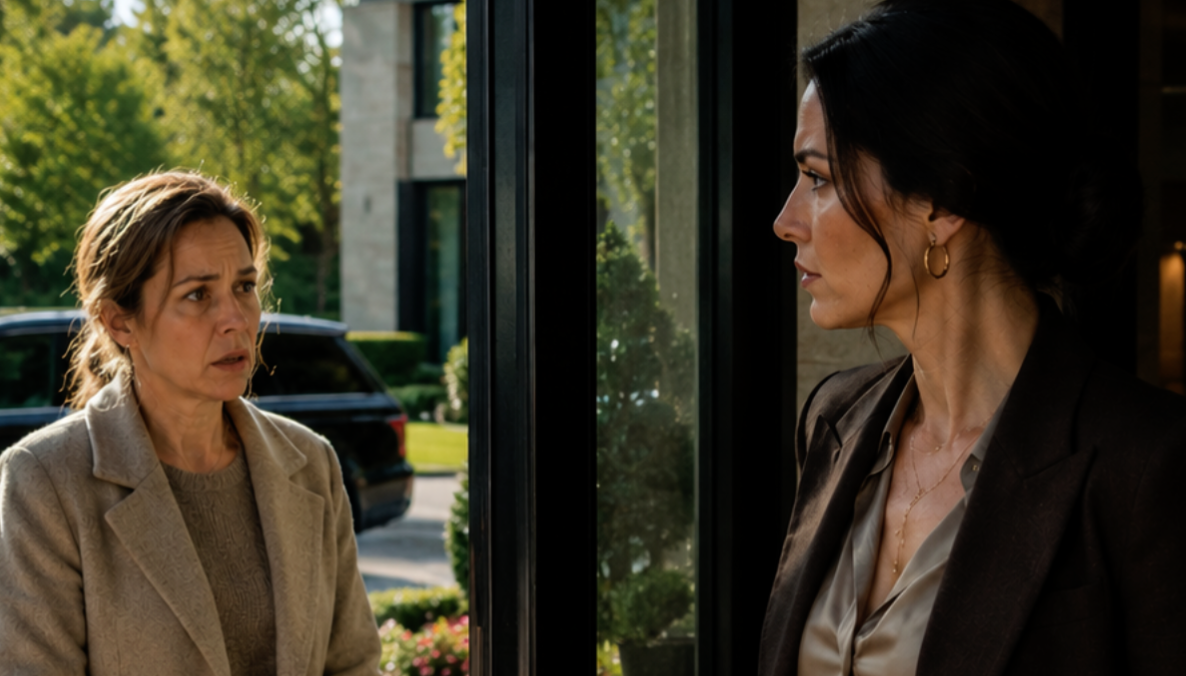
Alina arrived shortly after six.
I opened the door, and the first thing she did was inspect the hallway.
She didn’t do it quickly or discreetly.
She looked around openly, the way people examine someone else’s belongings while estimating how much everything costs.
The new floor tiles.
The custom-built shoe shelves.
The coat rack Andrei had brought back from a business trip.
“Not bad,” she said.
Not “hello.”
Not “it’s been a long time.”
Not bad.
“Come in,” I replied.
I led her into the office.
Andrei and I had converted one of the rooms into a shared workspace.
There was a desk, two monitors, shelves filled with folders organized by year and project, and several printed photographs of completed properties hanging on the wall.
Alina stopped in the middle of the room and slowly examined the shelves from left to right.
Three folders from the previous year.
Two magazines with bookmarks sticking out of them.
A stack of sketches.
Then she looked at the photographs.
Land.
Greenery.
Stone.
Water.
The “unsuccessful hobby” that had turned into all of this.
“You’re doing this seriously,” Alina said.
There was genuine surprise in the word “seriously.”
Real, undisguised surprise.
“Sit down,” I said.
Alina sat on the chair.
I immediately noticed the way she held her handbag—on her lap, gripping it with both hands.
That is exactly how a person holds their belongings when they have come to ask for something.
We spoke for a while.
About Mom.
About the weather.
About how long it had been since we had seen each other.
Alina spoke evenly, almost cheerfully, but the tension never disappeared.
I waited.
About ten minutes later, she finally got to the point.
“Marina, we’re in a difficult situation. Denis is having problems at work, and we’ve gotten ourselves into debt. The country house is being used as collateral.”
She paused.
“We need 500,000 rubles. Just for six months, at least. Then we’ll pay you back. You understand—I wouldn’t have come if things weren’t truly desperate.”
I looked at her.
Alina looked back at me, waiting.
“I understand,” I said.
She relaxed slightly.
Too soon.
I remained silent for about ten seconds.
Then I stood up, opened the bottom desk drawer, and took out a folder.
It wasn’t one of the folders containing our current projects.
It was old, with worn edges and a faded label on the spine.
I never throw away old estimates.
A document is a document. You never know when you might need it.
That folder had been lying in the drawer for seven years.
I opened it to the correct page and placed it on the desk in front of Alina.
I knew that page by heart.
During the year when everything happened, I had read it many times, repeatedly calculating the numbers and asking myself whether I had been right.
“This is the estimate for your property,” I said. “From seven years ago. Four months of work. Measurements, three layout options, on-site supervision, six visits.”
I pointed to the final line.
“Two hundred and seventy-eight thousand rubles, based on the market rates at the time. I did all of it for free. Because you were family.”
Alina stared at the page.
She said nothing.
“You came here to talk about money,” I continued. “So let’s talk honestly about money. Here is one amount. You have another one. You simply remember your number, while apparently forgetting this one.”
“Are you serious?” Her voice became harder. “That was a hundred years ago. That was help for the family. Are you billing me for it now?”
“I’m stating the numbers,” I replied. “You’re stating numbers too. Five hundred thousand is a number. Two hundred and seventy-eight thousand is also a number. Since we’re calculating, I suggest we calculate everything together.”
Alina stood up.
She was still gripping her handbag with both hands.
“You haven’t changed,” she threw at me.
I didn’t answer.
I simply looked at her.
Alina walked through the hallway and opened the front door.
She turned around on the threshold.
I thought she was going to say something else.
Instead, she simply looked at me for several seconds and left.
I closed the door.
I stood silently in the hallway for about thirty seconds.
Then I returned to the office, placed the folder back in the bottom drawer, and sat down at my desk.
I picked up my pencil.
I looked at the sketch of the Japanese garden.
Stones.
Water.
Clean, precise lines.
Everything in its proper place.
Two weeks passed.
Alina didn’t call.
Mom called on the third day.
Her tone immediately told me that Alina had told her everything.
Mom spoke for a long time.
I listened.
She talked about how a sister was still a sister.
How money wasn’t the most important thing.
How I could have helped.
I said:
“Mom, I love you. Goodbye.”
That evening, after Alina left, Andrei asked me only one question:
“How are you?”
“I’m fine,” I said.
He nodded and put the kettle on.
We drank tea and looked out the window at our yard.
A thuja tree has been growing there for three years now. Andrei and I planted it ourselves.
And, incidentally, it took root.
The folder containing the estimate is still in the bottom drawer.
I haven’t thrown it away.
A document is a document.
I sleep peacefully.
For the first time in a long while, truly peacefully—without feeling that something somewhere has been left unresolved.
Did I go too far that day, or did I do the right thing?
Tell me.