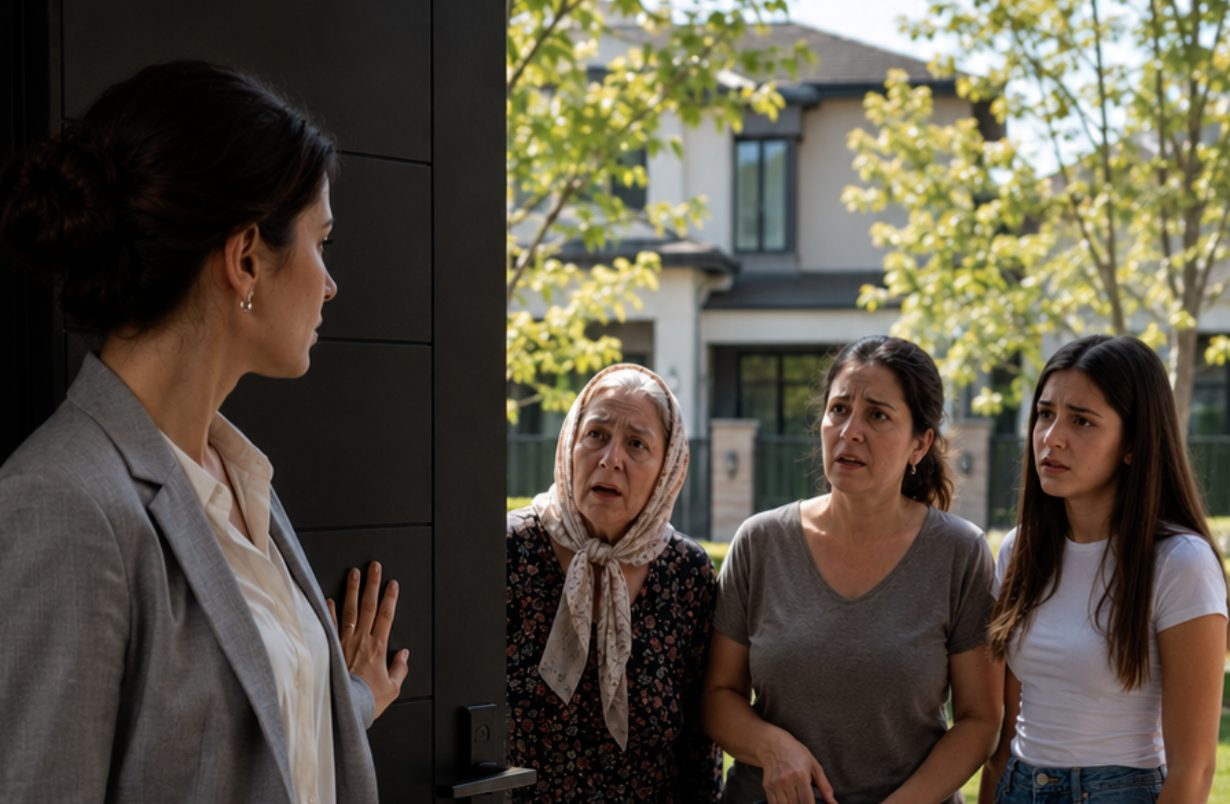
“I Bought This House Alone—and We’re Going to Live Here Without Your Mother, Your Sister, or Your Niece!” Vika Declared Firmly Before Slamming the Door in Their Faces
Vika slammed the door shut. The heavy door, reinforced with black metal, crashed so loudly that the foundation of the new house seemed to tremble. From outside came the indignant shriek of her sister-in-law, Lera, the tearful whimper of her niece, Alisa, and the theatrical cry her mother-in-law, Tamara Petrovna, had perfected over the years:
“Denis! Deniska! Your wife is throwing us out into the cold! Do you see this, son? Do you see the kind of woman you brought into this family?”
Vika leaned her back against the cold door and closed her eyes. Her heart was pounding somewhere in her throat, and there was a metallic taste in her mouth, like after chemotherapy. She swallowed and slowly exhaled. Her temples throbbed, circles floated before her eyes, but she forced herself to remain upright.
Three hours earlier, she and Denis had been moving into this house together, happy.
Or at least she had thought they were happy.
She remembered turning the key in the lock and feeling like the mistress of her own home for the first time in many years. The two-story house outside the city smelled of fresh paint and wood. In the living room stood the enormous sofa she had chosen herself, without asking her mother-in-law’s opinion. New appliances gleamed in the kitchen. Upstairs, a huge bed with snow-white sheets waited in the bedroom, and Vika dreamed of only one thing—to lie down and disappear into sleep, without pain, without fear, without endless tests and doctors.
Denis bustled around beside her, unloading boxes from the car. He was a handsome man: tall, with gentle features and a permanently guilty look in his eyes. Once, that expression had seemed touching to her. Now she knew it concealed weakness.
“Why are you just standing there, Vikulya?” he asked with a smile as he carried in the final bag. “Here it is—our house. You’re amazing. You’re practically a magician for managing to organize all this.”
“I managed it,” Vika repeated silently. “I did. Alone. Without your mother, without your sister, without their advice or involvement. I bought this house with my own money—the money I earned while you were searching for yourself in music, business, and all your other failed projects.”
But she did not say any of that aloud. She merely nodded and stepped across the threshold.
The house greeted them with silence.
But the silence was deceptive.
Someone was already sitting in the living room, on the very sofa Vika had chosen with such care. The room smelled of unfamiliar perfume, cheap coffee, and something else—something stale, like an old apartment whose windows had not been opened for years.
The first person Vika saw was Tamara Petrovna. Her mother-in-law sat in the middle of the sofa like a queen upon a throne. Her plump hands were folded in her lap, and her face wore an expression of offended dignity.
Beside her sat Lera, Denis’s younger sister—a thin, nervous woman with a sharp nose and lips that were perpetually pressed together.
In the corner, staring at her phone, sat Alisa, Vika’s niece by marriage. The girl was fourteen, but she looked older because of her heavy, exhausted gaze and the baggy clothes that concealed her figure.
At Lera’s feet stood a large cage. Inside, rustling through the wood shavings, ran a rat. White, with red eyes, it busily gnawed on a piece of cardboard, paying no attention to the people around it.
Beside the sofa towered a mountain of suitcases. Old and battered, tied with ropes and tape, they looked like refugees from another life. And Vika realized that the stale smell was coming from them.
“Oh, Deniska!” Tamara Petrovna sang, rising to greet her son. “At last! We’ve been waiting forever. Haven’t we, Lerochka? Tell him how long we’ve been waiting.”
“We certainly have,” Lera said, pursing her lips. “I was beginning to think they had traffic jams out here. Although what traffic could there possibly be outside the city? This place is the middle of nowhere. I don’t understand why anyone would buy a house so far away. There aren’t any proper shops or people around. But you know best, don’t you, Viktoria? You always know best.”
Vika stood in the doorway, unable to move. She stared at the suitcases, the cage containing the rat, and the smug faces of her husband’s relatives. A dark, suffocating fury began to boil inside her.
It was the kind of anger she had long ago learned to suppress and bury deep within herself because shouting and arguments never solved anything.
But today, something inside her snapped.
“What is the meaning of this?” she asked quietly, looking at her husband.
Denis went pale. He clearly knew nothing about it. His bewildered gaze darted between his mother and his wife.
“Mom?” he managed. “Why are you here? I didn’t…”
“What do you mean, you didn’t?” Tamara Petrovna interrupted. “Are we strangers? This is your house, Deniska. You’re the man of the house. And we are your family—your own flesh and blood. We rented out our apartment, Deniska. We rented it because we have nothing to live on. You know that after your father died, all we were left with were debts. Lerochka works two jobs to feed Alisa, and I’m a pensioner. I have diabetes, my blood pressure keeps rising. Where are we supposed to go? We can only come to you.”
“But…” Denis began, then fell silent.
“But what?” Lera demanded. “Denis, do you even understand what’s happening? While you’re building mansions out here, your own mother is crammed into a rented apartment. We can barely make ends meet. Aren’t you ashamed?”
Vika heard Denis swallow. She saw the familiar guilt spread across his face. Tamara Petrovna had spent her whole life manipulating her son through his sense of obligation.
“Mom, you should have warned us,” he mumbled pitifully. “We could have discussed it…”
“What is there to discuss?” his mother snapped. “Are you a man or a doormat? People make decisions in your own home without consulting you? I see Viktoria has already decided everything—who gets to live here and who doesn’t. And you’re nothing but an accessory, is that it?”
Vika gave a bitter smile. It was not a happy smile, but it cleared her mind. She turned toward her husband.
“Denis,” she said calmly, “please step aside.”
“Vika, I…”
“Step aside.”
She walked over to the sofa, looked around at the suddenly silent relatives, then bent down and picked up the rat cage. Lera jerked forward, but Vika was already walking toward the front door.
She opened it and carefully placed the cage on the porch.
“Hey!” Lera shrieked. “What are you doing? That’s my Busya! She’s a pedigree rat!”
“Then take your Busya,” Vika said as she returned to the living room. “Take your suitcases, take your mother, and leave. You do not live here, and you will not be living here.”
Silence descended.
Tamara Petrovna’s face turned crimson. Lera opened her mouth but could not produce a sound. Alisa looked up from her phone and stared at Vika with unexpected interest.
“What do you mean, we won’t be living here?” her mother-in-law finally hissed. “Denis! Do you hear this? Your wife is throwing your mother out into the street!”
Denis stepped forward, but Vika raised her hand.
“Be quiet,” she told him. “Just be quiet.”
Then she turned toward his relatives and spoke evenly, without shouting, but with such steel in her voice that even Alisa flinched.
“I bought this house alone. And we are going to live here without your mother, your sister, or your niece.”
With those words, she took Tamara Petrovna by the elbow and firmly, though not roughly, escorted her toward the exit.
Lera followed, gasping for air like a fish thrown onto the shore and dragging Alisa by the hand. The girl walked silently and did not even look back. On the threshold, Tamara Petrovna tried to say something, but Vika had already shut the door.
The same heavy door reinforced with black metal.
And now Vika stood with her back against it, listening to the shouting outside. Denis paced around the living room, clutching his head.
“What have you done?” he shouted, his voice breaking into a shriek. “You threw out my family! My mother! Do you even understand what you’ve done?”
“I understand,” Vika answered quietly. “I understand very well. Better than ever before.”
She looked at her husband, and images from the past rose in her memory.
There they were, meeting at some party: Denis charming and cheerful, singing with a guitar and promising her the stars.
There was her first meeting with his mother: Tamara Petrovna inspecting Vika as if she were merchandise in a shop window before delivering her verdict.
“Too thin, too focused on work. You probably won’t even want children.”
There was their wedding—modest because the groom’s family had no money—and Tamara Petrovna complaining all evening that the restaurant was wrong and the bride’s dress was too revealing.
Then came the first years of their marriage. Denis tried music, then business, then music again, while Vika carried everything on her shoulders. Her small advertising agency, which she had built from nothing, grew and began generating a solid income, while her husband continued searching for himself.
Her mother-in-law asked to borrow money, and Vika gave it without asking when it would be repaid.
Lera took a job as a secretary at Vika’s office and ruined an important contract within a month. Vika quietly dismissed her.
Tamara Petrovna came to confront her and screamed in the reception area:
“You’ve left Denis’s sister without a crust of bread!”
Denis was too afraid to raise his eyes.
“Vik, maybe you could give her another chance? Mom is worried…”
Vika closed her eyes.
Another memory appeared before her, the most terrifying one of all.
A doctor’s office. White walls. The smell of medicine. The exhausted doctor taking off his glasses and saying:
“Viktoria, the test results are bad. Very bad. You need surgery as soon as possible. After that, there will be a long recovery. But as you understand, no one can offer guarantees.”
She had not told Denis.
At first she had wanted to, but then she had changed her mind because she knew he would run to his mother. And his mother would begin offering advice, interfering, and pressuring her.
Even then, Vika had understood that if she was going to survive, she needed peace.
Absolute, sterile peace.
The house had become her refuge, her fortress. She bought it with her hard-earned money, registered it solely in her own name, and refused to let anyone interfere.
Denis was still shouting. He paced around the living room, accusing her of being heartless, of humiliating him in front of his family, and of having no right to treat his mother that way.
Then he struck the wall with his fist beside her head.
Vika did not even flinch. She merely studied her husband with a long, searching gaze.
“Your mother,” she said slowly, “has never done a single good thing for us. She has only taken from us. Your sister is exactly the same. And you expect me to continue tolerating it?”
“They’re my family!” he shouted.
“Then what am I?”
Denis froze. His face twisted as he struggled to find an answer, but Vika had already turned away.
She suddenly felt unbearably ill. The familiar dull pain in her right side returned with renewed force. She slipped her hand into her pocket and felt the painkiller ampoule.
She forced herself not to take it out.
Not now.
Not in front of him.
“They’re my responsibility,” Denis said hoarsely, lowering his head.
“Your responsibility,” Vika echoed, “does nothing but spend my money. And you… you’re nothing but a doormat.”
He recoiled as though she had slapped him.
But before he could answer, someone began knocking loudly and insistently at the door.
“Police! Open the door! We received a call!”
Vika smiled bitterly.
Of course.
Her mother-in-law would not have been herself if she had failed to use every available method.
Vika opened the door.
A local police officer stood on the porch. He was a man of about fifty, with a tired face and attentive eyes. Behind him hovered Tamara Petrovna, clutching a handkerchief to her chest. Lera held the rat cage and peered from behind her mother’s shoulder. Alisa stood a little farther away, still staring at her phone.
“Good evening,” the officer said wearily. “We received a complaint that you threw an elderly woman and a child into the street. What is going on here?”
“They entered my house without permission,” Vika replied evenly. “I bought this house before marriage, and it is registered in my name. Here are the documents. These people are my husband’s relatives. They arrived without an invitation and are refusing to leave.”
The officer frowned and looked at Tamara Petrovna.
“That’s a lie!” her mother-in-law shrieked. “This house belongs to my son! We are his family! We have the right to live here! And she… she’s simply insane! She’s infertile! She can’t give birth, so she takes her anger out on everyone else!”
The final word struck Vika like a slap.
Infertile.
How many times had she heard her mother-in-law whisper it behind her back or casually throw it into conversation?
Now she had said it directly to her face.
In front of witnesses.
“Ma’am, calm down,” the officer said sternly. “If the house does not belong to you or your son, then you have no legal grounds to live here. I am asking you to leave voluntarily. Otherwise, a report will be filed for unlawful entry.”
Tamara Petrovna’s face turned crimson. Lera clenched her fists.
“But we have nowhere to go!” Lera suddenly shouted. “We rented out our apartment! We have no place to live! We’re going to end up on the street!”
The officer sighed and rubbed the bridge of his nose. It was obvious that he had already had enough of the entire situation. He looked at Vika.
“Could you let them stay until morning?” he asked quietly. “Just as a human kindness. They can sort things out tomorrow. You can’t leave them outside all night.”
Vika remained silent.
She looked at Alisa. The girl finally raised her eyes from her phone, and there was such sadness and such hopeless understanding in them that something inside Vika softened.
She remembered herself at fourteen: her constantly dissatisfied mother, the lack of money, and the shame she had felt because of her family.
“Fine,” Vika said firmly. “They can stay for the night. But only until morning. They will use the guest room on the ground floor. Tomorrow, at nine o’clock, they must be gone. Otherwise, I will call security and have them removed by force.”
She threw the key to the guest room onto the floor in front of Lera, turned around, and went upstairs.
The guest room was cold.
Tamara Petrovna sat on the edge of the fold-out sofa, pressing her lips together. Lera paced around the cramped space, while Alisa sat on the windowsill and stared silently into the darkness outside.
“Did you see that?” Lera hissed. “She threw the key at us like we were dogs! Infertile doll! Denis is completely under her thumb. Mom, we have to do something. We can’t leave! We really don’t have any money! Yes, we rented out our apartment, but that little bit barely covers food!”
“Don’t panic,” Tamara Petrovna replied coldly. “Denis is my son. He won’t allow her to throw us out. I’ll speak to him tomorrow. He has always listened to me, and he always will.”
“And what about her? What do we do with her?” Lera nodded toward the staircase leading to the second floor.
“What about her?” her mother shrugged. “I searched through her study while all of you were making noise. Do you know what I found? A safe. I didn’t manage to open it because she came back too quickly, but I caught a glimpse of what was inside. It wasn’t just money. There were documents. Medical records. I managed to read the word ‘oncology.’”
Lera froze.
Alisa flinched almost imperceptibly but continued staring out the window.
“Oncology?” Lera repeated. “Are you sure?”
“I’m certain,” Tamara Petrovna nodded. “I wanted to ask Deniska about it, but you interrupted me with your shrieking. Now it’s obvious why she’s so nervous. She’s afraid she’ll die and the house will go to us.”
“Will it?”
“What do you think?” her mother lowered her voice. “If she dies, all her property will pass to Denis. And Denis is my son. That means the house will belong to us. We only have to wait.”
“How long will we have to wait?” Lera asked practically.
“I don’t know. But judging by the pills she keeps swallowing, not very long.”
Alisa jumped down from the windowsill and left the room without saying a word. Her mother and grandmother did not pay attention to her.
They had more important things to discuss than a teenager.
Meanwhile, Vika stood before the open safe in her study. Her hands trembled as she went through the papers.
Everything was there: the medical reports, the test results, and the bills for an expensive operation at a Swiss clinic.
And the money.
Five million in cash.
She knew keeping such a large amount at home was foolish, but she was afraid that if she was rushed into intensive care, Denis would not have the courage to withdraw the money from her private account.
She would die while he was asking his mother for the password.
Everything was still there. Nothing had been taken.
But she knew someone had searched through the safe. The documents were arranged slightly differently than she had left them. The envelope of cash had been moved.
She lowered herself into the chair and covered her face with her hands.
The pain in her side had become almost unbearable. Vika took out the ampoule and injected herself directly through her jeans. Then she froze, waiting for the medicine to take effect.
Outside, the pine trees rustled. The house was silent.
Far too silent for a house filled with people.
At around two in the morning, she went downstairs because she wanted some water. As she passed the guest room, she heard muffled voices and stopped.
“…she’ll be dead soon,” came her mother-in-law’s voice. “Then we’ll finally start living properly. Deniska will get over her quickly. We’ll find him a normal woman. One who can give him children. This one… this one was nothing but a mistake. I knew from the beginning she wasn’t right for us.”
“Does she have money?” Lera asked. “Besides the house?”
“Yes. It’s in the safe. I saw bundles of it. A lot. We just need to establish ourselves here. Let her try to throw us out. We’ll wear her down. A sick person doesn’t need much—day after day, argument after argument, and eventually she’ll collapse. Then the end won’t be far away. The main thing is to make sure Deniska doesn’t interfere.”
Vika stood gripping the stair railing.
She was trembling.
She knew her mother-in-law did not love her. She knew Lera envied her.
But she had never imagined they could coldly and calculatingly discuss her death and the division of her property.
She wanted to burst into the room, scream at them, and throw them out onto the cold nighttime street immediately.
But something stopped her.
Alisa.
The girl stood at the far end of the hallway, looking at Vika. There was no malice or hatred in her gaze.
Only understanding.
Vika silently turned around and went into the kitchen.
A minute later, Alisa entered.
“Sit down,” Vika said quietly. “Would you like some tea?”
Alisa nodded and sat at the table. They drank in silence without looking at each other.
Then Vika asked:
“You didn’t want to come here, did you?”
“No,” Alisa replied. “I liked our old apartment. My school was nearby, and so were my friends. But Mom said we were going to live in Uncle Denis’s house with his rich wife. She said it was our house now. But I knew immediately that wasn’t true. You’re not the way they describe you.”
“What am I like according to them?” Vika asked with a bitter smile.
“They say you’re a selfish, greedy bitch. But I think you’re simply tired. And you’re in pain. I saw you holding your side.”
Vika put down her cup.
“Alisa,” she said seriously, “your mother and grandmother are planning something bad. Something very bad. Can you help me? I need to find something among your mother’s belongings.”
Alisa remained silent for a minute.
Then she nodded.
“Mom records everything,” she said. “She uses a voice recorder. She says it’s for court, so if anything happens, she can prove that people mistreated her. I know where she hides it. Inside the lining of her makeup bag.”
“Bring it to me,” Vika asked. “Please.”
Alisa stood and silently slipped out of the kitchen.
Ten minutes later, she returned holding a small black voice recorder.
“Here,” the girl said, handing it to Vika. “But I don’t know what’s on it. Maybe it’s empty.”
Vika switched on the device and found the most recent recording.
Alisa froze beside the door but did not leave.
Vika pressed play, and Tamara Petrovna’s voice came from the speaker.
It was the same conversation Vika had just overheard in the hallway.
Only this time, the recording began earlier.
“…Denis said she’s very ill. The doctors have given her six months. Lera, the most important thing is for us to hold out here for three months and establish a claim. Then she’ll move out on her own—straight to the cemetery…”
The recording continued.
Vika listened as her mother-in-law and sister-in-law discussed her death, the division of her property, and their plans for the future.
Alisa stood with her head lowered.
“I’m sorry,” she whispered. “I didn’t know they were like this.”
“It isn’t your fault,” Vika replied. “You’re a good girl. Go to sleep. Tomorrow is going to be a difficult day.”
She went upstairs to the bedroom.
Denis was sleeping, sprawled across the bed. Even in his sleep, his face looked guilty.
Vika lay down beside him but did not close her eyes until morning.
The following morning, she came down to the living room wearing a severe business suit. Her hair was pulled into a tight bun, and her lips were pressed together.
She placed a portable speaker on the table, connected the voice recorder, and called loudly:
“Everyone into the living room. Now.”
Tamara Petrovna appeared first, wrapped in a robe. Lera followed her, and Alisa trailed behind them. Denis came down the stairs, rubbing his eyes.
“What is all this noise so early in the morning?” her mother-in-law began irritably. “Viktoria, you’ve become completely—”
“Be quiet,” Vika interrupted. “Sit down and listen.”
She pressed play.
Tamara Petrovna’s voice filled the living room.
“She’ll be dead soon… then we’ll finally start living properly… the most important thing is to hold out here for three months… she’ll move out on her own—straight to the cemetery…”
Denis’s face turned white. He stood frozen, unable to move.
Lera gripped the armrest of the sofa.
Tamara Petrovna opened her mouth but could not produce a sound.
Only Alisa sat with her head lowered, saying nothing.
When the recording ended, a ringing silence descended over the room.
“Mom…” Denis’s voice trembled. “Is this true? Did you really say those things?”
“It’s been edited!” his mother shouted. “She recorded it herself! She fabricated the recording!”
“This is Lera’s voice recorder,” Vika said calmly. “She records everything. For court. Isn’t that right, Lera? It appears she accidentally recorded something that should never have been said aloud.”
Lera went pale and could not think of an answer.
“And do you know why I never told you about my diagnosis, Denis?” Vika continued, looking at her husband. “Because six months ago, when I was admitted to the hospital, your mother was already trying to convince you to divorce me and marry her friend’s daughter before I ‘failed to recover and became a burden around your neck.’ Do you remember those messages? You replied, ‘Mom is right.’”
Denis squeezed his eyes shut. He looked as though he wanted the ground to swallow him.
“I… that isn’t what I meant…”
“You never say what you supposedly mean,” Vika cut him off. “You always listen to your mother. And your mother dreams of my death. She isn’t merely dreaming about it—she’s planning for it.”
She looked at Tamara Petrovna and Lera.
“The house belongs entirely to me. I bought it with my money, and it is registered solely in my name. But there is one detail you should know. I changed my will. If I die, the house will not go to Denis. It will be donated to a charity that helps orphaned children. So there is nothing for you to wait for.”
Lera jumped to her feet, but Vika raised her hand.
“Sit down. I haven’t finished.”
Lera sat.
“Alisa,” Vika called.
The girl raised her head. Her eyes were red but dry.
“Alisa will receive a modest trust fund for her education. She will be able to attend any university she chooses without depending on her mother. I have already arranged everything. You, Lera, will not receive a single penny. Neither will you, Tamara Petrovna.”
Silence descended again.
They could even hear Busya the rat scratching inside her cage on the porch.
“And now,” Vika said, standing, “you have one hour to pack your belongings and leave. I have a recording of your plans. If you attempt to claim my property or pressure me again, I will file a police report accusing you of psychological abuse and attempting to drive a critically ill person to suicide. With this recording as evidence, the court will take my side. Do you understand?”
Tamara Petrovna slowly rose to her feet.
For the first time, her face expressed not arrogance but confusion and fear.
“You… you’ll regret this,” she whispered. “You’ll remember us one day.”
“I doubt it,” Vika replied. “I seriously doubt it.”
Gasping for breath, Lera rushed away to pack the suitcases.
Alisa silently went into the hallway and picked up Busya’s cage.
Tamara Petrovna remained in the middle of the living room, squeezing the handkerchief between her fingers and staring at her son.
“Denis!” she suddenly shouted. “Why are you just standing there? Say something to her! Are you a man or not? This is your house! We are your family! Choose—either her or us!”
Denis stood with his shoulders slumped, staring at the floor.
Vika could see the struggle inside him: fear, shame, the lifelong habit of obeying his mother, and some new feeling that was unfamiliar even to him.
He raised his eyes toward his wife and then looked at his mother.
“Mom,” he said quietly. “Please leave.”
“What?”
“Leave. You… you were wrong. You wanted her to die. And she is my wife.”
Tamara Petrovna staggered.
She clearly had not expected this.
Denis, who had never contradicted her, had finally said no.
“You’ll remember this,” she hissed. “You’ll come running back to me one day. You’ll beg me to forgive you!”
She turned sharply and headed for the exit.
Lera hurried after her, dragging the suitcases.
Alisa paused for a moment at the door and turned toward Vika.
“Thank you,” the girl mouthed silently. “For my education and… for everything.”
Vika nodded.
The door closed.
Silence filled the house.
Vika and Denis sat alone in the empty living room. Denis was on the sofa, while Vika sat in an armchair opposite him. Between them stood cold tea and all the words they had not said.
“Why didn’t you tell me?” he asked quietly. “About your diagnosis.”
“Because I was afraid you would run to your mother. She would pretend to pity me while waiting for me to die. As you can see, I was right.”
Denis lowered his head.
“I’m an idiot. A complete idiot. I didn’t know they were capable of something like that.”
“You simply didn’t want to know.”
He did not answer.
He reached out and covered her hand with his.
Vika did not pull away, but she did not squeeze his fingers in return.
“I’m staying,” he said. “I want to be with you. I want to help you. I’ll change. I swear.”
Vika studied him for a long time.
She did not want to believe him. She had been disappointed too many times.
But somewhere deep inside her, a small spark of hope still remained.
“We’ll see,” she said. “Time will tell.”
Then she stood and went into her study.
She needed to check the safe.
Among the papers lay an envelope she had received the previous day but had not opened because of all the commotion.
She tore it open and quickly read the lines inside.
“Following a review of your test results, we are writing to inform you that the previous diagnosis was incorrect. The tumor has been determined to be benign. Your condition is stable, and surgery is not required. Medical supervision and a course of restorative therapy are recommended…”
Vika sank into the chair.
Tears poured from her eyes for the first time in many months.
She stared at the letter, reading it again and again, unable to believe what she was seeing.
A medical error.
Not cancer.
Not six months.
Life.
She smiled through her tears.
The house beyond the window filled with sunlight. The silence no longer pressed down on her.
It soothed her.
Vika folded the letter, placed it back inside the envelope, and locked it in the safe.
Outside, a taxi stood beside the gate. Three figures with suitcases were loading their belongings into it: Tamara Petrovna, Lera, and Alisa.
Her mother-in-law was shouting something and waving her arms, but Vika could no longer hear the words.
The taxi pulled away and disappeared around the corner.
Vika approached the window and stared at the empty road for a long time.
Then she picked up her phone and sent Alisa a message:
“When you need help with your education, write to me. I’ll be here.”
The reply arrived almost immediately:
“Thank you. I want to become like you. Strong. I can do it. I promise.”
Vika smiled and put down her phone.
Someone knocked on the study door.
Denis stood on the threshold, holding a cup of freshly brewed tea.
“May I come in?”
“You may.”
He entered and sat down beside her. The silence between them no longer felt quite so heavy.
“I want to try,” he said quietly. “If you’ll give me a chance.”
Vika looked at her husband.
She had not forgiven him. And she was unlikely to forgive him quickly.
But she needed him—not as her only source of support, but as someone who could help her.
Simple human help during a long recovery.
“One chance,” she said. “Only one, Denis. Don’t let me down.”
He nodded.
Vika turned back toward the window.
Outside, the pine branches swayed, and she could hear her heart beating inside the house.
Steady.
Calm.
Strong.
The silence was deafening.
And it was her silence.
In her house.
In her life.