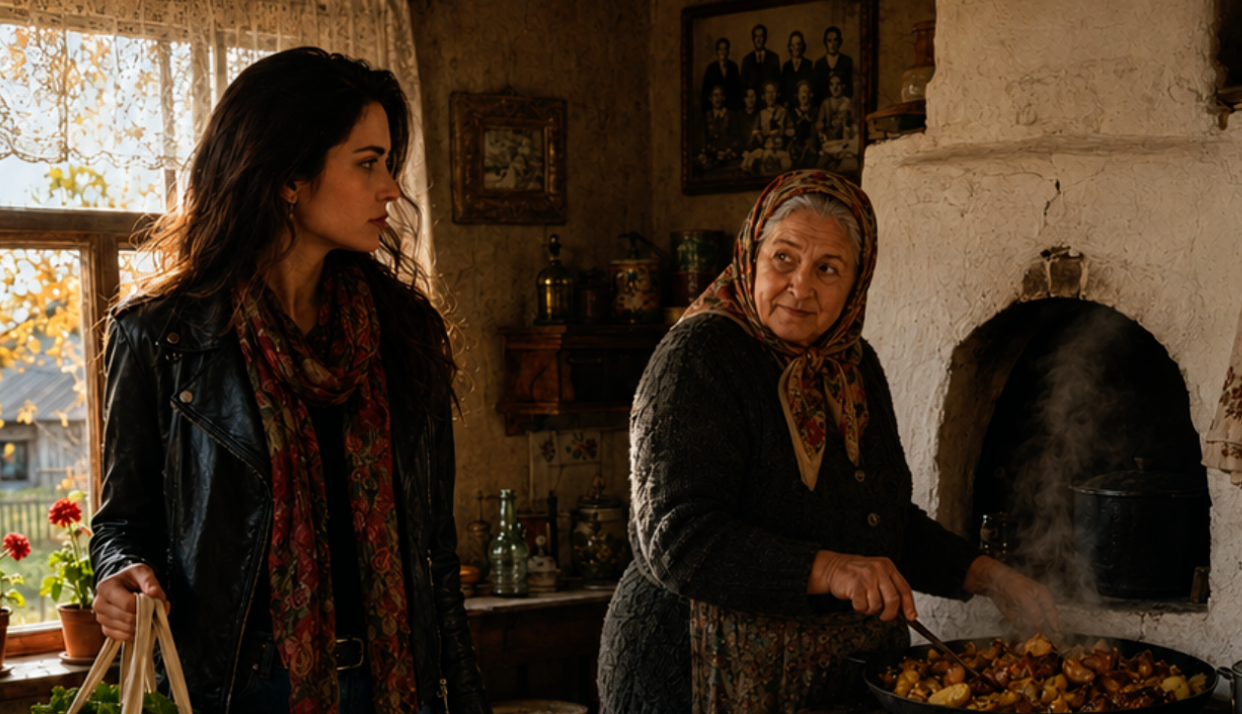
Her Daughter Came Home from the City and Announced That She No Longer Ate Meat. So Her Mother Got Up and Fried an Entire Pan of Potatoes with Pork Fat
Veronika arrived by bus, as usual.
She stepped off at the bus stop looking elegant and unmistakably urban, wearing a long faux-leather coat and a hand-knitted scarf. A backpack hung from her shoulders, and she carried a shopping bag in one hand. Inside were soy milk, tofu, avocados, and a package of gluten-free crispbread.
She stepped onto the village road, covered with its first thin layer of ice, and immediately caught the familiar smells.
Woodsmoke. Manure. Damp, rotting leaves.
The smells of childhood—the very smells she had spent three years consciously and persistently trying to forget.
The house stood on the riverbank. It was old and built from logs, with decorative window frames her grandfather had carved many years ago. Her mother came out onto the porch, wiping her hands on her apron.
“You’re here. Well, come inside. Why are you standing there?”
Her mother’s name was Galina Ivanovna. She was sixty-three years old and had spent her entire life in the village. First she had worked on a farm, then in crop production, and now she was retired.
She had a vegetable garden, chickens, and a goat. Her hands were cracked from years of hard work, but her eyes were still bright and sharp.
They embraced.
Veronika breathed in. Her mother smelled the same as always: smoke, bread, and some elusive warmth she could never quite describe.
“You’re so thin,” her mother said, examining her at arm’s length. “And pale. What do they feed you in that city?”
“Mom, I’m on a plant-based diet.”
“What does that mean?”
“I don’t eat meat, fish, dairy, or eggs. Nothing that comes from animals.”
Galina Ivanovna was silent for a moment.
Then she asked, “So what do you eat?”
“Plants. Vegetables, fruit, grains, and legumes. It’s healthy, Mom. And ethical. Animals shouldn’t be killed.”
“I see,” her mother said, and went inside.
Veronika followed her.
They sat in the kitchen while Veronika arranged her groceries on the table: avocado, tofu, soy milk, and quinoa.
“Look,” she explained. “This is tofu. It’s soy cheese. It has more protein than meat. And this is avocado. It contains healthy fats and absolutely no cholesterol.”
Her mother stared at the avocado.
“Looks like a pear. Is it expensive?”
“Well… not really.”
“How much is ‘not really’?”
“Two hundred rubles each.”
Her mother snorted.
“Two hundred rubles for a pear? Have you lost your mind?”
“Mom, it isn’t a pear. It’s a superfood.”
“A what?”
“A very healthy food.”
“I see,” her mother said. “Well, well.”
Veronika sighed. She pulled a brochure from her backpack titled Ethical Eating: Why We Don’t Eat Animals and placed it on the table.
“Here, read this. It explains everything. Factory farms, antibiotics, how cows and chickens suffer…”
Her mother did not pick up the brochure. She gave her daughter a long look and then stood up.
“All right. You settle in. I’ll make dinner.”
“Mom, just make sure there’s no meat.”
“No meat, no meat.”
Then she went to the stove.
Veronika unpacked her belongings in her old bedroom.
Everything looked exactly as it had before: the faded floral wallpaper, the bookshelf with its worn volumes, and the photograph of her father hanging on the wall.
Her father had died six years earlier. A heart attack.
Veronika had been in her second year at university. She had arrived in time for the funeral, but not in time to say goodbye.
She sat down on the bed.
Her father smiled down at her from the photograph, squinting in the sunlight while holding little Veronika on his shoulders.
She remembered his hands. Large and warm, smelling of diesel fuel and bread. He had worked as a tractor driver and always brought home a fresh loaf. He would break off the crusty end and hand it to her.
A smell drifted in from the kitchen.
Veronika inhaled.
Then she froze.
It was not the smell of soy tofu or avocado.
It was the smell of fried potatoes. Real potatoes sizzling in a frying pan until they developed a crisp, golden crust.
And mixed with it was another smell.
Rich. Heavy. Painfully familiar.
Cracklings.
Pork fat.
Her mother was frying potatoes with pork fat.
Veronika rushed into the kitchen.
She saw the frying pan. Golden slices of potato browned until crisp. Pieces of pork fat melting into clear grease. Dark, shrivelled, crunchy cracklings. And finely chopped onions that her mother had added at the very end.
Something in Veronika’s stomach tightened treacherously.
“Mom! I asked you not to!”
“What did I do?” Her mother turned away from the stove. “These are potatoes. They’re plants.”
“What about the pork fat?”
“I’m not eating the fat. I only put it in for the flavour. I’ll remove the cracklings afterward.”
“Mom, this isn’t funny. Pork fat is an animal product. The potatoes absorb it. It violates every principle I believe in!”
Her mother turned off the stove. She sat down on a stool and folded her hands in her lap.
“Listen, Veronika. I waited three years for you. Three years. This is the first time you’ve come home in all that time. I wanted to feed you properly, like I used to. Don’t you remember? Potatoes fried with pork fat were your favourite food when you were little.”
Veronika remembered.
Of course she remembered.
Whenever she came home from school frozen to the bone, her mother would place a plate in front of her. A large one, piled with yellow, crispy potatoes. There would be bread and a salted cucumber beside it.
She would eat quickly and greedily, burning her mouth, while her mother sat nearby, watching her and smiling.
“That was when I was a child,” Veronika said. “I’m an adult now. I have different values.”
“Values,” her mother repeated. “Sit down.”
Veronika sat.
Her mother looked at her for a long time, her expression heavy and serious.
“Have you ever been hungry?”
“Mom…”
“No. Answer me. Have you ever gone three days without eating?”
“What do you mean?”
“I mean exactly what I said. Have you ever woken up and thought, ‘Dear God, what am I going to feed my children? There’s only a handful of flour. No potatoes. One last piece of pork fat, and there’ll be nothing left for tomorrow.’ Have you ever woken up like that?”
Veronika remained silent.
“I have,” her mother said. “In the nineties. You were little then, so you don’t remember. Your father lost his job. The farm closed down. They went six months without paying wages. I knitted socks to sell for one ruble a pair. But I still had to feed you. You and Vanya. Your brother. He was still alive then.”
Veronika flinched.
They almost never spoke about her brother.
Vanya had died while serving in the army in Chechnya. He had been nineteen years old.
“I kept a goat back then,” her mother continued. “Our last one. There was almost nothing to feed her, but she still gave milk. Half a litre a day. I gave all of it to you children. I drank boiled grass myself. Do you know what saved us that winter?”
Veronika shook her head.
“Pork fat. Your father killed a wild boar in the forest that autumn. He happened to come across it while hunting. We butchered it and salted the fat in a barrel. We lived on it all winter. We had one sack of potatoes and that pork fat. I fried the potatoes in it, and it kept us full. It is because of that pork fat that you’re sitting here now, educated, with your avocados and animal rights.”
Her mother fell silent.
The kitchen was quiet. The cooling frying pan was the only thing still hissing on the stove.
“You need to understand,” her mother said. “I’m not arguing with you. Maybe it is wrong to eat animals. Maybe refusing to eat them is a good thing. But in this village, I have seen winters when an animal saved a person’s life. Not a person saving an animal, but an animal saving a person. You talk about ethics. To me, ethics means not letting your children starve to death. That’s my definition of ethics.”
Veronika sat with her head lowered.
“I didn’t know,” she said quietly.
“How could you know? You live in the city. When you run out of food there, you go to the store. We have one shop here, and even that is in the district centre, forty kilometres away. When the road gets buried in snow during winter, you sit here as though you’re under siege. You survive on whatever you have. The pork fat you salted for the entire winter. The potatoes stored beneath the floor. That’s our superfood.”
Her mother stood and walked over to the stove. She took a plate and spooned some potatoes onto it, choosing them from the edge of the pan where there had been almost no pork fat.
She placed the plate in front of her daughter.
“Eat. I removed almost all the fat. It’s mostly just potatoes. It won’t kill you.”
Veronika looked at the plate.
At the golden pieces. The crispy crust. The translucent onions that had turned sweet in the hot pan.
Then she picked up her fork.
She speared a piece, blew on it, and put it into her mouth.
The taste of childhood.
Exactly the same.
Rich and salty, with a hint of smoke and the flavour of the old cast-iron frying pan.
The taste of home.
The taste of her mother.
And Veronika began to cry.
Silently, she sat there chewing potatoes fried in pork fat while tears rolled down her cheeks.
Her mother looked at her and began to cry too. She stood beside the stove in silence, wiping her eyes with the corner of her apron.
“Mom,” Veronika said. “Forgive me.”
“For what?”
“For acting as though… because I was right, I was somehow better than all of you. But I’m not better. I simply forgot. I forgot everything.”
“You didn’t forget,” her mother said. “Your life is simply different. That isn’t a bad thing. It’s a good thing, even. Look at you. You’ve grown intelligent and beautiful. But remember this: when life becomes too hard, you can always come home. And I’ll feed you. Potatoes with pork fat or homemade pies. Your philosophy can wait. Because when a person is hungry, they aren’t a philosopher. They’re simply hungry.”
Veronika stood, walked over to her mother, and embraced her.
She was as warm as she had been in Veronika’s childhood. She still smelled of smoke and bread.
“I’ll fry some tofu for you,” Veronika said through her tears. “Would you like that?”
“Why not?” her mother said. “Go ahead and fry your tofu. Just don’t put any pork fat in it.”
They both burst out laughing through their tears.
They stood together in the kitchen of the old house while the season’s first snow swirled beyond the windows and the pan of potatoes cooled on the stove.
The following morning, Veronika woke early and went into the kitchen. Her mother was already busy beside the stove.
“Mom, I’ve been thinking…”
“Well?”
“Maybe we could get a chicken. Just one. But we’d let her roam freely. She could be ethically raised.”
Her mother turned around, looked at her daughter, and smiled.
“Two hens and a rooster. So they won’t get lonely.”
“Two hens and a rooster,” Veronika agreed. “But I’m still going to eat tofu.”
“Eat whatever you like,” her mother said. “Who’s stopping you? The important thing is to be a good person. What you eat doesn’t matter.”
For breakfast, they ate porridge.
Ordinary millet porridge cooked with water and pumpkin.
And it was the most delicious porridge Veronika had eaten in the past three years.