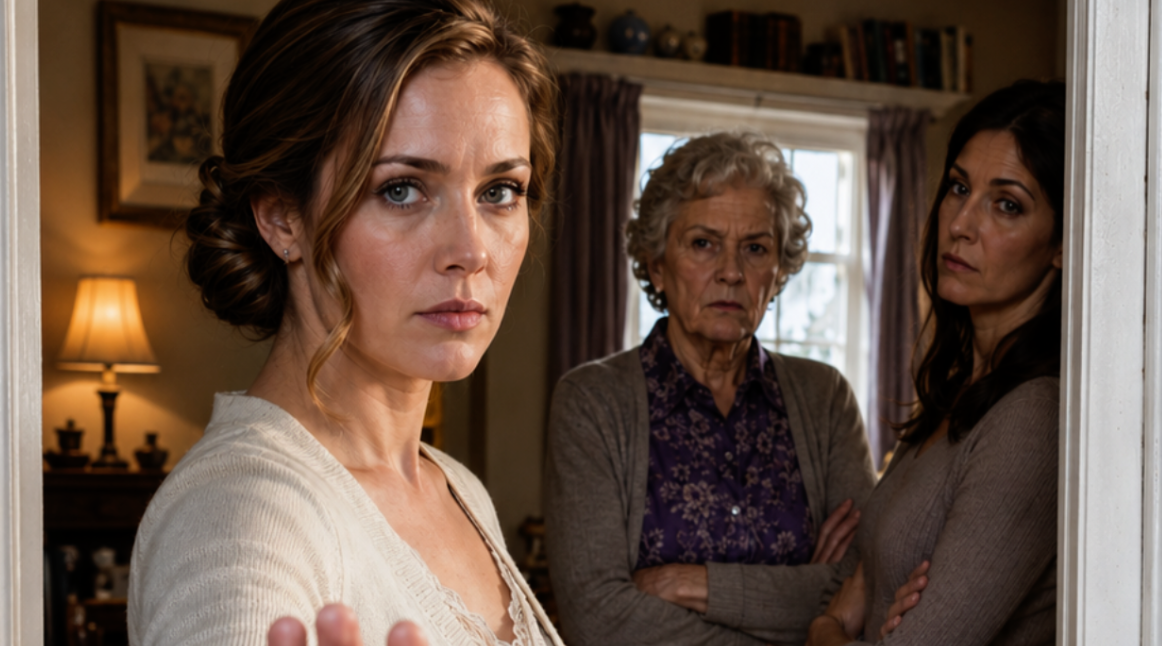
“I Don’t Meddle in Your Apartment, So Stay Out of Mine!” Marina Demanded of Her Mother-in-Law and Sister-in-Law
The room smelled of old wood, varnish, and the barely perceptible mustiness of aged fabric. Marina loved that smell. It meant peace, work, and the absence of living people who, unlike her charges, were always demanding something.
She was carefully opening the chest cavity of an antique automaton—a nineteenth-century mechanical doll depicting a pianist. The gears inside had rusted, and the spring had weakened. Marina restored rare mechanisms, a highly specialized profession requiring the patience of a sniper and the hands of a surgeon.
The silence, thick as jelly, was sliced apart by the ringing of the doorbell. It was not a polite ring but a demanding one, as though whoever was outside were trying to push the button straight through the wall.
Marina wiped her oil-stained fingers on a cloth and frowned. She was not expecting anyone.
They were standing on the doorstep.
Galina Ignatyevna, the mother of Marina’s husband, Yevgeny, and Lyudmila, his sister.
Her mother-in-law was a heavyset woman with a face resembling a sweet bun that had been forgotten in the oven. She surveyed the hallway of the workshop—a converted ground-floor apartment—with the disgust of a public health inspector.
Lyudmila, a skinny young woman whose mouth always seemed to hang open, was chewing gum and staring at her phone.
“Well, hello there, little worker,” Galina Ignatyevna said, stepping inside without waiting for an invitation. She immediately brushed an invisible speck of dust from the sleeve of her coat. “Still playing with dolls? Meanwhile, my son is breaking his back working two jobs.”
“Hello. Zhenya has one job. He’s an arborist, and he enjoys it. What are you doing here?”
Marina did not offer them tea. She remained standing in the doorway leading to the work area, blocking their path.
“We have some business with you,” Lyudmila muttered, putting her phone away. “Mom’s too embarrassed to say it, so I’ll be direct. I need to open a studio. I’ve completed some courses, and I’m going to become a groomer and psychologist for elite dogs. It’s a brilliant idea.”
“And?” Marina crossed her arms.
“What do you mean, ‘and’?” Galina Ignatyevna stepped forward, pushing her daughter aside. “Your grandmother Yarinna’s apartment is practically sitting empty. The old woman hides away at the country house all year anyway. Lyusya has nowhere to live. She broke up with her boyfriend and moved back in with us, but our place is cramped. Have your grandmother transfer the apartment to you through a deed of gift, and then you can transfer it to Lyusya. Or we can sell it and give Lyudochka the money to get started.”
“Grandmother is eighty years old. She only lives at the country house during the summer. That apartment is her home.”
“Oh, come on!” Lyudmila waved dismissively. “You can put her in a nursing home. They’ll take care of her and feed her there. Zhenka said you were kind and that you’d work something out.”
“Zhenya never said that,” Marina snapped. “I don’t meddle in your apartment, so stay out of mine! And stay out of my grandmother’s apartment too.”
Galina Ignatyevna turned red. Blotches appeared across her face, making it resemble spoiled sausage.
“How dare you speak to your mother like that, you ugly little scarecrow? We came to you like civilized people, and you… Your greed will destroy you, Marina. Mark my words, you’ll end up alone with those mechanical freaks of yours.”
They left, slamming the door so hard that a porcelain doll’s head fell from a shelf and shattered into pieces.
Marina looked at the fragments. She did not feel sorry about the doll.
She understood one thing very clearly: war had been declared.
Galina Ignatyevna sat in her office, which resembled a crypt decorated with artificial flowers.
Her position as head of cemetery operations had taught her two things: living people were far weaker than the dead, and there was profit to be made from every tragedy.
Across from her sat Tamara, an old friend who also happened to be the accountant at the same organization. Tamara smoked an electronic cigarette, blowing rings of vapor toward the ceiling.
“She won’t give you the apartment, Galya,” Tamara rasped. “There’s something about her eyes… They’re like glass. I saw her at the wedding. She looked like a mannequin.”
“She’ll give it to us. She won’t have a choice.” Galina snapped a pencil in half. “I’ll work on Zhenka. He’s soft as wax. I’ll tell him I have heart trouble and high blood pressure and that Lyudochka is on the verge of a nervous breakdown. He loves his mother. And that woman… that damned restorer. Who does she think she is?”
The door opened slightly, and Yevgeny looked inside. He was wearing work clothes that smelled of gasoline and tree resin. He was tall and strong, but his eyes held the guilty expression that appeared every time he saw his mother.
“You called me and said it was urgent. What happened?”
“Oh, my son…” Galina immediately pressed a hand to her chest, replacing the mask of a tyrant with that of a suffering victim. “I feel terrible, Zhenya. My heart hurts. It’s all because of your… wife.”
Yevgeny frowned as he entered the office and sat on the edge of a chair.
“What did Marina do?”
“She threw Lyusya and me out! We only came to visit her. We brought a cake and wanted to talk about life. But she called us beggars and told us to get out! Can you imagine? She called your sister a pauper!”
Tamara supported the story, nodding so energetically that, had her cigarette produced ash, it would have scattered all over the desk.
“Zhenya,” Galina continued, lowering her voice to a whisper, “Lyusya has nowhere to live. My two-room apartment is cramped, and your father snores so loudly that I can’t sleep. Meanwhile, Marina’s grandmother has a three-bedroom apartment in the city center gathering dust. Talk to your wife. Ask them to let your sister stay there temporarily. Just for a year or two. The old woman doesn’t care anymore. She already has one foot… well, you understand. We’ve even found a nice place for her here.”
Yevgeny squeezed his knees with his broad hands.
“Mom, the apartment belongs to Yarinna Andreyevna. Marina doesn’t have the right to decide…”
“What do rights have to do with it? Are we a family or not?” Galina demanded, forgetting about her supposedly aching heart. “You’re henpecked, Zhenya! She has you wrapped around her finger! Be careful, or you’ll regret it. She’ll donate everything to some cockroach-protection charity, and you’ll be left out on the street.”
Yevgeny stood up. The office felt suffocating, saturated with the smell of funeral wreaths and cheap perfume.
“I’ll talk to her, but I won’t pressure her.”
“Yes, talk to her,” Galina hissed at his back.
When the door closed, Galina smirked and pulled a folder from her desk drawer.
“Tamara, call our people. Tell them to frighten the old woman at the country house. Carefully—nothing criminal. Just enough to make her understand that it’s dangerous for her to live there alone. She’ll come running back to the city herself. Then we’ll say, ‘Oh, the apartment is occupied now, but we’ll help you get settled in a wonderful care home.’”
On Saturday, Marina visited her grandmother.
Despite her age, Yarinna Andreyevna was a strong woman with a straight back and a gaze that had once made crane operators tremble at the construction site where she had worked for forty years.
The country house was surrounded by greenery. Marina loved spending time there, but that day the idyllic atmosphere was disturbed by the roar of an engine.
A red crossover pulled up to the gate. Lyudmila tumbled out, followed by her friend Sveta, a young woman with overfilled lips and the stare of a predatory fish.
To Marina’s surprise, Yevgeny got out after them. He looked lost.
Marina stepped onto the porch, wiping her hands with a towel.
“Guests? Without calling first?”
“We brought meat for a barbecue!” Lyudmila shouted as she opened the trunk. “Marina, don’t be so gloomy. Mom said we need to make peace.”
Yevgeny walked over to his wife and attempted to embrace her, but Marina stepped away.
“Did you bring them here?”
“Marina, they just wanted to relax. What’s the problem? The property is large.”
“It belongs to Grandmother.”
Yarinna Andreyevna came out of the house, leaning on a cane topped with a carved lion’s head.
“Quiet, all of you,” she said softly, but with such authority that Lyudmila, who had already begun fanning the charcoal in the grill, froze.
“Who gave you permission?”
“Grandma, what’s wrong?” Sveta drawled. “We’ll behave ourselves. By the way, this place is amazing. If you tear down the bathhouse and remove those garden beds, you could build a swimming pool here. Lyusya, this would be a fantastic party spot.”
Marina felt her anger rising again.
They had already decided everything. They were already dividing the hide of a bear that had not yet been killed, right in front of the living owner.
“Get out,” Marina said.
“Zhenya, say something to her!” Lyudmila howled. “We spent five thousand rubles on the meat!”
Yevgeny hesitated, looking first at his sister and then at his wife.
“Marina, let them cook it since they’re already here. We can’t just throw them out.”
“Yes, we can,” Yarinna Andreyevna cut in. “They will never set foot here again. Zhenya, if you’re a man, take this entire circus away.”
Lyudmila threw the skewers onto the ground.
“Oh, is that how it is? You’re both witches! Mom was right—you need treatment! Electric-shock treatment! Do you hear me, old woman? You’re going to die soon anyway. Do you think you can take the apartment into the grave with you?”
Marina walked right up to Lyudmila. Lyudmila was taller, but she stepped backward.
“One more word,” Marina said quietly, “and I’ll put that skewer where your ‘elite dogs’ keep their tails.”
“Are you threatening her?” Sveta shrieked, recording everything on her phone. “That’s a criminal offense!”
Yevgeny finally came to his senses.
He looked at his wife’s face. It was completely white, calm, and terrifying.
Then he looked at his sister’s face, distorted by greed and malice.
“Get in the car,” he said hoarsely.
“What?” Lyudmila stared at her brother.
“I said get in the car! Now!”
The scandal was brought to an end. They drove away, leaving scattered charcoal on the lawn and a sickening sense of filth that could not be washed away with water.
Two weeks passed.
Yarinna Andreyevna returned to the city to undergo a medical examination at the clinic. Marina was planning to visit her that evening, but her grandmother’s call reached her while she was riding the subway.
“Marisha, they’re trying to break in,” her grandmother said, her voice tight with tension. “Galina and some man. They say I flooded their apartment and are demanding that I open the door. But everything is dry here.”
Marina jumped off the train at the next station and caught a taxi. The entire way, she prayed for the traffic jams to clear.
The anger inside her was transforming into something else.
When she reached the floor, she saw Galina Ignatyevna, Lyudmila, and a burly man in work clothes—obviously a fake plumber—pounding on the door.
“Open up, you old hag! We’ll call the emergency services!” Galina shouted.
The neighbors were peering fearfully through their peepholes, but none of them came outside.
Marina approached from behind. She did not shout. She simply kicked Galina’s handbag, which was sitting on the floor.
“Step away from the door.”
Galina turned around. Her face spread into the false smile of someone who believed she had already won.
“Oh, look who’s here. Your grandmother is flooding us! We came to draw up an official report. Then we’ll take her to court, and the apartment will be seized to pay the debt. I have everything arranged, little girl. Tamara has already prepared the documents.”
“It’s dry here,” Marina said, nodding toward the hallway.
“The only dry place is inside your head,” Lyudmila scoffed. “Listen, why don’t you leave voluntarily? We’re about to cut the locks off.”
The man switched on an angle grinder. The screech of the tool sliced through the air.
At that moment, the elevator doors opened, and Yevgeny stepped out. He had followed his wife after sensing that something was wrong when her grandmother called.
“What the hell are you doing?” he roared.
“My son!” Galina rushed toward him. “Save us! The old woman has lost her mind. She turned on the gas and the water and is trying to kill us! We’re saving the building!”
Yevgeny looked at his mother.
For the first time in thirty years, he saw her as she truly was.
Not as a caring mother, but as a greedy woman driven mad by the certainty that she could do anything she wanted—a woman willing to trample over her own family for the sake of a few square meters.
“Leave,” he said.
“Who are you throwing out? Your own mother?” Galina raised her hand to slap him, a familiar method of discipline.
But Yevgeny caught her wrist.
“I said get out. And forget my phone number.”
“You little bastard…” she hissed. “Lyusya, call the police. We’ll tell them they attacked us!”
The final confrontation occurred where no one had expected it.
A month later, Marina was holding a major exhibition of restored dolls and automatons. It was an important event attended by sponsors, collectors, and members of the press.
Marina stood in the center of the gallery in a black dress, accepting congratulations. Yevgeny was beside her, holding her hand.
Grandmother Yarinna sat proudly in an armchair nearby, leaning on her cane.
The entrance doors suddenly burst open.
Security did not have time to react. Two women forced their way inside, pushing guests aside.
They were Galina and Lyudmila.
Galina was wearing some ridiculous fur coat, while Lyudmila wore ripped jeans. They seemed drunk—not from alcohol, but from their own shamelessness and their desire to destroy Marina, trample her, and drag her through the mud.
“There she is! The swindler!” Galina shouted across the hall, drowning out the soft music. “Good people! She stole an apartment from an old woman, bewitched my son, and threw his own mother out of the house!”
The guests froze. Cameras turned toward the two troublemakers.
“And these dolls are made from corpses!” Lyudmila shrieked. She grabbed a glass from a nearby table and threw it onto the floor. Shards flew in every direction.
Yevgeny moved toward them, but Marina stopped him with a gesture.
She released her husband’s hand.
Her face became calm—the terrifying calm of a predator preparing to strike.
Without saying a word, Marina walked toward her mother-in-law.
“What are you staring at?” Galina faltered when she saw the look in her daughter-in-law’s eyes.
There was no fear in them. There was no shame.
There was only darkness.
Marina walked right up to Galina and, without drawing back her arms, grabbed the front of her expensive fur coat. The fabric crackled under her grip.
Marina was a restorer. Her fingers could bend wire and hold heavy components steady for hours.
“Let go of me!” Galina squealed.
“Shut up,” Marina said quietly.
Then she shook the heavy woman so violently that Galina’s teeth clacked together.
Lyudmila rushed to help her mother, raising one hand with its long fingernails.
Without releasing Galina, Marina caught her sister-in-law’s wrist with her other hand and twisted it with the professional precision of a mechanic who understood how joints worked.
Lyudmila howled.
“You wanted a show?” Marina said loudly enough for the entire hall to hear. Her voice rang through the room. “You wanted attention? Then you’re going to get it.”
She yanked Galina’s fur coat so hard that its buttons flew across the parquet floor like bullets.
Her mother-in-law lost her balance. Tangled in the coat, she collapsed onto the floor, exposing her skirt as it rode upward and her thick legs in elastic tights.
It was not merely a fall.
It was the toppling of an idol.
Lyudmila tried to grab Marina by the hair, but Marina used her momentum to shove her directly on top of her mother.
The two shrieking women writhed together on the floor among the broken glass and scattered buttons.
“You are filth,” Marina said, pronouncing each word distinctly as she stood over them. “Greedy, stupid filth. I tolerated you for Zhenya’s sake. But now it’s over.”
She picked up a pitcher of water from the table and, without hesitation, poured its contents over them.
The water washed away their makeup, turning Galina and Lyudmila’s faces into clown masks from a horror film.
“Get out of here before I carry you out like garbage,” Marina growled.
It was not the scream of a hysterical woman. It was the roar of an animal defending its territory.
Galina, soaked and disheveled, her blouse torn open, stared up at her daughter-in-law.
Animal terror had frozen in her eyes.
She had always considered Marina a harmless little mouse, one of those intellectual women who would never hurt a fly.
She had never expected a monster capable of physical violence to be living inside that “mouse.”
Her world—the world in which she had always been in charge—collapsed.
Sveta and several other friends of Lyudmila’s, who had come to support the scandal, saw the destruction and began backing toward the exit, trying to blend into the walls.
They scattered like rats abandoning a sinking ship, leaving their “captain” behind.
Yevgeny walked over to his wife.
He did not help his mother stand.
Instead, he stood beside Marina, shoulder to shoulder.
“Security,” he said calmly. “Take this garbage outside.”
Whimpering and supporting each other, Galina and Lyudmila crawled toward the exit beneath the contemptuous gazes of the high-society crowd, who were eagerly recording everything on their phones.
They were no longer victims or fighters for justice.
They were pathetic, soaked, humiliated hooligans.
Marina adjusted her hair, took a deep breath, released the last of her anger, and turned toward the guests.
“Please forgive the performance. It was an allegory entitled ‘The Struggle of Pure Art Against Everyday Barbarism.’ Let us continue.”
The hall erupted in applause.