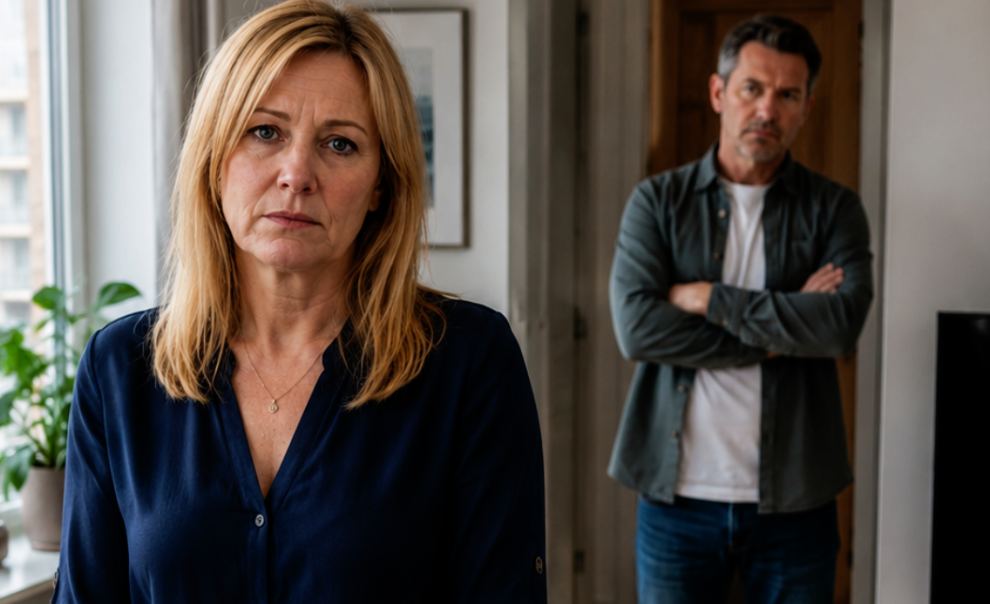
“Don’t Hang Your Rags in the Bathroom,” Her Live-In Partner Declared After a Year Together
“Marina, you do understand that this is my apartment, don’t you?”
He said it casually, the way someone might say, “Pass the salt,” or, “It’s going to rain tomorrow.” He was standing beside the refrigerator in his underwear and a T-shirt bearing the logo of some marathon he had never participated in, poking at the remains of yesterday’s meat patties with a fork. Her meat patties, incidentally.
“I’m not arguing with you, Artyom. The apartment is yours.”
“Good. Then just behave like a guest. Don’t rearrange the furniture. Don’t hang your rags in the bathroom. And stop moving my desk closer to the window. There’s a draft.”
Marina dried her hands on a towel she had bought three months earlier to replace his old one, which had been gray, stiff, and as rough as sandpaper. She looked at the curtains. Those were hers too. Cream-colored, decorated with tiny cornflowers. She had spent half a day choosing them because the windows faced north, and she had wanted to bring at least a little warmth into the room.
Then she looked at Artyom.
A handsome fifty-two-year-old man. A design engineer. Divorced. An apartment in Bibirevo—only one room, but with a large kitchen. When they had met at a mutual friend’s birthday party, he had seemed dependable. Calm. The kind of man who didn’t shout or smash dishes.
Now she understood that he didn’t shout or smash dishes simply because he was too lazy.
They had moved in together four months after meeting. Marina was forty-nine and worked as the chief accountant of a construction company. She did not own an apartment. She had a room in a communal apartment near Avtozavodskaya, inherited from an aunt, which she rented to a student from Voronezh for fifteen thousand a month.
Artyom had invited her to move in with him.
“Why do you need that communal apartment?” he had said. “Live with me. It’s bright here, and the metro is nearby.”
Marina brought two boxes of books, one box of dishes, and a suitcase. The books remained in the hallway. She had not unpacked them during the entire year. At first she had been too busy. Then she had grown accustomed to stepping around them. Eventually, she realized she did not want to unpack them.
It was as though something inside her had known all along: Don’t settle in completely.
“I’m not a guest, Artyom,” Marina said quietly. “Guests don’t pay the electricity bill.”
“You pay it because you volunteered.”
“I volunteered once. In February. When you told me your salary had been delayed.”
“So what? I didn’t force you.”
He finished the meat patty and placed the plate in the sink. He did not wash it. In the entire year they had lived together, Marina had seen him wash the dishes exactly four times. She had not counted deliberately. It was simply that everything automatically arranged itself into columns inside an accountant’s mind.
The following day, Marina went to see Natalia.
Natalia worked as a real-estate agent. They had been friends for about twenty years, ever since they were both young specialists attending dance classes at the Moskvorechye Cultural Center. Natalia knew everything about Artyom. Or rather, she knew exactly as much as Marina had told her, but that was enough.
The real-estate agency’s office was located on the ground floor of an apartment building, between a pharmacy and a shawarma shop. The air smelled simultaneously of heart medicine and grilled meat.
“Sit down,” Natalia said, pulling out a chair. “Would you like some tea? I have cookies, although they’re from yesterday.”
“Yes, please.”
Natalia poured tea into a mug bearing the inscription “Best Real-Estate Agent of 2024.” Her employees had given it to her, and she drank from it every day because, as she liked to say, “Compliments need reinforcement.”
“Tell me what happened.”
“He called me a guest.”
Natalia slowly put the kettle back down.
“Say that again.”
“He said that since I live in his apartment, I should behave like a guest. I shouldn’t rearrange the furniture or hang up my rags.”
“Rags? Was he talking about your robe?”
“The towels. And the curtains. He doesn’t like my curtains.”
Natalia leaned back in her chair. The chair creaked. Natalia was a large, cheerful woman who creaked her way through life along with the furniture and paid no attention to it.
“Marina,” she said, “you’ve been living with this man for a year. You cook for him, pay the electricity bill, and hang curtains, and he tells you to behave like a guest?”
“Yes.”
“And what did you say?”
“Nothing.”
“That was a mistake. You should have poured soup over his head.”
“I didn’t have any soup. There were meat patties.”
“Meat patties work well on the head too,” Natalia said, crunching a cookie.
Marina took a sip of tea. It was hot and sweet, served in the best real-estate agent’s mug. Suddenly, her eyes began to sting.
It was not because of the tea.
“Natasha, I don’t know what to do.”
“What is there to know? Leave him.”
“And go where? Back to the communal apartment? Vika from Voronezh is living there.”
“Give Vika a month’s notice. Or move in with me. My sofa is free.”
Marina shook her head. She was forty-nine years old. A chief accountant. A woman with a straight back, twenty-thousand-ruble glasses, a manicure, and a planner in which every hour of her day was carefully scheduled.
And now she was sitting in an office between a pharmacy and a shawarma shop, wondering where she was going to live.
That evening, she returned to Artyom’s apartment. He was watching football.
“Dinner is in the refrigerator,” Marina said.
“Uh-huh.”
She went into the room. The two boxes of books stood in the corner. Marina crouched beside them and ran her finger over the dusty lid. Someone had written “KITCHEN” across the top box with a marker. She herself had written it a year ago, when she believed she would live there for a long time and eventually arrange the books on a shelf.
Artyom had never bought the shelves.
“Artyom!”
“What?”
“Can I ask you something?”
He appeared in the doorway with a bottle of beer in his hand.
“Go ahead.”
“This apartment. Is it definitely yours?”
He frowned.
“What do you mean?”
“Exactly what I said. Are you the owner?”
“Of course I am. Why?”
“I was just asking.”
He shrugged and returned to the football match. Marina took out her phone.
In an accountant’s mind, a thought begins as a suspicion and ends as a spreadsheet.
A year earlier, shortly after they had moved in together, Artyom had asked her to pay the utility bill because “it would be more convenient since you work near the bank.” She had paid it. And she had continued paying it every month.
The bills were addressed to Elizar Petrovich Voronov.
Not Artyom.
At the time, Marina had not paid much attention to it. Perhaps the apartment belonged to his father. Or his grandfather. These things happened.
But now, sitting on the floor beside the dusty boxes, she suddenly realized that Artyom had never shown her a single ownership document.
The following day, Marina called Natalia.
“Natasha, can you look up an apartment by its address?”
“I can. Why?”
“I want to know who owns it.”
“Well, this is getting interesting. Give me the address.”
Marina dictated it. Natalia called her back two hours later.
“Are you sitting down?”
“I’m standing at a bus stop.”
“Sit down.”
“Natasha, there aren’t any benches here.”
“Then hold on to a lamppost. The owner of the apartment where you’ve spent a year paying the electricity bills, washing the floors, and hanging those objectionable curtains is Elizar Petrovich Voronov. He isn’t related to your Artyom. Not at all. He’s simply a man who rents the apartment out.”
Marina leaned against the lamppost.
“What?”
“The apartment is rented, Marina. Artyom is a tenant. The lease is officially registered and completely legitimate. Twenty-eight thousand a month, plus utilities.”
“The utilities that I pay.”
“Exactly. You’ve been paying the utility bills for someone else’s rented apartment for an entire year while he walks around in his underwear and tells you to behave like a guest.”
Marina began to laugh.
She stood at the bus stop as people walked past her. A bus slowed down and then drove away, while she continued laughing. Sometimes a situation was so absurd that crying would have seemed inappropriate.
On Saturday, Marina packed her belongings.
Two boxes of books, one box of dishes, and a suitcase. Exactly as much as she had brought with her a year earlier. She also took down the curtains, folded them carefully, and placed them inside a bag.
Artyom returned from the store and saw the boxes in the hallway.
“What is this?”
“I’m leaving.”
He put the bag of groceries down on the floor.
“Where are you going?”
“Home.”
“Marina, wait. Is this because of that conversation? I didn’t mean it that way.”
“What did you mean?”
He hesitated. Marina knew this habit of his: whenever Artyom did not know what to say, he began rubbing the bridge of his nose as though it itched.
Apparently, the bridge of his nose itched quite often.
“Well, I just wanted to say that we need rules. Order.”
“Order,” Marina repeated. “All right. Here is your order. I’m taking my curtains, my dishes, and my books. I’m also taking the electricity bills I paid for twelve months. And you are staying in Elizar Petrovich Voronov’s apartment. I hope he likes seeing your underwear hanging on the drying rack more than you liked seeing my towels.”
Artyom turned pale—not all at once, but in blotches beginning at his neck.
“How did you…”
“Artyom, I’m a chief accountant. For a year, I read bills bearing someone else’s surname. I simply felt uncomfortable asking about it before. Now I feel uncomfortable remaining silent.”
“This…this isn’t what you think,” he said.
“I’m not thinking anything,” Marina replied. “I’m calculating. According to the bills.”
She lifted one of the boxes. It was heavy.
Books were always heavier than they looked.
“Marina, let’s talk! I didn’t lie to you. I simply didn’t clarify.”
“‘Didn’t clarify.’”
Marina put the box back down and looked at him.
“Artyom, for an entire year, you kept saying, ‘my apartment.’ Every time I suggested buying a rug, you replied, ‘This is my apartment, so I decide.’ When I wanted to install a bookshelf, you said, ‘Don’t ruin my walls.’ But the walls aren’t yours.”
He opened his mouth and closed it. Then he opened it again.
“So what happens now?”
“Nothing. I’m leaving. The key is on the bedside table.”
Marina carried the boxes outside and called a taxi. She sat on a bench in the small park beside the metro station. Nearby, pigeons were pecking at a piece of bread, while an elderly woman on the next bench fed them with such a concentrated expression that she appeared to be carrying out a government assignment.
Natalia called.
“Well?”
“I left.”
“Was there a scandal?”
“No. He stood there holding his grocery bag and rubbing the bridge of his nose.”
“Beautiful.”
“Natasha, it isn’t beautiful. It’s sad.”
“It is sad,” Natalia agreed. “But it was the right thing to do. Should I come and get you?”
“I’m sitting on a bench.”
“Which bench?”
“Near the metro station. I’m waiting for a taxi.”
“What taxi? I’m coming right now!”
Marina put her phone away. Beside the boxes lay the bag containing the curtains. Cream-colored, with cornflowers. She stroked the fabric and thought about hanging them in her room near Avtozavodskaya. Vika from Voronezh would be graduating in a month anyway, so the room would soon become available.
Then Marina thought that perhaps the curtains would not fit. The windows were different. The light was different.
But they would be her windows.
And no one would tell her to behave like a guest.
A week later, Marina received a call from an unfamiliar number.
“Hello, this is Elizar Petrovich. Voronov. I’m the owner of the apartment where you were living.”
“Hello, Elizar Petrovich.”
“Your…former partner informed me that you had moved out. And do you know what? He moved out too. Yesterday. He left behind two months of unpaid rent and an iron. Is the iron yours?”
Marina smiled.
“No. I took my iron with me.”
“That’s a shame. It’s a good iron. Marina, there is a reason I’m calling. You paid the utility bills for an entire year. Regularly and on time. I saw the receipts. They had your pencil notes on them—neat, in an accountant’s handwriting. During the two years before you arrived, Artyom never paid anything on time.”
“Two years?”
“Yes. He rented the apartment from me for three years. As I understand it, you thought he owned it?”
Marina was silent for a moment.
“I did.”
“I see. Well, anyway, if you ever need an apartment in Bibirevo, call me. I remember you. You’re a good tenant.”
“Thank you, Elizar Petrovich.”
“You’re welcome. The curtains were beautiful, by the way. The ones with the cornflowers. My wife says the window looks bare without them.”
Marina ended the call and looked through the window of her room near Avtozavodskaya.
The curtains fit.
Not perfectly—they were slightly too short—but the light passing through them was soft and warm.
The room smelled of tea and old books, which she had finally unpacked. She had installed the shelf herself. She had borrowed a drill from her neighbor, Mikhail Semyonovich, who had asked for a cabbage pie in return, along with a promise that she would “never become involved with another design engineer.”
Marina promised.
She baked the pie on Sunday.
Her own pie.
In her own kitchen.
On her own plates.
—
Did Marina’s story touch your heart? Write a few words in the comments—it truly matters to me. Life’s complicated twists are much easier to discuss among friends. Stay close and visit every day, because we will always have something heartfelt to talk about.