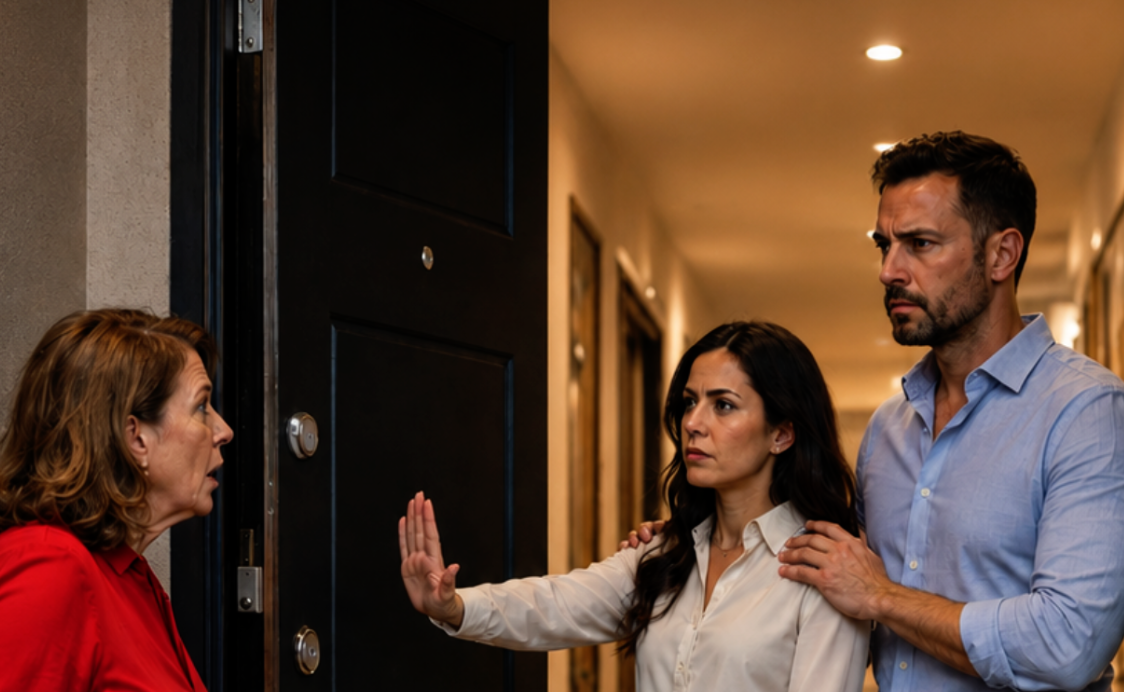
“They’re Not My Children, and Our Home Is Not a Daycare,” I Told My Sister-in-Law — and for the First Time, My Husband Took My Side
“Where am I supposed to leave them, Grisha? You’re their uncle—you have to help!” his sister was practically shouting into the phone, and Olga could hear every word from the kitchen, where she was slicing bread for breakfast.
The knife froze in her hand. Dawn had barely broken outside, Saturday was only beginning, and her sister-in-law’s voice was already invading their apartment as though she were the mistress of the house returning after a long absence.
Olga looked at her husband. Grigory stood by the windowsill with his shoulders hunched, guiltily avoiding her eyes. He held the phone against his ear as though it weighed a ton.
“Lena, all right, all right,” he muttered. “Bring them over. Yes, we’re home. We’ll be waiting.”
He hung up and reached for his cup as though nothing unusual had happened. Their first free morning together in three weeks was dissolving before Olga’s eyes like sugar in hot tea.
“Again?” Olga asked quietly.
“Just for a couple of hours,” Grigory replied, repeating his sister’s words. “She has some urgent things to take care of. You know how difficult it is for her alone with the boys.”
Olga put down the knife and sat at the table. She looked around their small kitchen, the one they had worked so hard to make comfortable. They had chosen every shelf together. They had been paying off the mortgage on this apartment for two years, after saving forever for the down payment and denying themselves almost everything.
Their home.
Their space.
Their fortress—which, apparently, could so easily be turned into a revolving door.
“This is already the fourth time this month, Grisha,” she said.
“The last time. I promise.”
Grigory kissed the top of her head and left the kitchen, abandoning his unfinished tea to grow cold.
Olga watched him go and sighed. She had heard the promise “this is the last time” so often that the words had long since lost all meaning.
The doorbell rang half an hour later.
Elena, her sister-in-law, stood on the doorstep dressed as though she were going not to deal with an emergency but to a celebration. She wore a bright dress, heels, and her hair was perfectly styled. Behind her stood two boys—eight-year-old Tyoma and five-year-old Kostik.
“Save me!” Elena rattled off, thrusting two enormous backpacks into Olga’s hands. “There’s food, spare clothes, toys. Everything as usual! Boys, listen to Aunt Olya!”
“Lena, when will you be back?” Olga managed to ask.
But her sister-in-law was already clicking down the hallway in her heels toward the elevator.
“I’ll call! Don’t miss me!” she shouted, waving.
The door closed.
Olga was left standing there with two backpacks in her hands. Kostik timidly clung to his brother’s pant leg, while Tyoma had already kicked off his shoes and raced into the living room.
“Aunt Olya, can I watch TV? Do you have anything tasty?” came his voice from somewhere inside the apartment.
Olga closed her eyes and slowly exhaled.
A couple of hours, she reminded herself. Just a couple of hours.
By lunchtime, it was obvious that Elena was in no hurry to return. Olga called her twice, but there was no answer. Her message received only a short reply:
“I’m running a little late. Everything’s fine.”
Meanwhile, Tyoma had managed to draw on the hallway wallpaper with markers, spill a jar of cereal across the kitchen floor, and organize a competition to see who could jump the highest from the sofa.
Kostik sat quietly whimpering in the corner, saying he wanted his mother.
At first, Grigory played the cheerful uncle. He showed them tricks, built a fort out of cushions, and made sandwiches.
But by three in the afternoon his enthusiasm had disappeared, and he sat down at his computer, using headphones to shield himself from the children’s noise.
“Grisha, help me,” Olga asked while scrubbing marker stains from the wallpaper. “Kostik is crying again.”
“In a minute,” her husband replied without looking away from the screen.
That “minute” lasted an hour.
Olga was torn between looking after the children, cleaning up, and thinking about the important work project she had planned to finish that day. She worked remotely as a designer, and quiet was as essential to her as air.
At six in the evening, the phone finally rang.
“Olenka, sweetheart,” Elena began in an overly sugary, guilty voice. “Listen, could you keep them until nine? Nine at the latest!”
Olga went into the bedroom so the children wouldn’t hear.
“Lena, you said a couple of hours. We had plans.”
“What plans? Watching a movie?” her sister-in-law laughed. “When you have children of your own, you’ll understand that sometimes a mother needs to breathe too.”
Olga bit her tongue.
They’re not my children, she wanted to say. And her exhaustion isn’t my responsibility.
Instead, she only said:
“I’ll talk to Grisha.”
She found her husband on the balcony. He was staring at the darkening sky in silence.
“Your sister wants to leave the boys here until nine,” Olga said, leaning against the doorframe.
“I’m sorry,” Grigory replied guiltily. “I’ll have a serious talk with her tomorrow.”
“You said that last time.”
“But things really are difficult for her right now.”
Olga studied her husband’s profile. The same stubborn chin Elena had. The same expression whenever he wanted to avoid an argument.
That family resemblance had once seemed endearing to her.
Now it stirred a dull irritation inside her.
“When we moved in here, we said this place would belong only to us,” she said quietly. “Remember?”
“I remember. But family is important.”
His eyes silently begged her not to make a scene.
Olga nodded and went back inside.
She respected her husband’s desire to help his relatives. But why did helping them always mean erasing her own boundaries like chalk from a blackboard?
Elena arrived shortly after ten.
By then Kostik was asleep on the sofa, while Tyoma refused to go to bed because he wanted to finish playing on the tablet.
“Oh, the traffic was horrible!” Elena exclaimed from the doorway, even though the streets were practically empty that evening.
Grigory silently helped gather the children’s things.
They had to wake Kostik, who became cranky and tearful.
When the door finally closed behind them, Olga began cleaning up the traces of the children’s invasion—candy wrappers wedged between sofa cushions, crumbs on the carpet, toy cars scattered everywhere.
“Leave it until morning,” Grigory said. “It’s already late.”
“I can’t,” she replied, picking up an open packet of cookies from the floor. “This is my home. I want to see it clean.”
Her husband looked as though he wanted to say something but remained silent.
Fifteen minutes later, he was already asleep.
Olga lay awake for a long time in the darkness, staring at the ceiling.
Something told her this was only the beginning.
The following week, everything happened again.
Wednesday. Eight in the morning.
Olga had just turned on her computer when the phone began ringing.
“Grisha said you’re working from home today,” Elena announced cheerfully. “I have a doctor’s appointment and there’s nobody to watch the boys.”
“Lena, I can’t. I have three important client calls today.”
“What calls? You’re just sitting at a computer!” her sister-in-law snorted. “The kids will play. You won’t even notice them.”
Half an hour later, Tyoma and Kostik were already rummaging through the cookie cupboard.
Elena rushed away after swearing she would return by two.
Olga’s first video call turned into a disaster.
She had barely switched on her camera and begun presenting the design to her client when a crash and Kostik’s scream came from the next room.
“I’m sorry, just a second,” she said helplessly, forcing a smile at the screen.
While chasing his younger brother, Tyoma had knocked a framed wedding photograph off a shelf.
The glass had shattered.
Kostik was sobbing, smearing juice over his face after spilling it in fright.
Olga hurriedly swept up the broken glass and sat the boys in front of the television.
“Please, be quiet,” she begged. “Aunt Olya is working.”
The client waited on the screen, barely concealing his annoyance.
“It sounds like you’re running a daycare over there,” he remarked coldly.
By three o’clock, Elena still had not appeared.
Olga called her repeatedly. No answer.
Another important meeting had to be postponed because Tyoma turned music on at full volume in the middle of the call.
Then the doorbell rang.
Standing outside was their neighbor, Valentina Sergeyevna, an elderly woman with observant eyes.
“Olya, is everything all right?” she asked, peering inside. “There’s so much noise, I thought you were renovating.”
“I’m sorry, Valentina Sergeyevna. They’re my husband’s nephews,” Olga replied apologetically. “My sister-in-law asked me to watch them.”
The neighbor pursed her lips.
“In our day, people didn’t dump their children on relatives like that,” she said disapprovingly. “Parents should take responsibility for their own children.”
Olga nodded, feeling unexpectedly grateful for those words.
“And where is their mother?” Valentina Sergeyevna continued.
“At the doctor. She promised to pick them up a long time ago.”
“At the doctor, sure,” the neighbor scoffed. “I saw your sister-in-law at the shopping center an hour ago. She was sitting in a café with a friend, laughing loudly enough for the whole floor to hear.”
Olga froze.
“Are you sure?”
“My memory hasn’t failed me yet,” the woman snapped. “Bright dress, heels. Drinking coffee and eating pastries.”
There could be no mistake.
Olga thanked Valentina Sergeyevna and closed the door.
Something inside her began to boil.
She opened her phone.
One of Elena’s friends had just posted a new photo.
“Girls’ day out in the middle of the week! Relaxing while the kiddos are with their auntie.”
Elena was in the picture with a cup in her hand, flushed and delighted.
Olga lowered the phone.
This was no longer simply taking advantage of someone’s kindness.
This was deliberate, shameless deception.
Elena arrived close to six, trying to conceal the smell of her afternoon entertainment with chewing gum.
“Sorry, sweetie!”
She reached out to hug Olga without noticing how tense her shoulders were.
“The line at the clinic was enormous, then there were tests, then I had to wait for the results…”
Olga stepped away and looked directly into her eyes.
“Lena, stop. I know you were at the shopping center. Someone saw you.”
Her sister-in-law faltered, but recovered quickly.
“Well, I stopped there for five minutes to get something to eat after the doctor. What’s the big deal?”
“Because of you, I had to cancel two calls today. And I’ll probably lose a major client.”
“Oh, come on. Everyone understands when there are children around…” Elena began.
“They’re not my children,” Olga cut her off quietly but firmly.
At that moment, Grigory came into the hallway. He had just returned from work.
“What happened?” he asked, looking from his wife to his sister.
“Your sister wasn’t at the doctor. She was enjoying herself at a café while I stayed here with her children and ruined my workday,” Olga said, folding her arms.
Elena rolled her eyes.
“Oh my God, what a big deal! I met a friend. I have no personal life at all because of these kids!”
“Then solve your own problems!” Olga snapped. “Don’t dump them on other people!”
Grigory’s phone rang, interrupting the argument.
He looked at the screen and his face darkened.
“Mom,” he said, stepping aside.
Olga knew that tone.
Her mother-in-law seemed to have a special instinct for calling at exactly the right moment to make everything worse.
Tamara Petrovna’s voice was so loud through the speaker that everyone in the hallway could hear.
“Grishenka, why didn’t you tell me Lenochka and the boys were at your place? I would have brought a pie!”
“We’re leaving already, Mom,” Elena quickly interrupted, grabbing her bag. “But go visit them anyway!”
After her sister-in-law left with the children, Olga leaned against the wall.
“She’s deliberately dumping them on us,” she said. “She just wants a free babysitter. It isn’t fair, Grisha.”
“Not now,” her husband replied tiredly. “Mom is coming.”
The doorbell interrupted them.
Tamara Petrovna stood outside carrying a cake and a large bag.
“Here I am!” she announced, kissing her son. “And where are my precious grandchildren?”
“They’ve gone home, Mom. Lena picked them up.”
“What a shame! I bought them some toys.”
Her mother-in-law walked into the apartment and placed two large construction sets and a remote-controlled car on the sofa.
“Well, never mind. They can stay here. The boys can play with them next time.”
Olga stared at the unfamiliar objects now occupying her sofa.
“So the toys are going to be kept here?” she asked.
“Where else?” Tamara Petrovna replied as though it were obvious. “The boys visit you, don’t they? Grisha, sweetheart, help me in the kitchen.”
Her mother-in-law took her son away, leaving Olga standing there looking at the boxes.
They didn’t feel like toys.
They felt like flags marking territory that someone else had claimed.
In the kitchen, Tamara Petrovna behaved as though she were in her own home.
She rearranged jars, looked inside the refrigerator, and shook her head.
“It’s a little cramped here,” she remarked. “I have a three-bedroom apartment. The children would have much more room there.”
“So maybe you could take them to your place?” Olga couldn’t resist saying. “Since you have so much room.”
Her mother-in-law froze with a knife poised above the cake.
“What do you mean, ‘my place’?”
She pressed a hand dramatically to her chest.
“I have high blood pressure and migraines. The doctor told me not to get stressed. How am I supposed to deal with children? They have a mother. Relatives are simply supposed to help one another.”
“Sometimes,” Olga emphasized. “Not constantly.”
Grigory coughed awkwardly, clearly uncomfortable at being caught between the two women.
“Mom, let’s have some tea,” he suggested, changing the subject.
Over tea, Tamara Petrovna questioned her son about his job while elegantly ignoring her daughter-in-law.
Eventually, the conversation turned to Elena.
“Poor thing has such a difficult life,” Tamara Petrovna sighed. “Alone with two children after the divorce. And her ex-husband doesn’t give her a penny.”
“Lena has a job,” Olga pointed out. “And child support, as far as I know.”
Her mother-in-law pursed her lips.
“A job! They pay her pennies. And children grow. They need everything.”
Olga stood up and began gathering the cups.
“What does any of that have to do with our apartment?” she asked directly. “Why do the children always have to be here? Lena has her own home. You have a three-bedroom apartment.”
“Olya!” Grigory warned her.
“No. I want to understand,” she insisted.
Tamara Petrovna straightened herself, radiating wounded dignity.
“In our family, people have always helped one another. Nobody kept score over who owned what.”
“This is our home,” Olga said firmly. “And I have the right to know who is going to be here and when.”
“My daughter’s children are not strangers to you!” her mother-in-law raised her voice.
“But they aren’t mine either!”
Olga felt her hands trembling.
“I’m not against helping. But not when people lie to us, use us, and don’t care about my feelings!”
Silence descended over the kitchen.
Grigory stared into his cup, avoiding both women’s eyes.
“Grisha is fine with it,” Tamara Petrovna finally remarked. “He loves his nephews.”
“And did anyone ask me?”
Olga turned toward her husband.
“Are you really fine with your sister lying to us? Using us as free babysitters?”
Grigory grimaced but remained silent.
And that silence said more than any words could have.
Her mother-in-law stood up.
“I should go. It’s late. I’ll leave the toys here.”
She kissed her son.
“Call me.”
When the door closed behind her, Olga leaned against the table.
“Why didn’t you say anything?” she asked quietly.
“What was I supposed to say? Start a scandal in front of my mother?”
“You could at least have stopped pretending you were fine with everything.”
Grigory’s phone chimed.
A message from Elena.
“Listen, can I leave the boys with you for two days tomorrow? I urgently have to go on a business trip to another city.”
He showed the screen to Olga.
She read it and gave a bitter laugh.
“A business trip? Seriously?”
“Maybe it really is for work,” her husband replied uncertainly.
Olga shook her head and walked into the living room.
The boxes of toys sat confidently in the middle of the sofa.
She picked them up and moved them into a corner, reclaiming at least some of her space.
At least one small piece of her life.
The next morning, after Grigory had already left for work, the doorbell rang.
Olga opened it, already knowing who would be there.
Elena stood outside in a business suit with a small suitcase. She held Tyoma and Kostik by the hands. The boys had backpacks and travel bags with them.
“Hi, sweetheart!” Elena rattled off. “Can you imagine? An urgent business trip! Just two days. Grisha knows—I messaged him.”
“I know,” Olga nodded without stepping aside. “But the children can’t stay here.”
Elena stopped short.
Her smile froze.
“What do you mean? I warned you.”
“I’m working today. And tomorrow. I have a project with a deadline.”
“But you’re at home!” her sister-in-law exclaimed in confusion. “What difference does it make?”
“A big difference,” Olga answered calmly. “Working from home is still work. And I can’t work while looking after your children.”
Elena stared at her in shock, then glanced at the boys.
“But I have nowhere else to leave them! My train leaves in two hours!”
“What about your mother?” Olga asked. “She has a three-bedroom apartment downtown.”
“She has high blood pressure and migraines! You know she can’t handle children!”
Olga looked at the boys.
They were confused, glancing back and forth between their mother and their aunt.
She felt sorry for them.
They were not to blame for any of this.
But that was precisely why Olga could no longer allow them to be used as a tool for pressuring other people into giving up their boundaries.
“Lena, this isn’t my responsibility,” she said gently but firmly. “If you planned a business trip, then you should have arranged a babysitter in advance. Or asked your mother. Or canceled the trip.”
“You can’t help your own family?!” Elena suddenly shouted. “How selfish can you be? Grisha would never…”
“Call Grisha,” Olga suggested. “Ask him to take time off work. They’re his nephews.”
Her sister-in-law’s face turned crimson.
“You’re just jealous! I have children and you don’t—that’s why you’re angry!”
The words had been deliberately chosen to hurt.
But Olga simply held her gaze calmly.
She had learned long ago that once someone crossed the boundary of basic decency, they often attacked the most painful place they could find, hoping the victim would surrender from the pain.
“You can think whatever you want,” Olga replied. “But I’m not taking the children today.”
“What if I just leave them here and walk away?” Elena challenged. “What will you do then?”
“Then I’ll call child protective services,” Olga said evenly. “And I’ll tell them that their mother abandoned her children with relatives who never agreed to take responsibility for them. I don’t think you want that.”
The two women stared at each other.
Something in Olga’s calm expression finally made Elena back down.
“Fine,” she hissed through clenched teeth. “I’ll call Mom.”
She grabbed the boys by the hands.
“Come on. Aunt Olya doesn’t want to help us. She doesn’t care what happens to us.”
“What about your business trip?” Tyoma asked in confusion.
“It’s canceled,” his mother snapped.
The door slammed.
Olga lowered herself onto the small bench in the hallway.
She felt neither joy nor triumph.
Only determination—the kind that had been forged through months of exhaustion and humiliation.
And deep inside, there was still anxiety.
Because she knew the real storm was yet to come.
That evening, the storm arrived.
Grigory burst into the apartment and slammed the door behind him.
“What have you done, Olga?!” he shouted from the doorway. “Lena has been calling me all day in tears! Mom too!”
Olga calmly raised her eyes from the computer.
She had just finished her project—in the complete silence of her own home.
“I told your sister the truth,” she replied evenly. “I’m not her children’s babysitter. And our apartment is not a daycare.”
“They’re my family! My nephews!”
“Exactly,” Olga nodded. “Yours. Not mine.”
“What are you trying to say?”
She closed her laptop and stood.
“I’m saying that if you want to help your sister, then help her. But not at my expense.”
“What do you mean, ‘at your expense’? We live together! This is our shared home!”
“Exactly,” Olga said firmly. “Ours. Not your sister’s. Not your mother’s. Not your nephews’. Yours and mine.”
They stood in the middle of the room staring at each other almost like strangers.
But Olga no longer felt guilty.
She felt only the strange calm of someone who had finally called things by their proper names.
“So what are you suggesting?” Grigory asked quietly.
“If you want to babysit your nephews, go to your sister’s place and babysit them there. Or go to your mother’s. But don’t bring them here—into my life, into my space—without asking me first.”
“You’re giving me conditions?” Disbelief filled his voice.
“No.”
Olga shook her head.
“I’m simply telling you that I refuse to be a bargaining chip in your family anymore. I’m tired of tolerating lies, manipulation, and disrespect. I’m tired of being convenient for everyone except myself.”
Grigory lowered himself onto the sofa and covered his face with his hands.
“They’re my family,” he repeated dully.
“And what about me?” Olga asked. “Who am I to you?”
He looked up at her.
For the first time, there was confusion in his eyes—the confusion of a man suddenly seeing the whole situation from the outside.
“You’re my wife,” he finally said. “I love you.”
“Then protect me.”
Olga sat down beside him but didn’t touch him.
“Protect our home. Our space. Our life. I’m not asking you to turn your back on your sister. I’m asking you to put us first. At least sometimes.”
Grigory remained silent for a long time.
Twilight deepened outside the window, and in the stillness they could hear the clock ticking on the wall.
“You’re right,” he finally said, his voice trembling. “Forgive me. I kept taking the easy way out. It was easier to stay silent than to argue with Mom and Lena. But every time I stayed silent, you were the one paying for it. I’ve only just realized that.”
Olga looked at her husband and felt something inside her finally loosen.
For the first time in months, he had heard her.
He had not dismissed her.
He had not hidden behind the word “family.”
He had actually listened.
“I’ll talk to them,” Grigory said. “Properly this time. We’ll help when help is genuinely needed. But like normal people—we’ll discuss it beforehand. No more putting us in front of a fait accompli. No more lying.”
The conversation with his relatives was not easy.
Tamara Petrovna called her daughter-in-law heartless and refused to answer her son’s calls for a week.
Elena staged a dramatic show of resentment and declared that she would never set foot in their home again.
But the days passed, and the world did not collapse.
Elena eventually found an after-school program for the boys and hired a weekend babysitter.
As it turned out, she had always managed to find money for cafés and new clothes. Somehow, money only became impossible to find when it came to solving her own responsibilities.
Even Tamara Petrovna softened after grumbling for a while.
But most importantly, Grigory changed.
He became more attentive.
He started asking Olga’s opinion before making promises to his relatives.
One evening, while hugging her in the kitchen, he said:
“You know, I used to think being a good son and brother meant always saying yes. Turns out being a good husband sometimes means saying no.”
Olga smiled.
She looked around their little kitchen—the shelves they had chosen together, the familiar walls, their home that finally felt like theirs again.
A fortress that at last had walls.
Personal boundaries are a strange thing.
You cannot see them until someone starts walking all over them.
And the hardest part is not defending them against strangers.
It is explaining to the people closest to you that respecting your space is also a form of love.