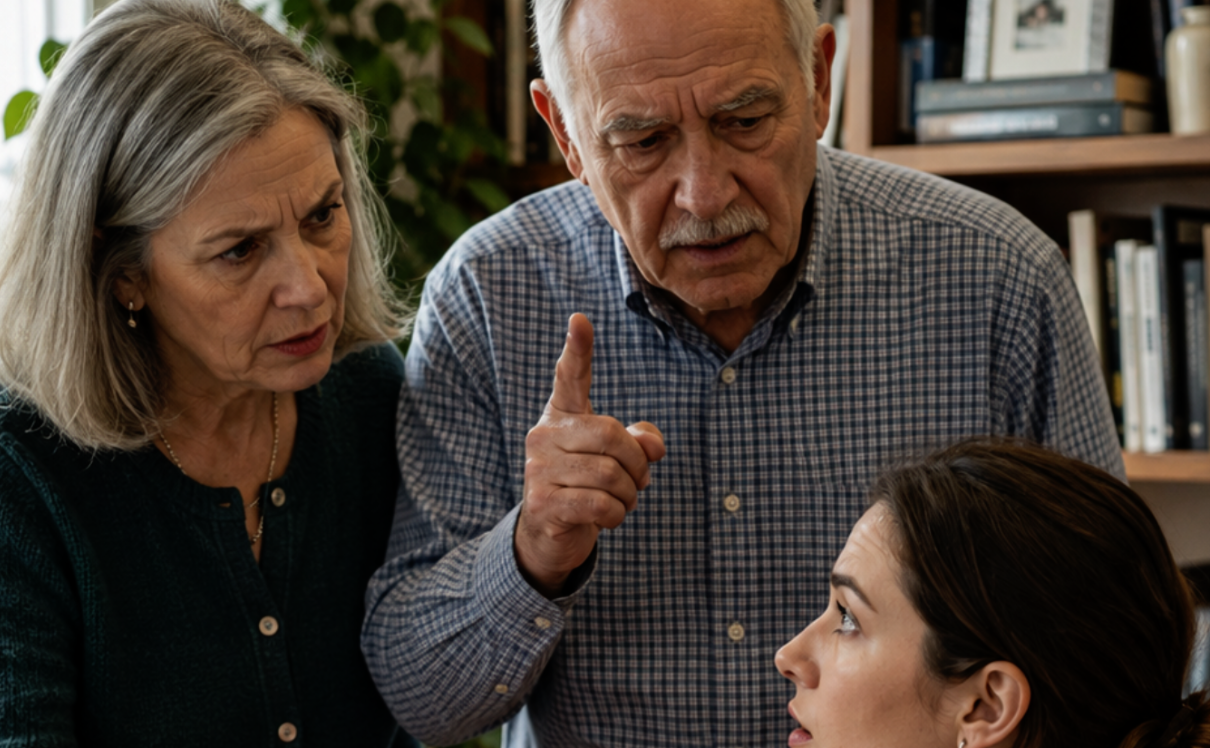
“Then either return the three hundred thousand to us by the end of the week, or you can stop considering us your parents!” her father said in an icy voice, placing a piece of paper with a bank card number in front of his daughter.
Elena silently stared at her parents, unable to understand how an ordinary birthday gift had turned into a debt in just a few days. Only recently they had smiled, hugged her, and said how proud they were of their daughter. Now they were demanding the money back simply because she had spent it differently from how they had decided she should.
The piece of paper lay on the table—an ordinary sheet torn from a notepad. The numbers had been written neatly in her father’s handwriting. Lyudmila Pavlovna sat beside her husband with her hands folded on her lap, looking somewhere past her daughter. She said nothing. And that silence was more frightening than any words. Elena was turning thirty-two.
She lived alone in a small apartment on the ninth floor—the same apartment whose mortgage she had been methodically paying off for several years, setting aside every spare thousand she could. She worked as an architectural visualization specialist at a design bureau, and in the evenings and on weekends she took private projects from home.
A typical morning began with coffee and her old computer. While the machine was booting up, Elena had enough time to drink half a cup. Sometimes an entire one.
“Come on,” she would whisper habitually, staring at the frozen screen.
The computer responded reluctantly. Rendering complex scenes took hours, and several times she had missed deadlines—not through any fault of her own, but it was embarrassing to explain that to clients. One day her boss, Dmitry Olegovich, called her into his office and said without any unnecessary preamble:
“Lena, I value you. But I can’t entrust major projects to a computer that takes all night to render them. Think about upgrading your equipment.”
She did think about it. She had been thinking about it for a long time.
She simply never had enough money.
Her parents, Viktor Andreevich and Lyudmila Pavlovna, lived in a neighboring district and came to visit roughly once every two weeks. Every visit resembled the one before it. Her mother inspected the apartment with the expression of someone who had discovered disorder where none should exist.
“You should have replaced this wallpaper a long time ago,” she would say, running a finger along the wall near the hallway.
“Why do you even need this coffee machine?” her father would frown. “A waste of money.”
“You should have bought a proper cabinet instead,” her mother would add. “A good wooden one. That’s something worthwhile.”
Elena had stopped arguing with them long ago. She simply nodded and poured the tea.
For her birthday celebration, everyone gathered at a small family restaurant—Aunt Galya, her cousin Olya and her husband, and several friends. After a toast, her father unexpectedly stood up and pulled a large envelope from the inside pocket of his jacket.
“Buy yourself something serious,” he said, handing it to his daughter. “Something that will last for many years.”
Elena looked inside and felt her throat tighten.
Three hundred thousand rubles.
“Dad… Mom…”
She couldn’t finish. She simply hugged them both.
Everyone at the table applauded.
And Elena already knew exactly what she was going to spend the money on.
The next morning, Elena went to a professional computer equipment store on the other side of the city.
She had prepared for this purchase for a long time—studying forums, reading reviews, and consulting with colleagues. She knew exactly what she needed.
“I’ll take this workstation,” she told the salesman, a young man in a blue shirt. “And a monitor with a wide color gamut. A professional one, for graphics.”
“Good choice,” he nodded. “For visualization work?”
“Yes. And I also need a licensed software package.”
Elena added some of her own savings to the money her parents had given her. The final amount was substantial, but she didn’t hesitate for a second.
Getting all the boxes into a taxi turned into quite an adventure. The driver kept glancing irritably into the rearview mirror while Elena and the salesman tried to squeeze the packages onto the back seat.
“Will it fit?” the taxi driver asked doubtfully.
“It should,” Elena replied, slamming the door shut.
It did.
That evening, she spent several hours unpacking everything, connecting the equipment, and installing the software. Her workspace transformed before her eyes. When the monitor finally lit up in all its width and a test scene appeared on the screen—sharp, vivid, with perfectly rendered shadows—Elena simply froze.
“Wow,” she whispered to herself.
For the first time in a long while, work began to feel genuinely enjoyable.
A render that previously would have taken the entire night finished in less than an hour.
In her mind, she thanked her parents.
When Dmitry Olegovich learned about the purchase, he even whistled in surprise.
“This is a completely different level,” he said. “We’ve got a major commercial project. Now I can confidently give it to you.”
The client sent feedback that same evening: the visualizations exceeded all expectations.
Elena was happy.
She was certain her parents would be happy for her too. Viktor Andreevich and Lyudmila Pavlovna arrived on Friday afternoon to “see what their daughter had done with the gift.”
Elena baked a pie and made tea.
At the table, her father good-naturedly stirred sugar into his tea and finally asked:
“So, did you buy a new kitchen?”
Elena smiled.
“Come on. I’ll show you.”
She led her parents into her study.
The workstation stood neatly and impressively on the desk, while the monitor glowed with a soft, even light. Elena began explaining what the equipment was, how it worked, and what kind of project she had already been able to accept because of it.
A heavy silence settled over the room.
Her mother slowly reached out and cautiously touched the edge of the monitor, as though checking whether it was real.
“And you spent three hundred thousand on this?” she asked quietly.
“Mom, this is professional equipment. I’ve already received a project that will pay for—”
“Toys,” her father interrupted.
His voice hardened.
“This isn’t a purchase. These are toys.”
Elena tried to explain that the computer was a tool she used to earn money, that her old equipment had been holding back her career, and that now she would be able to take on projects at an entirely different level.
But her parents seemed to be speaking a different language.
“A normal person would have renovated the apartment,” her mother said.
“Or bought furniture,” her father added. “That lasts. This equipment will be outdated in three years.”
“Return everything to the store,” Viktor Andreevich demanded.
“Dad, the equipment works perfectly. They won’t accept it back.”
Her father remained silent for a moment.
Then he stood up, straightened his jacket, and said something Elena had never expected to hear.
“Then give us the money back. By the end of the week.”
She stared at him and, for the first time, understood clearly: they had never truly given her that money.
They had given it to her with a condition—an unspoken but absolute condition.
Their daughter was supposed to spend it correctly.
Meaning, exactly the way they thought she should. Lyudmila Pavlovna suddenly lowered her head and began to cry—quietly, without saying anything, her shoulders trembling slightly.
“We saved that money for several months,” she finally said, pulling out a handkerchief. “We didn’t replace the windows even though they’ve needed replacing for ages. Your father went through the entire winter wearing his old boots. I told him to buy new ones, but he said no—we’re saving the money.”
Elena stared at her mother and felt something inside her being stretched to the breaking point.
“Mom,” she said, her voice trembling. “I buy your medicine every month. I order groceries for you whenever you ask. I make appointments with Dad’s cardiologist and take you to your medical examinations. I always help you. But this gift—for the first time in my life—I spent it on myself. On my work. On my future.”
“So your pieces of metal are more important to you than your family,” her father concluded coldly.
“Then just transfer the money back to us,” he added more quietly, as though offering a compromise.
“You can’t demand a gift back, Dad.”
Lyudmila Pavlovna raised her tear-filled eyes.
“So this is your gratitude. We tried so hard for her, and she…”
“Until you return the money, don’t bother calling us.”
Viktor Andreevich said it calmly, without shouting, which somehow made it even worse.
They gathered their things in silence.
Her mother didn’t say goodbye.
The door closed with a quiet click.
Elena sat in front of her new computer for a long time without touching the keyboard.
She had no desire to work at all.
The monitor glowed uselessly in front of her.
For the first time in her life, she had firmly said “no” to her parents.
She didn’t know whether she had done the right thing.
But she knew one thing for certain: she could not have done otherwise. That same evening, her phone chimed softly.
A message from her mother.
There was a bank card number and a short sentence:
“We’re expecting the transfer by Friday.”
Elena read the message, hesitated for a second, and deleted it.
She did not send the money.
The following morning, she forced herself to sit down at her desk.
She opened the project and started the render.
The machine responded instantly—no freezing, no waiting.
Gradually, the work absorbed her, and the pain subsided a little.
The new equipment really did allow her to work faster and more accurately.
A month later, Dmitry Olegovich called her into his office and placed a bonus order on the desk.
“You earned it,” he said simply.
The amount of the bonus practically covered everything Elena had added to her parents’ money from her own savings.
The investment had already paid for itself.
But her parents continued to remain silent.
Elena still paid for their medicine through a pharmacy app. She transferred money toward their utility bills, just as she had done before.
They accepted the help without a word of thanks—and without any attempt at reconciliation.
One day, Elena realized that she no longer thought about the three hundred thousand.
She was thinking about something else.
It had never really been about the money.
It had never been about the money at all.
Her parents simply could not accept that their daughter was an adult who had the right to decide for herself how to live her own life.
The gift had been an attempt to help.
But hidden beneath it was an unspoken condition:
You will do what we believe is right.
And when she chose differently, that condition finally revealed itself.
Elena looked out the window and thought that this realization was bitter—but honest.
Almost a year passed.
Elena became one of the bureau’s leading specialists.
Her income increased noticeably, and she could finally see the end of her mortgage—the final few payments no longer frightened her.
Her desk acquired more new equipment, all of it purchased entirely with her own money, without anyone’s help and without anyone’s conditions.
She spoke to her parents only occasionally.
They talked about the weather, their health, prices in the stores.
Nothing personal.
It was a cold, carefully maintained peace in which everything was in its proper place—and nothing truly alive remained.
One late evening, Elena was finishing a major commercial project.
The final render was processed quickly.
She leaned back in her chair and looked at the monitor—the same wide monitor with its soft, even glow.
She smiled. Not because of her parents. Not because of the resentment. Not because of everything that had happened that year. She simply smiled. Quietly and without bitterness.
A true gift stops belonging to the giver the moment it is handed over.
And trying to take it back is no longer an act of care.
It is a desire to maintain control over another person.
Elena understood that now.
And she let it go.