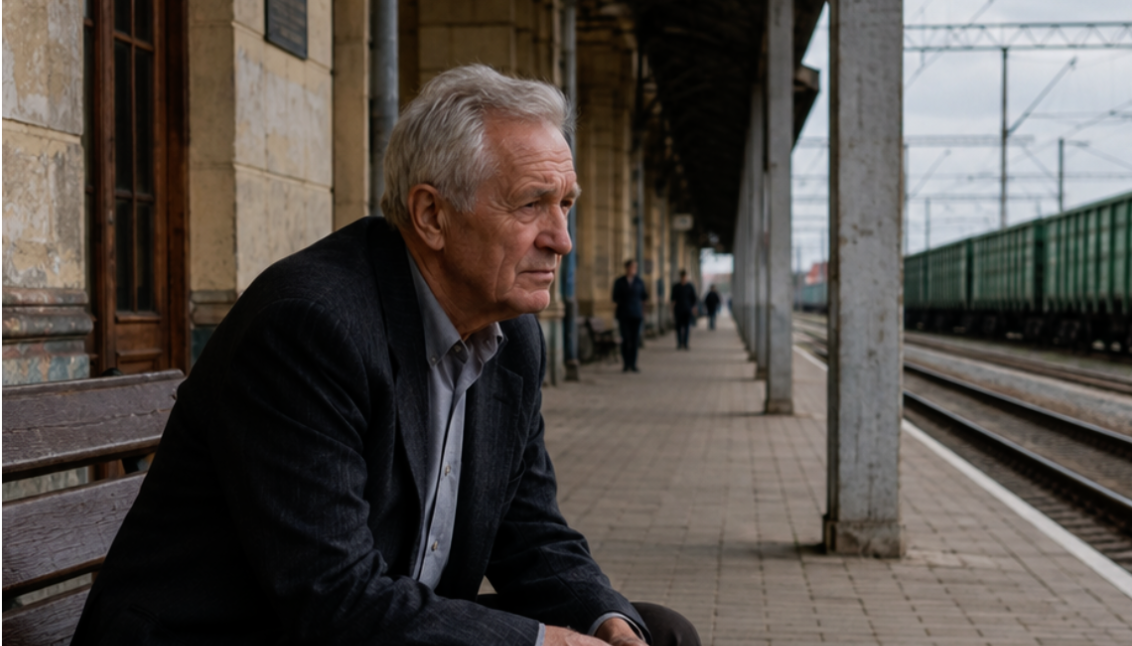
For Many Years, Once a Year, Grandfather Would Dress Up and Go to the Train Platform to Wait for Someone. His Grandson Decided to Uncover the Mystery…
On July 14, Grandpa Ivan got up at five in the morning.
Artyom could hear from his room as the old man moved around the house. But today everything was different, unlike an ordinary day. His footsteps seemed heavy and unhurried, and Grandpa kept stopping every now and then. First, the wardrobe door creaked, then a mug quietly knocked against the table, and a minute later came a deep, drawn-out sigh that seemed loud enough for the whole house to hear.
Artyom lay with his eyes closed. He knew perfectly well what day it was.
July 14.
For as long as Artyom could remember, every year on that exact date, his grandfather woke before dawn. He shaved carefully, took out his only formal suit—far from new, but always clean and neatly pressed—and caught the first bus to the district center. Ivan returned home only on the last bus, when darkness had already begun to fall. After coming back, he would usually sit down and barely say a word for the rest of the evening.
People in the village had long since grown accustomed to this strange habit and no longer asked him questions. Ivan did not like talking about himself in general. Even Olga, Artyom’s mother and Ivan’s own daughter, would merely sigh:
“Gone again.”
It was impossible to get any further explanation out of her. Artyom never understood whether his mother truly knew nothing or simply believed that he did not need to know.
In the past, Artyom himself had never attached much importance to his grandfather’s trips. So the old man went somewhere once a year—there had to be a reason. What business could an elderly man have in the district center? Perhaps he visited doctors. Or dealt with paperwork. Maybe he went to the cemetery.
But now everything felt completely different.
That year, Artyom had turned twenty-two. For the first time, he had come to stay with his grandfather alone, without his mother and without the usual bustle of family life. And for the first time, he could see with his own eyes how Ivan prepared for his annual journey instead of merely hearing about it afterward.
And suddenly a question appeared in his mind:
Who was Grandpa waiting for there?
At about half past five, Ivan left the house. Artyom cautiously looked through the window.
His grandfather paused on the porch. He wore a dark jacket over a snow-white shirt, and his shoes had been carefully polished. Ivan’s gray hair was neatly combed back. In one hand he carried an old leather bag, worn so heavily over the years that the leather had faded almost pale in places.
For several moments, the old man stood motionless, staring down the road. Then he adjusted the collar of his shirt and slowly stepped off the porch.
Artyom waited until his grandfather disappeared around the bend. Then he quickly pulled on some clothes and followed him.
He did not think of it as spying on his grandfather. For some reason, he simply felt uneasy. The image of Ivan standing on the porch remained before his eyes—the way he had stared down the road, adjusted his collar, and put on his best suit.
The old man did not look as though he was going out to run ordinary errands.
He looked as though he were going somewhere where something very important was supposed to happen.
Something that had not happened for many years.
The bus arrived at ten past six. Ivan took a seat by the window. Artyom boarded a little later and sat two rows behind him, pulling his cap lower over his forehead.
The bus left the village, and the familiar houses slowly disappeared behind them.
The journey to the district center took about forty minutes. During the entire ride, Grandpa never looked away from the window. He did not try to sleep, did not read anything, and did not speak to the other passengers. He simply watched the road in silence.
Sometimes his lips moved almost imperceptibly.
It seemed as though Ivan was silently repeating the same thing over and over again. Perhaps a word. Perhaps a name. But no matter how carefully Artyom watched him, he could not make it out.
At the bus station, his grandfather got off first. He stood beside the stop for several seconds and looked around.
Then, instead of heading toward the hospital, the government offices, or even the market, Ivan walked toward the railway station.
The old, shabby building stood on the opposite side of the square. Above the entrance hung a large clock that had been showing the wrong time for years.
Artyom continued following, careful to keep his distance.
His grandfather approached the station entrance and chose the farthest bench beneath the canopy, a place from which the platform could be seen clearly.
Ivan slowly sat down.
He placed the old leather bag beside his feet.
He folded his hands calmly on his knees.
And began to wait.
Trains arrived at the platform one after another. First came the morning train, then another around midday, and several more closer to evening. Passengers poured out of the carriages, picked up their bags, greeted relatives, and gradually scattered across the square. Artyom studied every face carefully.
By evening, hope had almost disappeared. He had already begun thinking that he had come here for nothing. Perhaps that letter no longer meant anything. Maybe Pavel was no longer alive. Or perhaps he had stopped coming many years ago.
But at six thirty in the evening, a train from the north arrived.
Among the passengers, Artyom noticed a man.
He was tall, slightly stooped, and completely gray-haired. He wore a gray raincoat and carried a travel bag over one shoulder. The man stepped off the platform and stopped, looking around carefully.
Exactly as Grandpa Ivan had done three days earlier.
Then the stranger walked directly toward the bench.
Toward that same farthest bench beneath the canopy.
Artyom slowly stood up. His heart was beating so hard that he could almost hear his own pulse.
The man approached, stopped in front of him, and looked at him.
“Excuse me,” he said quietly. “May I sit here?”
“Of course,” Artyom replied.
The stranger gave a short nod, sat down, placed his bag beside his feet, and folded his hands on his knees.
Exactly like Grandpa.
Artyom watched him for several seconds before finally gathering the courage to speak.
“You’re Pavel.”
The man jerked his head around.
“How do you know…?”
“My name is Artyom. I’m Olga’s son. Your nephew.”
Pavel turned pale.
For a long moment, he stared at the young man as though trying to convince himself that he had heard correctly. His lips trembled, but the words did not come immediately.
“Olga…” he finally whispered. “My little sister… How is she?”
“She’s alive. She’s fine. But you… do you really come here every year?”
Pavel lowered his eyes.
“Every year,” he said quietly. “On July 17. For thirty years. Just like I wrote in the letter.”
He gave a joyless little smile.
“I wrote to Father back then: ‘I’ll be at the station on the seventeenth. If you forgive me, come.’ And I came. I sat right here. Stayed until the last train. Father never came. I thought that meant he still couldn’t forgive me. So I left. But for some reason, I came back the next year. And then again the year after that. I don’t even know why I kept coming. I suppose I hoped that one day he would finally show up.”
Artyom felt something tighten painfully inside him.
“He does come.”
Pavel froze.
“What?”
“Grandpa comes here every year. He has for all thirty years. Just not on the seventeenth. He comes on July 14.”
“The fourteenth?” Pavel frowned. “Why would he come on the fourteenth? I clearly wrote the seventeenth.”
“The ink on the letter had smudged,” Artyom explained. “Right where the date was written. Grandpa read the seven as a four. Maybe he was looking at it in poor light and wasn’t wearing his glasses. The bottom of the seven blurred. That’s how it happened.”
Pavel stared at his nephew, his lips visibly trembling.
“My God…” he whispered. “Thirty years. For thirty years, I was certain my father hadn’t forgiven me. And he simply misread the number.”
“And Grandpa has spent all these years believing that you promised to come on the fourteenth and never showed up,” Artyom continued. “Every year, he gets up at five in the morning, puts on his best suit, catches the first bus, and comes here. Then he sits on this bench until the last train.”
Tears began running down Pavel’s cheeks.
He did not even try to wipe them away. He simply kept looking at Artyom.
“Thirty years,” he repeated. “Just three days. Three miserable days… and one blurred number.”
Artyom stood up.
“Let’s go.”
Pavel looked at him.
“Where?”
“To Grandpa. Right now. He’s alive. That means it isn’t too late.”
Pavel remained motionless for several seconds. Then he slowly stood and picked up his travel bag.
“Let’s go.”
They reached the village after darkness had already fallen.
Ivan was sitting on the porch. He clearly had no intention of going to bed. He was waiting for Artyom and, apparently, had already started worrying about why his grandson had been gone all day.
When he saw him near the gate, Grandpa rose.
“Where have you been all day?” he began angrily. “I was starting to think…”
Then he fell silent.
Behind Artyom, another figure emerged from the darkness.
Tall.
Stooped.
Gray-haired.
Ivan did not move. He stared intensely at the stranger’s face.
Then he breathed softly:
“Pasha?.. Pashka?”
Pavel took a step forward.
And then suddenly dropped to his knees in the middle of the path, straight into the dry dust.
“Forgive me, Father,” he said, but his voice broke. “Forgive me. I came. Late… far too late. But I came.”
For several more moments, Ivan simply stood over him.
Then he slowly lowered himself beside his son, wrapped his arms around him, and held him tightly against his chest.
One gray-haired old man was embracing another gray-haired man.
“Late…” Grandpa whispered. “Oh, son… what have you done… what have you done…”
And for the first time in thirty years, he cried.
Artyom stepped quietly to the side.
In the moonlight, directly on the path, two men sat together—father and son. They clung to each other and wept.
Three days apart.
Thirty years of waiting.
Ivan and Pavel talked throughout the entire night.
It turned out that Pavel had long since married, had two children, and held a steady job at a factory. All those years, he had not even lived particularly far away—only about three hours away.
Three hours.
And yet father and son had lived as though they were on opposite ends of the world.
“I looked for you,” Ivan said. “For years, I looked for you. I contacted everyone I could think of. Wrote letters, sent inquiries… But you were nowhere.”
Pavel lowered his head guiltily.
“After I got married, I took my wife’s surname. At the time, I thought it would be better that way. I didn’t want anyone to find me.”
Grandpa gave a bitter smile.
“You didn’t want to be found… while I kept waiting.”
Closer to dawn, Ivan suddenly fell silent. Then he asked quietly, almost as though he felt embarrassed:
“And that last letter… You wrote when you were coming, didn’t you? I reread it so many times that I nearly memorized it. I was certain about the date—the fourteenth. For thirty years, I traveled there on the fourteenth.”
Pavel flinched.
He reached into the inside pocket of his raincoat and took out a sheet of paper folded several times.
He handed it to his father.
“The seventeenth, Father. I wrote the seventeenth.”
Ivan unfolded the paper, brought it closer to the light, and stared at the lines for a long time.
Then he slowly shook his head.
“So that’s how it was…” he said softly. “The seventeenth. And all this time, I saw the fourteenth. I was already getting old. My eyes failed me. And of all moments, it had to happen when making a mistake mattered most.”
He fell silent for a while.
“So you really came on the seventeenth?”
“Every year, Father,” Pavel replied. “For all thirty years. I sat on that bench and waited for you.”
Grandpa closed his eyes.
“And I sat there on the fourteenth,” he whispered. “In exactly the same place. There were only three days between us.”
He shook his head again, and tears rolled down his wrinkled cheeks.
“What fools we were, Pashka. Two old fools. For thirty years, we came to the same bench and never once saw each other.”
A year later, on July 17, the three of them came to the railway station together.
Ivan, Pavel, and Artyom.
They approached the familiar bench—the farthest one beneath the canopy—and sat down side by side.
This time, nobody was waiting for anyone.
They simply watched the platform, the arriving trains, and the passengers hurrying past.
Pavel ran his hand over the wooden back of the bench.
“It’s a good bench after all.”
Ivan nodded.
“It is.”
And he smiled.
Artyom looked at them and thought about how strangely life sometimes works.
Two people can spend decades carrying love, resentment, and hope without ever realizing that the answer has been close beside them the entire time.
Only three days away.
Only three hours down the road.
Hidden in one blurred number on an old letter.
It was a good thing Artyom had not simply dismissed the mystery.
It was a good thing he had climbed into the attic and opened the old chest.
It was a good thing he had taken out the yellowed letter and carefully examined the date beneath the lamp.
Because otherwise Ivan would have continued coming on the fourteenth.
Pavel would have continued coming on the seventeenth.
And they might have spent the rest of their lives sitting on the very same bench, separated by only three days, without ever meeting again.