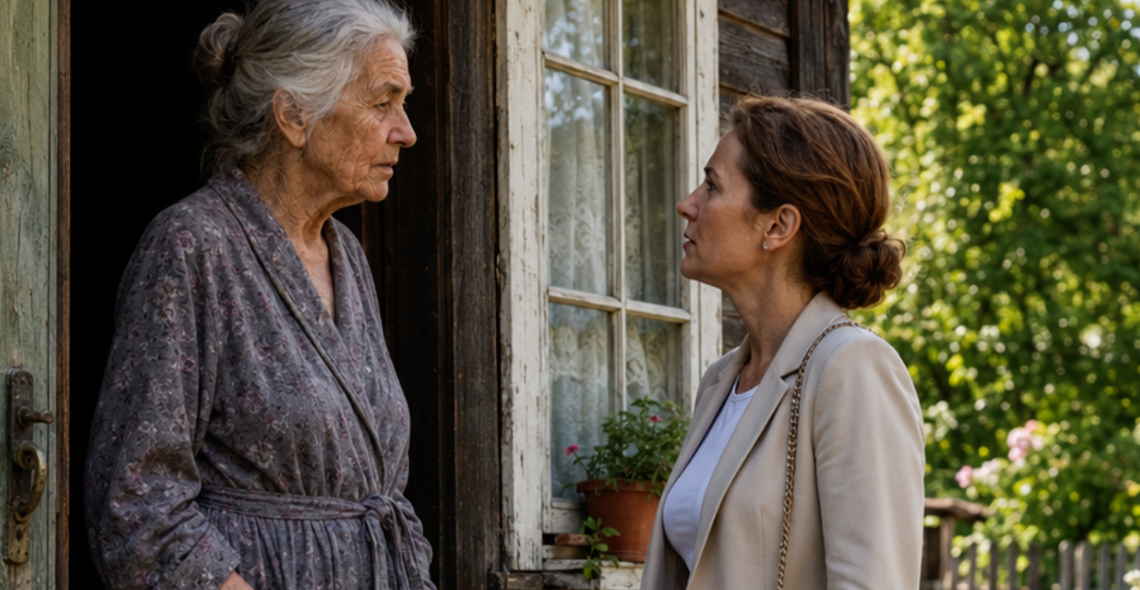
The Daughter Found Out Her Mother Was Selling the House and Rushed in from the City to Argue. But Her Mother Had a Powerful Argument…
The phone rang around nine in the evening, just as Vera was leaving the office.
“Vera!” Aunt Galya’s voice, belonging to her mother’s longtime neighbor, sounded anxious, almost frightened. “Do you even know that your mother is planning to sell the house?!”
Vera stopped right on the steps and pressed the phone more tightly to her ear.
“What?”
“Your house! That very house! There’s already a ‘For Sale’ notice hanging near the store. And a realtor came by and photographed the whole property and all the rooms. I went to see Zoya and asked her, ‘What are you thinking?’ And she tells me, ‘What else am I supposed to do?’ Vera, do you understand? She really is selling the house!”
“What realtor?” Vera was already hurrying toward her car. “Aunt Galya, maybe you misunderstood something?”
“What is there to misunderstand? I saw everything with my own eyes! Come here, Vera. Before she gives the house away to someone.”
For the rest of the drive, Vera couldn’t calm down. Her fingers gripped the steering wheel as she drove faster than usual, feeling her irritation growing stronger by the minute.
How could her mother make such a decision?
The house.
Her father’s house.
The very house where Vera had grown up, where she had spent her entire childhood, where her father had once sat on the porch repairing his old felt boots.
Had her mother completely lost her mind? Selling the family home without even consulting her—her own only daughter?
Vera reached the village at dawn.
Everything around her was still wrapped in sleepy silence. Only roosters called to one another from neighboring yards, while somewhere in the distance a dog barked from time to time.
Vera slowly drove along the street she had known since childhood. Almost nothing had changed. Only the fences had grown older, and the poplar tree beside the former community club had become noticeably taller.
She stopped the car in front of her parents’ yard.
The fence leaned slightly to one side. The heavy gate, with the same wrought-iron latch Vera remembered from childhood, stood slightly open.
She walked to the small gate and pushed it.
It creaked slowly.
The sound was so familiar, almost dear to her, that for a moment Vera felt a painful tightening in her chest.
She stepped into the yard and stopped.
Her mother was already standing on the porch.
Zoya Pavlovna wore an old housecoat and worn slippers. Her thin gray hair was gathered into a small, sparse bun at the back of her head.
She looked at her daughter with complete calm. There was no surprise or confusion in her expression.
As though she had known Vera would come.
“Hello, sweetheart,” Zoya Pavlovna said quietly.
“Mom, what on earth is going on here?!” Vera strode quickly toward the porch without even returning the greeting. “Aunt Galya called me last night and said you’re selling the house! Is it true?”
Zoya Pavlovna remained silent for several seconds.
Then she turned around and slowly headed inside.
“Come in,” she said over her shoulder. “There’s no need to shout for the whole yard to hear.”
Vera followed her.
The house smelled of fresh baking.
On the kitchen table, covered with the familiar old oilcloth, stood a still-warm cabbage pie. Two cups had been prepared beside it, and a samovar stood nearby.
Vera stopped in the kitchen doorway.
“You were expecting me?” she asked, confused.
“I was,” her mother replied calmly as she poured tea into the cups. “I knew you’d come.”
“How could you know?”
“Aunt Galya doesn’t know how to keep quiet. Of course she would call you.” Zoya Pavlovna smiled faintly. “So I waited.”
Vera sat down, but she didn’t even touch the pie. Food was the last thing on her mind.
“Mom, explain this to me properly,” she said, trying to keep her voice steady, though it still trembled. “Why did you decide to sell the house? Our house. Do you even understand what you’re doing?”
“I understand perfectly,” Zoya Pavlovna nodded. “Better than you do.”
“What do you understand?!” Vera suddenly jumped up from the chair. “This is Dad’s house! Everything here reminds me of him! You can’t just bring in some realtor without saying anything to me and—”
“Verochka.”
Her mother merely lifted her eyes toward her, and Vera suddenly fell silent. There was such quiet exhaustion and such simple truth in her mother’s gaze that somehow it became impossible to continue shouting.
“You haven’t come here in five years,” Zoya Pavlovna said quietly.
“I was working!” Vera immediately protested. “I have my own business, clients, responsibilities. I can’t just drop everything whenever I want and—”
“Five years,” her mother repeated. “Five Easters have passed. Five of my birthdays. Five anniversaries of your father’s death. You weren’t here for five years. But today you came. And you came because of the house. Not because of me.”
Vera said nothing. Suddenly her chest felt tight, as though there wasn’t enough air.
“Mom, that’s not fair…”
“And how often did you call me?” Zoya Pavlovna asked. “Once a month? At least once every two months? I counted, sweetheart. In five years, you called me thirteen times. And not one of those conversations lasted even five minutes. You have your own life there. And here, all I have is this house. Huge. Cold. And empty.”
Zoya Pavlovna got up from the table.
“Come with me,” she said. “I want to show you something.”
They went outside and walked toward the gate.
“Look.”
Her mother placed her hand on the old wrought-iron latch.
“I haven’t locked this gate with a padlock once in five years. At night, I only hooked the latch. I never put the lock on. I kept thinking: what if you arrive during the night? The lock is heavy and old, and you could never manage it properly even when you were a child. So I left it open. For all five years.”
Vera stood beside her with her eyes lowered.
Zoya Pavlovna walked back toward the porch and pushed open the front door.
“I almost never locked this door either. Not in winter, not in summer. Even during the worst frosts. I just pulled it closed. I kept thinking: what if you arrive while I’m asleep? You’ll push the door open and come inside.”
They entered the house. Her mother opened another door—the door to Vera’s old room.
“Here’s your room.”
She switched on the light.
The room immediately filled with brightness. It was astonishingly clean. Fresh bedding lay on the bed, a geranium grew on the windowsill, and old magazines were neatly stacked on the table.
“I cleaned here every week,” Zoya Pavlovna continued. “Washed the floor, wiped away the dust, cleaned the windows. From time to time, I changed the bed linen. I always thought you might come. Five years, Verochka. Every week, I waited.”
Vera slowly entered the room and sat on the edge of the bed.
Almost nothing had really changed. Even the smell was the same—old wood, dried herbs, and something warm and summery from a distant childhood.
“Now let’s go to the bathhouse,” her mother said.
They went outside again.
“I heated the bathhouse for you too. Once a month, on the first Sunday. I carried the water, chopped the firewood, lit the stove. I waited. But you didn’t come. The water would get cold, and later I would pour it away. That went on for five years.”
Vera’s lips trembled.
They reached the cellar.
“And here are my preserves,” Zoya Pavlovna said as she opened the heavy lid. “Cucumbers, tomatoes, mushrooms, jam. I made all of it for you. Every autumn I thought, ‘My Verochka will come, and I’ll give her so many jars that her car will barely carry them.’ But you never came. Now there are already five rows of them.”
Her mother straightened up and looked carefully at her daughter.
“There are your five doors, Verochka,” she said quietly, gesturing around the yard. “The gate. The front door. Your room. The bathhouse. The cellar. For five years I kept them open for you. And during all that time, you didn’t open a single one. Not once. Do you understand now?”
Vera stood in the middle of the yard. Tears were already running down her cheeks, though she seemed not to notice them.
She looked at her mother—small, gray-haired, dressed in her old housecoat—and suddenly realized that for the first time in many years, she was truly seeing her. Not as the familiar word “Mom” in her phone contacts, but as a living human being.
“Mom…” Vera whispered.
“That’s why I decided to sell the house,” Zoya Pavlovna continued. “Not to spite you. I’m simply tired of waiting. Open doors require strength too, sweetheart. An enormous amount of strength. Especially when you realize that no one is going to walk through them anyway.”
They returned to the kitchen.
Vera sat at the table, holding the long-cold cup between both palms, afraid to raise her eyes.
She was ashamed.
Not merely embarrassed, but painfully, unbearably ashamed.
“Mom,” she finally said. “I didn’t know any of this.”
“Because I never told you,” her mother replied calmly. “I kept hoping you would remember on your own. You didn’t. So that’s how things turned out.”
“No, that’s not right!” Vera suddenly lifted her head. “You should have told me! Called me. Written to me. Explained!”
“Did you write to me?” Zoya Pavlovna asked quietly. “Did you call? Vera, I gave birth to you, raised you, educated you. After your father died, I worked two jobs at once just so you could get an education and build your life. And what did I receive in five years? Thirteen short phone calls. And every one of them was about the same: ‘Mom, how’s your health?’ — ‘Fine.’ — ‘Good, then.’ And that was it.”
Vera couldn’t hold back any longer.
She burst into tears, no longer trying to hide them.
“Mommy, forgive me… Please forgive me…”
Zoya Pavlovna moved closer and hugged her daughter.
“Why are you doing this to yourself, sweetheart? I’m not trying to make you beg for forgiveness. I’m simply tired. And I want you to understand one thing: memories are not the walls of this house. While I’m still alive, I am the memory. And I can’t manage this house anymore. I’m in my seventy-sixth year. My heart has started giving me trouble, and my back barely straightens anymore. Lighting the stove is a whole ordeal for me now. Carrying water from the well is difficult. That’s why I decided to sell the house. I wanted to buy a small apartment closer to the district center. The hospital would be nearby, the store would be nearby, and there would be people around.”
Vera wiped her face with her palms and looked at her mother with reddened eyes.
“Why didn’t you tell me anything? Not about your heart, not about how hard things have become for you here?”
Zoya Pavlovna smiled sadly.
“When was I supposed to tell you? During one of those thirteen phone calls? Whenever I started talking, you would say, ‘Mom, I’m in a meeting right now. I’ll call you back later.’ But later, you never called back.”
Vera buried her face against her mother’s shoulder again and sobbed.
She stayed in the village for two days.
On the third day, Vera found the realtor. He turned out to be a young man named Roman, Aunt Galya’s son. Vera spoke with him, asked him to remove the advertisement, and stopped the sale.
That evening, she sat opposite her mother.
“Mom, I’ve decided everything. We’re not selling the house.”
Zoya Pavlovna looked at her carefully.
“And what are you suggesting?”
“We’ll transfer it into my name. I’ll repair everything. And you…” Vera hesitated for a moment. “You’ll come live with me. I have plenty of space. I’ll find you a good doctor, get your heart examined, have your back treated. You can stay with me. And the house will remain ours. We’ll come here every summer. And not just in summer. We’ll try to visit more often.”
Her mother didn’t answer for a long time.
Then she slowly shook her head.
“No, Verochka. I wouldn’t fit into city life. I’ve lived here my whole life. I feel trapped among apartment buildings. You can hear neighbors talking through the walls, someone walking upstairs, a television playing downstairs. It isn’t for me.”
“Then I’ll move here!” Vera suddenly blurted out, surprising even herself. “I’ll switch my work to remote. I’ll live here. With you.”
Zoya Pavlovna smiled.
“You silly girl. You have your own work, your own responsibilities, your own life. You don’t need to give it up for me.”
She walked over to the window and looked into the yard, where the gate was now locked with a real padlock for the first time in years.
“I’ll stay here,” her mother continued. “Just come visit me. At least once a month. Even if it’s only briefly, even just for one day. And from now on, I’ll lock the doors. I promise. But whenever you come, I’ll always open them for you.”
A week later, Vera left.
This time, everything changed.
She really did begin visiting every month. Sometimes she stayed for only a day; sometimes she spent the entire weekend in the village. She brought groceries and necessary medicines and arranged for repairmen to come.
Little by little, they repaired the leaning fence, fixed the roof, and eventually installed running water inside the house so that her mother no longer had to carry buckets from the well.
The house came alive again.
Vera transferred ownership of it into her name, just as she had promised, but she had no intention of selling it. Instead, she gradually put everything in order, carefully preserving the things that were precious to both of them.
Zoya Pavlovna seemed to come alive along with the house.
She started tending the vegetable garden again, began baking once more, and even got a few chickens.
Whenever neighbors met her by the gate and asked,
“How are you, Zoya?”
She always gave the same answer:
“Things are good now. My daughter comes to visit.”
And she said those words with such quiet happiness that the neighbors couldn’t help smiling.
In the evenings, when Vera got into her car and headed back to the city, Zoya Pavlovna would walk with her to the gate to see her off.
After her daughter left, she would close the heavy old padlock.
She did it slowly, with effort, but no longer with anxiety.
Now she knew for certain: Vera would come again.
And then the door would open once more.
Only now, she wouldn’t have to keep it open for five long years.
It was enough to open it when she was truly expecting someone.