“Enough! I said ENOUGH! You won’t get a single penny or a single square meter from me. Get out!” — these words had been choking me for years.
“Mom, sign the power of attorney. The notary is waiting for us in forty minutes,” Oleg said.
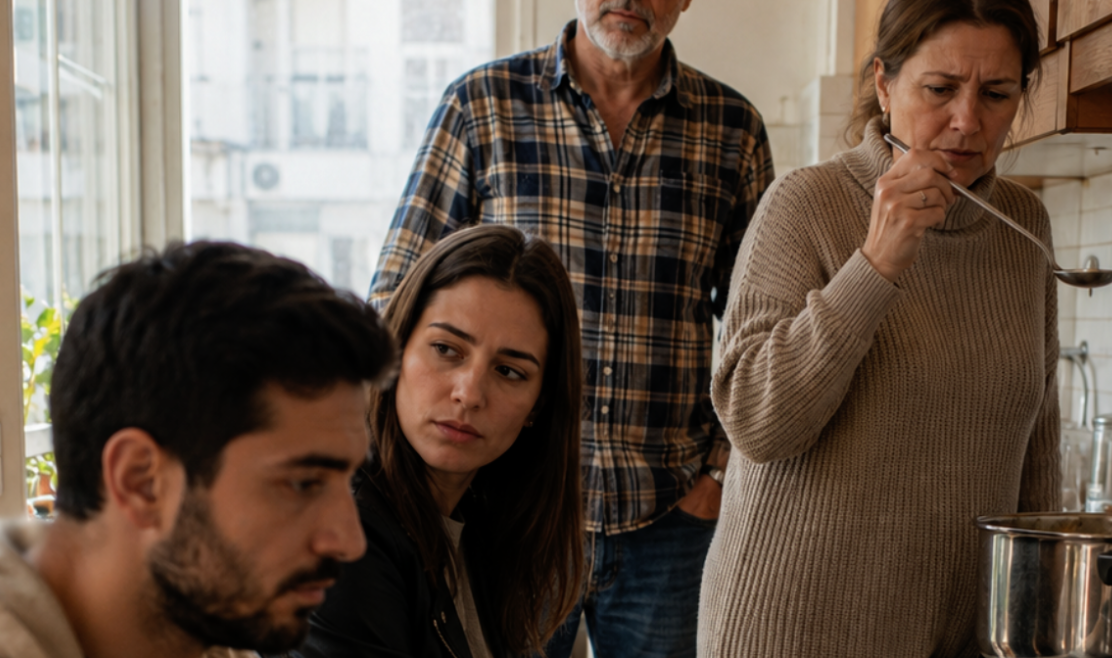
I stopped in the hallway with my bag still in my hand. I had only just come home from work and hadn’t even taken off my coat, yet my passport, the apartment documents, several printed sheets, and a pen were already lying on the kitchen table. Oleg, his wife Dasha, and her mother, Valentina Arkadyevna, were sitting at the table. Viktor stood by the window, pretending that whatever was happening had nothing to do with him.
I kept my passport in the bottom drawer of the dresser. The drawer was locked with a small key. I kept that key in my jewelry box, while Viktor had once been given a spare because he had asked for one “just in case.”
Apparently, that case had finally arrived.
“Who took my passport?” I asked.
Oleg looked at Viktor. Dasha immediately lowered her eyes to her phone. Valentina Arkadyevna adjusted the collar of her coat and sighed like someone who had to explain something obvious to an unbearably stubborn person.
“I did,” Viktor said. “Lida, don’t start. Your passport was here at home. Nothing happened to it.”
“It was in a locked drawer.”
“We’re not strangers,” he replied, turning toward the window again.
I took off my coat, hung it in the hallway, and walked to the table. Oleg pushed a sheet of paper toward me.
“Mom, it’s just a standard power of attorney. So I can handle the apartment paperwork, obtain certificates, go to the public services office, speak to the real estate agent. You won’t have to run around doing anything yourself.”
“What real estate agent?”
Dasha placed her phone face down on the table.
“Lidia Petrovna, let’s not beat around the bush. We found a reasonable option. Your apartment can be sold quickly because it’s in a good neighborhood. We’ll buy you a studio in a new building with an elevator and shops nearby. The remaining money will go to Oleg and me for a down payment. It makes sense. Everyone wins.”
I looked at my son.
“You brought me home to a ready-made power of attorney because you decided to sell my apartment?”
“Mom, don’t make it sound as if we’re throwing you out onto the street,” Oleg said irritably. “You’ll be buying another place. A perfectly good place. You live alone in a three-room apartment.”
“I live in my apartment.”
“No one is arguing that it’s yours,” Viktor intervened. “But there’s such a thing as family. Young people need help. You and I will move into the studio too. What difference does it make where we live if it makes life easier for the kids?”
I picked up the power of attorney and began reading it. The first lines looked ordinary: my personal information, Oleg’s information, the apartment address. Then came wording that immediately made it clear why they were rushing me. Oleg would have the right to represent my interests, file applications, sign documents, obtain certificates, conduct negotiations, and perform actions connected with disposing of the apartment.
“Oleg, did you read this?” I asked.
“The lawyer drafted it,” he answered.
“I’m asking whether you read it yourself.”
He grimaced.
“Mom, stop nitpicking. Without the power of attorney, I can’t arrange anything. You’ll be the first to complain later that you’re tired of going from office to office.”
“What transaction are you planning to carry out in my name?”
Dasha was the first to lose patience.
“The sale, of course. We’ve already explained it to you. You’ll get separate housing, and we’ll finally get a chance to live normally. Our rent keeps going up, and no bank will give us a mortgage without a down payment. We’ve been stuck in the same place for two years, while two rooms in your apartment are just sitting empty.”
“Dasha, those rooms aren’t empty. One has my wardrobe in it. The other has my belongings, documents, books, sewing machine, and everything else I’ve accumulated during my life. This is my home, not a warehouse of square meters.”
Valentina Arkadyevna gave a loud snort.
“This is exactly why young families suffer. Everyone else’s parents help, but here every shelf is apparently more valuable than her own son.”
“Are you selling your apartment too, to help your daughter?” I asked.
She immediately straightened.
“My apartment has nothing to do with this.”
“Why?”
“Because it’s my home.”
I nodded.
“Now that is an answer I understand. All of you remember it. My home is involved here only in the sense that I am the one who decides what happens to it.”
Oleg jumped to his feet.
“Mom, enough. The notary is waiting in forty minutes. Sign it, and then we can calmly discuss everything.”
“After I sign it, there’ll be nothing left to discuss.”
Viktor came over to the table and placed his palm on the folder.
“Lida, you’re tired after work. That’s exactly why we prepared everything for you. Don’t work yourself up. You’ll give your son power of attorney, and he’ll handle everything properly. No one is going to hurt you.”
“You already hurt me when you took my passport out of a locked drawer.”
His cheek twitched.
“Here we go. Somehow I’m guilty again.”
I opened the folder further. There was a calculation for the sale: the estimated value of my apartment, the price of a studio on the outskirts, the amount that would remain for Oleg and Dasha, the agent’s commission, moving expenses. They had even chosen the neighborhood for my future studio.
Not one of them had asked whether I wanted to move there.
They had simply calculated how much space would be enough for me.
The next sheet turned out to be a handwritten acknowledgment stating that many years earlier Viktor had supposedly given me a large sum of money to buy out the last room in the apartment. There was no signature yet, but they had left a space for one at the bottom.
I placed the document in front of Viktor.
“Explain this.”
He looked at the paper, then at Oleg.
“It’s just in case.”
“Did you give me that money?”
“I contributed to the family.”
“You didn’t contribute to the apartment. I bought the final room before we were married. The money came from my account. I still have the receipts.”
Dasha quickly interrupted.
“Lidia Petrovna, no one is planning to sue you. The lawyer simply said the documents had to be prepared properly. You’re treating everything like an attack.”
“Because it is an attack. My passport was taken without permission, a power of attorney was prepared without me, a receipt was invented retroactively, the apartment has already been appraised, and you’ve even decided where you’re going to relocate me.”
Oleg squeezed the pen so tightly that it cracked.
“We’re asking for help, Mom.”
“No, Oleg. People ask for help with words. You came here with a prepared power of attorney to sell my apartment.”
He stepped toward me.
“Give me the passport.”
I put the passport into my bag and zipped it shut.
“No.”
“Mom, don’t embarrass me in front of people.”
“You’ve embarrassed yourself.”
Valentina Arkadyevna rose from the table.
“Oleg, I told you from the beginning she wouldn’t sign anything voluntarily. You can’t deal with people like this the normal way.”
I took out my phone and placed it beside me.
“Go on. Now I’m actually curious what you mean by ‘another way.’”
Dasha stood abruptly.
“You’re going to regret this. We’ll find a way to settle the matter anyway.”
“After that sentence, this conversation is over,” I said. “Everyone leaves my apartment. Now.”
Oleg stared at me as if, until the very last second, he expected me to back down.
He probably had reason to expect it.
I had backed down too many times.
I had given money for the car, the wedding, the rent, appliances, “just a couple of weeks until payday.” I never reminded him about debts because I felt ashamed demanding my own money from my son. I didn’t argue with Viktor when he decided whom we were supposed to help. I tried to be a convenient mother, a convenient wife, a convenient homemaker who always had an extra plate, an extra thousand rubles, and an extra piece of her life available for someone else’s problems.
But a power of attorney to sell my apartment was no longer a request.
It was the boundary beyond which I could no longer pretend nothing serious was happening.
“Mom, you’re throwing us out because of some papers?” Oleg asked.
“Because those papers contain my apartment and your attempt to decide what happens to it without my consent.”
Dasha grabbed her bag. Valentina Arkadyevna was the first into the hallway, loudly complaining about ingratitude. Oleg lingered at the door, but I said nothing to him.
He needed to understand for himself that there would be no dinner, no tea, and no reconciliation tonight.
Viktor remained in the kitchen.
He waited until the door closed behind Oleg, then turned toward me.
“You’ve gone too far this time, Lida.”
“All I did was take back my passport.”
“You’ve destroyed your relationship with your son.”
“No. I refused to sign a power of attorney.”
“Is the apartment more important to you than family?”
“What matters to me is not ending up without a home because of people who call themselves family.”
He smirked.
“Greed ages a woman faster than wrinkles.”
“And the habit of living at someone else’s expense doesn’t make a man attractive either.”
Viktor picked up his jacket from the chair.
“I’m going to my sister’s. Maybe after a couple of days you’ll come to your senses.”
“Leave the keys.”
He spun around.
“What?”
“The keys to the apartment and to my drawer.”
“I live here.”
“Today you took my passport out of a locked drawer and placed it beside a power of attorney for the sale of my apartment. After that, you are not going to come in here whenever you feel like it.”
“You have no right.”
“Then tomorrow we can discuss it with the local police officer. And while we’re at it, we can discuss how my passport ended up on the table in front of people who had come to take me to a notary.”
Viktor looked at the phone in my hand and realized that arguing was no longer advantageous.
He threw the key ring onto the hallway cabinet.
“Choke on your apartment,” he said at the door.
“That won’t happen. It took me far too long to buy it.”
After he left, I locked the door and returned to the kitchen.
The folder was still lying on the table. Apparently, in their rush, they had forgotten to take it with them.
I didn’t hide it. I didn’t tear the documents up. I didn’t create a dramatic scene for myself.
I sat down, arranged the sheets in order, and photographed every single one.
The power of attorney granted excessively broad powers.
The fabricated receipt might have been useful to Viktor if they decided to create the appearance of a property dispute.
The calculations showed that they had already discussed the sale with a real estate agent.
On the final page, Dasha had written out a plan for the conversation: first Viktor would speak, then Oleg would remind me about family, then Valentina Arkadyevna would join in if I started arguing.
One separate line read:
“Do not let her read for long. Go straight to the notary.”
I stared at that sentence and thought not about Dasha.
She was easy to understand. She wanted to solve her problems with someone else’s square meters.
I thought about Oleg.
He knew I had to be rushed.
He knew they couldn’t give me enough time to read the documents.
He knew I might become frightened, confused, and give in.
And despite knowing all that, he had still sat at my table with a pen in his hand.
The next morning I called work and asked Galya to swap shifts with me. She heard my voice and didn’t ask unnecessary questions.
“Family?” was all she asked.
“The apartment,” I replied.
“Then go take care of the apartment. I’ll cover your shift.”
First, I went to the public services center. I took a number, waited my turn, and submitted a request that any registration actions concerning my apartment could only be performed with my personal participation.
The employee asked for my passport and property documents and calmly showed me where to sign.
No one seemed surprised.
Apparently, I wasn’t the first woman who had come there to protect her home from overly “caring” relatives.
Then I ordered a fresh property extract and went to a lawyer.
Not the lawyer Valentina Arkadyevna had recommended, and not some friend of a friend.
Just an ordinary legal office near the courthouse: a small room, a desk with worn edges, and a woman in a gray jacket with a tired face.
She read the power of attorney, then the fabricated receipt, and then listened to my story.
She asked only practical questions: when had the apartment been purchased, when had I bought the final room, had Viktor made any payments, did I still have the receipts, and where were the originals now?
“Don’t sign anything,” she said. “Not the power of attorney, not the receipt, not any consent forms. It would be better to keep the documents outside the apartment if Viktor had access to them. Save all correspondence. If there are threats or attempts to pressure you, document them. You are the owner. Being your son does not give him the right to dispose of your real estate.”
“And what if Viktor claims it’s marital property?”
“Let him claim whatever he wants. The documents and dates are what matter. According to what you’ve told me, the apartment was acquired before the marriage and is registered in your name. If a dispute arises, it will have to be proven with payments and documents, not statements made around a kitchen table.”
That consultation didn’t solve my entire life, but it gave me solid ground beneath my feet again.
I left the lawyer’s office, placed the original documents in a bank safe-deposit box, and only then returned home.
The apartment felt unusually peaceful.
Copies of the documents I had made for myself were lying on the table.
I no longer kept my passport in the dresser.
Toward evening, the calls began.
First Oleg, then Dasha, then Viktor.
I didn’t answer.
An hour later, a message arrived from my son:
“Mom, have you seriously decided to ruin everything? We’ve already paid the agent a deposit.”
I read the message twice.
They had paid a deposit without having my signature.
They had been so certain I would give in that they had already begun spending money against the future sale of my apartment.
I replied:
“You paid the deposit. I’m not selling the apartment.”
A minute later Oleg wrote:
“Do you understand we’re going to lose that money now?”
I typed:
“You’ll lose money because of a decision you made without me. I’m not going to lose my apartment.”
Dasha sent a long message almost immediately.
She wrote that I was taking revenge on them, that normal mothers helped their children, that I thought only about myself, and that because of me, her and Oleg’s future was falling apart.
In the past I would have started defending myself.
This time I simply saved the message and didn’t reply.
That evening they came again.
This time they didn’t catch me by surprise.
There were no original documents in the apartment. My phone was sitting on the kitchen shelf with the recorder turned on. On the table lay copies of the power of attorney, the receipt, and a list of all the money I had transferred to Oleg over the previous years.
I had compiled it using my banking app: the car, the wedding, a washing machine, a refrigerator, rent, transfers “until payday.”
There was a date beside every amount.
Oleg came in first.
Dasha followed him, then Valentina Arkadyevna.
Viktor entered last, carrying a travel bag.
He wanted to look like a man who had been thrown out of his home, but he looked more like an irritated man whose convenient plan had fallen apart.
“Mom, we need to talk normally,” Oleg said.
“Go ahead.”
Dasha noticed the phone on the shelf.
“Are you recording us?”
“Yes. After what you said yesterday about finding another way, I’m going to record every conversation about the apartment.”
Valentina Arkadyevna sat down without being invited.
“Lidia Petrovna, you’re turning a family matter into a scandal. No one wanted to hurt you. The children are simply upset because for years you’ve failed to notice how difficult things are for them.”
“I noticed. That’s why I paid for their wedding, helped with the car, bought appliances, and transferred money for their rent for several months.”
“No one forced you,” Dasha said.
“That’s true. And now no one will force me to give up my apartment.”
I placed the list of transfers in front of Oleg.
“Read it.”
He picked up the sheet reluctantly.
At first, he looked as though he wanted to brush it aside, but then he saw the amounts and went quiet.
The farther his eyes moved down the page, the more serious his expression became.
Dasha tried to look over his shoulder, but he moved the sheet away.
“Mom, why did you dig all this up?” he asked.
“Because yesterday you talked about help as though I had never helped you before.”
“That was family helping family.”
“In every message you said you would pay me back. That means it wasn’t a gift. It was a debt you became accustomed to ignoring.”
Valentina Arkadyevna immediately intervened.
“A mother is billing her son. Lovely. Absolutely lovely.”
“Yesterday you billed my apartment,” I replied. “Today I’m simply showing you how many times I’ve already helped.”
Oleg placed the paper on the table.
“I don’t have that kind of money.”
“I’m not asking you to return it all tomorrow. First payment by the end of the month. After that, installments. Put ‘loan repayment’ in the payment description.”
Dasha spun toward him.
“You’re going to agree to that?”
Oleg didn’t answer her immediately.
He stared at the list and, perhaps for the first time, saw not “Mom helped” but specific sums of money he had once promised to return.
“I’ll pay it back,” he finally said.
“Oleg!” Dasha slammed her palm against the table. “We’re going to lose our deposit because of her, and now you’re planning to give her money too?”
“Dasha, we paid that deposit without her consent,” he said quietly.
“Because your father said everything had already been settled!”
Everyone looked at Viktor.
He stood by the door in silence.
“Viktor,” I said, “tell your son when exactly you decided everything on my behalf.”
“I thought you’d be reasonable,” he answered. “That you wouldn’t ruin the children’s lives.”
“Being reasonable, according to you, means signing a power of attorney without reading it.”
Dasha jumped to her feet.
“She wouldn’t have ended up on the street! We were buying her a studio!”
“With my money from the sale of my apartment,” I said. “How generous.”
Valentina Arkadyevna stood.
“Oleg, we’re leaving. This conversation is pointless. Your mother has chosen her walls.”
I looked at her.
“You chose your walls too when you said your own apartment had nothing to do with this. The only difference is that I never came to your home carrying a power of attorney.”
She turned red but said nothing.
Dasha grabbed her bag.
Oleg slowly folded the debt list in half and put it in his pocket.
At the doorway, he stopped.
“Mom, I genuinely thought you would help,” he said.
“You didn’t ask me for help. You brought me a power of attorney.”
He wanted to say something else, but Dasha called him from the hallway, and he left.
Viktor was the last one remaining.
“I’ll come for my things on Friday,” he said.
“Between six and seven. Alone.”
“You’re giving me visiting hours now?”
“Yes. After you let people into the apartment with prepared documents for selling my home.”
He looked at me with such wounded indignation that you would have thought it was his passport that had been lying on the table the previous evening.
“You’ve become a stranger, Lida.”
“No. I’ve simply stopped being convenient.”
On Friday, Viktor arrived exactly at six.
He rang the doorbell.
I opened the door but remained in the hallway.
He went into the room and gathered his sweaters, tools, razor, and some papers from an old folder.
He didn’t go into the kitchen, although several times he glanced in that direction.
I didn’t offer him tea.
I didn’t ask where he was living now.
At the door, he took another set of keys out of his pocket.
“Found them in my jacket.”
“Any more?”
“No.”
“If you find any, give them to Oleg.”
He smirked.
“So everything is official now?”
“There was no other way with you.”
He put the keys on the cabinet and left.
I locked the door and immediately checked the lock.
Not because I was afraid.
Because I no longer wanted to rely on someone else’s decency where I had already seen proof that it could not be trusted.
The first transfer from Oleg arrived three weeks later.
The amount wasn’t large, but the payment description said:
“Loan repayment.”
I looked at the screen and understood that it wasn’t about the money.
For the first time in a very long time, he had acknowledged that he had not been taking money from some limitless source called “Mom’s duty to help.”
He had been taking it from a specific person.
Later he wrote:
“Dasha and I found another option. We’ll rent somewhere cheaper and save on our own. Can we come over Sunday? No conversations about the apartment.”
I didn’t answer immediately.
I wanted to write a long message telling him how tired I was, how much he had hurt me, how I was still his mother but would no longer prove it with square meters.
Then I deleted everything and wrote something simpler:
“You can come. Sunday after four. Without Valentina Arkadyevna.”
He replied:
“Understood.”
Dasha didn’t write until a month later.
Her message was short:
“Lidia Petrovna, I was wrong when I said that the apartment would eventually be ours anyway. Forgive me.”
I didn’t know whether she truly meant it or whether she had simply realized that pressure would no longer work.
My reply was equally short:
“I heard you.”
I wasn’t ready for more.
Valentina Arkadyevna never came again.
Later, Oleg happened to mention that Dasha had asked to stay with her mother for a couple of months so they could save for the down payment faster, but her mother had refused.
She said her apartment was small, she had her own routine, and she wasn’t ready to have young people living with her.
I didn’t comment.
Sometimes life itself says out loud what people truly believe.
Viktor called several times.
At first, he spoke coldly and asked about various belongings.
Then one day he suggested that we meet and talk.
I told him a meeting was possible under one condition: the conversation could not turn once again into a discussion about the apartment, Oleg, or what I supposedly owed other people.
Viktor was silent for a moment, then said he understood.
I wasn’t ready to believe him immediately.
Gradually, the apartment became easier to breathe in.
I cleared out the storage room, threw away Oleg’s old boxes, Viktor’s broken drying rack, and two bags full of cables he had been planning to sort through for three years.
On the newly freed shelf, I placed folders containing copies of my documents and a box with spare keys.
My passport was now kept somewhere else.
The original property documents remained in the safe-deposit box.
There were no longer other people’s calculations lying on my kitchen table.
There were no keys in the hallway belonging to people who could walk in without ringing the bell.
In my home, people had stopped deciding how much space was enough for me or where it would be more convenient for me to grow old.
I didn’t become happy in a single evening, and I didn’t suddenly turn into an iron woman.
It hurt because of Oleg.
It was unpleasant to remember Viktor’s expression.
It was difficult to accept that people close to me had so easily agreed to a plan in which my entire life became nothing more than a line in a calculation.
But the pain no longer made me sign papers, give away money, and pretend everything was fine.
They came to me with a prepared power of attorney, my passport, and a plan to sell my apartment.
They left without my signature, without the keys, and without their former certainty that I would surrender if they applied enough pressure.