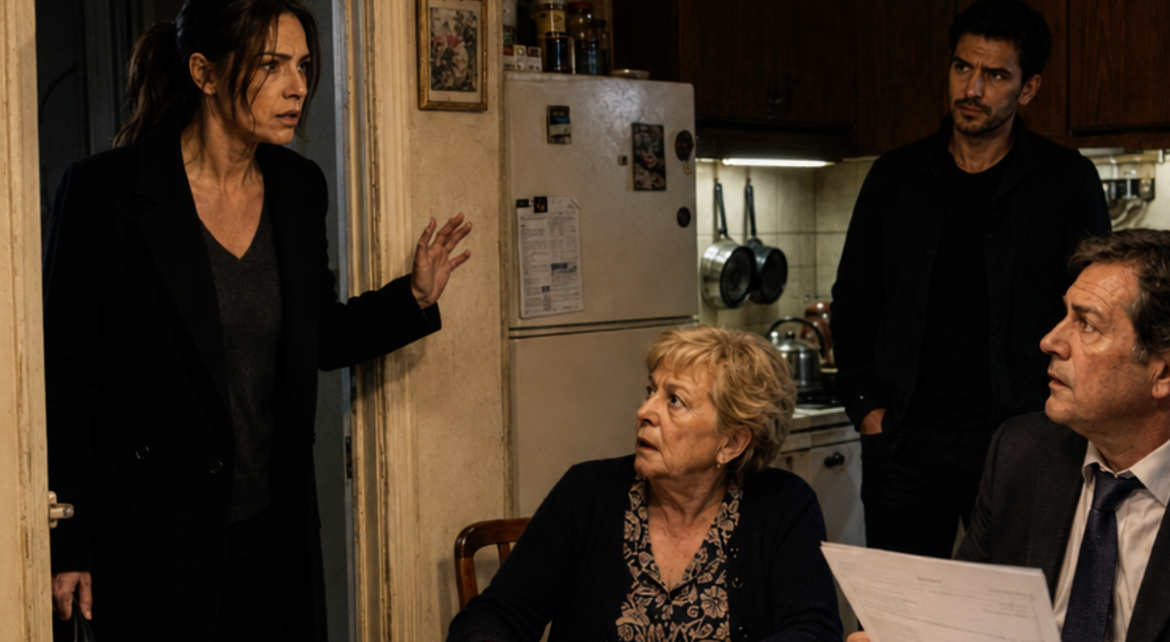
“Pack Your Things and Leave — All Three of You,” the Daughter-in-Law Said When She Found Her Mother-in-Law With a Lawyer in Her Kitchen
“Mom, why is some lady sleeping in my bed?”
Eight-year-old Kirill stood in the doorway of his room, pointing toward the far side, where an unfamiliar elderly woman was reclining on the lower bunk, right on top of the bedspread with little cars on it. The woman was scrolling through her phone and did not even bother to look up.
Marina froze on the threshold of her own apartment without taking off her coat or boots. The smell of boiled cabbage drifted from the kitchen—a smell that had never existed in this home before. Bags were scattered along the hallway. Three, four, five of them—huge plaid bags of the kind people used when buying goods wholesale at markets. Someone else’s slippers stood neatly in a row against the wall.
“Kirill, come here,” Marina said quietly, pulling her son close.
Her mother-in-law appeared from the kitchen.
Nina Arkadyevna was smiling broadly as she wiped her hands on a towel—Marina’s towel, the waffle-knit one with roosters printed on it.
“Marinochka! We’ve been waiting and waiting for you. Come in, why are you standing there like that? I made real cabbage soup, not those store-bought soups you people eat.”
“Nina Arkadyevna,” Marina swallowed. “Who is in the children’s room?”
“Oh, that’s Zoya, my cousin. She just got off the train and she’s tired. She’ll lie down for an hour. You don’t mind, do you?”
Marina slowly looked from the kitchen to the hallway, then from the hallway toward the children’s room.
Five bags.
An unfamiliar woman on her son’s bed.
Her mother-in-law wearing an apron beside the stove.
And the smell of cabbage seemed to have already soaked into everything.
“Where’s Artyom?” she asked about her husband.
“Your Artyom is at work, where else would he be? Take your coat off. Why are you standing there like a stranger?”
Marina had inherited this apartment from her grandfather. It wasn’t especially large—a three-room apartment in a prefabricated building on the outskirts of the city, overlooking the tram turnaround.
But it was hers.
Her grandfather, Pyotr Nikolayevich, had transferred it to her as a gift when Marina had just graduated from university. He took her to a notary and made sure everything was properly documented.
“Here you go, granddaughter,” he had told her. “Having a roof of your own means no one can throw you out. Remember: whoever owns the door owns their destiny.”
Marina had laughed at her grandfather’s philosophy back then.
Now, standing in the hallway, she remembered his words exactly.
When she married Artyom, he moved into her apartment. It made sense—why pay rent when they already had a place to live?
Artyom had been easygoing and hardworking. He helped with renovations. They repainted the walls, installed new laminate flooring, and replaced the kitchen faucet.
Marina had appreciated it.
But the apartment remained hers. That was how her grandfather had arranged it, and that was what the documents said.
Before that day, her mother-in-law had rarely visited.
Nina Arkadyevna lived outside the city in her own house and usually came only for major holidays. Every time she stepped through the doorway, however, she would slowly scan every room with an appraising gaze, as though imagining how she would rearrange everything if the apartment belonged to her.
Artyom came home shortly after eight that evening.
By then Marina had fed Kirill and taken him to sleep in her own bedroom, because the mysterious Zoya was still occupying his room. She had also washed an enormous pile of dishes that her mother-in-law and Zoya had left after lunch.
Nina Arkadyevna had settled comfortably in front of the television in the living room, her feet resting on the ottoman, commenting on the TV series so loudly that anyone would have thought she lived there alone.
“Oh, our breadwinner is home!” she exclaimed happily when she saw her son. “Tyomochka, do you want something to eat? I made cabbage soup.”
“Later, Mom.”
Artyom caught his wife’s gaze.
“Marina, what’s wrong with you?”
Marina silently nodded toward the bedroom.
She entered first, waited for her husband, and closed the door behind him.
“Artyom. What is going on in my apartment?”
“What do you mean?”
He sat on the edge of the bed and began pulling off his socks.
“Mom came to stay for a while. Didn’t I tell you?”
“No, you didn’t. And as for ‘staying for a while,’ there are five bags in the hallway. People don’t bring that much luggage for a weekend visit.”
Artyom sighed.
Marina already recognized that particular sigh. It was the sigh of a man who knew an unpleasant conversation was coming and planned to simply endure it the way someone waits out the rain under an awning.
“Listen, there’s a situation. Mom has a problem with her house. The roof is leaking and it needs serious repairs. She’ll stay with us for now while she gets everything sorted out.”
“How long is ‘for now’?”
“A month. Maybe however long the repairs take.”
“And why is her sister here?”
“Zoya? She’ll help Mom around the house. It’s difficult for her to manage everything alone.”
Marina sat across from her husband.
The television roared through the wall, and her mother-in-law burst into loud laughter at something.
“Artyom. Do you understand that you brought two people into my home without asking me?”
“Marina, what do you mean by ‘my home’?” her husband said with a grimace. “We’ve lived here for six years. It’s our home.”
“It’s ours when we’re talking about who washes the dishes. But when we’re talking about who gets to move in here, then yes—it’s mine. Because the apartment is registered in my name. And I decide who lives in it.”
“Are you serious right now? That’s my mother. She needs help, and you’re arguing over who owns the apartment.”
“I’m not arguing over ownership. I’m saying you should have discussed it with me. Before she arrived. Before her sister lay down in our son’s bed.”
Artyom waved dismissively and lay down with his back turned toward her.
“We’ll talk in the morning. I’m tired.”
Marina sat in the darkness for a long time.
Eventually the television went silent in the next room.
But Marina still could not fall asleep.
The first week was difficult.
Nina Arkadyevna took complete control of the kitchen. She cooked everything her own way—heavy, greasy meals filled with fried onions, whose smell gave Marina a headache by evening.
Food in the refrigerator was rearranged according to some mysterious system.
Marina’s favorite tea disappeared, replaced by bags of some cheap variety that smelled like hay.
Zoya turned out to be a quiet woman, but she was everywhere.
She washed the floors three times a day, moving the furniture around. She dusted things no one had asked her to touch. Once she rearranged all of Marina’s books on the shelf “by color,” making it almost impossible to find anything.
“But it looks prettier this way,” Zoya shrugged when Marina asked her about it.
On the eighth day, Kirill came home from school crying.
“Mom, Grandma Nina said I’m going to sleep on a folding bed in your bedroom now. She and Aunt Zoya are going to stay in my room because there isn’t enough space for the two of them.”
Marina put down her spoon.
Her heart began pounding.
“Who said that?”
“Grandma Nina. She already put my toys in a box.”
Marina stood up and walked into the children’s room.
It was true.
Half of Kirill’s shelf had been emptied. His toy cars were dumped into a cardboard box, and someone else’s nightgown was already lying across his bed.
“Nina Arkadyevna.”
Marina’s voice trembled, but she kept it controlled.
“Why are my child’s things in a box?”
Her mother-in-law appeared in the doorway, perfectly calm, a towel draped over one shoulder.
“Marinochka, think about it yourself. Zoya and I can’t both fit comfortably in one room. We’re not young anymore. And Kirill is little. He’ll sleep perfectly well on a folding bed. Children can sleep anywhere.”
“Kirill will sleep in his own room. Just as he always has.”
“What kind of mother are you?” her mother-in-law exclaimed, throwing up her hands. “You feel sorry for a child sleeping on a folding bed, but you don’t feel sorry for two elderly women? That’s selfishness, Marinochka. I suppose that’s how you were raised.”
Marina felt her face growing hot—not from embarrassment, but from the anger boiling inside her.
Still, she took a slow, deep breath.
“Put his toys back on the shelf. Please. And don’t touch my son’s room again without my permission.”
“Look at her, ordering everyone around,” her mother-in-law hissed behind Marina’s back.
Quietly—but loudly enough for Marina to hear.
That evening Marina tried to speak with her husband again.
“Artyom. Your mother wanted to throw Kirill out of his room. She wanted our child sleeping on a folding bed while she and her sister took over his room.”
“So what?” Artyom said without even looking up from his phone. “Seriously, Kirill could sleep with us for a week. What’s going to happen to him?”
“A week? Artyom, they’ve already been here eight days, and there’s no sign of this ending.”
“Marina, just be patient. They’re family.”
“They’re family to you. To me, your mother has spent eight days ordering people around in my home, trying to push my child out of his bedroom and calling me selfish.”
“You’re exaggerating.”
Marina stared at her husband for a long moment.
And for the first time, she understood something clearly.
He wasn’t on her side.
Perhaps he never had been.
There simply had never been a situation before where he had been forced to choose.
On the tenth day, Marina received a call from her grandfather’s former neighbor, Grandma Valya.
The old woman had known Marina since she was a baby and lived one floor below the apartment where Pyotr Nikolayevich had once lived.
“Marisha, you might want to come by and find out what’s going on. Your mother-in-law was here asking our concierge questions. She wanted to know how to get a share of an apartment registered in someone’s name, and how to register a person as a resident so they couldn’t be removed later. I happened to be walking past and overheard part of it. Be careful, sweetheart.”
Marina thanked her and hung up.
Her temples began throbbing.
Register someone so they could not be removed.
Obtain a share in the apartment.
That evening, she waited until her husband came out of the shower and confronted him directly.
“Artyom. Your mother has been asking questions about how she can get a share of my apartment and register herself here. Did you know about this?”
Artyom froze with a towel in his hands.
That tiny hesitation—half a second, no more—was enough for Marina to understand everything.
“Well… we talked about it,” he finally admitted. “We were just considering possibilities. Things with Mom’s house are uncertain, and you have… well, there’s plenty of room here. I thought if we registered her here, it would be easier for her to receive her pension and see doctors in this district.”
“Register your mother in my apartment. Permanently.”
“Not permanently. Temporarily.”
“Artyom, removing someone who is officially registered here when they don’t want to leave can be extremely difficult. It isn’t just a piece of paper. It gives her the right to live here. Do you understand that, or are you pretending not to?”
Her husband said nothing.
And in that silence Marina heard his answer.
“And the share,” she continued.
Her voice was quiet now, almost calm, although everything inside her was trembling.
“You and your mother discussed how to take part of my apartment away from me.”
“Not ‘take it away’!” Artyom suddenly snapped. “I invested money in these renovations! The laminate flooring, the paint, that stupid faucet! I have rights!”
“You contributed to the apartment where you live with your wife and son. To your home. Apparently, though, you were accumulating ownership rights.”
“I thought we were a family!”
“A family,” Marina echoed. “A family is when people make decisions together. Not when a husband whispers with his mother behind his wife’s back and runs around asking how to get around her.”
Marina believed the worst was over.
She was wrong.
Two days later she returned from work earlier than usual. Her boss had let everyone leave ahead of schedule.
Marina unlocked the door with her key and immediately heard an unfamiliar male voice coming from the kitchen.
Calm.
Smooth.
Accompanied by the rustling of papers.
Four people were sitting around her kitchen table.
Her mother-in-law.
Her mother-in-law’s cousin Zoya.
Artyom.
And an unfamiliar man in a gray suit with an open folder full of documents lying in front of him.
“Ah, here’s the owner,” the man said, rising slightly from his chair. “Perfect timing. We were just waiting for you.”
“Who are you?”
Marina remained in the doorway.
“Marina, this is Gennady Lvovich,” Artyom said quickly. “He’s a lawyer. He handles family matters. We were just… discussing something.”
“What exactly were you discussing at my table?”
Her mother-in-law stood up and adjusted her blouse.
Her voice suddenly had a firmness Marina had never heard before. The sweet, affectionate tone was gone.
“Marinochka, sit down. This is serious. We consulted some knowledgeable people. Here’s the situation. Tyoma has invested in this apartment for six years—that’s one. By law, he deserves a share—that’s two. Kirill is his son and heir, and his interests have to be protected too—that’s three. And then there’s me. Where am I supposed to go in my old age if something happens? I’ll register here as family, and everything will be properly arranged.”
The lawyer gently pushed some documents toward Marina.
“Olga Anat… excuse me, Marina Sergeyevna. There’s nothing frightening here. This is an application to register a certain citizen at this address. And this is an agreement recognizing part of the property as jointly acquired, taking your husband’s contribution into account. You sign them, everything gets resolved, everyone is satisfied, and there’s peace in the family.”
Marina stared at the papers.
At the neatly printed lines.
At the empty spaces waiting for her signature.
Then she looked at her husband.
Artyom was staring at the table.
“Tyoma,” she said quietly. “Look at me.”
He raised his eyes.
There wasn’t even guilt in them.
Instead there was a strangely childish resentment, as though he were the one being treated unfairly.
“You prepared all of this. While I was at work earning money for the life we were building together, you brought a lawyer into my home so you could carve out a piece of my inheritance. And register your mother here. Permanently.”
“Marina, it’s only fair…”
“Do not talk to me about fairness.”
She turned toward the lawyer.
Then she picked up the pen from the table.
Her mother-in-law immediately leaned forward, triumph flashing in her eyes.
Zoya seemed to stop breathing.
Artyom tensed.
Marina rolled the pen between her fingers.
Then she placed it back on the table.
“Gennady Lvovich. Thank you for coming. Please gather your papers and leave.”
“Marina Sergeyevna, don’t make a rushed decision. Think about it…”
“I have thought about it. Take your documents.”
The lawyer glanced at her mother-in-law.
Nina Arkadyevna turned pale.
“Marinochka, don’t be foolish…”
“And now,” Marina said, looking around the kitchen, “I’m going to say what apparently needed to be said from the beginning. So listen carefully. All of you.”
She walked to the window and opened it.
The smell of fried onions was so strong that it was difficult to breathe.
Then she turned around.
“Pack your things and leave my apartment. All of you. Nina Arkadyevna—you. Zoya—you. And you too, Artyom.”
Silence descended over the kitchen.
Even the lawyer froze with the folder in his hands.
“You… mean me?” Artyom half rose from his chair. “Marina, what are you doing? I’m your husband!”
“You were. I’ll file for divorce myself. But right now, yes, you too. Pack a bag.”
“You have no right!” her mother-in-law shrieked. “My son lives here! My grandson lives here! We’re not going anywhere!”
“Yes, I do.”
Marina spoke calmly, and something about that calmness made her mother-in-law fall silent.
“The apartment belongs to me under a deed of gift. None of you are registered here. You, Nina Arkadyevna, despite your best efforts, didn’t manage to get yourself registered. Without registration and without ownership rights, you are guests in my home. And I have every right to ask guests who behave this way to leave.”
She looked at the lawyer.
“Gennady Lvovich, please confirm that for her so she doesn’t start making a scene.”
The lawyer cleared his throat and looked away.
“Formally… the owner does indeed have that right.”
“You see?”
Marina opened the kitchen door wider.
“Pack your things.”
Their departure was long and noisy.
Nina Arkadyevna complained loudly enough for the entire apartment building to hear that an old, sick woman was being thrown out onto the street.
Zoya silently stuffed their belongings into the plaid bags.
Artyom moved back and forth between his mother and wife, repeating:
“Let’s talk about this.”
“This is insane.”
“Marina, come to your senses.”
Marina did not change her mind.
She called a taxi for them.
She even carried their bags downstairs herself, simply because she wanted them gone faster.
Then she stood outside the entrance with her arms crossed while her mother-in-law climbed into the car, lips tightly pressed together, staring at her former daughter-in-law as though she wanted to burn a hole through her.
Artyom approached last.
A travel bag hung over his shoulder.
His face looked defeated.
“Marina. What about Kirill?”
“Kirill stays with me. You’re his father, and you’ll see him. We’ll work everything out calmly, through proper people—not by bringing lawyers into my kitchen behind my back. But he’ll live here. At home.”
“You’re destroying our family.”
Marina looked at him.
And suddenly she realized she was no longer angry.
She was simply sad.
“Tyoma. I didn’t destroy our family. I only called things by their real names.”
He stood there for a little longer.
Perhaps he expected her to run after him, grab his sleeve, and say, “Stay.”
She didn’t.
Artyom climbed into the taxi.
The car drove away.
Kirill returned from school an hour later.
He saw that the plaid bags were gone from the hallway.
The unfamiliar slippers had disappeared.
The door to his room was open again, and his toy cars were back on the shelf.
“Mom, where did everyone go?”
Marina crouched in front of her son.
“Grandma Nina and Aunt Zoya went back to their place. And Dad is going to live somewhere else for now.”
“Forever?”
“I don’t know yet, sweetheart. But you’ll still see him. He isn’t going anywhere. He’s your dad.”
Kirill thought for a moment.
“Does that mean I get to sleep in my room again?”
“Only you. Always.”
“And Grandma won’t say I’m selfish anymore?”
Marina hugged her son tightly.
“No one will say that to you again. Ever.”
They went into the kitchen.
Marina opened both windows wide, finally letting the heavy smell of cabbage and fried onions escape.
She found her favorite tea hidden deep inside a cupboard, where her mother-in-law had apparently stuffed it for reasons known only to herself.
Marina brewed two cups—stronger for herself and weaker for her son, with milk.
“Kirill, how about we order pizza?” she suddenly suggested. “Tonight. For no reason at all.”
“With sausage?”
“Whatever kind you want.”
Her son’s face lit up.
They sat together at the table, just the two of them, surrounded by a silence no one interrupted with loud television programs or unsolicited advice.
Outside, the tram rattled around the turnaround.
The apartment no longer smelled of cabbage.
It smelled fresh, filled with the evening air coming through the windows.
That night, after putting Kirill to bed, Marina returned to the kitchen.
She poured herself some tea and sat by the window.
There were many unpleasant things ahead.
The divorce.
Conversations with a lawyer.
Explanations for her son.
Judgmental looks from mutual acquaintances, to whom her mother-in-law was probably already describing Marina as some heartless monster.
Ahead of her was all the exhausting, difficult work that somehow always seemed to fall on the woman after a man created a situation like this.
But Marina wasn’t afraid.
Staying would have been much more frightening.
Signing those papers.
Agreeing to a “temporary” registration that could become permanent.
Remaining silent about the bags in the hallway.
About the strange woman sleeping in her son’s bed.
About her child’s little world being shoved into a cardboard box.
She remembered her grandfather.
When Pyotr Nikolayevich had handed her the keys, he had said:
“Whoever owns the door owns their destiny.”
All her life, Marina had thought he was talking about locks and square meters.
Only now did she understand.
Her grandfather hadn’t been talking about the apartment.
He had been talking about boundaries.
About the invisible line a person draws around themselves—a line no one should be allowed to cross without permission.
Not even family.
Especially not those who hide behind the word “family” while trying to erase that line.
Marina finished her tea.
She washed the cup and placed it on the drying rack.
Then she turned off the light.
And for the first time in many weeks, she fell asleep in her own home the way a person should sleep in a place that truly belongs to them—knowing that in the morning no stranger would be banging pots around in her kitchen, rearranging her belongings, or telling her how she should live.
The door was locked.
The key lay exactly where it belonged.
And once again, she was the owner of that door—and therefore the owner of her own destiny.