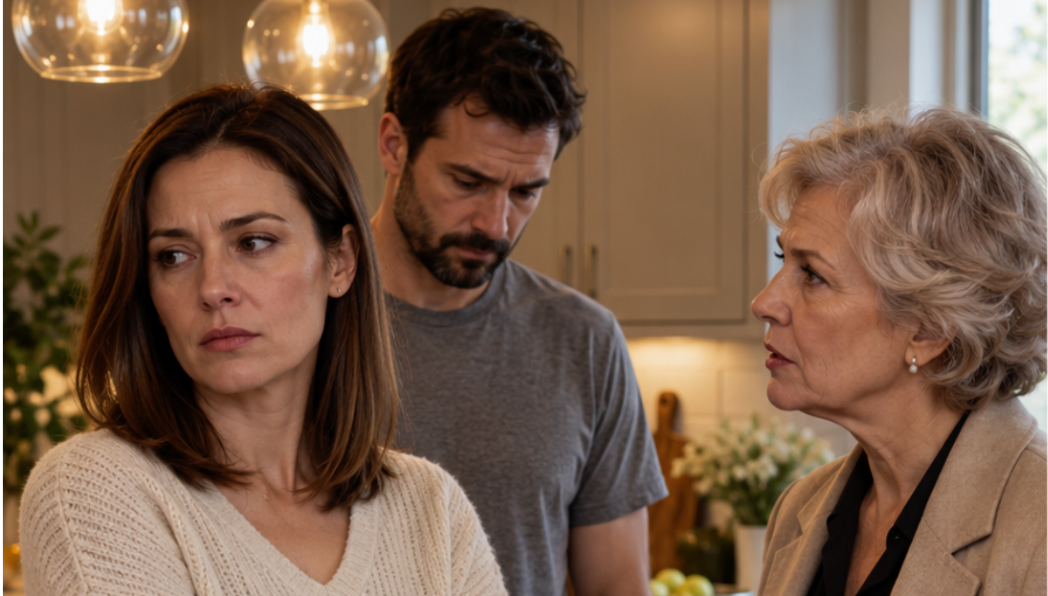
Your grandmother’s apartment has already been transferred to my mother. The documents are at the notary’s office,” Dmitry announced indifferently as he stirred his cold coffee.
Anna froze by the stove, still holding the frying pan filled with steaming syrniki. For a moment, she thought her husband was joking—one of those ridiculous, tasteless jokes he was so good at making. But Dmitry did not even look up at her. He calmly scrolled through his phone as if he had merely mentioned tomorrow’s weather.
“Dima, say that again,” she said evenly, although an icy chill was already spreading through her.
Her husband finally looked away from the screen and frowned irritably.
“Why are you acting like a child? I arranged for your grandmother’s apartment to be transferred to Mom. It’ll be more convenient for everyone. Mom feels cramped living alone in her little Khrushchev-era apartment, and things aren’t easy for Lyosha and Nastya in their new place either—the mortgage is suffocating them. Mom will sell it to them at a reduced price, and everyone will be happy.”
Anna slowly placed the pan on the burner. Her hands were trembling so violently that she had to grip the edge of the stove.
It was a two-bedroom apartment in the city center that she had inherited from her grandmother six months earlier. The apartment where she had spent her entire childhood. The apartment her grandmother had left specifically to her—the only granddaughter who shared her name.
“You must be confused,” Anna said quietly. “The apartment is registered in my name. I’m the sole heir. How could you transfer it to anyone?”
Dmitry sighed heavily, as though he were speaking to a stubborn teenager.
“Anya, don’t play dumb. Mom spoke to the notary, and everything has been arranged. We’ll go there tomorrow at ten, and you’ll sign the deed transferring the apartment to Mom. Then she’ll transfer it to Lyosha. We’re keeping everything in the family.”
“Keeping it in the family,” Anna repeated slowly.
At that moment, a long, demanding ring sounded from the hallway. Anna flinched. She recognized that ring. Only one woman rang the doorbell that way.
Her mother-in-law.
Tamara Viktorovna swept into the apartment like the owner of a grand estate who had discovered a sluggish maid at the entrance. She was wearing a camel-hair coat which, incidentally, had been bought with the bonus Anna received the previous summer. In her hands, she carried a leather folder.
“Dear little Anya!” she exclaimed in an excessively sweet voice. “I baked some potato pies! And I brought the paperwork so we won’t waste a single minute tomorrow.”
Anna silently accepted the bag of pastries. Their warm aroma made her nauseous. Without waiting to be invited, Tamara Viktorovna walked into the kitchen and settled herself at the table as though she owned the place.
“Dimochka, darling, put the kettle on! And you, Anyuta, why are you just standing there? Sit down and we’ll discuss everything.”
Anna slowly lowered herself onto a chair. Her eyes wandered around the familiar kitchen—the curtains she had chosen the previous spring, the honeymoon photograph on the refrigerator, and the pot of basil she watered every morning. Suddenly, everything seemed unfamiliar, as though she had entered someone else’s home by mistake.
“Tamara Viktorovna,” Anna began, her voice firmer than she expected, “I don’t understand what’s going on. Dima says that my grandmother’s apartment is being transferred to you. But that apartment belongs solely to me. It’s my inheritance.”
Her mother-in-law carefully placed her cup on its saucer. The sugary mask slowly slipped from her face, revealing something cold and calculating beneath it.
“Anya, my dear girl,” she began in the tone of a patient schoolteacher, “a family isn’t about ‘mine’ and ‘yours.’ A family is about ‘ours.’ When you married Dimochka, everything you owned became shared property—your salaries, apartments, and inheritances. That’s what it means to treat your loved ones properly.”
“Legally, it isn’t shared property. An inheritance is the personal property of the spouse who receives it,” Anna replied calmly.
“Legally!” her mother-in-law snorted. “Why don’t you start quoting the civil code to me, too? Lyoshenka has a young family, a mortgage, and a small child. I have high blood pressure, and my cardiologist says I need to get out into the fresh air more often. And what are you and Dimochka doing with that apartment? Renting it out! You’re renting it to complete strangers! You leave your own mother crammed into an old apartment while renting a perfectly good home to outsiders!”
Anna felt something slowly rising inside her. It was not anger. It was realization—cold and sobering.
“And none of you thought it necessary to ask me?” She turned toward her husband. “Dima, do you understand what you’ve done? You signed documents concerning property that doesn’t belong to you. My property.”
Dmitry looked away and began turning a teaspoon between his fingers. He had done exactly the same thing three years earlier when Anna discovered that he had lent his mother a large sum of money without consulting her.
“Anya, I only signed a preliminary agreement. Why are you making such a scene? We’ll complete everything properly at the notary’s office tomorrow. Mom is right—Lyosha has a family, and Mom has health problems. You and I are still young. We can earn enough to buy another place.”
“We?” Anna laughed bitterly. “Dima, you’ve been sitting at home for four months. I feed you, pay the utility bills, and make the car payments. Exactly how are you planning to earn enough for another apartment?”
Her husband’s face turned crimson.
“Don’t humiliate me in front of my mother!” Dmitry shouted. “I’m a man—the family’s provider! I’m only temporarily looking for work. That’s just how the job market is; there aren’t enough positions for everyone!”
His mother immediately rushed to defend him.
“Exactly, Anna! That’s your biggest problem—you have no respect! My son is pure gold, an uncut diamond, and all you do is nag him! You’re barren—that’s what you are! Three years of marriage, and you haven’t given us a child or given me a grandchild! You could at least give the apartment to the family and make up for your failure!”
A deafening silence filled the kitchen.
Anna slowly raised her eyes to her mother-in-law. There was no confusion or doubt left in them—only clarity.
“Did you just call me barren, Tamara Viktorovna?”
“I called you what I consider appropriate!” her mother-in-law snapped, clearly enjoying herself now. “You couldn’t give birth to a child, and now you want Lyosha’s children to suffer in a new apartment without a proper kitchen? You’re heartless!”
Dmitry remained silent. He did not say a single word in his wife’s defense. He sat staring into his cup, waiting for his mother to finish her attack.
At that moment, Anna understood the most important thing.
This was not a spontaneous outburst. It was a scene they had rehearsed long ago. They had planned everything—the accusations about children, the comments about his mother’s cramped apartment, and the visits to the notary behind her back.
Her husband had known from the beginning. He had supported the plan and kept silent.
Anna slowly rose from the table.
“All right,” she said quietly. “I understand everything now.”
“That’s my clever girl!” Tamara Viktorovna beamed. “Tomorrow at ten, at the notary’s office. I sent you the address.”
“I’m not going to the notary,” Anna said calmly as she walked to the cupboard and took out her handbag.
“What do you mean, you’re not going?” her mother-in-law demanded, rising as well.
“It’s very simple. I’m not going. I won’t sign anything, and no one will receive any documents for that apartment. Now, Tamara Viktorovna, I’m asking you to leave this apartment.”
“This apartment?” her mother-in-law shrieked. “This is my son’s apartment!”
“This apartment was bought with money my parents gave me for our wedding. I have the gift agreement, which specifies that the funds were intended for purchasing a home. The apartment is registered in my name. So I’m asking you to leave—right now.”
Dmitry jumped to his feet.
“Anya, have you lost your mind? This is my mother!”
“She is your mother, Dima. But this is my apartment. My grandmother’s apartment belongs to me as well. This is my life, and I will no longer allow anyone to control it without my consent.”
Tamara Viktorovna’s face turned purple with rage. The mask of the caring mother-in-law disappeared completely. Standing before Anna was an ordinary spiteful woman accustomed to getting her way through pressure and shouting.
“You’ll regret this, you little wretch!” she hissed. “Dimochka, get ready! We’re leaving! Let this ungrateful woman sit alone in her miserable hole!”
“Wonderful idea,” Anna agreed. “Leave—and take your son with you. If he depends so much on your opinion, he can go back to living with his mother.”
Dmitry looked helplessly from his mother to his wife. He had clearly not anticipated this outcome. According to the scenario he and his mother had devised, Anna was supposed to burst into tears, apologize for her selfishness, and rush to sign the papers.
“Anya, what are you doing?” he muttered, instantly changing his aggressive tone to a plaintive one. “So Mom lost her temper. You hurt her feelings, too. Let’s have some tea and discuss this calmly.”
“We have nothing to discuss, Dima. You signed documents concerning my property without my consent. That may constitute a criminal offense. You betrayed me—coldly and deliberately, after planning everything with your mother. There is nothing left to discuss.”
“What, are you planning to divorce him?” her mother-in-law exploded. “Because of an apartment? Because of your grandmother’s old place?”
For the first time that evening, Anna smiled.
“Not because of the apartment, Tamara Viktorovna. Because I’ve finally seen all of you for who you really are—and because I no longer want to play a role in this performance.”
Her mother-in-law began pulling on her coat. Her hands shook with anger, and she could not fasten the buttons.
“Dima, move! Pack your things!”
“Mom, wait…” her husband muttered helplessly.
“I said pack! This witch is throwing you out of your own home!”
Anna went into the bedroom and took a large sports bag down from the storage shelf. Silently, she began putting her husband’s belongings into it—shirts, a tracksuit, chargers, and socks. She worked methodically, without tears or hysterics, as though packing for an unwanted guest who had overstayed his welcome.
Dmitry hovered in the doorway.
“Anya, why do this? Let’s at least think about it until morning. I didn’t mean any harm. Mom asked me, so I…”
“Dima,” she said, looking him directly in the eyes for the first time, “tell me honestly: if it weren’t for the apartment, would you even talk to me? Do you remember the last time you asked how I was? The last time you hugged me for no reason? The last time you looked at me as your wife instead of a source of money?”
Her husband remained silent. He had no answer.
“I thought we were a family,” Anna continued. “I thought we were a team. But it turns out I was merely the support staff for you and your mother. And you know what? Enough. I don’t want this anymore.”
Forty minutes later, Dmitry and his mother left the apartment. On her way out, Tamara Viktorovna slammed the door so hard that a vase fell from a shelf in the hallway. Anna slowly walked over, picked up the broken pieces, and threw them away. Then she leaned against the wall and closed her eyes.
Silence.
For the first time in years, there was an extraordinary, healing silence.
Anna returned to the kitchen. The untouched syrniki had gone cold on the table beside her mother-in-law’s pastries. She gathered the pastries, wrapped them in the bag, and placed them beside the trash. Then she returned to the table, sat down, and finally allowed herself to sob.
She cried for a long time, releasing everything that had accumulated during the past three years: every grievance, every humiliation, every compromise, every evening when she swallowed her mother-in-law’s barbed remarks to preserve the peace, every time her husband joined his mother in mocking her “career ambitions,” and every celebration at which she was treated like a second-class member of the family.
Eventually, the tears stopped. In their place came an astonishing feeling of freedom.
She stood, washed her face with cold water, and took out her phone. Then she found the number she needed.
“Igor Sergeyevich, good evening. This is Anna. I’m sorry for calling so late. Do you remember helping me with my inheritance six months ago? I urgently need a consultation. Could I see you tomorrow? Wonderful. One more thing—I’m also going to need a good family-law attorney. Could you recommend someone trustworthy?”
The following morning, Anna did not go to the notary’s office.
She went to see a lawyer.
Igor Sergeyevich, a gray-haired man with a sharp gaze, listened to her story without interrupting. Then he slid a sheet of paper toward her.
“Anna Mikhailovna, let’s take this step by step. Your grandmother’s apartment is registered solely in your name, correct? Do you have the ownership certificate?”
“Yes.”
“You inherited it during your marriage?”
“Yes, but an inheritance is a gratuitous transfer. By law, it remains the receiving spouse’s separate property.”
“Exactly. Your husband has no rights to that apartment. Any documents he signed without your participation or power of attorney have no legal force. Moreover, if he represented himself as acting on your behalf, that may constitute a crime—document forgery and fraud.”
Anna exhaled. Until that moment, part of her had feared that her husband had found some kind of loophole.
“What about the apartment where we live?”
“Was it purchased during the marriage?”
“No. My parents gave me the money before the wedding, specifically to purchase a home. I still have the gift agreement. The apartment is registered in my name.”
“Then that is also your separate property. Congratulations, Anna Mikhailovna—you are fully protected legally. Your husband can claim only half of the assets jointly acquired during your three years of marriage. What property did you acquire together?”
Anna thought for a moment.
“The car, refrigerator, washing machine, and microwave.”
“Those will be divided equally. The apartments belong to you. And I strongly recommend filing immediately…”
[The source text appears to be missing a section here and resumes in the middle of a later sentence.]
“…on the embankment. Sometimes Kirill came with his son—a serious fourteen-year-old boy who immediately respected Anna because she spoke to him like an adult.
One autumn evening, Nastya, the wife of Anna’s former brother-in-law, called her.
“Anya, please don’t hang up,” she said wearily. “I’m not calling on behalf of Lyosha or Mom. I’m calling for myself.”
“I’m listening.”
“I just wanted to say…I’m sorry. I knew about their plan for the apartment, and I supported it. I thought it really would be fair. Now I understand that it had nothing to do with fairness. We simply wanted something that belonged to someone else. Please forgive me.”
Anna was silent for a moment.
“Thank you for calling, Nastya. I hope you manage to sort out your life—truly.”
“Mom and Dima are still blaming each other. Mom says Dima ruined everything, and Dima says Mom went too far. I look at them and realize what kind of life you saved yourself from.”
Anna ended the call and stared out the window for a long time.
An autumn evening was settling over the city. A warm light glowed in her new kitchen. Mulled wine was simmering on the stove, nearly ready for Kirill’s arrival. A new book she hoped to finish by the weekend lay on the table.
She took an old photograph down from the shelf. It showed her grandmother as a young woman, wearing a polka-dot dress and standing beside the window of that very apartment. On the back, in her grandmother’s handwriting, were the words:
“Dear Anyuta, always remember: a home isn’t made of walls. A home is a place where you are respected.”
“I remember, Grandma,” Anna whispered. “Now I truly remember.”
The first streetlights came on outside. Anna poured herself a cup of mulled wine and sat beside the window. The life in which she was finally in control of every decision continued—and it proved far more beautiful than all the illusions she had once called a family.
Her mother-in-law never appeared in her life again. Dmitry occasionally sent her messages, especially on her birthday and before New Year’s. Anna politely replied, “Thank you,” and nothing more. Once every six months, she reread their old messages and wondered how she could have spent so many years living beside a man who saw her only as a wallet and a source of convenience.
Then she would put her phone away and keep moving forward.
Toward herself. Toward Kirill. Toward the work she loved. Toward the books that had remained unread for so long. Toward the life Anna had finally begun living for herself—not for her mother-in-law, her husband, or other people’s expectations.
And it was the most genuine life she had ever known.