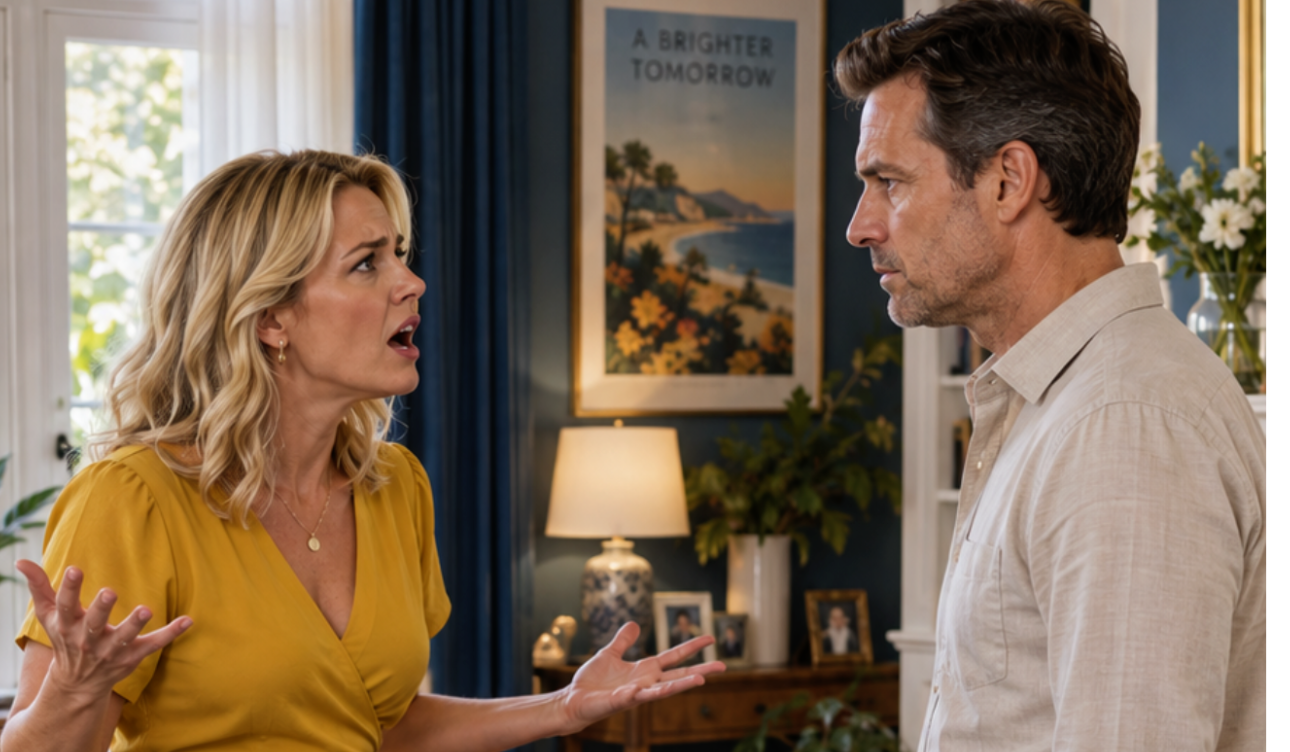
The suitcase refused to close. Tanya pressed her knee against the lid and tugged at the zipper until it finally gave way, hissing as though reluctantly agreeing with her anger.
“Are you serious?” Vitya stood in the bedroom doorway with his arms crossed, staring at her as though he were seeing her for the first time. “Tanya, Mom is here. She came to see Sonya. And you’re packing your bags as if the house is on fire.”
“The house isn’t on fire,” she said without looking up. “It’s just that your mother is once again in my apartment, teaching me how to cook borscht, how to dress my child, and how to talk to my own husband. And you know what, Vitya? I’ve had enough.”
“She only came for a few days! Would it really have killed you to put up with it?”
Tanya straightened. Her heart was pounding so hard that it felt as though it might burst through her ribs and fall right onto the neatly folded T-shirts.
“You brought your mother into my home,” she said slowly and distinctly, as though hammering in every word like a nail, “so I’m going away to get some rest.”
She snapped the suitcase locks shut and pulled it toward the door. Vitya stood motionless, and there was something on his face Tanya had never seen before—not anger, not irritation, but the genuine confusion of a man who had suddenly realized that what was happening to him was not a dream he could simply wake up from.
“Where are you even going?” His voice rose half an octave. “What about Sonya? What about work?”
“Work can wait. I took vacation time. Sonya is staying with you and your mother. Since she’s missed her granddaughter so much, let her enjoy every minute of it. I’ll come back when she’s gone.”
She stepped into the hallway and rolled the suitcase toward the front door. Its wheels rattled loudly over the parquet floor, almost echoing her footsteps—confident, angry, determined.
Behind her, she heard Valentina Petrovna, her mother-in-law, poke her head out of the kitchen. She looked perfectly fresh despite having just arrived, dressed in an immaculately ironed blouse and wearing the expression of someone who had just been handed enough gossip to last an entire month.
“Tanechka, where are you going?” she asked in that particular tone that had been making Tanya grit her teeth for the past three years.
Tanya did not answer. She gripped the door handle, turned around for a second, looked at her husband—confused, pale, still unable to understand what was happening—and walked out, quietly closing the door behind her.
In truth, it had not started that morning.
It had started a week earlier, one evening after Sonya had gone to sleep. Tanya and Vitya were sitting in the kitchen when he began twisting a teaspoon between his fingers and said the words she had dreaded hearing most.
“Mom wants to come. She hasn’t seen Sonya in a long time.”
Tanya put down her phone and looked at him carefully.
“She was here a month ago.”
“So what? She’s her grandmother. She misses her granddaughter.”
“Vitya,” Tanya said, trying to stay calm even though she could already feel herself beginning to boil inside, “last time your mother was here, it took her three days to tell me that I feed our child incorrectly, that our apartment isn’t clean enough, that I work too much and spend too little time with Sonya, and then that I spend too little time with you because I’m too busy with our daughter. Somehow she managed to criticize me from every possible direction at once. That’s a talent, seriously.”
“She’s just concerned,” Vitya said with a shrug.
That casual, familiar gesture irritated Tanya even more than his mother’s words.
“She comes from a different generation. They’re used to speaking directly.”
“Speaking directly means saying something useful. Your mother comments even on the way I hold a spoon. Vitya, I’m tired. I really am. I already have enough to deal with—work, our child, the house. After every visit from your mother, it takes me a week to recover.”
He remained silent, staring into his cooling cup of tea.
“I understand that it’s difficult for you to hear this,” Tanya continued more gently, “but please try to understand me too. I don’t need another source of stress in my own home. My head is already spinning from everything I have to handle.”
“So what am I supposed to do now, never see my own mother?” There was resentment in his voice, the familiar resentment of a man who felt caught between two sides and was angry at being forced to choose.
“I’m not asking you not to see her. Go visit her yourself. Take Sonya with you if you want. But she doesn’t need to stay here for weeks at a time. Let it be a visit for a couple of hours, not a relocation complete with suitcases.”
“You’re exaggerating.”
“I am not exaggerating!” Tanya raised her voice, then immediately became afraid she would wake their daughter and lowered it to an angry whisper. “Vitya, do you even notice what happens in this house when she comes? She sits in my kitchen and starts giving orders. She moves things I deliberately arranged the way that is convenient for me. She criticizes me in front of Sonya—and Sonya is five years old now. She understands everything, and then she repeats what she hears. The other day she told me, ‘Mom, you cook badly. Grandma said so.’ Can you imagine how it feels to hear that from your own child?”
Vitya sighed and rubbed his face with both hands.
“Fine. I’ll talk to her. I’ll tell her not to stay long.”
“Thank you,” Tanya said, although deep down she no longer believed it would make any difference.
And she was right.
Three days later, Vitya came home from work and announced from the doorway, trying to sound casual as though he were talking about buying new wallpaper:
“Mom is coming next week. I bought her a ticket.”
Tanya froze with a knife in her hand. She had been slicing carrots for dinner. Slowly, she turned around.
“We had an agreement.”
“We didn’t agree on anything, Tanya. You told me your opinion. I heard it. But she is my mother, and I have the right to invite her into my own home.”
“Our home,” she corrected him. “Not just yours.”
“Fine, our home. But I live here too, and I also have the right to decide who I invite.”
“And it didn’t occur to you to ask me before buying the ticket?”
“I don’t have to ask permission for every single thing I do,” he said, irritation mixed with something almost challenging in his voice. “You don’t ask my permission when you invite your friend over.”
“That’s completely different, Vitya, and you know it. My friend doesn’t criticize you every five minutes. My friend doesn’t teach me how to raise our daughter.”
“Mom doesn’t mean any harm either. That’s just the kind of person she is.”
“I don’t care whether she means harm or believes she’s helping.” Tanya put the knife down on the cutting board so sharply that it clattered. “The result is the same. I feel like a guest in my own home whenever she comes. Every one of her visits exhausts me as though I’d worked two shifts in a row. And you knew that. I told you clearly a week ago.”
“So what now? I’m not supposed to communicate with my mother at all?”
“Communicate with her as much as you want! Go visit her yourself! Take Sonya to see her! But stop turning our home into a railway station where people come and go and I can’t even relax in my own kitchen!”
They shouted at each other for a while longer, caught in the same familiar, exhausting argument whose ending they both knew in advance: nothing would change.
Vitya would not cancel the visit because “the ticket had already been bought” and because “it would be awkward with Mom.”
Tanya would simply be left with her irritation, which would continue building inside her like water behind a dam, ready to burst at any moment.
That night she lay awake for a long time.
But she was no longer thinking about how to change her husband’s mind.
She was thinking about the fact that trying to convince him was pointless.
She had already tried.
Conversations, requests, even tears once—nothing worked. Vitya always found a “compromise” that, in practice, turned out to be complete surrender to his mother.
And then, somewhere between sleep and wakefulness, a thought came to Tanya.
It was simple.
Bold.
Almost crazy.
What if she stopped arguing?
What if she simply showed him what the consequences of his decision looked like?
The next morning, Tanya got up earlier than usual, took Sonya to kindergarten, and instead of going straight to work, stopped at a travel agency near their home.
The woman behind the counter, friendly and wearing a colorful scarf, offered her several options.
Tanya did not hesitate for long.
She chose a countryside retreat on the shore of a small lake, surrounded by pine trees, with the promise of peace and quiet printed across the brochure.
“How many days would you like to book?” the woman asked.
Tanya thought for a moment.
“Without a fixed departure date, if possible. I don’t know yet how long I’ll need.”
The woman raised an eyebrow in surprise but said nothing. Her job had taught her not to ask unnecessary questions.
Then Tanya went to work.
Instead of arriving early as she normally did, she went straight to her department manager’s office.
“Marina Sergeyevna, I need some vacation time,” Tanya said from the doorway. “Unplanned leave. Family circumstances.”
Her manager, an older woman who had seen plenty of employees dealing with family dramas over the years, studied Tanya carefully.
Apparently she saw something in Tanya’s expression, because she did not ask for details.
“For how long?”
“I’m not exactly sure yet. I’ll try to keep it within a week.”
“All right, we’ll arrange it. Just let me know if you need to stay away longer.”
Tanya left the office with a strange feeling of lightness, as though for the first time in a long while she had done something not for somebody else, but for herself.
At home, she said nothing to Vitya about her plans.
Not until the morning his mother arrived.
Valentina Petrovna appeared at the door exactly at the appointed time, carrying two bags stuffed with gifts and food.
“Tanechka, hello!” She kissed Tanya on the cheek with exaggerated warmth. “Oh, how I’ve missed all of you! And where is my little princess?”
Sonya ran out of her room, happily shouting, “Grandma!” before throwing her arms around Valentina Petrovna’s neck.
For a second, Tanya felt a stab of guilt.
Her daughter really did love her grandmother, after all, and it was not Sonya’s fault that the adults could not get along.
But the feeling lasted only a moment.
The irritation remained.
Within half an hour, Valentina Petrovna had unpacked her belongings in the guest room and entered the kitchen, where Tanya was preparing lunch.
She glanced at the stove and immediately spoke in that same familiar tone that made Tanya want to grind her teeth.
“Tanechka, are you frying food in that oil again? I told you, it’s unhealthy. I have some good oil. I’ll bring it next time.”
“Thank you, Valentina Petrovna, but I’m used to this one.”
“Well, suit yourself.” Her mother-in-law sighed like someone whose wisdom had once again gone unappreciated. “And why isn’t Sonya’s hair braided? She didn’t go outside like that, did she?”
“She wanted to wear it loose.”
“At her age, you can’t let children do everything they want. Back in my day…”
Tanya clenched her teeth and silently continued chopping vegetables.
She knew that if she answered, an argument would begin and grow into something much bigger.
And she did not want to make a scene right now.
She had another plan.
She waited until evening, after Sonya had gone to sleep and Vitya and his mother were sitting in the living room discussing family news.
Then she called her husband into the kitchen.
“I need to talk to you,” she said quietly.
Vitya came in, slightly irritated at being interrupted during his conversation with his mother.
“What happened?”
“I’m leaving tomorrow morning,” Tanya said calmly, as though she were talking about something perfectly ordinary. “I’m going to a holiday retreat. I took time off work.”
Vitya blinked, unable to understand what she meant.
“What do you mean, you’re leaving? Where? Mom is staying with us.”
“That’s exactly why I’m leaving.”
He stared at her for several seconds, and something resembling panic flashed across his face.
“Tanya, are you joking?”
“No.”
“What about Sonya? What about me? You can’t just get up and leave. We have a guest!”
And that was when, standing in the middle of the kitchen and looking directly into her husband’s eyes, Tanya said the words she would remember for a long time afterward—with bitterness, relief, and a strange sense of satisfaction all at once.
“You brought your mother into my home, so I’m going away to rest. Sonya will stay with you and her grandmother. I’m sure you’ll manage perfectly well without me, since you decided everything yourself without asking what I thought.”
“You can’t do this,” he whispered.
“I can. And I’m going to do it every time you invite her into our home without asking me. Every single time, Vitya. I’m not going to spend another week under stress just to maintain the appearance of a normal family. You want to invite your mother? Invite her. But I won’t be here while she is.”
He stared at Tanya as if he were seeing her for the first time in his life—not the wife who always gave in during arguments, but a person who had made a decision and had no intention of changing it.
The next morning, Tanya really did leave.
She said goodbye to Sonya, hugged her tightly, and explained that Mommy was going away to rest for a little while and would be back soon.
Still sleepy, her daughter simply nodded and buried her face back in the pillow.
Her goodbye to Vitya was short and cool.
He stood in the doorway, still stunned, apparently hoping until the very last moment that she would change her mind.
But Tanya picked up her suitcase, called a taxi, and left without looking back.
The drive to the countryside took about an hour.
Fields flashed past the window, followed by forest, and when the car finally stopped at the gates of the retreat, Tanya felt something inside her—something that had been tightly clenched for years—beginning to loosen.
The grounds looked exactly as the brochure had promised.
Pine trees.
Silence.
A lake glittering through the branches.
Tanya checked into a small room overlooking the water, unpacked her things, and for the first time in a very long while found herself completely alone.
No child demanding her attention.
No mother-in-law offering constant criticism.
No husband making compromises that always seemed to work against her.
On the first day, she simply slept.
She slept during the afternoon.
She slept in the evening.
She woke only to eat and then went back to sleep again, as though her body had finally been given permission to recover after months of tension.
On the second day, she walked along the lakeshore, breathed in the scent of the pine trees, and tried not to think about what was happening at home.
She did not switch off her phone, but neither did she check it every five minutes like she normally did.
Vitya sent several messages.
At first they were short questions about household things, such as where the spare set of bed linen was kept.
Then the messages became longer, filled with irritation mixed with confusion.
“Tanya, are you seriously going to keep ignoring me?” he wrote on the third day.
She replied briefly:
“I’m resting. I’ll come back when your mother leaves.”
“This is ridiculous. You abandoned your family because of a whim.”
Tanya did not respond.
There was no point arguing through messages.
Vitya did not need to hear her words anymore.
He needed to experience the consequences of his own decision firsthand.
And those consequences did not take long to appear.
As Tanya later learned from a friend whom Vitya had confided in out of desperation—because apparently he had no one else to talk to—Valentina Petrovna remained cheerful for the first two days.
She continued giving advice and commenting on everything around her.
But apparently she failed to notice at first that Vitya was no longer reacting as patiently as he usually did.
“Mom, enough,” he finally said one evening over dinner when she once again began criticizing the way he was putting Sonya to bed. “I already have more than enough to deal with without your advice. My wife is away, I’m alone with a child and work, and instead of helping, all you do is criticize me.”
Valentina Petrovna was stunned.
Her son had never spoken to her that way before.
“I’m only trying to help you.”
“Your ‘help’ cost me my wife,” he blurted out before he had time to think. “She got tired of your comments, Mom. She warned me, and I didn’t listen. And now this is the result.”
According to Tanya’s friend, the atmosphere in the house changed after that conversation.
Valentina Petrovna became quieter and more careful about what she said.
On the third day of her visit, she herself mentioned that perhaps it was time to go home.
She had “things to do” there, she said, and “the garden needed attention.”
To his own surprise, Vitya did not try to persuade her to stay.
Tanya remained at the retreat for several more days.
She walked, read books she had been postponing for months, attended treatments at the local spa, and met some of the other guests—mostly women around her own age who, she suspected, had come there for similar reasons.
Nobody said it out loud.
They simply exchanged knowing looks over cups of herbal tea in the evenings.
Tanya could feel something inside herself beginning to recover.
Not only her energy.
Her confidence too.
And her sense of personal boundaries—something she had almost lost over the years of marriage, gradually dissolving herself into endless compromises.
Vitya called every day.
At first the conversations were short, full of resentment and confusion.
But gradually his tone changed.
He told her how he was managing Sonya by himself, how for the first time in a long while he had had a serious conversation with his mother, and how he finally understood—not when Tanya had tried to explain it with words, but only now—how difficult all those years had been for her.
“I was wrong,” he said one evening.
His voice sounded tired, but sincere.
“I got used to thinking that Mom was always right, that arguing with her was pointless. And somehow I never thought about the fact that every time she criticized you, you were left to deal with it alone while I simply brushed the conflict aside.”
Tanya listened silently while standing on the balcony of her room, watching the sunset reflected in the lake.
“Mom left today,” he added. “I drove her to the station myself.”
“Good,” Tanya said.
“Are you coming back?”
She remained silent for a moment, watching the final rays of sunlight slide across the water.
“I’ll come back. But I want you to understand one thing, Vitya. This isn’t really about your mother. It’s about the fact that you make decisions that affect both of us without discussing them with me. You hear the words I say, but you don’t actually hear me. That is what destroys me.”
“I understand,” he said quietly. “I really do. I won’t make decisions like that alone anymore. I promise.”
Tanya returned home several days later.
She was rested, lightly tanned, and there was a calm confidence in her eyes that Vitya had not seen for a long time.
The apartment was spotless.
Apparently Vitya had made an effort before her arrival.
As soon as Sonya saw her in the doorway, she squealed with happiness and threw herself into her mother’s arms.
Valentina Petrovna, of course, was already gone.
The only reminder of her visit was a vase on the kitchen table filled with the treats she had left behind—a silent reminder of both her arrival and the way the visit had ended.
Vitya stood in the kitchen doorway watching Tanya unpack.
There was something different in his expression.
The old certainty that he was always right had disappeared.
In its place was the caution of a man who had learned a lesson.
“I’m sorry,” he finally said. “For everything. I genuinely didn’t understand how difficult it had been for you.”
Tanya walked over to him and embraced him tightly.
There was no anger in the hug, only the kind of warmth that returns when a person finally knows they have truly been heard.
“I don’t want this to happen again,” she said quietly. “Not because I don’t love your mother or because I don’t want Sonya to see her. But because I want my boundaries to mean something in this house. I want my opinion to matter just as much as yours.”
“It will,” Vitya promised.
There was none of his former carelessness in his voice.
Only the seriousness of a man who had finally understood the cost of his own words.
That evening, while putting Sonya to bed, Tanya heard Vitya talking on the phone in the kitchen.
From what she could tell, he was speaking to his mother.
His voice was calm but firm, without the usual submissiveness.
“Mom, I love you, but next time you want to come, I’ll talk to Tanya first. This is our shared home, and we make decisions here together.”
Standing in the doorway of Sonya’s room, Tanya smiled despite herself.
For the first time in a long while, she felt that she had truly been heard—not only through words, but through actions.
And she knew that if necessary, she would pack her suitcase again.
But it seemed that this time, she would no longer have to.