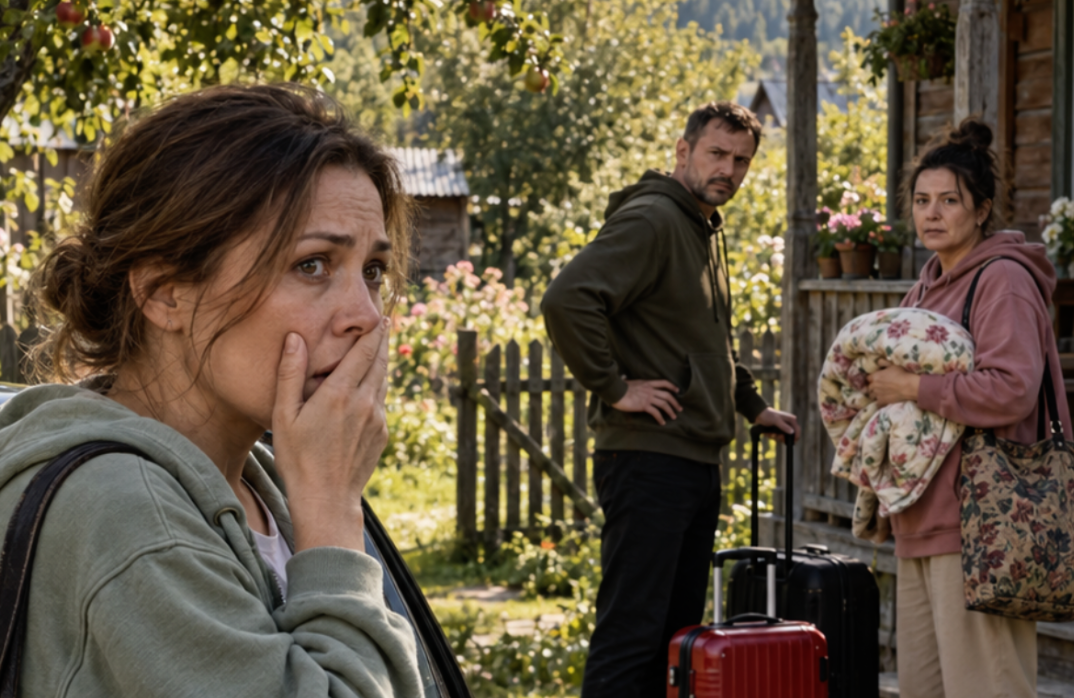
After the Divorce, My Ex Found Out I Had Bought a Country House and Brought His Sister There “to Stay for the Summer.” I Called the Police
There were two suitcases, a bag of groceries, and a folded blanket I had never bought sitting on the veranda. The gate stood wide open, and someone had already moved my folding chair over beside the apple tree.
I stopped the car by the gate and sat there for several seconds, staring through the windshield. The house was locked, the keys were in my handbag, and I had never given them to anyone. So at least they hadn’t managed to get inside yet.
But they were already settling onto the property as if everything had been decided.
A man in a familiar gray T-shirt came out from behind the shed. He was wearing my gardening gloves.
And only then did I realize who had arrived before me.
It Had Always Started With Something Small
Andrei and I had been married for thirteen years. Whenever acquaintances ask why we divorced, I can never name one single reason.
Everything happened in such an ordinary, everyday way: someone took keys without asking, someone promised to return money, someone decided that I “wouldn’t object.”
Our first serious argument happened about five years before the divorce.
We were leaving town for several days, and I had asked a neighbor to water my seedlings. I left one set of keys with her. The second set was usually kept in the dresser, but before we left, I couldn’t find it.
“Andrei, where did you put the keys?” I asked.
He was fastening his jacket and answered almost casually.
“I gave them to Oksana. Let her keep them just in case.”
“In case of what?”
Andrei shrugged.
“Well, you never know. We’ll be away. Maybe she’ll need something.”
He couldn’t explain what exactly his sister might need from our apartment while we were gone.
After the trip, I asked him to get the keys back. Andrei promised he would, then kept forgetting, and a week later he was already getting annoyed.
“Are you seriously going to start this every evening because of one key?”
Two months later, I came home earlier than usual and heard voices in the kitchen.
Oksana was sitting at our table with her son, heating up food. An open loaf of bread was lying beside them.
When she saw me, she asked:
“You’re home early today?”
“How did you get in?”
“I have a key. We were nearby, and my son got hungry. Andrei said we could come in.”
That evening, I demanded the key back again.
Eventually, they returned it, but Andrei spent a long time insisting that his sister hadn’t done anything wrong and that I was treating his family like strangers.
But the principle behind it never changed.
“Three Days” Turned Into Almost a Month
A year later, Oksana was having the floors replaced in her apartment.
Andrei informed me only after he had already made the decision.
“They’ll stay with us for three days, four at the most. There’s dust everywhere at their place, and it’s uncomfortable for the kid.”
I agreed.
Oksana arrived with two large bags.
One week passed. Then another.
Her belongings appeared in the bathroom. Her groceries took up half the refrigerator. Her son started coming straight to our place after school.
On the twenty-fourth day, I found Oksana in our bedroom folding freshly washed laundry on the bed.
“Oksana, when are you going home?”
She called out to her brother, who was fixing a shelf in the hallway.
“Andrei, are we bothering her?”
He looked into the room and immediately frowned.
“Who are you bothering? Stay as long as you need until everything is finished.”
I reminded him about the original three days.
Andrei replied that renovations couldn’t be scheduled “down to the hour” and that throwing a woman and her child out over an extra couple of weeks was petty.
Oksana moved out four days later, after I told her directly that morning that I wanted to see my hallway without her bags in it by evening.
For almost a week afterward, Andrei and I spoke only about household matters.
He would theatrically ask whether he was allowed to use my phone charger or move a stool, then smirk and say:
“Wouldn’t want to violate your personal boundaries.”
Back then, I still believed it was possible to explain to an adult the difference between helping a relative and making decisions for someone else.
They Decided What to Do With My Money Too
Two years before the divorce, we started saving for a bathroom renovation.
The money was kept in a separate account, and both of us transferred part of our salaries into it.
By spring, we had saved a little more than three hundred thousand rubles.
One evening, I opened the banking app and saw a transfer.
One hundred and forty-six thousand rubles had been withdrawn from the account that morning.
Andrei was sitting in the room with his tablet.
I showed him the screen.
“What is this?”
“I gave it to Oksana. She needs to finish her kitchen. The contractor is already booked.”
“Why didn’t you ask me?”
He muted his tablet.
“Because you would have started calculating exactly how much she was going to pay back and by what date. She’ll return it.”
I reminded him that half of that money had come from me and that in two weeks we were supposed to buy materials for our own bathroom.
“We’ll buy them later. Nothing is urgent for us.”
That sentence stayed with me more clearly than the transfer itself.
Oksana later returned about forty thousand rubles.
The rest kept being postponed. First there were school expenses, then an appliance broke, then she needed money for something else.
After about three months, Andrei stopped asking her altogether and became irritated whenever I did.
After that, I opened a separate bank account in my name only.
Andrei called it “family accounting with official stamps.”
By the time we divorced, we were constantly clarifying what belonged to whom.
But I didn’t simply walk away from our jointly owned apartment.
We waited until it was sold, signed a property division agreement with a notary, and divided the money.
Andrei kept the car and garage and paid me compensation for my share. I received my portion from the apartment.
The divorce was officially registered.
A few months later, I added my savings and bought a small plot of land with a country house.
The ownership rights were registered solely in my name after the divorce.
The Country House Was Small, But It Was Mine
Six hundred square meters of land, an old apple tree, a shed, a veranda, summer water supply, and a wire-mesh fence.
Inside there was one room and a kitchen.
The previous owner had left a table, two chairs, and a metal shelving unit.
On Saturdays, I arrived early, opened the windows, watered the plants, and then sometimes spent an hour reading on the veranda.
My son Maksim visited occasionally.
He was twenty-two, lived separately, and had never tried to reconcile us after the divorce.
That spring, he helped me replace some boards on the front steps.
I sent him the exact location of the property so I wouldn’t have to explain all the turns between nearly identical streets in the gardening community.
Later, Andrei asked him where I had been spending my weekends.
Without thinking anything of it, Maksim told him that I had bought a country house and forwarded the location.
I only learned about this afterward.
On the Friday before that particular visit, Andrei unexpectedly called me.
“Are you going to the country house tomorrow?”
“Yes, in the morning. Why?”
“No reason. Maksim mentioned you were thinking about putting up a greenhouse.”
I told him the greenhouse was still a long way off.
Nothing about the conversation seemed suspicious.
Now I understand why he wanted to know what time I was arriving.
He and Oksana got there about an hour before me.
Her Belongings Were Already on My Veranda
When Andrei came out from behind the shed, Oksana appeared after him.
She was wearing casual house pants and a light sweater.
“Hi, Natasha. Where do you keep the kettle? We couldn’t get inside.”
I locked the car and walked toward the gate.
“What are you doing here?”
Andrei took off my gardening gloves and put them on the bench.
“Don’t start the moment you arrive. Oksana is on vacation, and her neighbors are doing noisy renovations at home. We thought she could stay here. You only come on weekends anyway.”
I looked at the suitcases.
“Who is ‘we’?”
“Natasha, why are you picking apart every word? Me and Oksana. Are you really that protective of an empty house?”
“This is my house.”
Oksana sat down on the veranda step and adjusted the strap of her bag.
“I’m not going to bother you. I can leave on Friday evening if you want to spend the weekend alone. Then I’ll come back on Monday.”
She spoke as though we had already agreed on everything.
“Oksana, you are not going to live here. Pack your things and leave my property.”
Andrei stepped closer.
“Are you seriously making a scene because of her? She was your relative for thirteen years.”
“She was. And I bought this country house after the divorce.”
“What difference does that make? You’re alone, the house sits empty five days a week, it would be convenient for her, and it costs you nothing.”
I asked why Oksana hadn’t simply rented a cottage for a month.
“Why pay when someone close to you has an empty place?” she replied.
After that sentence, there was nothing left for me to argue about.
I asked them a second time to go outside the gate.
Andrei said that first we needed to “talk normally” and sat down on the bench.
Oksana remained on the veranda step.
Neither of them touched the suitcases.
That was when I took out my phone.
I Didn’t Call the Police for Dramatic Effect
I dialed 112 and explained to the operator that two people were on my private property without my invitation and were refusing to leave after I had directly asked them to do so.
I gave the address and my personal details and made it clear that there had been no threats or physical violence.
After asking several clarifying questions, the dispatcher said the report would be registered and passed to the local police officer responsible for the area.
When I put my phone away, Oksana stood up.
“You actually called the police? On us?”
“I asked you to leave. You refused.”
Andrei walked over to the car and called someone.
I sat down on the chair by the gate and waited.
About ten minutes later, Oksana approached me.
She no longer looked quite so confident.
“Natasha, come on. We don’t need to do this. I would have bought groceries and paid for the water. I wasn’t trying to take your house away.”
“I never agreed to let you live here.”
“Andrei said he would work it out with you.”
“He decided to bring you here with suitcases first and negotiate afterward.”
Oksana went back to the veranda and zipped up the suitcase she had left open.
The local police officer arrived about forty minutes later.
He introduced himself, asked for our identification, and listened to each of us separately.
Andrei spoke first.
“This is just a family misunderstanding. Nobody is taking anything over. We came here to talk.”
I showed my passport and the electronic property registry extract saved on my phone.
The officer checked the address and asked Andrei:
“Do you own a share of this property? Do you have a rental or usage agreement?”
“No, but we were married for thirteen years. She’s just emotional right now.”
The officer did not attempt to analyze the history of our marriage.
He explained that the fact that Andrei and I had once been married did not give him the right to decide what happened on property purchased by me after the divorce.
If Andrei believed he had any property claims, those had to be handled separately.
At that moment, however, the owner was asking them to leave and was not giving permission for anyone to stay there.
There was no dramatic “eviction.”
The officer wrote down our personal information and statements.
After that, Andrei finally picked up one of the suitcases from the veranda.
Oksana took the second one and the bag of groceries.
“Well, there. Are you happy now?”
I noticed her bag with towels beside the bench.
“Take your bag too. You left it behind.”
She came back and grabbed it.
Andrei stopped at the gate.
“Do you understand how this looks from the outside? You called the police on your own family.”
“After the divorce, your sister doesn’t become the owner of my country house.”
He looked as though he wanted to reply, but instead he just waved his hand and followed Oksana out.
A minute later, their car drove away.
The Next Day, Andrei Tried Again
That evening, he sent me several messages.
First, he wrote that I had “humiliated the family in front of the neighbors.”
Then he reminded me how many times his parents had helped us during the marriage.
After that, he suggested that I let Oksana stay for at least two weeks anyway, “since she had already taken time off work.”
I replied once:
“Do not come onto the property again without my invitation.”
The next morning, Maksim called me.
“Mom, I’m the one who sent Dad the address. I honestly had no idea why he was asking.”
I told him I wasn’t angry, but I asked him not to send anyone my location again and not to tell people when I wasn’t at the country house.
“He called me yesterday,” my son said. “He wanted me to convince you.”
“And what did you tell him?”
“That I wouldn’t be happy either if somebody showed up at my place with suitcases and decided to live there without asking.”
That same day, I bought a proper padlock and a metal latch for the gate.
I kept the old latch for when I was actually on the property, but from then on, whenever I was away, the gate stayed locked with a key.
A week later, Andrei messaged Maksim again, asking whether I had changed my mind.
My son forwarded the message to me and added:
“I didn’t reply to him.”
Several days after that, Maksim told me that Oksana had rented a small house in another settlement for the rest of her vacation.
Andrei never came back.
In August, I finally built the greenhouse.
I moved the folding chair—the one someone had placed beside the apple tree that Saturday—back onto the veranda.
And ever since that incident, I keep my gardening gloves inside the house, in the bottom drawer beside the door.