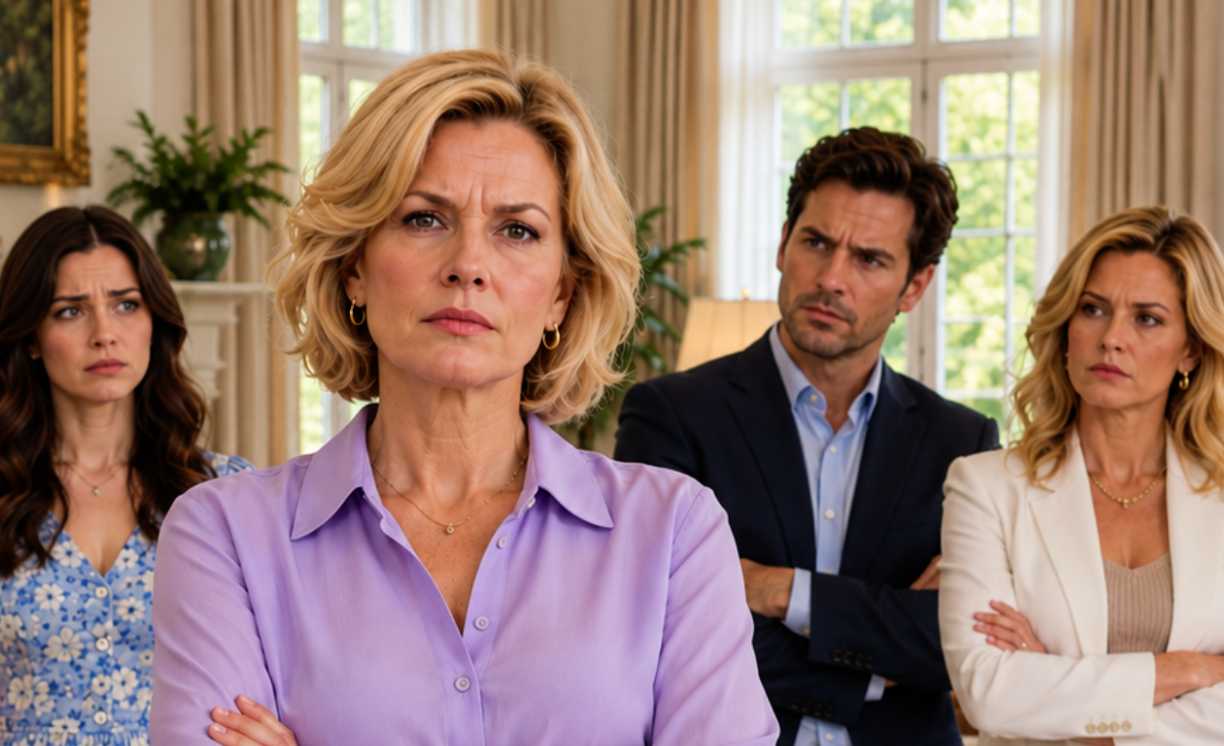
— The apartment is mine. Not “ours,” not “the family’s.” Mine. I lived in it, and I’m the one protecting it. And you’re nothing but greedy relatives.
Valentin, the cousin of Ekaterina’s late husband, leaned over the kitchen table as though he intended to crush it with his bare hands.
— Do you even understand how wrong this is? We’re family, Katya. Blood relatives. And you… who are you to Nikolai now?
Ekaterina slowly raised her eyes from her lukewarm coffee.
— And who exactly are you to me? Would you like some coffee too, “dear relative”?
His sister Taisia immediately stepped in.
— Stop pretending you don’t understand. We didn’t come for coffee. We came for justice. Nikolai would have wanted everything divided fairly.
Ekaterina placed her cup in the sink with deliberate calm.
— You both have homes, cars, and your own lives. Kolya and I lived here. We built the dacha ourselves. So tell me, where exactly is your share? In the kitchen tiles? In the old shed?
Valentin straightened.
— There’s no will. That means the law decides. We’re heirs too. I’ve already spoken to a lawyer.
— So have I, — Ekaterina replied. — The apartment was bought during our marriage and registered in both our names. Half belongs to me. Nikolai’s half is handled according to inheritance law. Yes, you may have legal rights to part of his share, but that doesn’t mean you can walk into my home whenever you please and start behaving as if you already own it.
Taisia crossed her arms.
— Nikolai helped us. My children spent every summer at the dacha. Valentin depended on him too. And now you want everything?
For the first time, Ekaterina’s voice trembled.
— And now I’m the one who has been left alone. You go back to your families. I stay here with an empty chair, an empty bed, and silence. So don’t try to make me feel guilty for protecting what Kolya and I built together.
She paused.
— And don’t touch his motorcycle either.
Valentin looked away.
Taisia gave her a bitter smile.
— You’re acting tough because you’re afraid. You’re alone now. The dacha is falling apart. You’ll get tired eventually.
Ekaterina stared at them and finally understood.
This wasn’t only about inheritance.
They resented her because Nikolai had chosen his wife over them. Because he had built his life with her. Because during his final years, she had been the one beside him.
— Where were you when he was sick? — Ekaterina asked quietly. — Where were you when he couldn’t breathe at night? When we sat with doctors discussing chemotherapy? When I was afraid to fall asleep because I thought he might stop breathing before morning? Which one of you came and said, “Katya, you’re not alone”?
Neither answered.
Valentin finally muttered:
— The law will settle everything.
Ekaterina pointed toward her phone.
— Good. Then speak to lawyers. I’ve recorded this conversation.
They left furious.
At the door, Taisia turned back.
— You’ll regret this. You’ll rot here alone.
After the door slammed, Ekaterina sat at the kitchen table.
Her hands shook.
For one terrible moment, she admitted the truth to herself.
She was afraid.
But fear, she decided, was not a reason to surrender.
The following Saturday, violent pounding shook her front door.
— Open up! We have rights!
Ekaterina stood in the hallway in her bathrobe, holding her phone with the camera recording.
Outside, Valentin was working at the lock while Taisia repeatedly pressed the intercom.
— You can’t keep us out! — Taisia yelled. — We came peacefully!
— If this is peaceful, I’d hate to see what you call hostile, — Ekaterina whispered.
She called the police.
Before help arrived, the lock suddenly jerked.
The security chain snapped.
Valentin forced the door inward, throwing Ekaterina backward against a cabinet.
Taisia rushed past her toward the rooms.
— Have you both lost your minds?!
Valentin started opening cupboards and drawers.
— Where are the dacha documents?
— Get out of my apartment!
Taisia grabbed a family album, threw it aside, and stepped on it without even noticing.
Then a framed photograph of Nikolai fell to the floor.
The glass shattered.
Something inside Ekaterina shattered with it.
— Enough! — she screamed. — This is my home! My life! Stop tearing it apart because you think grief gives you permission to take whatever you want!
At that moment, the alarm she had installed the day before began screaming.
Minutes later, the police arrived.
The apartment looked as though a storm had passed through it. Papers covered the floor. A vase lay broken. Furniture had been overturned.
Ekaterina showed the officer the recording and the bruise already forming on her shoulder.
— Unlawful entry. Damage to property. Assault.
Valentin tried to dismiss it as a family disagreement.
This time, the officer didn’t tell them to reconcile.
He took out his notebook.
— Everyone is coming to the station.
After they were taken away, Ekaterina sat on the floor among the broken glass.
Her neighbor, Aunt Galya, appeared in the doorway.
— Katya, sweetheart, are you all right?
— I’m alive, — Ekaterina whispered.
Then she burst into tears.
She cried because she was frightened, because her back hurt, and because it felt unbearably unfair that she had to fight for the life she had already spent decades building.
During the following week, Ekaterina barely slept.
Every noise in the stairwell made her tense.
Sometimes she even imagined Nikolai standing in the kitchen doorway wearing his old flannel shirt.
The police filed the report. Ekaterina submitted a formal complaint, and a lawyer who knew her niece agreed to help.
Three days later, Taisia returned.
This time she carried flowers.
Gladioli.
— Why are you turning this into a tragedy? — she asked. — We lost our tempers. We’re family. Valentin has been drinking since Nikolai died. Give us another chance.
Ekaterina stared at the flowers.
She had always hated gladioli.
— I’m sorry, — she said. — I’m allergic to insincerity.
Then she closed the door.
That evening, she drove to the dacha.
Under the old apple tree stood the ladder Nikolai had once used to repair the roof antenna. Every corner of the property seemed to contain a memory.
But instead of collapsing under them, Ekaterina called her friend Natasha.
— Can I borrow your son for the weekend? I need some work done around here.
On Saturday, Natasha’s son Sasha arrived.
Together they cleared the shed, repaired old furniture, painted walls, and threw away years of useless clutter.
By late afternoon, Sasha was grilling sausages when a car stopped outside.
A tall, gray-haired man stepped out.
— Ekaterina Alexeyevna?
She turned cautiously.
— Yes?
— My name is Konstantin Sergeyevich. I’m Nikolai’s brother.
She froze.
— His brother?
— Half-brother. Our father had been married before. Nikolai and I hadn’t spoken in years.
Ekaterina immediately tightened her grip on the paintbrush.
— If you’re here about the inheritance—
— I’m not.
Konstantin shook his head.
— I don’t want the apartment or the dacha. I only found out recently that Nikolai died. I came because I wanted to know who my brother really became.
For a long moment, Ekaterina said nothing.
Then she pointed toward a bench.
— Sit down. But don’t smoke.
— I quit twenty years ago.
They sat together as evening slowly settled over the garden.
Konstantin explained that some relatives had known about him but had deliberately kept quiet, afraid another heir might appear.
Then Ekaterina began telling him about Nikolai.
She spoke about his jokes, his fears, his financial troubles, the flowers he used to bring home, and the final years when illness changed everything.
Eventually she told Konstantin something Nikolai had once said to her.
“If I die first, Katya, don’t stay silent. Shout if you have to. Pound your fist on the table. Don’t let anyone walk over you.”
Her voice broke.
— The worst part isn’t that they broke into my home, — she said. — The worst part is that for a moment I almost believed them. I almost believed none of this belonged to me. Not the apartment. Not the dacha. Not even the memories.
Konstantin looked at her quietly.
— You’re not an attachment to Nikolai’s life. You were his life for many years. And you stayed beside him until the end.
For the first time in months, the words didn’t feel like pity.
They felt true.
The court hearing came months later.
The recordings, police reports, witnesses, and documents supported Ekaterina’s case.
She won.
The apartment and the dacha remained hers.
Valentin disappeared from her life.
Taisia attempted to challenge the decision but eventually gave up.
By autumn, Ekaterina stood on the veranda of the dacha and realized something strange.
She wasn’t waiting for another attack anymore.
Her phone rang.
Konstantin.
— I’m nearby. Can I come over for coffee?
Ekaterina smiled.
— Come over. But don’t bring gladioli.
— What should I bring?
She glanced toward the garden.
— Daisies. They’re simpler.
She paused.
— But they’re more honest.
Konstantin laughed.
And for the first time in a long while, Ekaterina felt that Nikolai had not completely disappeared.
Life, somehow, had continued.