“Margarita Pavlovna, maybe we should still agree on a guest list?” Kira asked calmly, not confrontationally, just wanting to understand the scope of what was coming.
Her mother-in-law tore her eyes from her phone and looked at her daughter-in-law as if she had just suggested something absolutely absurd.
“Why are you interfering at all? I’ve already sorted everything out with Denis. Go focus on your design work.”
It was September. Warm, slightly dusty, with chestnut trees outside dotted with rusty patches. Kira stood by her living room window, watching elderly ladies leisurely shelling sunflower seeds on the bench outside. An ordinary day. An ordinary conversation. The hundredth one, by now.
Margarita Pavlovna—a large, loud woman with a teased copper-colored hairstyle—arrived unannounced, as always. She had been living for this jubilee for six months already. Fifty-five years old—a milestone her mother-in-law treated like a national event.
Kira had inherited her apartment from her grandmother three years ago—a spacious three-room ‘stalinka’ on the fifth floor, with stucco ceilings and oak parquet that rang out underfoot like a musical instrument. Kira had renovated it herself—carefully planning every detail and choosing every shade. White walls, gray linen curtains, no unnecessary clutter. Her grandmother’s crystal in the cabinet. A large oil painting above the couch—a seaside landscape at dusk, bought from an old artist at a flea market for next to nothing.
After the wedding, Denis moved in with her, got registered there—and that was all. From then on, his mother began considering the apartment the ‘family nest.’ Meaning: her personal domain.
“Son, tell your wife to get rid of those gray rugs,” Margarita Pavlovna would say to Denis, walking past Kira as if she were just another piece of furniture. “They ruin the whole look.”
Denis would nod. He always nodded.
Kira called this his ‘ostrich policy’ to herself: her husband truly believed that if he buried his head in the sand deep enough, the scandal would disappear on its own. Soft and good-natured, he turned into a twelve-year-old child in front of his mother—agreeing, smiling, shrugging. “You know what she’s like,” he would later say to Kira, looking guilty.
Kira understood. But understanding didn’t mean she agreed.
The idea to host the banquet in their apartment didn’t just appear on its own—it came because Margarita Pavlovna wanted to impress her ex-colleagues. A restaurant was too expensive. Her own dacha was too cramped and unimpressive. But her ‘son’s apartment’ in the old building, with high ceilings and designer renovations, was a different story entirely.
“There’s plenty of space to spread out,” she told her friends over the phone, pacing around Kira’s living room. “Big hall, everything is classy.”
‘Hall.’ Kira heard that and just slightly closed her eyes.
The next six months turned into a never-ending marathon of other people’s instructions. Margarita Pavlovna called Denis and gave directions. Denis would pass them on to Kira, looking away. Kira nodded, smiled, and then did things her own way. They called it ‘family compromise,’ though in reality, it was just patience on one side and rudeness on the other.
By September, the banquet plans were mapped out to the minute: forty guests, a buffet, live music, and a huge banner with the birthday girl’s portrait. Kira still couldn’t recall exactly when she agreed to all of it. Probably that moment when she stayed silent yet again.
One day before the celebration, the doorbell rang. It was a long, insistent ring—the kind that made it clear the person on the other side expected a warm welcome.
Standing at the door was Uncle Petya.
He was broad, loud, smelling of expensive cheap cologne and something bitter—maybe tobacco, maybe just a tough life. Fifty-eight years old, balding, with brush-like mustache, a checkered shirt hanging out. In his hands—a worn-out duffel bag, with something metallic sticking out.
“Welcome your guest!” he announced, stepping inside without bothering to take his shoes off.
Kira watched as his heels left dark marks on the pale parquet floor.
“Uncle Petya,” she said calmly, “we usually take our shoes off in this house.”
He looked at her as if she’d just asked him to sing an opera aria.
“Oh, come on. I’m only here for a minute.”
The duffel bag landed on the white couch. Uncle Petya strolled through the living room, inspecting the walls like a connoisseur.
“What a hole,” he finally declared. “Margarita, I thought you said it was gorgeous. These walls are as bare as a hospital’s. Where am I supposed to set up the moonshine still? I brought my homemade chacha, you know. The good stuff!”
Margarita Pavlovna, who appeared in the hallway with the air of a true hostess, clapped her hands in delight.
“Petya! Finally!” Then she turned to Kira: “What are you standing there for? Go put the kettle on. We’ll sort things out here ourselves.”
“We’ll sort things out ourselves” meant that Uncle Petya would stomp around the apartment in his shoes, rearrange furniture, and loudly share his thoughts about how “the younger generation is so fragile these days.” And that’s exactly how it went.
All evening, the apartment buzzed with his voice. He moved two armchairs “for comfort,” discovered a half-empty bottle of cognac in Denis’s bar and proclaimed, “This will do to get started!” He dropped by the kitchen several times, opened the fridge, and commented on its contents. Kira sat in her office, hearing it all through the wall, staring at her laptop screen without seeing a single word.
That night, Denis went to bed earlier than usual. Apparently, the ostrich buried its head even deeper.
In the morning, on the day of the big celebration, Kira woke up with the feeling that something was already off in the house.
The smell. Faint but undeniable tobacco. She walked into the hallway—Uncle Petya had slept in the guest room and, judging by the quiet, had gotten up before everyone else.
Kira pushed open the living room door.
What she saw took several seconds to fully register.
Uncle Petya was sitting on her pristine white couch, wearing a sleeveless undershirt and track pants, smoking out the open window and tapping his ash right onto her grandmother’s crystal, which was arranged on the coffee table. Meanwhile, Margarita Pavlovna was standing on a chair, trying to take down the painting—the one with the seashore. On the floor already lay a rolled-up banner: ‘Margarita—55!’ with a huge, colorful portrait of the birthday girl.
“The painting is in the way,” her mother-in-law explained without turning around. “We’ll hang the banner here instead. It’ll look nicer.”
Kira didn’t shout. She didn’t slam the door. She just stood in the doorway and watched—as if she were looking at a fire that can’t be put out anymore, but you can still measure its size.
The painting had hung there for three years. Her grandmother never saw it—she passed away before Kira renovated the place. But it was her grandmother’s money, saved in an envelope labeled ‘for something beautiful,’ that paid for the painting. The old artist at the flea market wrapped it in newspaper and said, ‘It’s a good piece. Take care of it.’ And Kira did.
“Margarita Pavlovna,” she said softly, “please get down from the chair.”
Her mother-in-law glanced over her shoulder, looking like someone who’d been interrupted at a most important task.
“Kira, don’t bother me. Can’t you see I’m busy?”
“Please get down from the chair.”
Something in her daughter-in-law’s voice made Margarita Pavlovna actually step down. Not out of obedience—more like instinct. She straightened up and fixed Kira with her usual hint of mild irritation.
Uncle Petya finished his cigarette, flicked the butt out the window, and turned around.
“Oh, you’re up!” he announced with that special enthusiasm only people who never sense the tension can have. “Hey, girl, when’s breakfast? I’m starving after my trip.”
Kira looked at him. Then at the ashes scattered across the crystal. Then at the banner rolled up by the wall.
“Denis!” she called.
Her husband showed up a minute later—wearing a t-shirt, face crumpled from lack of sleep. He saw Uncle Petya on the couch, his mother with the chair, and Kira in the doorway—and slipped right into his favorite posture: hands in his pockets, gaze somewhere between the ceiling and the floor.
“Good day,” he said cautiously, as if tiptoeing through a minefield.
“Denis,” Kira repeated, “your uncle’s been smoking in the room. There’s ash on the crystal. And someone’s taking the painting off the wall.”
“Well, Mom…” he started.
“What do you mean ‘well, Mom’?” Margarita Pavlovna immediately turned to her son. “Son, tell your wife not to make a fuss over nothing. Petya’s tired from the trip. I’ll hang the banner carefully, nothing will be broken. There are guests coming anyway—we need it to look nice.”
“Mom, maybe let’s not mess with the painting…”
“Denis!” Her voice took on the wounded tone of a mother betrayed. “Whose side are you on?”
She asked that question often. And Denis, as usual, didn’t answer—he just shrank, got quieter and less noticeable. Kira had watched this for three years, and each time she thought the same thing: he’s not a bad person. He just never outgrew that childhood where mom always knew best.
Uncle Petya got up from the couch, stretched until his joints popped, and looked his nephew over with a nasty smirk.
“Who did you raise here, Margo? The man can’t say a word in his own house.” He nodded toward Kira. “Hey, you’re just here on borrowed time anyway. This is Margarita’s son’s house. You should just sit quietly and be glad you were even let in.”
Margarita Pavlovna pursed her lips with satisfaction.
Denis stayed silent.
Kira stood there, listening—and felt something inside her stop being quiet. It wasn’t anger. No. It was something calmer and colder. Clarity, maybe.
She walked out of the room, headed to the study, and opened the top drawer of the desk. Inside, in a cardboard folder tied with strings, was something she had never really hidden—just kept, like people keep important documents. The property ownership certificate. She took it out, returned to the living room, and placed it on the coffee table—right next to the crystal bowl, where some ash was still drifting down.
“Margarita Pavlovna. Uncle Petya.” Her voice was perfectly steady. “You spent six months planning this celebration. You made lists, counted seats, negotiated with the caterers. But in all those careful preparations, there was one small mistake.”
She opened the folder and unfolded the document.
“This apartment is mine. Not Denis’s. Not a family nest. Mine, personally. By will and with registration of ownership. Denis is registered here—that’s all he has. And now, the two of you are going to pack your things and leave. The banner, the chacha, the bag—take it all with you.”
For about three seconds, absolutely nothing happened in the room.
Then Uncle Petya burst out laughing—loudly, with a whistle.
“Do you hear that? She’s kicking us out! Kicking us out of the house! Margot, can you believe this?”
Margarita Pavlovna clutched her chest as if Kira had just told her something truly horrifying.
“Kira.” Her voice was high, almost childlike. “Do you understand what you’re doing? I’m Denis’s mother. I’ve been preparing for six months. Forty people will be here in two hours!”
“Then you have two hours,” Kira replied.
“Denis!” The mother-in-law turned sharply to her son. “Tell her! Tell your wife this is impossible! This is your home, you’re the man of the house!”
Denis stood by the wall, staring at the document in his wife’s hands. Something in his face was slowly changing—it was like someone who had been walking with their eyes closed finally stumbled and opened them.
“Mom,” he said quietly, “the apartment really belongs to Kira. You knew that.”
Margarita Pavlovna opened her mouth—and closed it again. His response was so unexpected that for a moment, she was stripped of her entire arsenal.
Uncle Petya, however, didn’t lose his nerve.
“What’s wrong with you, boy? Whipped already?! If it were me, I’d put my woman in her place in no time…”
“Uncle Petya,” Kira interrupted, “I’ve already ordered you a taxi. It’ll be here in ten minutes.”
She picked up her phone and dialed the catering company.
“Good afternoon. Today’s event is canceled. Yes, entirely. Thank you.”
The next ten minutes felt like a badly staged play, with actors who didn’t know their lines but were giving it their all.
Uncle Petya was yelling. Not even words—just this loud, senseless noise, like a car alarm in the middle of the night. Something about respecting your elders, about how young people have forgotten how to live, about his own principles, though the meaning of those got lost by the third sentence. He paced the living room with big steps, bumped into the doorframe with his shoulder, ran into the armchair.
Margarita Pavlovna clutched her heart and stared at Denis for a long time, with an expression that was meant to say “betrayal.” Denis stood by the window in silence. Kira noticed he hadn’t gone to another room—he stayed. For him, that was already almost an act.
“Do you understand what I’ll tell our guests?” Margarita Pavlovna finally spoke, her voice quiet and terrifying. “That my daughter-in-law threw me out? That my own son couldn’t protect his mother?”
“You’ll say whatever you think is right,” Kira replied. “That’s your choice.”
Her mother-in-law stared at her, as if waiting for tears, an apology, or at least a trembling lip. But Kira stood tall, calm, still holding the document firmly in her hand.
Then, something switched in Margarita Pavlovna. She lowered her hand from her chest, straightened up, and started gathering her things from the table—her phone, a small notebook, a folder with some printouts. She was silent. That silence spoke louder than any words: she was leaving like an offended queen, every movement making it clear that Kira had just done something unforgivable.
By then, Uncle Petya had run out of steam. He grabbed his duffel bag, stuffed in a rolled-up banner—it didn’t fit, so it stuck out like a flag of surrender—and trudged out to the hallway, muttering to himself all the while.
At the door, he turned around.
“You shouldn’t have done that, girl. Really, you shouldn’t.”
“Safe travels,” Kira said.
The door closed.
The silence after they left was almost physical. Kira stood in the middle of the living room and could hear a car passing outside, a TV turning on somewhere upstairs, the ticking of the wall clock. Ordinary sounds. Full of life.
Denis stepped out from around the corner—he’d spent the whole time standing by the window.
“Kira,” he began.
“Wait,” she said.
She picked up her grandmother’s crystal glasses—first one, then the other—from the coffee table and carried them to the cabinet. She brushed ash off the polished surface. Then she walked over and threw open the window. The September air rushed into the room thick and full, carrying the scent of leaves and wet asphalt after the night’s rain.
“Kira,” Denis repeated, “I should have… earlier…”
“Yes,” she agreed simply.
He waited for her to say more. But there was nothing else—just the air from the open window and the rust-colored lindens in the courtyard.
“Are you angry?” he finally asked.
Kira thought for a moment.
“No. I’m just tired. It’s not the same.”
Denis sat down on the couch—the very white one where she’d already mentally scrubbed away his uncle’s tracksuit stains. He dropped his head, rubbing his face with his hands.
“She’ll call in an hour and say it’s her heart.”
“Most likely,” Kira agreed.
“And what should I say to her?”
“Denis.” She turned to him. “You’re a grown man. You’ll decide what to say. I’m not doing it for you anymore.”
He looked up at her—a little confused, a little guilty. That look was rare for him: not his usual evasive glance, but something genuine. Real.
“Alright,” he said softly.
Downstairs, by the entrance, the final act of the day was unfolding.
Kira could see everything from the window—not on purpose, just because she was standing there, airing out the room.
The taxi arrived exactly ten minutes later. The driver, a young guy in a cap, got out, opened the trunk, and watched in barely concealed amazement as Uncle Petya tried to stuff a duffel bag with a banner sticking out of it into the back seat. The banner just wouldn’t fit. Uncle Petya cursed at the top of his lungs, echoing down the quiet morning street. The grandmas on the bench—the ones with the sunflower seeds—followed the action with great interest.
Margarita Pavlovna stood a little to the side, looking like someone who has been unfairly wronged by fate. She was already on the phone with someone—Kira saw her press the phone to her ear as she explained something. Probably to the guests. Probably making up something about “a few changes in the program” on the fly.
Then another car pulled up—one of the friends, most likely. A tall woman in a fancy coat got out holding a bouquet, looked around, and was surprised to find the birthday girl not at the door of her luxurious apartment, but sitting on a bench by the entrance next to Uncle Petya, who by then had finally conquered the duffel bag and now sat red-faced and disheveled.
Kira stepped away from the window.
She made coffee—real coffee, taking her time, brewed in a cezve just the way she liked it. She poured it into her favorite mug with the broken handle, the one she could never bring herself to throw away. Then she walked into the living room.
The painting was right where it always hung. A seashore at dusk, in an old frame darkened at the corners. “Take care of it,” the artist had said back then. And she had.
Kira sat in her armchair, cupped her hands around the mug, and looked at the white walls, the gray linen curtains, and the parquet floor that seemed to hum underfoot like it was alive. Her apartment. Her peace. Her air streaming in through the open window.
Down below, she could still hear snatches of her uncle’s voice—he was shouting at the departing taxi because Margarita Pavlovna had left first, not waiting for her brother.
Then even that went quiet.
Denis entered the living room and paused at the door.
“Is there any coffee?” he asked.
“In the cezve, on the stove.”
He went to the kitchen. Came back with a mug and sat down across from her. They sat in silence—not awkward, but new. As if something between them had shifted and settled differently. Not broken, just rearranged.
“You know,” Denis said, staring into his mug, “I should’ve done this a long time ago. Told her. That you can’t treat people this way.”
“You told her today.”
“Too late.”
“Better late,” Kira replied, “than never. That’s not just a phrase. It’s simply the truth.”
He nodded and stayed quiet a little longer.
“She’ll call.”
“I know.”
“And what will you say?”
Kira looked up and gave a small smile—the first one she’d managed all morning.
“I’ll tell her she can celebrate her next milestone wherever she wants. I’ll even help pick the restaurant.”
Denis looked at her—and it seemed like he smiled, too. Just a little. Barely at the edges.
Outside, the lindens rustled. September carried on, calm and auburn, smelling of damp leaves and fresh air. The living room was quiet. Wonderfully quiet.
Kira finished her coffee, set her mug on the table, and reached for her laptop. Work hadn’t gone anywhere—a new project, and a client waiting for Wednesday. Life went on. Her life, in her apartment, on her own terms.
And that was exactly how it was meant to be.
Margarita Pavlovna called again that evening. Then the next day. And the day after that.
Denis always answered the phone himself—Kira never asked him to, he just took it upon himself. He kept the conversations brief, with no excuses or the usual “Come on, Mom, you know how it is.” Then he’d hang up and come back to the room. Kira never asked what they discussed; sometimes he would share a little, straight to the point. That was something new, too.
Uncle Petya went home two days later. When he left, he left a half-empty bottle of homemade moonshine and a soggy towel on the guest room floor. Kira tossed the bottle and washed the towel without a word.
About three weeks later, Margarita Pavlovna finally celebrated her anniversary—at a café across the city, in a small room with fake flowers on the tables and a menu made of laminated sheets. They say there were about twenty-five people, not forty. Uncle Petya gave the toast for the birthday woman, and by his third glass he was already telling some story about his youth that nobody had asked to hear.
Kira wasn’t at the party that night. No one invited her. She didn’t expect to be.
That evening, she and Denis went to the movies—to see some forgettable film they both had already tossed from their memories by the time they were on the subway. After, they dropped by a little pizzeria around the corner, sat there for a while and talked about all sorts of things. Work, plans for October, how they really should finally replace the bathroom faucet. Just a normal conversation. Real.
The painting still hung in its place.
Sometimes, on her way to the kitchen, Kira would pause in front of it for a moment—no particular reason. A seashore at dusk, old frame, warm light from the window cast at an angle. Grandma used to say, “The main thing is to know what’s yours.” Back then, Kira didn’t really understand what that meant.
Now she did.
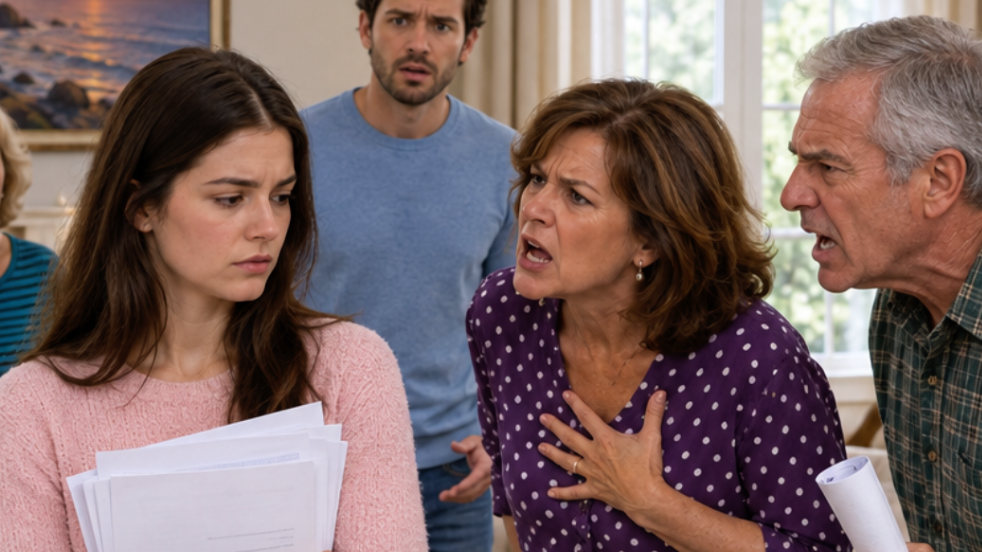
My Mother-in-Law Spent Six Months Planning Her Big Anniversary—But Forgot One Important Detail: The Apartment for the Party Is Actually Mine
Don’t forget to hit the SHARE BUTTON to share this video on Facebook with your friends and family.