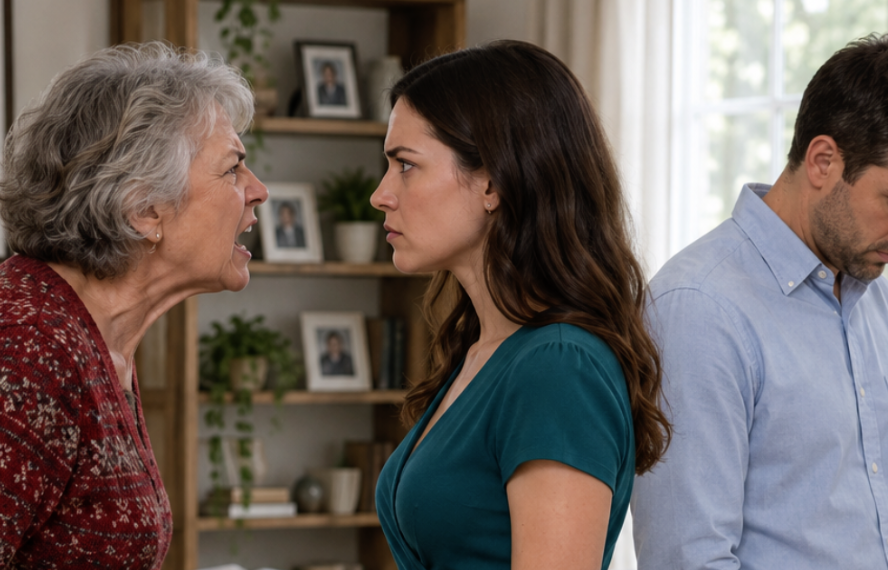
— Seriously, this is just out of line! Living here like she’s some kind of lady of the manor, yet she doesn’t even own a thing!
Nina Pavlovna announced this right from the doorway—loud and completely sure of herself, not even bothering to take off her shoes. The heels of her boots already left marks on the freshly cleaned floor, but she clearly didn’t care. She came in the way people do when they believe someone else’s home is rightfully theirs—without knocking, without waiting to be invited, and with no hesitation.
Sonya stood in the hallway, silently watching her mother-in-law. Just watching. No words.
After three years of living with Anton, she’d learned a lot. She’d learned not to flinch at harsh words. She’d learned not to blush. She’d learned to keep her expression steady—calm, almost indifferent. Even though, on the inside, it was far from that.
Nina Pavlovna was a big, loud woman with a sort of deliberate messiness. Not poor—just didn’t care. Her hair was always half done up, her coat never buttoned straight, and a shabby-handled purse dangled from her elbow. Yet she managed to look down on everyone else as if she were the ultimate example of taste and order.
Anton came out of the room when he heard his mother’s voice—and immediately seemed to shrink, hunching over, somehow becoming shorter. Sonya had noticed long ago: the moment Nina Pavlovna appeared, her husband turned into a mix between a nervous teenager and a well-trained puppy. His voice would get quieter, his eyes apologetic, and his shoulders would slump.
— Antoshka, did you eat? — his mother switched focus as soon as she saw her son. Her voice instantly softened, turning sugary. — You look tired, my boy.
— I’m fine, Mom.
— Fine, really! — she snorted and looked around the entryway as though it was an abandoned warehouse. — Anyway, I’m here on business.
She walked straight into the living room without waiting to be asked, sat down in the armchair—the very one Sonya had picked out for herself after much searching—and plopped her purse right onto the coffee table.
— Anton, I need money. The bathroom needs fixing, you know that. I’ve told you already.
— Mom, we’ve already talked about this…
— Talked about what? — she interrupted easily, out of habit. — You promised back in August. It’s already September.
Sonya walked past, sat on the couch, and picked up her phone. Not because anything on it interested her—it just gave her hands and eyes somewhere to go. She had no intention of joining this conversation. She’d learned a long time ago: getting involved between Anton and his mother was pointless. They operated in their own universe, where Sonya was practically part of the furniture—present, but hardly considered.
— How much do you need? — Anton asked quietly.
— Well, the contractor said at least seventy thousand. If you want it done right.
Sonya looked up. Seventy thousand. Just like that. Casually mentioned. As if they were talking about buying a loaf of bread.
— Anton, — she said, calmly. — We don’t have seventy thousand right now.
Nina Pavlovna looked at her. With a stare so intense, a more sensitive person’s hands would probably have started shaking.
— I don’t recall anyone asking you.
— It’s our joint budget, — Sonya replied. — So actually, I am being asked.
The silence was brief but intense. Anton shifted his gaze between his mother and his wife, looking like a man desperately wishing he could disappear.
“A joint budget,” Nina Pavlovna repeated slowly, emphasizing each word as if repeating something unbelievably foolish. “Well, isn’t that something. So, you know what your so-called joint budget really is? After all, it’s Anton who works, not you.”
“I work too.”
“Oh yes,” her mother-in-law replied, with a sly, unpleasant smile. “I’ve heard all about your job.”
Sonya worked at a small company—handling the paperwork, managing contracts, sometimes helping with HR. Nothing extraordinary, but it was honest, steady work. Nina Pavlovna always said the word “job” about Sonya with a certain tone—as if she put it in air quotes.
“I’ll go to the accounting office myself,” her mother-in-law said suddenly, as if it was no big deal. “And I’ll find out how much you actually earn. Just so I understand what this ‘joint budget’ is all about.”
Sonya looked at her. Then she glanced at Anton.
Anton stayed silent.
He stayed silent the way people do when they’ve already made up their minds—and it isn’t in your favor. He didn’t look up. He didn’t argue. He simply stood by the doorframe, staring out the window where the bare September branches swayed behind the glass.
Nina Pavlovna got up from her chair slowly, with the dignity of someone who believes they’ve won, and went out into the hallway. She put on her coat and grabbed her purse.
“Anton, call me tonight,” she called from the door. “We’ll discuss the details.”
The click of the lock.
And then, silence.
Sonya sat on the sofa and felt something strange—not anger, not quite. Rather a cold, almost mechanical clarity. As if something that had always been blurry had suddenly come into sharp focus.
So, she was really going to accounting.
Sonya slowly put her phone down on the cushion beside her. She looked at her husband—he was still standing by the window, still silent.
“Anton,” she said, very calmly.
He finally turned to face her.
“Well, what do you want me to say to her?” he began. “She’s my mother, she…”
“That’s enough,” Sonya interrupted him. No anger, no shouting. Just—a full stop. “I need to think.”
She stood up, took her coat from the rack—her own, gray, bought last year—and left the apartment. The air outside was cool, filled with the scent of autumn and damp asphalt. The lindens were bare and leafless, and only the yellow leaves rustled somewhere beneath her feet.
Sonya walked and thought.
Not about money. Not about her mother-in-law.
She was thinking about what Nina Pavlovna said about accounting. And in her mind, an idea was already forming—quiet, sharp, like a needle.
Let her go.
Because Sonya knew something her mother-in-law didn’t suspect. And when she found out—not right away, not today, but eventually—it would change everything. The only question was how to use it.
And that, Sonya decided, would be up to her.
Sonya returned an hour later.
Anton was sitting in the kitchen with a cup of coffee, looking like a man who wished the past two hours had never happened. His phone lay face down on the table—a sure sign that he’d already spoken to his mother.
Sonya took off her shoes, hung up her coat, and walked into the kitchen. She poured herself a glass of water. He watched her carefully—the way you’d watch something unpredictable.
“Where did you go?”
“Just took a walk.”
“Sonya, come on, you know she didn’t mean any harm…”
“Anton.” She set the glass down on the table. “Don’t.”
He fell silent. And in that silence, everything was there—how he’d called his mother as soon as Sonya left, how they’d probably discussed Sonya, and how there wasn’t going to be any real conversation with him tonight. Not because he was a bad person—just that he’d long since forgotten how to be on her side. Maybe he never really knew how—she just hadn’t realized it at first.
That night, Sonya lay awake for a long time.
Outside, a sparse rain tapped at the window, somewhere below a car passed by, its headlights slashing across the ceiling before the darkness returned. Anton slept beside her—steady and deep, like someone with a clear conscience. Or like someone who’s mastered the art of pushing away what’s uncomfortable.
Sonya stared at the ceiling, thinking about Nina Pavlovna.
About how she’d come in today—with that victorious look, handbag on her arm, heels clicking on someone else’s floor. The way she mentioned the accounting—as if it was nothing, almost cheerfully, like playing a trump card. Clearly, she was expecting a reaction. Fear, confusion, tears—something to retell to her friends with pleasure.
But Sonya hadn’t been afraid.
Because she knew: in her company’s accounting department, Nina Pavlovna wouldn’t find a single thing of interest. Everything was clean, legal, and honestly, boring. Middle-of-the-road salary, small bonuses. Nothing that could be used as a weapon.
But Sonya knew a few things about Nina Pavlovna herself. And she’d kept that knowledge to herself—not out of fear, but because there hadn’t been a reason to bring it into the open. Now, it seemed, that reason had arrived.
A year ago, purely by chance, she’d run into Lena—a friend of her mother-in-law from Soviet days, though they’d fallen out badly. The meeting was random, in line at the notary’s office, and Lena—a talkative, bitter woman clearly starved for an audience—shared something interesting.
Turns out, Nina Pavlovna had a sister. A cousin, but still family. This sister, Raisa, had lived in Pskov and died several years ago, leaving behind a small apartment. Nina Pavlovna had managed to claim the inheritance—quickly and quietly, before any other relatives could react. She sold the apartment. Where the money went, no one knows. But everything was done properly, legally spotless.
That alone isn’t a crime. But here’s the curious part: when Anton once asked his mom where the money for her new furniture came from, she said she’d been saving up. Not a word about Raisa.
Sonya put two and two together at the time—and kept quiet. She decided it wasn’t her business. Her mother-in-law’s family secrets didn’t concern her.
But now, things were different.
Because if Nina Pavlovna was demanding seventy thousand from Anton for a bathroom renovation, pretending she lived off just her pension—well, that was a whole new story.
The next morning, Sonya got up before her husband. She drank her coffee, got dressed, and headed out to work.
Her office was in an old building downtown—fourth floor, windows facing the courtyard, and an eternally creaky elevator. Sonya loved this place. Everything here was clear and predictable. She was expected to deliver actual results, not just silently agree with everything.
She closed the door to her office, opened her laptop, and sat there for a while just staring at the screen.
Then she grabbed her phone and sent a message.
Lena replied after twenty minutes:
Sonya! Wow, it’s been forever. How are you?
They agreed to meet on Thursday. A café on Petrogradskaya—convenient for both. Sonya typed out the address and put her phone back in her bag.
For now—it was just to talk. Just to clarify a few details. Nothing extra.
At lunch, Anton called.
“How are you?”
“I’m fine. Working.”
A pause.
“Sonya, I just wanted to say… about yesterday. Mom sometimes says too much, you know how she is. She doesn’t mean any harm.”
Sonya gazed out the window at the gray September sky.
“Anton,” she said eventually. “She said she was going to come to my company’s accounting department. Did you hear that?”
“Well, she’s not actually going to do it…”
“And how do you know?”
He fell silent.
“Exactly,” Sonya said. “You don’t know. You never know what she’ll do. And you never say anything to her. I just want you to understand that.”
She hung up. No anger, no tears.
Outside, a bare branch was pressed against the window by the rain, and Sonya suddenly realized that for the first time in a long while, she felt something like interest in her own life. Not anxiety, not exhaustion—interest.
Because on Thursday, she’d be meeting Lena.
And then she would finally learn what cards she was holding.
Thursday turned out to be a gloomy day.
Sonya walked out of the metro and raised her collar—not because of the cold, but out of habit. Petrogradskaya greeted her with wet sidewalks and the scent of soggy leaves. There weren’t many people around—it was the middle of the day, middle of the week, the city moving along with its businesslike, slightly sleepy rhythm.
The café was small and cozy, with wooden tables and floor-to-ceiling windows. Lena was already seated in the corner—a full-figured woman in her sixties, wearing a maroon sweater, dyed auburn hair, and lively but slightly cautious eyes. She waved at Sonya from across the room.
“Sonya! You haven’t changed a bit.”
They hugged—awkwardly, the way people do when they aren’t close but still have things to say to each other. They sat down. Ordered coffee. Chatted about random things—the weather, prices, how quickly time flies.
Then Lena set her cup aside and looked at her intently.
“You didn’t call just to say hello.”
“No, not just to say hello,” Sonya agreed.
And she told her. Briefly, without dramatics—about Nina Pavlovna’s visit yesterday, about the seventy thousand, about the accounting department. Lena listened without interrupting, only once raising her eyebrows.
“So, she hasn’t changed,” Lena said when Sonya stopped. “Still the same Nina. Imagine that.”
“You haven’t talked in a while?”
“Three years now,” Lena replied with a wry smile. “We had a falling-out over that very apartment. Because of Raisa.”
Sonya nodded.
“I’d heard bits and pieces. But not everything.”
“What did you hear?”
“That Nina managed to secure the inheritance before anyone else. And that she sold the apartment.”
Lena fell silent for a moment. She picked up her spoon and twirled it in her fingers.
“It’s true,” she finally said. “But it’s not that simple. Raisa had a daughter—Natasha. She lived in Germany, moved there a long time ago, and Nina took advantage of that. She sorted everything out quickly, before Natasha could claim her rights. Legally, yes, it was all above board. But from a human perspective…”
She left the sentence hanging. She didn’t need to say more.
“Does Natasha know?” Sonya asked.
“She knows. They had a court case. It didn’t work out—Nina did everything by the book, there was nothing to contest. In the end, Natasha gave up. But you can imagine how it feels.”
Sonya understood.
They finished their coffee, paid the bill, and went outside. Lena immediately pulled out her phone and hurried off—she had her own things to do. They exchanged numbers and promised to stay in touch.
Sonya walked toward the metro, deep in thought.
She had no weapon to use now—that much was clear. Everything Nina Pavlovna had done about her sister’s apartment was in the past; the matter had gone through the courts and was closed. There was no point waving this around. She had nothing to threaten her mother-in-law with.
So, a different approach was needed.
She took out her phone as she walked and found a contact: Pavel Igorevich. He was their family lawyer—or, more accurately, the lawyer from the company where her father worked. She had reached out to him two years ago when she was settling her grandmother’s inheritance—he was smart, concise, and dependable.
She typed out a short message:
Pavel Igorevich, I have a question. Are you free tomorrow?
A reply came ten minutes later:
Of course. Is 11 convenient for you?
The house was quiet. Anton was working late—he sent a brief message, no explanations. Sonya changed clothes, sat at the table, and opened her laptop.
She spent the next hour digging into something she should have checked a long time ago: her and Anton’s financial situation. Not just the general picture, but the details. What was registered to whom. Whose signatures were on which documents. Where her name appeared, and where only his did.
And there, something interesting began to take shape.
The apartment they lived in had been bought during their marriage, so it was joint property—she knew that. But the car—the car was registered only in Anton’s name. The loan for it was his as well. But the down payment—Sonya checked old messages and found a screenshot of the transfer—had come from her card. Her money, saved up before they got married.
She leaned back in her chair.
Anton had never talked about this directly. He didn’t deceive her—it just happened, somehow, that she gave the money and everything was put in his name. Back then, it hadn’t seemed to matter. They had just gotten married; everything felt shared, theirs, endless.
Now, it looked different.
Anton came home around nine. He looked tired—took off his jacket as soon as he stepped inside, walked to the kitchen, and opened the fridge. Sonya was sitting in the living room with a book she wasn’t reading.
“Is there anything to eat?” he called from the kitchen.
“Second shelf, in the container.”
He ate in silence. Then he came into the living room, sat down in the chair opposite her. For a while, they simply existed side by side—each in their own world.
“Sonya,” he finally said. “My mom called.”
“I know.” She turned a page she hadn’t read. “What did she say?”
“She’s coming to your work on Friday.”
Sonya looked up.
“Seriously.”
“Well… she said she just wants to talk to your management.” He completely understood how that sounded. “Sonya, I’ll try to stop her…”
“Don’t.”
He fell silent.
“Let her go,” Sonya said calmly. “Honestly. Let her go.”
Anton looked at her like someone who couldn’t quite grasp the situation but sensed that something had quietly and irreversibly shifted.
“What are you planning?”
“Nothing,” she replied. And it was the truth.
Because she really wasn’t planning anything. She’d simply made up her mind.
Tomorrow at eleven — Pavel Igorevich. A talk about money, the car, about how to officially settle what should have been settled long ago. No drama, no confrontation — just order. Documents, signatures, numbers. Things that Nina Pavlovna understands best.
And if her mother-in-law wants to go to accounting, let her. Let her see Sonya’s salary. Let her see there’s nothing interesting there.
Because the real story was somewhere completely different.
And Nina Pavlovna had no idea about that.
Sonya closed her book, stood up, wished her husband good night, and went to the bedroom.
Outside, September hummed softly but persistently — the kind of sound only autumn makes when it has nothing left to lose.
Nina Pavlovna did show up after all.
On Friday, right around noon, she appeared at Sonya’s office — in that same coat, carrying the same purse over her arm, wearing the same look of someone with a special mission. At the reception, she asked for management, citing some personal business.
Management — thanks to Sonya’s warning — politely declined. Company employees aren’t discussed with third parties. That’s just how things work.
Nina Pavlovna pursed her lips and left.
A coworker told Sonya about it, offhandedly, with a hint of confusion:
“Some woman stopped by, kind of strange.”
Sonya nodded and didn’t explain a thing.
By that time, she’d already come back from seeing Pavel Igorevich.
The conversation was short and to the point. The lawyer laid out exactly what needed to be done and in what order. Step one: an agreement defining shares in jointly acquired property. Step two: a written acknowledgment of her loan—the money she’d put into the car. All legal, all peaceful, no drama.
Anton signed everything without complaint.
He’d grown quieter those days — as if he sensed something but didn’t dare to ask directly. He looked at Sonya differently now. Not with fear, but with the sudden realization that he’d been living with someone he never truly saw.
Nina Pavlovna never found out about the lawyer meeting. Anton didn’t tell her — and that, in itself, was a small but important sign.
In the end, her mother-in-law didn’t get the money for the bathroom renovation.
Anton told her simply: we can’t right now. Nina Pavlovna called three times, then stopped. She found the money herself — no one asked where from.
One day, Sonya was walking past her mother-in-law’s building and paused at the entrance. Just for a second. She looked up at the second-floor windows — there was light on inside, and a shadow moving behind the glass.
She stood there for a moment and then walked on.
Autumn was ending. The trees were bare; the sky, low and still. The city rustled around her — familiar, indifferent, honest in its own way.
And suddenly, Sonya realized she was walking effortlessly.