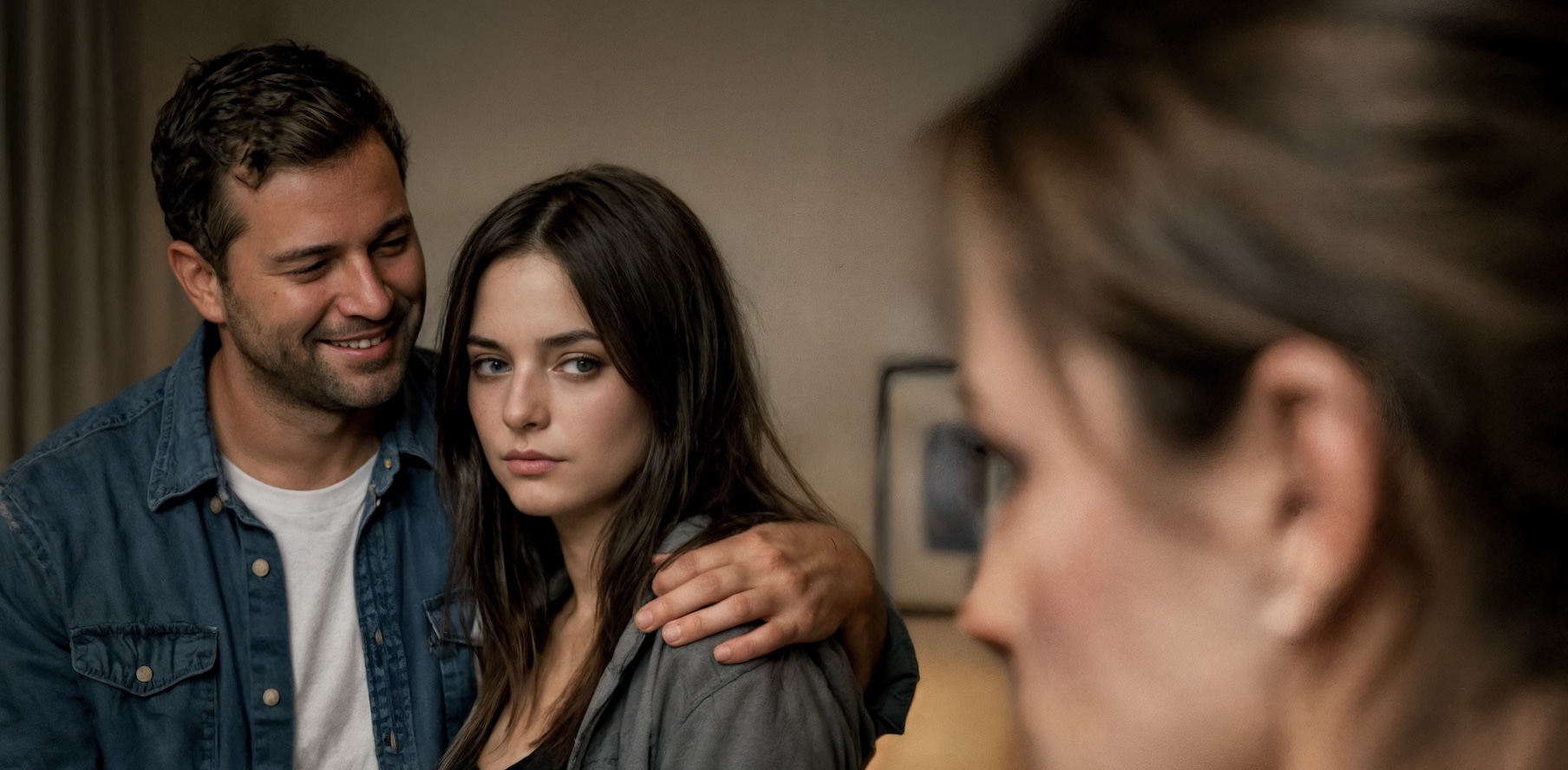
Elena stood in the hallway, staring at someone else’s boots.
They were far too new for this apartment. In the entryway—where the air always carried old shoe polish and damp wool—those shiny, lacquered toes looked shamelessly out of place.
And they weren’t even where shoes belonged. Not on the ridged rubber mat. The boots were planted right on the parquet, in the exact spot that always squeaked like a snitch whenever anyone stepped there.
From the kitchen came the smell of onions frying—thick and heavy, seeping into the wallpaper and clinging to hair.
Elena winced. She never fried onions like that—burned nearly black, smoked until the air turned sharp and bitter.
Sergey loved them that way. But his stomach wasn’t what it used to be. He shouldn’t have been indulging in that kind of “treat.”
“Lenochka… is that you?” her husband called, and his voice carried guilt.
He peeked out from the kitchen, wiping his hands on a towel—her linen towel with roosters on it, the one she saved for Easter.
Now it hung over his shoulder like a wrinkled rag.
“It’s me,” she said, taking off her coat.
The coat rack swayed as usual; the empty hangers clinked softly.
“So who do we have here, Seryozha?” Elena asked evenly. “Whose shoes are those?”
Sergey fussed and avoided her eyes—the same way he did three years ago, when he smashed her favorite vase and hid the shards behind the sofa.
“Well… you see… it’s a bit of a situation,” he mumbled. “A surprise, really. Remember that aunt from Voronezh I told you about?”
Elena didn’t remember, but she kept quiet, unfastening her buttons.
“The one whose husband was in the military,” Sergey rushed on. “So—this is her daughter. Larisa. My sister, basically. A third cousin.”
A pot lid clinked in the kitchen—confident, like an owner closing a door.
Only women who already know where the salt is make sounds like that.
Elena walked into the kitchen without even changing.
A woman sat at the table—about Elena’s age, maybe a little younger.
But “well-groomed” in that strained, expensive way—when money is poured into fighting time as if it were a major overhaul of a building that’s already collapsing.
Her face was smooth, almost expressionless. Her lips were slightly swollen, unnaturally so.
“Hi,” the guest said, not bothering to stand.
In her hands was Elena’s cup—the one with the chipped handle. Elena never threw it away because tea tasted better from it.
“We’re making ourselves at home,” Larisa added, voice casual. “Sergey said you’ve been torturing him with diets. A man needs proper food.”
Elena glanced at the frying pan. Potatoes were drowning in oil.
“She has nowhere to live, Len,” Sergey whispered quickly, pressing himself to the doorframe. “Sold her apartment, hasn’t bought the new one yet—deal got delayed… You can’t leave family out on the street.”
In the hallway, the neighbor’s elevator rumbled; the heavy hum vibrated through the floor. Larisa smiled.
The smile came out crooked, as if the skin behind her ears had been pulled too tight.
“I won’t be here long,” she said. “I won’t get in your way.”
She got in the way instantly—everywhere.
It wasn’t about space. Their place was large, a Stalin-era apartment with high ceilings where warm air pooled near the top.
It was about things.
Larisa didn’t just live there.
She rearranged.
In the morning, Elena found the dish sponge had moved—from the left side of the faucet to the right.
“Easier that way,” Larisa tossed over her shoulder as she drifted past in a silk robe. The fabric slid over her like snakeskin. “You’re right-handed—why should you reach across?”
That evening Elena couldn’t find her vitamins. They’d been relocated from the kitchen table to a dark cabinet.
“Light ruins them,” the “sister” explained, clicking the TV remote.
Sergey blossomed. He ate greasy potatoes and wore shirts that weren’t ironed.
Larisa told him a “little wrinkle” suited him.
He listened to her endless stories about the Voronezh relatives—people Elena had never once seen in any family photos.
But the worst part was how Larisa moved through the apartment.
She didn’t bump into corners.
She knew the floorboard by the balcony dipped and stepped over it without even looking.
She knew the bathroom door had to be lifted slightly by the handle, or the latch wouldn’t catch.
Elena noticed on the third day.
She was sitting in her old, sagging armchair with a knitted throw, darning a sock.
Larisa went to shower.
Click.
The door closed softly—on the first try.
Elena set the sock down. The needle with red thread stayed stuck in the heel like a tiny warning flag.
No one could get into that bathroom on the first try except Elena and Sergey.
Even their son—when he visited with the grandkids—always yanked the handle and cursed.
“Trade secret,” Sergey used to laugh. The lock had been finicky for twenty years.
So how did a third cousin from Voronezh know the trick to an old Moscow door?
That night Elena couldn’t sleep. The window was cracked open.
From outside came wet asphalt and exhaust fumes—the city smell that usually soothed her, but tonight felt irritating.
Sergey snored beside her, whistling slightly on the exhale.
Elena got up, pulled on a sweater. The floor was cold.
She crossed into the living room, where Larisa slept on the unfolded sofa.
The guest lay on her back, arms spread. Moonlight hit her face, turning it into a mask.
A strange, чужой face.
But the hands…
Elena stepped closer.
Larisa’s hands lay on top of the blanket. On the ring finger of her right hand there was a mark—
a pale, slightly indented band of skin, the kind you get from wearing a wide ring for decades and taking it off only recently.
Elena returned to the bedroom, sat on the edge of the bed. Her heart thumped dully, unevenly, pounding into her temples.
She reached into the nightstand and felt the blood pressure cuff—but didn’t take it out.
Instead, she pulled out an old photo album.
Black-and-white photos with jagged edges. Sergey—young, curly-haired, in a ridiculous sweater.
And next to him: his first wife.
Galina.
Elena had only seen her a couple of times, briefly, back when she and Sergey first got together. Galina was loud, large, with a commanding chin.
Their divorce had been ugly—shattered dishes, war over every fork. Galina went north, married a polar explorer, and vanished.
People said she got rich.
Elena held the photo up to the window light. Nothing about her looked like Larisa.
Galina had a blunt, potato nose, heavy eyelids, thin lips. Larisa had a neat sculpted nose, wide eyes, bow-shaped lips.
But the hands…
Elena narrowed her gaze. In the photo, Galina held Sergey by the elbow.
The fingers were short, the nails wide.
Larisa’s fingers were the same.
Different manicure—expensive, filed into an “almond” shape. But the hand itself—broad, sturdy, almost peasant—was unmistakable.
In the morning Elena called her son.
“Misha, you promised you’d bring me that camera,” she said. “The small one we used to watch the nanny when the kids were little.”
She paused, listening.
“Bring it today. No, everything’s fine. I just… want to check whether the housekeeper is stealing.”
Then, with irritation: “Yes, I know we don’t have a housekeeper—just bring it.”
The camera—a black cube the size of a matchbox—Elena hid on the bookshelf.
It crouched between a volume of Chekhov and a reference guide to medicinal plants. The lens pointed straight at the sofa.
The day dragged on forever. Larisa behaved almost ostentatiously “proper.” She washed the windows.
“Look how filthy they were, Lena! Now you’ll finally see real daylight. You were living like a basement.”
Elena said nothing. She loved those windows.
She liked the rain streaks on the glass. Now the panes were sterile, empty—like a hospital.
“Sergey needs a new suit,” Larisa declared at lunch, piling food onto his plate. “That gray one makes him look old. I saw a gorgeous blue one in a shop window. I’ll buy it. I have money.”
Sergey chewed, squinting with bliss.
“Oh come on, Lar… that’s awkward…”
“For family, nothing’s awkward,” Larisa snapped.
Elena watched Sergey straighten his shoulders. He liked it.
The foolish old man liked having two women circling him—one pushing pills and nagging about blood pressure, the other feeding him fried food and promising a blue suit.
That evening Elena said she was going to the pharmacy. Instead, she sat on the bench outside the building and pulled out the tablet her grandson had given her.
She connected to the camera feed.
On the screen was the living room. Larisa was alone.
She wasn’t watching TV. She paced. Then she went to the display cabinet.
She opened the door. Elena held her breath.
Larisa took out a crystal shot glass from the set Sergey had received for his factory anniversary.
Turned it in her hands. And then—flicked it with her fingernail.
The sound rang pure and long.
Larisa smiled. A frightening, unfamiliar smile. And then she spoke to the empty room:
“Don’t worry, Seryozhenka. Soon we’ll toss this junk. We’ll renovate.”
“We’ll knock down the wall, combine the kitchen. And that one…” she sneered. “Let her run off to her son.”
She went to the dresser where the documents were kept and pulled out a drawer—
not the top one with utility bills, but the lower, far drawer. Under a stack of old newspapers lay the folder with the apartment papers.
She didn’t rummage.
She knew exactly where to look.
She took the folder, opened it, checked the documents, and slid it back into place.
Then she sat on the sofa, pulled a phone from her purse, and dialed.
“Yes, doctor. The swelling is almost gone. No—no one will find out.”
She touched her cheekbone.
“My voice? I’m practicing. Speaking higher. He’s a fool—he doesn’t remember anything anyway. The main thing is the apartment papers are still there. Everything’s on track.”
Elena shut the tablet off. Her hands were shaking.
But inside—somewhere around her solar plexus—spread a strange coldness.
Not fear.
Clarity.
She stood. Her knees cracked. She lifted her head and looked up at her third-floor windows.
The light was on—warm, yellow light she had guarded for forty years.
“No,” Elena said aloud. “She’s not renovating anything. Not on my watch.”
She entered quietly. The key turned smoothly.
She had oiled the lock a week ago—unlike the other woman, who knew the “secret” but didn’t know how to care for the mechanism.
Sergey was watching the news in the bedroom. Larisa sat in the kitchen, drinking tea.
From Elena’s cup. Elena’s.
Elena sat across from her and placed her hands on the table. Her palms were dry, speckled with age spots—but strong.
“Galya,” she said simply. Not loudly. As if naming the weather.
The woman across from her choked. The cup clinked against the saucer.
“What Galya?” Larisa snapped. “What’s wrong with you, Lena—overheated your brain?”
“I set up a camera,” Elena nodded toward the hallway. “I heard you talking to your doctor.”
“And about knocking down the wall. And calling Sergey a fool.”
Larisa—Galina—went still. Her smooth, stretched face rippled, as if the mask cracked.
Her eyes—wide and sweet a moment ago—narrowed into something sharp and mean. The same eyes from the past.
“So what?” Her voice changed. The cooing softness vanished; a rough, smoky bass cut through. “What are you going to do? Throw me out? He’ll believe me, not you. I gave him his youth back.”
“And you?” she sneered. “Pills and watery porridge?”
“I’ll show him the video,” Elena answered calmly. “Where you call him a fool.”
“Sergey’s proud,” Elena added. “He might be a fool, but he won’t tolerate hearing it from a woman. You know that.”
That hit. Galina’s mouth tightened.
“That’s why he left you thirty years ago,” Elena said, each word like a nail. “Because you never treated him like a person.”
Galina said nothing. She twisted an invisible ring on her finger, pressing her nail into the pale band of skin.
Elena recognized that gesture too—nervous, angry.
“You’re out of money,” Elena continued. “You spent it all on your face.”
“You thought you’d come back as a queen, push me out, and take a downtown Moscow apartment. Clever. But you missed one thing.”
“What?” Galina spat.
“You opened the bathroom door on the first try.”
Galina blinked.
“So?”
“So Sergey fixed that lock the day after we got married.” Elena smiled faintly. “Twenty-five years ago.”
“He rebuilt it completely. Back then you had to pull up—like you’re used to.”
“Now you have to press the handle slightly down.”
“And you pulled up out of habit—and it opened only because the latch has worn down.”
“But a ‘cousin from Voronezh’ couldn’t possibly know the old defect.”
“You gave yourself away on a door, Galya. A plain old door.”
Silence settled in the kitchen. The refrigerator hummed—an old ZIL unit Elena refused to throw out because it froze better than modern ones.
“Pack your things,” Elena said. “Finish your tea and go.”
“Where am I supposed to go? It’s night.”
“To a hotel. You had money for a suit—so you’ll have money for a room.”
Galina stood abruptly, scraping the chair back with an ugly screech.
She no longer resembled a sweet relative. She was a tired, reconstructed woman who had just lost her last gamble.
“Are you going to tell him?” she asked at the door.
Elena looked at the tablecloth. There was an oil stain—Galina had dripped it while frying the potatoes. It would take salt to lift it.
“No,” Elena said. “Why upset him? His blood pressure.”
“I’ll say there’s an emergency in Voronezh,” Elena added calmly. “Some inheritance paperwork.”
Galina huffed—almost respectful.
“Well then.” She gave a tight nod. “Goodbye, mistress of the house.”
When the front door shut—the one you had to hold so it wouldn’t slam loud enough for the whole stairwell—Elena finally exhaled.
All the air left her at once. Her shoulders sagged.
She picked up the cup Galina had used, walked to the trash bin, and opened her fingers.
Clink.
Her beloved chipped mug shattered into pieces. It hurt. It really did.
But Elena knew she’d never be able to drink from it again.
“Lena!” Sergey called from the bedroom. “Did something fall?”
Elena wiped her hands on her apron.
“Nothing, Seryozha. Just took out some trash. I’ll bring you tea—chamomile.”
She opened the window vent. Cold, clean air rushed in, pushing out the stink of burned onions and the heavy, sweet perfume of a чужая woman.
Elena breathed in deeply. Tomorrow she’d buy a new mug.
And she would definitely replace the bathroom lock for good.
Epilogue
Sergey never came out. The news hadn’t reached him—lost somewhere between the anchor’s voice and the weather forecast.
Elena swept up the porcelain shards carefully, checking under the old sideboard so the grandkids wouldn’t cut themselves later.
The pieces clinked in the dustpan—dry and sad, like fallen autumn leaves.
She poured salt onto the oil stain. The crystals darkened immediately as they soaked up the grease.
That was how a home worked too: it absorbed everything—arguments, чужие smells, joy. The important thing was to shake out the dirty salt in time.
The kettle clicked off as it boiled. Elena brewed chamomile, covered the mug with a saucer so it could steep.
Then she walked to the sink with decision.
The dish sponge lay on the right.
Elena picked it up and moved it to the left—back where years of rubbing had left a dull mark in the metal.
She opened the cabinet. The vitamin jar went back onto the table, to its rightful place where morning sunlight would hit it.
“Light ruins them,” Galina’s words echoed.
Elena smiled. Light doesn’t ruin anything.
Light simply makes things visible.
She went into the bedroom. Sergey lay on top of the blanket, one hand tucked under his head. The TV murmured something about grain harvests.
“Asleep?” he whispered, nodding toward the living room.
“She left,” Elena set the tea on his nightstand. “She got a call. Urgent.”
“Something about a disputed inheritance. Needed signatures before morning.”
Sergey propped himself up, blinking.
Disappointment flashed in his eyes—then relief, like a student whose exam was canceled after all.
“Just like that? At night?”
“Called a taxi. Said she’d ring later.”
He took the mug and blew on the steam.
“Well… wow.” He sipped, grimaced, then pressed a hand to his chest. “Heartburn, Len. It’s burning.”
“I told you,” she adjusted the blanket at his feet the way she always did. “Too much fried food. Want a pill?”
“Yeah. The white one.”
He looked so ordinary then—no “fashionable wrinkles,” just a tired older man in a stretched undershirt.
And Elena felt a sudden, aching tenderness.
Not the kind from romance novels with butterflies—something heavier and dependable, like cast iron.
The next day Elena did laundry. She stripped the sofa bedding in the living room, even though Galina had slept there only three nights.
She washed the curtains. She wiped door handles with vinegar.
The apartment resisted, reluctant to release the smell, but by evening it surrendered.
The air returned to dried apples (Elena kept them in a little cloth bag on the radiator) and old paper.
A week later, her son Misha came with the grandkids.
“Mom, you’re a spy,” he laughed, unscrewing the tiny device from the shelf. “So—did you catch anyone?”
“I did,” Elena said, pinching dumplings in the kitchen. The dough was warm and elastic under her fingers.
“I caught my own foolishness. I thought strangers could become family if you just let them stand in your entryway.”
Misha didn’t understand, and didn’t ask. He went to wash his hands.
“Ma!” he called from the bathroom. “What happened to the door?”
Elena wiped flour from her forehead.
“What about it?”
“There’s a new lock. Works like a clock. You don’t even have to yank it.”
“Your dad called a repairman,” Elena answered loudly so Sergey in the living room would hear. “He said he was tired of struggling. Said it’s embarrassing in front of people.”
Sergey, in front of the TV, grunted with satisfaction.
He hadn’t called anyone. Elena had found a number in the newspaper while he was at the clinic.
But when she told him that evening, “You’re such a good man, Seryozha—finally got it done,” he didn’t argue.
He’d been quieter lately, as if he carried guilt for something he couldn’t remember, a heavy residue on his soul.
That night, after the children left, the apartment grew quiet.
The good, dense quiet—where you can hear the kettle cooling and the neighbors upstairs moving chairs.
Sergey sat in his chair, reading the paper, wearing an old sweater Elena had wanted to throw away last year, but he wouldn’t let her.
The elbow was worn through—an ugly hole.
Elena took her sewing box: a tin of Danish cookies that hadn’t held cookies in years—only buttons, spools, and needles.
“Let me fix it,” she said, settling on the arm of his chair. “Don’t wiggle.”
She caught the torn edge neatly. The needle dipped into the wool, pulling the sides together until they became one.
The seam came out rough and visible, but strong.
“Len,” Sergey said suddenly, still reading. “It’s good she left.”
“Why?”
“Just… fussy. And her perfume—like a hair salon.”
“It gave me a headache,” Elena admitted softly. “But it felt awkward to say. Family and all.”
Elena smiled and bit the thread off with her teeth—a habit her mother scolded, a habit she never broke.
“So you tolerated it?”
“I did,” Sergey said. “For you. You’re the one who let her in.”
Elena stroked his shoulder, right where the new seam was. The wool was warm and alive.
“I won’t do that again, Seryozha. Two of us barely have enough room as it is.”
“That’s true,” he agreed, turning the page. “Hey—where are my horn-rimmed glasses? These ones pinch.”
Elena stood, walked to the cabinet. The glasses were exactly where she’d put them—second shelf, behind the crystal vase.
Not moved. Not hidden.
Theirs.
She handed them to him. Sergey put them on and instantly looked like an old, wise owl.
“Now that’s better.”
Outside, snow began to fall—the first of the year, wet and heavy.
It pasted itself against the same window Galina had scrubbed to sterile shine.
Now the glass was turning cloudy again, cozy—separating their small world from the rest of the universe.
Elena looked at her reflection in the dark pane: fine lines near her eyes, a gray strand escaping her hair.
Not a queen. Not a cover model.
But real.
And the button on her robe—the one she’d sewn on yesterday—held firm, on its own strong thread.