Olga woke up early, when dawn was only beginning to wash the sky outside. February twenty-sixth. Her birthday. Twenty-eight. It should have been a reason to celebrate, yet a strange unease had settled in her chest and wouldn’t let her breathe freely.
Maksim was snoring beside her, sprawled across half of their narrow bed. Olga turned her head and looked at her husband. Three years earlier she’d been certain she was marrying the love of her life. Now, watching his sleeping face, she felt only weariness.
They had spent two years living in Lidiya Petrovna’s apartment—two long, draining years. Her mother-in-law had “welcomed” the new bride with the air of someone bestowing a grand favor. From the very first day she laid down rules that could not be broken: when you were allowed to use the bathroom, how to wash the dishes, where to keep the groceries. Olga tried to follow everything, but the more she tried, the more complaints she heard.
It all started after the wedding. Maksim worked as a logistics specialist at a small transport company and earned forty-two thousand rubles. Olga was a cashier at a supermarket—thirty thousand a month. At first they rented an apartment, but the city was expensive: even a one-room place cost no less than twenty-five thousand, plus utilities. There was nothing left to save. When Lidiya Petrovna offered to let them stay with her “until they’d saved up,” it sounded reasonable.
Temporary.
Only the temporary turned into a trap that wouldn’t end.
Her mother-in-law’s apartment was a two-bedroom in an old brick building. Olga and Maksim were given the tiny room: a narrow bed, an old wardrobe, and one window facing the courtyard. Lidiya Petrovna kept the larger bedroom with the balcony. The kitchen was supposedly shared space, but in reality it belonged to the landlady of the home, who guarded every pot and pan with jealous precision.
Family dinners became a kind of punishment. Lidiya Petrovna would sit at the head of the table and start her monologue—about her wonderful youth, about how Maksim had been such an obedient boy, and about what an amazing girl Kristina had been before Olga.
“Kristina always cooked so deliciously,” Lidiya Petrovna would say, stirring her tea. “Remember her signature duck with apples, Maksim? Unbelievable.”
Maksim would stay silent, eyes lowered into his plate.
“And such a bright girl! An economist. Worked at a bank. Building a career,” his mother would sigh, like she was mourning something beautiful and forever lost. “Such a pity you broke up. She was the perfect match.”
Olga would squeeze her fork and stare out the window. Arguing was useless. Lidiya Petrovna could twist any words until Olga somehow became the guilty one.
What hurt most was that her husband never defended her. Maksim would sit in silence, avoid Olga’s gaze, and pretend he didn’t hear his mother’s barbs. After dinners, when Olga tried to talk to him, he waved her away.
“Don’t pay attention. Mom’s just like that. You’ll get used to it.”
“I don’t want to get used to being compared to your ex.”
“Olga, please, don’t start. I’m tired. Let’s just sleep.”
And Olga would go quiet—because she didn’t have the strength to fight, and because she kept hoping that sooner or later they’d move out and everything would finally get better.
But money kept leaking away on “little things”—Maksim needed a new jacket, the laptop broke, his mother’s car had to go to the shop. Their savings grew painfully slowly, and the dream of a home of their own drifted farther away.
On her birthday Olga got up and went to the kitchen. To her surprise, Lidiya Petrovna was already there, bustling around. She stood at the stove frying something. When she heard footsteps, she turned and smiled—an odd, strained smile.
“Happy birthday, Olenka.”
Olga stopped in the doorway. Lidiya Petrovna never used pet names for her—only “Olga,” dry and formal.
“Thank you,” Olga replied carefully.
“I decided to set a festive table today,” her mother-in-law said, stirring the pan. “Since it’s your birthday. Tonight we’ll all sit together—like a family.”
“You didn’t have to trouble yourself.”
“Oh, it’s nothing. It’s not hard for me.”
Olga sat down in her usual chair. A cautious hope stirred inside her. Maybe Lidiya Petrovna had finally decided to soften. Maybe after two years she’d grown used to Olga and was ready to accept her. Olga knew it was foolish, yet she couldn’t stop herself from wanting to believe.
Maksim woke later and wandered into the kitchen messy-haired, in an old T-shirt and sweatpants. Seeing his mother at the stove, he tensed.
“Mom, what are you doing?”
“Making a birthday dinner. It’s your wife’s birthday—or did you forget?”
“No, I didn’t forget,” Maksim scratched his head and flicked a quick look at Olga. “Happy birthday, sweetheart.”
“Thanks.”
The whole day passed with an odd tension in the air. Lidiya Petrovna cooked, humming to herself. Maksim paced, checked the time, grabbed his phone and shoved it into his pocket as if hiding something. Olga tried to read, but she couldn’t focus. Something hovered around them—something wrong.
By seven the table was set. Lidiya Petrovna had made Olivier salad, baked chicken, mashed potatoes, and cutlets. Olga noticed that none of it was what she liked: no crab-stick salad, no spaghetti with cheese and ham. Instead, there was a broccoli casserole Olga couldn’t stand.
The three of them sat down. Lidiya Petrovna smiled, but her eyes stayed cold. Maksim was visibly nervous, shifting in his chair and twisting his fork in his fingers. Olga forced conversation, telling them about work and a coworker who had recently married.
“Marina is so happy now,” Olga said, serving herself salad. “She and her husband rented a place in a new neighborhood—bright, renovated. She says she finally feels at home.”
“It’s nice when you have your own home,” Lidiya Petrovna remarked. “Isn’t it, Maksim?”
Maksim nodded without looking up.
Dinner dragged on. Olga ate a little chicken and refused the casserole. Her stomach clenched with anxiety; she didn’t want food at all. Lidiya Petrovna kept watching her, occasionally tossing out meaningless comments about the weather and neighbors.
After dinner Maksim stood up and left the kitchen. He returned a minute later holding a small velvet box.
“This is for you,” he said, handing it to Olga.
Olga opened it. Inside lay a thin gold chain—delicate, elegant. Exactly the kind she’d dreamed of but never asked for. Too expensive. They didn’t have extra money for jewelry.
“Maksim… this…” Olga looked up. “Where did you get the money for it?”
“I saved a little here and there,” Maksim said with an awkward smile. “I wanted to make you happy.”
Tears rose to Olga’s throat. So he had remembered her dreams. So he did love her. Maybe it wasn’t all hopeless. Maybe they’d manage.
“Thank you,” she whispered, and hugged him.
Maksim hugged her back—but stiffly, tense. Olga pulled away and searched his face. He wouldn’t meet her eyes.
“Touching,” Lidiya Petrovna’s voice cut in.
Her mother-in-law stood and went to the sideboard, pulling out a large photo album wrapped like a gift—shiny paper, a wide red ribbon tied into a bow.
“I prepared a present too,” Lidiya Petrovna said, placing the album on the table in front of Olga. “I put it together with very special care.”
Olga looked at the woman, then at the album. A bad premonition crawled up her spine. But refusing wasn’t an option—Lidiya Petrovna stood there, watching, waiting for the reaction.
“Thank you,” Olga said, reaching for the ribbon.
She untied the bow, peeled away the wrapping, and opened the album.
On the first page was a photo: Maksim in a blue shirt standing beside a girl—tall, slim, with long dark hair. Beautiful. They were hugging and smiling at the camera.
Olga turned the page. Another photo: Maksim and the same girl in a restaurant, sitting close, holding hands.
Next page: a park. They walked down an alleyway, and Maksim kissed the girl on the cheek.
Olga kept flipping, and with every photo something inside her collapsed. Maksim and the stranger in a café. By a fountain. In the lobby of some hotel.
Her hands began to shake. Olga looked at her husband. Maksim sat with his head lowered, staring at the table. His shoulders were rounded, his hands on his knees. Not a word. Not a single attempt to explain.
“I can see you like my gift, dear,” Lidiya Petrovna said, her voice thick with triumph.
Olga looked at her. The older woman leaned back in her chair, smiling—pleased, victorious.
“This…” Olga tried to speak, but her voice snapped.
“That is Anna,” Lidiya Petrovna explained. “Maksim has been seeing her for over a year. A wonderful girl. From a respectable family. Her father is a well-known attorney, her mother is a doctor. Anna graduated with honors, works for a large company—promising, educated.”
The words landed like blows. Each sentence hit harder than the last.
“Unlike you,” Lidiya Petrovna added, staring at her daughter-in-law with open contempt. “A supermarket cashier. No education, no ambition. I told Maksim from the beginning you weren’t his match.”
Olga stared at the photos, unable to believe what she was seeing. A year. Her husband had been cheating for a full year. And his mother had known. More than that—she had been collecting proof to present it on Olga’s birthday.
“Maksim,” Olga whispered. “Is it true?”
At last he lifted his head. His eyes were guilty and frightened. His lips moved—but no words came.
“Answer me!” Olga shouted, her voice cracking.
“It’s true,” Maksim said quietly.
Olga closed the album and pushed it away. She stood up. Her legs felt weak; the room blurred in front of her.
“You should pack your things and leave, Olga,” Lidiya Petrovna said, folding her arms. “Maksim didn’t have the courage to tell you himself. My boy is soft—he didn’t want to hurt you. So I decided to take matters into my own hands. Help you both move on.”
“Help?” Olga felt anger boiling up. “You staged this show on my birthday to help?”
“So you’d finally understand,” her mother-in-law replied calmly. “You’re unnecessary here. You always were. Maksim loves someone else—the one who suits him.”
Olga turned to her husband.
“You let her do this?”
Maksim was silent.
“You knew she was going to?”
“I didn’t know she’d show the photos,” he forced out. “But I knew Mom wanted to talk to you.”
“Talk?” Olga’s voice trembled. “You call this talking?”
“I’m sorry, Olya,” Maksim finally stood. “I didn’t want it this way. Everything got complicated.”
“Complicated?” Olga blinked hard, trying to hold back tears. “You cheated on me for a year. Lied for a year. And you’re saying it’s complicated?”
“I met Anna at work,” Maksim started to justify himself. “We just talked. Then we started seeing each other. I didn’t plan it—it just happened.”
“It just happened,” Olga repeated. “Convenient.”
“Olya, I really didn’t want to hurt you.”
“But you did.”
“I just… I needed time to figure myself out.”
“A year wasn’t enough?” Tears burned her eyes. “A whole year you were ‘figuring yourself out’ while I lived here, swallowed your mother’s humiliation, and believed we were a family?”
Maksim dropped his head and fell silent.
“How could you?” Olga whispered. “How could you do this to me?”
“It’s complicated,” he repeated. “I don’t know how to explain it.”
“Don’t,” Olga said. “Don’t explain.”
She turned and ran out of the kitchen. At last the tears broke free, blurring everything. She reached their room, slammed the door, collapsed onto the bed, and buried her face in the pillow.
Everything was gone. Her life, her plans, her hope. Years of marriage turned out to be a lie. Her husband had betrayed her. Her mother-in-law had taken sadistic pleasure in humiliating her. And no one cared how much it hurt Olga.
A few minutes later, she heard voices from the kitchen. Maksim said something to his mother. She couldn’t make out the words, only the tones—his guilty one and her cold one.
Olga wiped her cheeks and sat up. There was no time for crying. She had to pack. Leave this place. Now.
She pulled a large bag from the wardrobe and began throwing her things inside: jeans, sweaters, underwear, her makeup bag. Her hands shook so badly she could barely close zippers. She didn’t fold anything, didn’t sort—just stuffed it all in. The only thing that mattered was getting out.
Her phone buzzed. A message from Marina: “How’s your birthday? Fun? I wish you…”
Olga stared at the screen and felt tears press at her throat again. She typed: “Can I come to you? Urgent.”
Marina replied a minute later: “Of course. What happened?” “I’ll explain later.”
Olga zipped the bag, put on her jacket, and looked around the room one last time. Two years she’d lived here, telling herself it was temporary—that soon they’d move and start their real life. But it turned out there had never been a real life at all. Only deception.
She stepped into the corridor. The voices in the kitchen went quiet. She walked past without looking in. She didn’t want to see either her husband or her mother-in-law.
But at the threshold she stopped. From the kitchen came Lidiya Petrovna’s whisper:
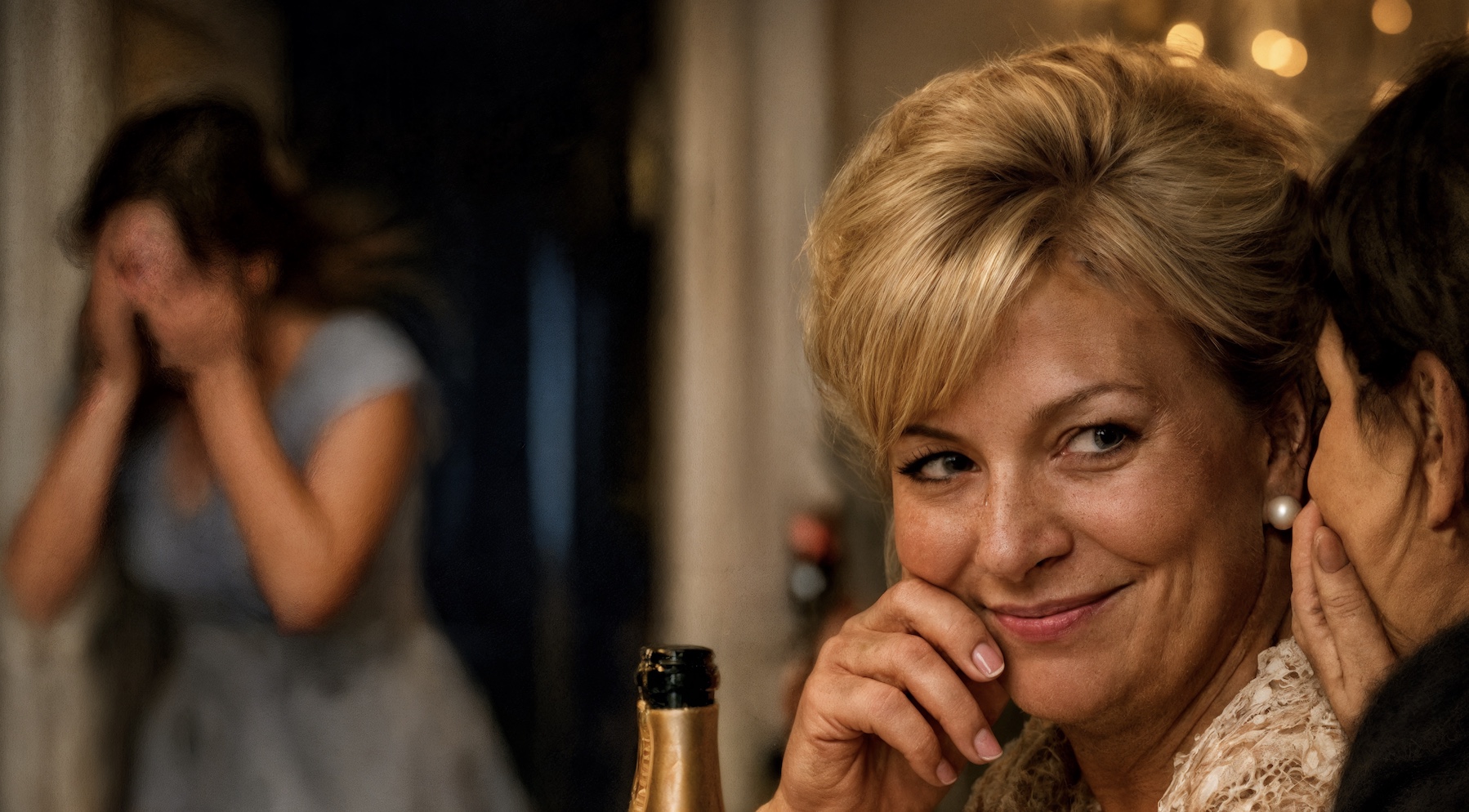
“The party was a success.”
Olga froze and turned her head. Lidiya Petrovna stood by the table, watching her with a triumphant smirk. Maksim sat with his face buried in his hands.
“The party was a success,” her mother-in-law repeated, louder.
Olga didn’t answer. She simply turned, opened the door, and walked out—slamming it so hard the echo rang through the entire stairwell.
She went down the stairs and stepped outside. The cold February wind hit her face, carrying the scent of snow and exhaust. Olga stopped, inhaled deeply, and headed toward the bus stop.
Marina lived on the other side of the city. It took an hour, switching from bus to метро. The whole way Olga stared out the window and tried not to think—not to analyze, not to remember. Just to move forward.
Marina opened the door, saw Olga’s tear-streaked face, and hugged her without a word.
“Come in. Tell me.”
They sat in the kitchen until three in the morning. Olga told her everything—the album of photos, Lidiya Petrovna’s words, Maksim’s silence. Marina listened, repeatedly jumping up to shout furious comments.
“What a vile woman!” Marina fumed. “To do that on your birthday!”
“She’s always hated me,” Olga said quietly. “I just didn’t think it could be that bad.”
“And Maksim said nothing?”
“He said it was complicated. And that he didn’t want to hurt me.”
“Idiot,” Marina snapped. “Stay here as long as you need. You’ll deal with this mess and then you’ll move on.”
The next days blurred into a dull nightmare. Olga barely ate. Slept in scraps, waking at night from bad dreams. Maksim called ten times a day, but Olga didn’t pick up. He sent messages—long, tangled, full of apologies and excuses. Olga read them and deleted them without replying.
A week later, Marina marched Olga to a lawyer.
“File for divorce,” Marina said. “Don’t drag it out. The faster you end it, the faster you start a new life.”
The lawyer was a woman around forty-five with short hair and a crisp suit. She listened and nodded.
“No jointly owned property?” “No. We lived at his mother’s. Just a little savings—I kept it in cash.”
“No children?”
“No.”
“Then it will be quick, if your husband doesn’t fight it. We’ll file, and in about a month there will be a court decision.”
“He won’t object?”
“If he does, it won’t change the outcome,” the lawyer said, opening a folder. “If both agree, divorce can be done through the registry office. If one side refuses—then court. But the decision will still go through. Still, it’s better to meet and settle the question of money.”
Olga signed the paperwork with a trembling hand. Walking out of the office, she felt an odd relief. At last it would end officially. At last she would be free of this nightmare.
Maksim tried to meet her. He came to Marina’s building, waited by the entrance. One day he caught Olga as she stepped outside.
“Olya, wait,” he said, blocking her path. “Let’s talk. I want to explain.”
“Too late,” Olga said, stepping around him.
“I understand everything now,” Maksim hurried after her. “I was wrong. It’s over with Anna. Let’s start again.”
Olga stopped and looked at him. He looked terrible—gaunt, unshaven, dark circles under his eyes.
“You dumped Anna? Or did she dump you?”
“I did,” he said quickly. “I realized I love you.”
“After your mother publicly humiliated me?” Olga shook her head. “I don’t believe you.”
“Mom shouldn’t have done that,” Maksim mumbled. “I fought with her over it.”
“How sweet,” Olga said with a bitter laugh. “So you finally fought with Mommy—after three years of marriage. That princess really must have kicked you out.”
“Olya, forgive me. I’m an idiot. But I want to fix everything.”
“There’s nothing to fix, Maksim,” Olga said. “You betrayed me. And you stayed silent while your mother tortured me.”
“I was afraid of conflict.”
“And I was afraid of being alone,” Olga said softly. “But that’s exactly what happened. And now I don’t want to go back.”
She turned and walked away without looking back. Maksim didn’t follow.
The divorce was finalized two months later. Maksim didn’t argue, didn’t demand money, didn’t cause a scandal. He simply signed the papers and disappeared. Olga took her copy of the divorce certificate and walked out of the registry office a free woman.
“How does it feel?” Marina asked, having come with her for support.
“Strange,” Olga admitted. “Like one life ended and another began.”
“That’s exactly it. Now you’ll build a new life—the right one.”
With Marina’s help, Olga found a job as a sales consultant at a cosmetics store. The pay was better than before—thirty-five thousand plus commission. The owner, a kind, understanding woman in her fifties named Svetlana Ivanovna, treated Olga warmly.
“You’re a smart girl,” Svetlana Ivanovna told her after the first week. “You learn fast, you get along with customers. If you sell well, I’ll raise your base pay.”
Olga worked as hard as she could. The job distracted her from thoughts of her ex-husband and the ruined marriage. Customers, makeup, sales—everything filled her days and kept her from spiraling into the past.
Three months after the divorce, Olga rented a tiny one-room apartment of her own. Twenty thousand a month plus utilities. Expensive, but peaceful. Marina helped her move, brought dishes and a few pots.
“Now you’re a truly independent woman,” Marina said, looking around the empty apartment.
“Yes,” Olga smiled. “Now I really am.”
One evening, walking home from work, Olga passed a jewelry store. The display window glowed brightly in the dusk. And there, on a velvet cushion, lay a gold chain—exactly like the one Maksim had given her on that disastrous birthday.
Olga stopped and stared. She remembered returning it during the divorce, saying she didn’t want anything that reminded her of him.
And suddenly she laughed—quietly at first, then louder. Passersby turned their heads, but Olga didn’t care. She stood before the glass and laughed, feeling something light and bright begin to bloom inside her. Freedom. That was what it was—freedom from toxic love, from humiliation, from a life that had never truly been hers. Freedom to start again, to build a future without looking over her shoulder at the past.
Olga smiled at her reflection in the window and walked on.
Home.
To her apartment.
To her own life.