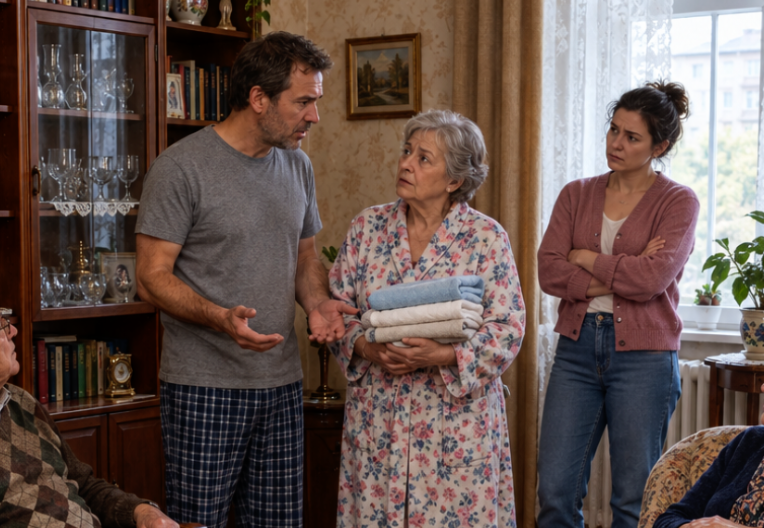
“Marina, give your dad another slice of pie, he’s been on the road for three hours and hasn’t eaten a thing,” Artyom nudged the dish of apple pie toward me and flashed my mother an exaggerated, caring smile.
Mom gently touched the porcelain cup. Her fingers were dry and wrinkled from a lifetime working in the school library.
“Thank you, Artyomka, I’m full,” Dad slowly unwrapped a caramel. “The crust is excellent, so fluffy. Marina, did you use your mom’s recipe?”
“Yes, Dad, I did,” I replied, watching the enamel kettle start to boil on the stove. “But I used dry yeast instead of fresh—didn’t have time to fuss with fresh ones, had to finish up my reports.”
“Isn’t this nice?” my husband leaned back on the couch, resting his hand behind his head. “You guys barely ever get out. We need to do this more often. The air out here is a lot cleaner than over by your foundry.”
The doorbell didn’t just ring—it shrieked. Short and demanding, twice in quick succession.
Artyom jerked, glanced at the wall clock above the fridge, and quickly swung his legs off the couch, suddenly looking shifty.
“Who’s coming by at nearly nine?” Dad raised his eyebrows.
“I’ll get it,” my husband said as he hurried down the hallway, smoothing his thinning hair at the back of his head as he went.
The top lock clicked open. A draft from the stairwell flowed in, bringing with it the sharp scent of cheap lavender air freshener.
“Oh, don’t just stand there! Help me already!” a familiar, booming voice called from the corridor. “My back went out back on Prospect; I didn’t think I’d make it to the third floor. Your elevator is always stuck on the first!”
A heavy plaid suitcase rattled into the living room doorway on its plastic wheels. Right after it came Nina Vasilievna, limping on her right leg, wearing an unbuttoned moss-green coat. In one hand, she clutched a huge supermarket bag crammed with jars.
Artyom shuffled behind her, not sure where to put her travel bag. In his rush, he tossed his old blue sports bag—zipper half-broken—from his morning workout right onto the floor near the shoe rack.
“Nina Vasilievna?” I slowly got up from the table. “Weren’t you supposed to leave for the sanatorium on Sunday?”
My mother-in-law didn’t even turn her head in my direction. She scanned the table, the pie, the half-opened cherry bowl, and finally settled her calculating gaze on my parents.
“Hello, in-laws,” she greeted dryly, pulling off her knitted gloves. “Didn’t expect me? Well, here I am. What sanatorium, Marina? Do you even listen when people tell you things? They postponed the two-week voucher; they’re recalculating things at the factory. I told Tyoma on Tuesday that I’d stay with you for now. Can’t breathe at home—my upstairs neighbor started renovations, drilling with a hammer from seven in the morning.”
Dad slowly set his caramel down on the tablecloth. He looked over at Artyom.
“Tuesday, you say?” he asked quietly.
My husband pretended to be absorbed by the lock on his mother’s suitcase.
“There was just some confusion, Dad Kolya,” he mumbled quickly, avoiding eye contact. “Mom wasn’t sure if she’d get the exemption or not. Well, she got refused. She had nowhere else to go.”
“Nowhere to go, son?” Nina Vasilievna sighed loudly, dramatically pressing her hand to her lower back and twisting her face in pain. “I could barely make it here. Everything hurts. Give me a proper chair, will you? These kitchen stools of yours are a death sentence for my spine.”
“Come to the table, Nina Vasilievna,” Mom shifted on the sofa to make room. Her voice was steady, but I noticed her knuckles turning white as she gripped her cup. “The tea is hot. The pie is fresh.”
“I can’t have pastries at night,” the mother-in-law cut her off, sinking heavily into Mom’s spot. “And your black tea raises my blood pressure. Marinka, pour some boiling water into my mug, I have my own blend in my bag—chamomile and mint.”
She turned her back to me, already taking over the whole room.
Legal Meters
“Find the chamomile in the side pocket,” Nina Vasilievna instructed, stretching out her aching legs in thick woolen socks. “And rinse the mug better, you always leave tea stains.”
I stood by the kitchen cabinets, mechanically clutching the edge of the counter. Inside, a heavy, murky wave was rising—not anger, but a sluggish, sticky exhaustion. Exactly two years ago, there was a scene just like this. Back then, she supposedly came for three days to get some IV drips at the district hospital, and stayed two months. I kept quiet then. I put up with it when she took the linens my sister gave me out of my closet, claiming, “This satin is much nicer on the skin, and it’s no shame for the young to use simple cotton.” I even pitied my husband. Artyom would follow me around, look deep into my eyes, pleading, “Marina, she’s elderly, her personality is complicated, be smarter, just give in.”
And I gave in. I taught him myself that it was alright to move me into a corner like an old nightstand.
“Here’s your herbal tea, Mom,” Artyom shoved a crumpled paper packet under my nose. “Brew it, Marina. Why are you standing there frozen? People need to rest.”
“Your father didn’t finish his tea,” I quietly said to my husband, nodding toward the table.
“He’ll finish it, it’s not urgent,” he brushed off. “Look, we need to sort out where everyone’s sleeping. It’s getting late.”
Nina Vasilievna noisily sipped the hot water from her cup, made a face, and then set it down loudly on the saucer.
“What’s there to sort out, Tyoma?” she said, looking straight at my mom. “I’m having a flare-up. This cursed sciatica is twisting me up so much it hurts to breathe. I need a flat, firm surface. I won’t be able to sleep on your pull-out couches—my legs will stop working by morning. Who’s going to take care of me? Marina, are you going to take time off work? I doubt it.”
“Nina Vasilievna,” Mom couldn’t hold it in, her quiet voice suddenly clear and firm. “Nikolai and I came for the weekend. We bought our train tickets a month ago to celebrate Marina’s birthday. She turns thirty-six tomorrow.”
The mother-in-law didn’t even bat an eyelash.
“Congratulations, Vera,” she said curtly. “She’s a big girl now. It’s not like it’s a milestone birthday. No need for a song and dance. And health—well, we only get one. At my age, every attack could be the last.”
Dad sat absolutely still. He pulled a pocketknife with a bone handle from his pocket, carefully peeled the green apple resting at the edge of the table, and placed a slice on his palm. He stayed out of it. In our family, Dad was always the picture of patience—he’d worked as a foreman in the rolling mill for forty years, couldn’t stand yelling, and never tolerated scandal. If he was quiet, it meant he was weighing every word.
“Artem,” I looked my husband straight in the eyes, “there’s a bed in our bedroom. My parents and I already agreed back on Monday: Mom and Dad take the bedroom, because after Dad broke his hip, his leg can’t straighten on the low couch. You and I get the big corner couch here in the living room. There’s enough room for everyone.”
Artem suddenly frowned, pulled his head down into his shoulders, and stepped back, moving closer to his mother.
“Marina, don’t start,” he said sharply, his tone turning harsh with that fake confidence he used in arguments with suppliers at work. “Mom had a compressed fracture in her spine three years ago, and you know that perfectly well. Soft beds are absolutely out of the question for her. She needs our mattress, the orthopedic one we spent seventy thousand on. The couch here is soft and sagging in the middle.”
“Your father isn’t young either,” I reminded him, feeling a cold emptiness spreading under my ribs.
“Nikolai Sergeevich still does full shifts at the plant,” my husband shot back, raising his voice. “He’s a strong man, what’s two nights going to do to him? He’ll be fine on the couch. But Mom is sick. And anyway, this is a family matter, don’t make a big deal out of it in front of company.”
“Exactly, son,” Nina Vasilievna chimed in triumphantly, dabbing her lips with a napkin. “Family needs to know what’s really important, and what’s just fuss.”
The iron arrangement
“Here’s how it’s going to be,” Artem said, slapping his palm on the table so hard that the spoons in the glasses jumped.
He straightened up, fixed his at-home t-shirt, and looked at my parents as if he’d just closed a major deal and was waiting for applause.
“That’s final. Mom gets the master bedroom—she needs the good mattress!” my husband declared flatly in front of my parents. “It’s quiet there, the windows face the courtyard, nobody will make noise. You and I will move into the kitchen. We’ll blow up the guest air mattress or put up the old cot by the fridge. We’ll get by for two nights just fine—we’re not nobility.”
Nina Vasilievna gave my mom a long, triumphant look. There was no pain from sciatica in that glance—it was filled with pure, satisfied superiority, the look of a woman whose son had danced to her tune right in front of his in-laws.
“That’s more like it,” my mother-in-law drawled as she got up from her armchair without the slightest hint of a limp. “Marina, make up a fresh set for me. The beige one, made of bamboo. Don’t use synthetics, it makes me itch.”
A heavy, stifling silence filled the room. All you could hear was water quietly rushing through the radiator pipes and the monotonous ticking of the cheap wall clock above the microwave.
I stood there, watching Artyom. His straight-backed posture, his chin held high with confidence, and that smug wink he gave his mother—it was like a veil lifted from my eyes in that second. For five years, I had been building the illusion of our shared home. For five years, I’d saved money on shoes and vacations, poured every work bonus into making extra mortgage payments, cleaned, cooked, smoothed over his arguments with his boss, and endured visits from Nina Vasilievna. She could show up at eight a.m. on a Saturday, using her own keys, to inspect how clean the baseboards were.
And this is how it ends: me, the real owner of this apartment, who invested my parents’ one and a half million, being told—right in front of everyone—to sleep on the linoleum next to the trash bin.
I didn’t even have time to say a word.
My father slowly placed his pocketknife onto the wooden cutting board. The blade clicked as it folded neatly into its slot.
He looked up at Artyom—steadily, without blinking—with the same heavy stare he used at the plant when he came across a serious defect in a finished part. In all the years we’d been together, my father had never once raised his voice to his son-in-law. He always kept his distance, telling my mom, “They’ll figure it out. The young ones need time to adjust.”
“Kolya…” my mom whispered softly, touching his elbow.
“Wait, Vera,” my father replied calmly.
He stood up to his full, impressive height—shoulder broad, sinewy, blocking out the chandelier’s light. He pushed his chair back without making a sound.
“Nikolay Sergeevich, really, don’t worry,” Artyom called out condescendingly, clearly thinking his father-in-law was about to argue over the bed. “I’ll give you a warm blanket for the sofa. It’ll all be fine, like family.”
My father didn’t respond. He silently turned and walked out to the hallway.
Nina Vasilievna let out a mocking snort:
“Oh, he’s offended, look at that. We really do get sensitive in our old age.”
“Mom, just let him cool off,” my husband grunted. “He’ll get over it.”
From the hallway came the sound of a zipper being unfastened. My mother-in-law frowned, craning her neck:
“What’s he doing out there? Is he digging through the closet?”
A moment later, my father returned to the room. In his right hand was Artyom’s blue sports bag—the one with the broken zipper pull.
He walked past his frozen son-in-law straight into the master bedroom. The door remained wide open. We could hear the wardrobe doors being flung open with a dull thud, hangers rustling, jeans, knit t-shirts, and a stack of socks all landing in a hurry from the shelves.
“Hey!” Artyom lunged toward the doorway. “Nikolay Sergeevich! Have you lost your mind? What are you doing in there?”
Half a minute later, my father came back out. The bag was packed to bursting, the zipper barely closed at the middle. In his left hand, he held Artyom’s phone charger and the leather pouch with his documents—the one Artyom always left on the nightstand.
A ticket to the street
My father stopped in the middle of the living room and, with a dry thump, set the bag down right in front of his son-in-law’s freshly-shined house slippers.
“Here’s your luggage,” he said quietly. No shouting, no gruffness—just the even, steady tone of a man giving orders at his workshop.
Artyom was stunned. His face showed complete, childlike confusion. He glanced from the bag to his father-in-law, then to his mother.
“Wh-what is this?” he stammered, nervously twitching his shoulder. “What are you doing in my apartment?”
“Yours, you say?” Dad tilted his head slightly. “I thought you and Marina bought it together. And if I’m not mistaken, a million and a half from our house in the village was invested here. Or have you already crossed us out as co-owners?”
“What’s that got to do with anything?” my husband snapped, his face turning red from his collar to his ears. “We have an emergency! My sick mother is here! The bedroom is taken!”
“Exactly,” Dad nodded, fixing him with a heavy stare. “The bedroom’s taken. There’s no room for you in this apartment tonight, dear son-in-law. My daughter is not going to sleep on the floor by the sink while I’m alive. And you’re not sleeping on the living room couch either—Vera and I will be there. Since you care so much about shoving people into corners, the solution is simple.”
Nina Vasilievna squealed as she jumped off the couch:
“What solution?! Who do you think you are, ordering people around in someone else’s home? Artyom, call the police! He threw out your things!”
“The police?” Dad didn’t even turn to look at her. “Go ahead, Artyomka, call them. When the officer comes, we’ll show him the property certificate—Marina owns half, and we’ll include the mortgage receipts paid from her account. And by the way, we’ll ask why a citizen without temporary registration is planning to spend the night here after 11 PM. Want to play by the rules? Let’s play by the rules.”
Artyom stood there, opening and closing his mouth. His usual strategy—pressure, insistence, playing the victim—just didn’t work. This wasn’t me, willing to swallow an insult for peace at home. He was facing a sixty-year-old working man who didn’t care one bit about his managerial tone.
“Papa Kolya… come on, what are you doing?” my husband’s voice dropped an octave, becoming pleading and pitiful. “Okay, maybe I went too far. I shouldn’t have joked about the kitchen. We can figure something out…”
“No, we won’t,” Dad cut him off. “There’s a decent hostel open now by the station—the ‘Severny.’ Eight hundred rubles a bed. Grab your bag, Artyom. You can spend the night there. And maybe think about where a son-in-law should sleep when his father- and mother-in-law come to stay.”
“Marina!” my husband turned to me in despair, searching for the usual support. His eyes darted everywhere. “Marina, do you hear what he’s saying? Say something! This is nuts! Am I really supposed to go sleep in the cold in my own home?”
I looked at him—at his rumpled, angry face, at his hands already reaching for the bag handles, at my mother-in-law, frozen in rage. And I suddenly felt an amazing, ringing calm. As if someone had flipped a switch inside me, cutting off the power to all my old fears.
“Dad’s right,” I said very quietly. “Take your bag.”
“What?!” Nina Vasilievna wailed. “You’re kicking your own husband out over some old bed? Well… I’ll never set foot in this place again! Tyoma, let’s go to my place! Call a taxi right now! Let them sit here, drowning in their precious square meters!”
“But your neighbor uses a power drill,” I reminded my mother-in-law, looking her straight between the eyes. “And your back is out. Will you make it?”
My mother-in-law gasped for air, snapped her mouth shut, and tugged at her son’s sleeve:
“Let’s go, Artyom! Don’t stoop to their level! File for divorce tomorrow! We’ll get everything down to the last penny, I’ll find you the best lawyers!”
Artyom silently, without raising his eyes, bent down, grabbed the blue bag by its torn strap and backed down the hallway. He didn’t say a word. He didn’t slam the door, didn’t curse. He just slipped his feet into his shoes, threw his jacket over his home t-shirt, and dashed out to the stairwell. Chasing after him, dragging her checkered suitcase, Nina Vasilyevna rolled out too, forgetting even to limp.
Morning Light
The English lock clicked shut. Dad walked over to the front door, turned the heavy lower bolt all the way—its deep metallic clank put a full stop to it all—then he returned to the hallway.
“The kettle’s gone cold,” Mom said from the living room. Her voice trembled just a little, but there was no panic in it. “Should I warm it up, Kolya?”
“Warm it up, love,” Dad replied, taking off his wool vest, hanging it carefully over the back of a chair, and looking at me. “How are you, daughter?”
“I’m fine, Dad,” I answered, staring at the empty rug in the entryway where, just ten minutes ago, someone else’s suitcase had stood. “Really. I’m fine.”
We didn’t start any big conversations. Mom brewed fresh tea, took dried apples from home out of her bag, sliced some cheese. The three of us sat at the table, talking about small repairs in their library, how Dad needed to change the winter tires on his old Lada, and the weather for the next week. Artyom’s name never came up once all evening. Neither Dad nor Mom asked me, “How will you live now?” or “What about the apartment?” They were just there for me.
We went to bed around midnight. My parents went to the master bedroom. Mom resisted for a while, wanting to sleep in the living room, but Dad just took her arm and led her into the room: “Go to bed, love. The bed is wide, the mattress is good, your back won’t hurt.”
I made up the fold-out couch in the living room for myself. I laid down a clean sheet and covered up with that same old plaid blanket. The apartment was filled with an unusual, dense stillness—not the oppressive kind I’d grown used to over the past years, when every little noise meant someone’s irritation, but calm, steady quiet.
In the morning, I woke up without an alarm, at half past seven.
The sun streamed straight through the kitchen window, casting a golden rectangle on the pale linoleum. I got up, walked barefoot down the hallway, pushed open the balcony door, and flung it wide. Cold, fresh October air hit my face, carrying the scent of the first frost and damp poplar leaves.
My phone vibrated on the kitchen table. On the screen was a message from Artyom:
“Mom didn’t sleep all night because of her blood pressure. I stayed over at her place. I’ll come on Sunday for my things and the apartment papers—we’ll resolve this through a lawyer. You crossed the line, Marina.”
I stared at the glowing screen. My fingers weren’t shaking. My heart wasn’t pounding in my throat. I felt neither anger, nor the urge to send back a long explanation, nor fear of upcoming court battles and division of property. All that was ahead—heavy, tedious, full of paperwork. But that would come later.
I placed my phone face down next to the salt shaker. Then I walked over to the stove, struck a match, and set the coffee pot on the smallest burner.
My father quietly came out of the bedroom, wearing sweatpants and rubbing the sleep from his eyes.
“Good morning, Marin,” he said as he walked to the window and took a deep breath of the cool air. “It’s nice outside. So fresh.”
“Good morning, Dad,” I smiled. “Do you want me to make you some coffee or put on some tea?”
“Tea, please,” he replied, sitting down on the stool. “With cherry jam.”
Did my father have the right to interfere in his adult daughter’s family dispute with her own husband, or should Marina have seen it through herself, without hiding behind her parent’s support?