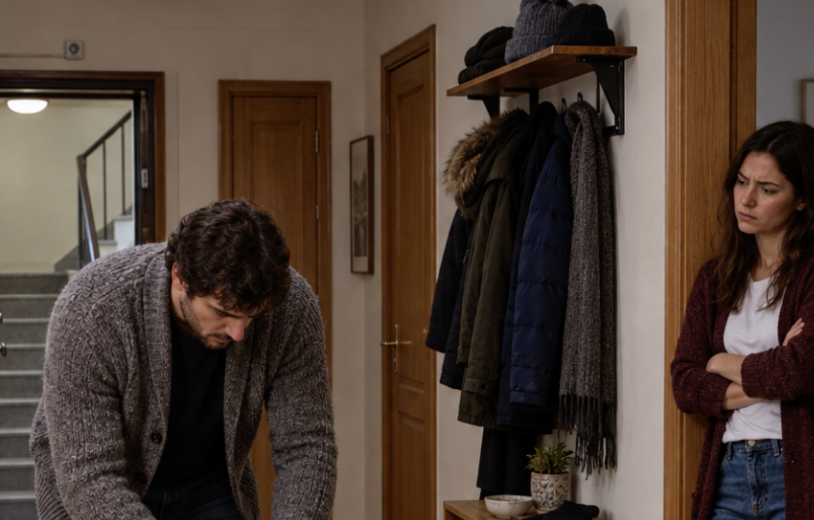
“Please sign right here, on the preliminary inspection report,”
the evaluator, dressed in a strict gray jacket, handed me a plastic clipboard holding a printed form and a cheap blue pen attached on a spring.
“The supporting walls are original, no unauthorized changes. The floor is perfectly level, and it’s a second-floor apartment in a historic part of the city. One hundred sixty thousand per square meter is the absolute minimum for a quick sale. Your husband specifically asked me to give the lowest estimate so the agency can transfer the deposit by Friday.”
I froze in the middle of my own hallway. A small mailbox key was still stuck between my fingers; I’d just taken it from the front door lock. The air smelled of freshly brewed coffee with cinnamon—Roman always made it in a copper cezve on mornings when he felt guilty or was planning another “family surprise.”
“What quick sale by Friday?”
My voice sounded muffled, almost as if I was speaking through a layer of cotton.
“Roman, what is this specialist talking about?”
Roman, standing in the kitchen doorway in his favorite chunky-knit wool cardigan, didn’t flinch. He calmly set his white porcelain coffee cup on the windowsill, wiped his hands with a linen towel, and walked over to the evaluator, placing his heavy hand on the man’s shoulder like he owned the place.
“Inna, do we really have to start this in front of others?”
he said gently, using that same coaxing tone he always used to talk me out of buying a second pair of winter boots.
“We’re grownups here. Viktor Sergeevich is just doing his job. I applied for the urgent sale through his company last week. You can see for yourself how well this is all coming together: the market’s at its peak, and they’re already pouring the foundation for my mom’s house in the village. If we sell this apartment fast at the urgent rate, it’ll be just enough to finish our contract for the cottage shell and pay for the roofing work.”
Viktor Sergeevich blinked, his sharp gaze moving from Roman to me, then quickly set the clipboard down on the edge of our shoe cabinet.
“Hold on,”
the evaluator said dryly, reaching for a laser measurer in his pocket.
“According to the registry extract, there’s only one owner—Vasileva Inna Andreevna. The ownership is based on a gift agreement from 2016. Young man, on the phone you told me the property was acquired during your marriage and your wife was just running late for work and would sign her consent in person.”
“What difference does it make whose name is on the paper?”
Roman forced a nervous smile, but there was a flash of anger in his eyes.
“We’ve been married for six years. Are we a real family or just strangers? Inna, please sign the preliminary form. Mom is already at the builder’s office near Moscow, waiting for the confirmation. You promised we’d help make her dream come true!”
“I promised to help move her seedlings in May, Roman,”
I replied, looking straight into his wide, indignant eyes.
“And this three-room apartment was a gift from my grandfather, back when you weren’t even on the horizon of my life.”
A tea set sitting on cardboard boxes from Leroy
The evaluator cleared his throat, glanced down awkwardly, and took a step toward the exit:
“You know what, folks… Figure it out yourselves. I’ll send an invoice for the false call to the number I was given.”
The door clicked shut behind Viktor Sergeevich, leaving us in the heavy, stifling silence of an old hallway with three-meter high ornate ceilings. Roman let out a loud sigh through his nose, crossed his arms over his chest, and leaned his back against the oak wardrobe door.
“Bravo, Innochka. Just bravo. You managed to humiliate me in front of a stranger. Do you even realize how you made me look?”
“And how do you think you look, inviting some outside appraiser to sell MY apartment behind my back?”
I slowly slipped my coat off my shoulders and hung it on the hook. My hands were trembling, but I forced myself to unfasten my boots without rushing.
“Why is it always ‘my’ this, ‘your’ that?!”
he snapped, his voice rising to a falsetto as he took a step toward me.
“How many times have we talked about a spacious house out of the city? Fresh air, apple trees, a sauna! My mom has been cramped in her damp Khrushchyovka on the first floor her whole life—her joints ache every fall! We agreed that one day we’d sell this dusty tomb and move to the countryside!”
“We agreed to buy a plot in five years, once we pay off the car loan,”
I reminded him as I walked into the kitchen.
“And we planned to build OUR house, with both our names on the deed. Not a two-story mansion on a lot that your mom just registered solely in her name last week! Did you really think I didn’t see the paperwork on the table when we had tea at her place on Sunday?”
Roman was startled for a second, but quickly straightened up, putting on a mask of wounded righteousness:
“Mom put the land in her name because she gets a veteran’s property tax discount! You don’t know how to save a penny, but she’s thinking of our future! We’d all live there together. You’d have your own second floor, a terrace with a pine view. What’s so great about this old Stalin-era place? Rusty pipes, squeaky floors, twenty minutes on foot to the metro!”
“It’s a seven-minute walk to the metro, Roman. And those creaky floors were laid by my grandfather, the city’s honored architect. They’ll outlast both me and your illusions.”
“Illusions?”
he angrily tossed a towel right onto the dining table, tipping over the empty salt shaker. A fine white dust scattered across the polished surface.
“So my mother means nothing to you? She gave up her funeral savings for the down payment on the builders! She handed over three hundred thousand rubles—everything she’s ever saved! And you’re upset about square meters you got for free, just like that, without ever lifting a finger on that construction?!”
“Those square meters came from my family,”
I shot back firmly.
“And in six years of marriage, you didn’t even replace the bathroom faucet out of your own pocket—I had to transfer you money from my bonus.”
Roman’s phone vibrated in his jeans pocket—loudly, insistently, drumming against the button. An image lit up the screen: an elderly woman with a dramatic perm, standing in front of blooming dog roses. Zoya Pavlovna.
Roman grabbed the phone, shot me a look full of undisguised triumph, and hit speakerphone:
“Yes, Mom! We’re just talking over the details with Inna!”
A voice from Sosnovy Bor settlement
Out of the speaker came my mother-in-law’s piercing, slightly cracked voice, brimming with the urgency of a commander before a decisive offensive.
— Romochka, dear son, so what did the appraiser say?
Zoya Pavlovna began rattling off questions. In the background, a construction crane droned and workers bickered loudly.
— Foreman Sergey says if we don’t pay the advance for the aerated concrete blocks by 3 pm, the truck will leave for another site in Dmitrov! I’m already sitting in his trailer, the supply papers are signed. Has Innochka given her consent? How much are you asking for the three-room? Don’t let it go for less than eleven million, realtors always try to lowball at first! We’ll give ten million to the builders, and Innochka and I will spend a million on curtains and a kitchen from IKEA… or, well, that local showroom!
I walked up to the table, leaned toward the phone, and calmly said:
— Hello, Zoya Pavlovna. The appraiser left five minutes ago.
There was a brief pause on the line before my mother-in-law’s tone instantly shifted from overly businesslike to instructively familial:
— Oh, Innulya, dear! Are you home already? Roma said you’d be at the department until evening. Well, good thing you made it! Did you sign the paper? Don’t worry, sweetheart, the house is being built for all of us. I’ve even planned a room for your books on the second floor — the brightest one, with windows facing east! You’ll be able to write your lectures in peace, not in this city smog.
— Zoya Pavlovna,
I interrupted her in an even tone.
— I didn’t sign anything and I’m not planning to. My apartment isn’t for sale. Not today, not next week, not in a year.
The silence on the line grew so dense that I could hear a distant dog barking at the construction site.
— What do you mean… not for sale?
My mother-in-law’s voice dropped an octave, losing all its syrupy sweetness.
— Inna, are you out of your mind? I already paid the deposit for the blocks! Three hundred thousand—my own hard-earned, saved money! If we don’t pay the rest today, the deposit is lost under the contract! Are you trying to drive me crazy in my old age?
— You paid a deposit for YOUR house on YOUR land without asking me,
I replied.
— I never promised you anything. Sort out your contracts yourself.
— Roma!
the phone squealed so loudly the speaker crackled.
— Pick up! Who did you bring into my house six years ago?! A cold, stone-hearted woman! Your mother is going to have a heart attack right here in the trailer! Tell her!
Roman grabbed the phone off speaker mode, pressed it to his ear, and hurried into the hallway, whispering angrily:
— Mom, calm down, I’ll handle it… She’s just tired after teaching… Let me figure this out, mom, please don’t cry…
I sank into a chair and ran my hand over the smooth tabletop. Six years. For six long years I’d closed my eyes to how Roman gently, quietly pushed me toward this line. At first it was talk about how the ‘family was cramped in the city.’ Then it was endless complaints from my mother-in-law about her blood pressure and the dampness of their basement. Then came evenings spent browsing house projects online over tea, with Roman enthusiastically sketching out ‘mom’s wing’ and ‘our bedroom’ with a pencil.
But I never, not once, agreed to sell my grandfather’s inheritance. Grandpa Andrei Matveevich built this house for Academy of Sciences employees. The rooms used to smell of old structural engineering books, and in that corner stood his oak desk where he would draft bridges. And now Roman wanted to tear it all down—for a two-story concrete block shack thirty kilometers outside the MKAD, registered in someone else’s mother’s name.
The Blue-Ribbon Folder
Roman came back to the kitchen ten minutes later. His face had gone ashen, lips pressed into a thin white line. He had lost that careful tone—he wasn’t trying to be gentle anymore.
“Here’s how it’s going to be,”
he stopped across from me, knuckles digging into the countertop.
“Either you come with me to the realtor’s office tomorrow morning and sign a power of attorney for the sale, or we file for divorce.”
I looked up at him. There was no fear, no pain, not even any resentment left—only a strange, cool sense of relief, like a tight band that had squeezed my temples for three years was finally gone.
“You’re giving me an ultimatum in my own home?”
I asked.
“This isn’t your home! This is OUR family life!”
he snapped.
“For six years I’ve poured my soul into this family! I took you on vacations, I put up with your boring colleagues from the department, I did cosmetic repairs in that damned bedroom with my own hands! And what do I get in return? A selfish woman obsessed with her square meters, while my mother’s dream is collapsing?! Divorce, Inna. And division of property. By law. You think you’re smarter than everyone? Mom’s lawyer has already calculated everything.”
“What lawyer?”
I barely suppressed a bitter smile.
“A real lawyer!”
he straightened up, basking in his supposed authority.
“For six years we paid for all the renovations. We updated the wiring, we glazed the balcony, we bought Italian furniture for this place! Mom has kept every single receipt! In court, we’ll claim all the improvements paid for from our shared budget and secure a share for me! Either you give half the value in cash for the construction project, or I’ll have the court settle my mother here on a legal basis! Let’s see how you handle your lectures then!”
I slowly stood up, left for the bedroom and opened the built-in closet. From the top drawer, I took out a thick cardboard folder tied with a faded blue ribbon. Grandpa’s habit—keeping every payment order and receipt in chronological order.
When I returned to the kitchen, I set the folder down in front of Roman and untied the knot.
“Here’s the contract for replacing the electrical wiring from 2019. Paid from my salary account, down to the last kopeck,”
I said, laying out the first receipt.
“Here’s the balcony glazing contract. Paid from my card, by wire transfer. Here are the invoices for the furniture—paid from my savings account, which I opened two years before our wedding. And here, Romochka, is your credit card statement, which we paid off for three years out of my salary while you were ‘finding yourself’ in start-ups.”
Roman’s gaze darted to the paperwork. His arrogance began to crumble, revealing the confusion of a schoolboy caught cheating.
“And most importantly,”
I pulled my phone from the pocket of my house robe.
Half an hour ago, while you were in the hallway trying to stop your mother from taking Corvalol, I got a call from the chairman of the country house cooperative, ‘Sosnovy Bor.’ Remember Pavel Nikolaevich? He’s been an old friend of my father’s.
Roman’s complexion changed from gray to an earthy shade.
He was very surprised when Zoya Pavlovna showed up at the office yesterday with the assignment agreement for the neighboring plot, announcing that the second payment for the land would come from selling an elite three-bedroom apartment on Leninsky Prospekt. Pavel Nikolaevich called my dad immediately. And my dad called me.
“Inna, wait…”
he mumbled, taking a step back.
“Did you and your mother really think you’d found some gullible fool with property?”
My voice was tense, strung as tight as a wire.
“Was your plan to sell the apartment at a knockdown price through your friendly appraiser, pocket the cash under the pretense of a ‘construction fund,’ register the cottage entirely in Zoya Pavlovna’s name, and then file for divorce and leave me in a rented apartment?”
“That’s not true!”
he shouted, but his eyes darted around the corners of the kitchen.
“We just wanted what was best! Mom was worried that if the house was in our name, your relatives would try to claim it! She only wanted to protect the family!”
“Family?”
I walked over to the front door and flung it wide open onto the landing, where slanted autumn light filtered in through the stained-glass window.
“Your family is sitting in a trailer in Sosnovy Bor. Go to them. Right now.”
Suitcases on the stair landing
Packing took less than forty minutes. When someone realizes they’ve been caught down to the last detail, all their brazen confidence vanishes without a trace. Roman feverishly tossed his shirts, branded sneakers I bought with my vacation money, and the expensive wristwatch I gave him for his thirtieth birthday into travel bags.
“You’ll regret this,”
he hissed, zipping up his overstuffed suitcase right on the parquet in the hallway.
“You’ll end up alone in these four walls with your dusty books and cats! No one needs you with your drill-sergeant attitude! A woman should follow her man, not fight over square meters!”
“I followed my man for six years, Roma. Until I realized he was leading me straight to the poorhouse, just so his mom could sleep better at the dacha.”
He rolled the first suitcase out the door. On the third floor landing, a door slammed—our neighbor peeked out with her dog, clearly curious about all the noise.
“Keys on the table,”
I said curtly.
With a look of hatred, Roman threw the bundle of keys onto the wooden shelf. They clinked against the mirror glass, leaving a tiny chip.
“File for divorce yourself. And remember: you won’t get a single cent from me! Don’t even count on money for the court fee!”
“I’ll pay the court fee with great pleasure,”
I replied and slammed the oak door right in his face.
Turning the heavy old family lock twice, I pressed my forehead against the cool wood. Silence returned to the apartment. Real, clean, safe silence. The kitchen still smelled of cinnamon, but now that scent didn’t feel like comfort anymore—it was just the scent of a spice, one that could be easily aired out with an open window.
I walked over to the window, threw open the wide wooden frames, and breathed in the crisp October morning air. Down below, by the iron gates of the yard, Roman was frantically stuffing suitcases into the taxi’s trunk, still yelling into the phone pressed to his shoulder. He was probably explaining to Zoya Pavlovna why the builders in Sosnovy Bor wouldn’t be seeing their millions today.
Did the heroine have the right to kick her husband out with no chance for discussion after six years of marriage, or should they have tried to talk it out and find a compromise to save their relationship?