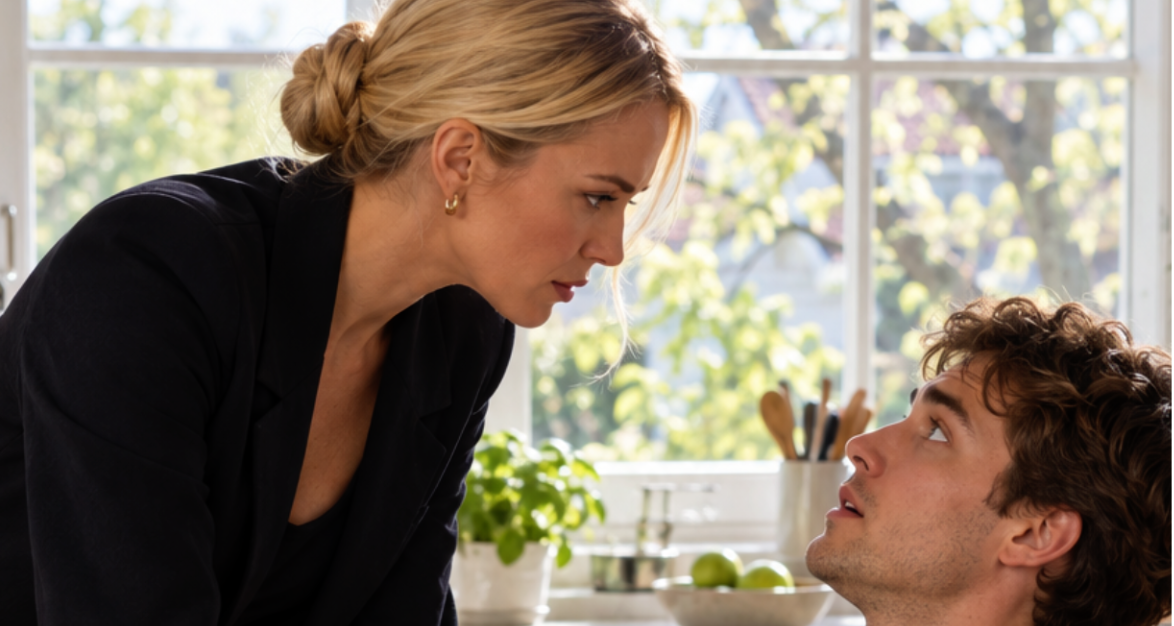
“Mom, you must understand that every penny counts for us right now, and with all your injections, you’re becoming a real burden on our family.”
The words echoed too loudly in the quiet of the tiny kitchen, like someone had slammed a metal ruler on the table. The teaspoon the woman had been stirring in her cup slipped from her weakened fingers and clattered onto the porcelain saucer.
Nina Pavlovna slowly raised her eyes to her son. Igor sat across from her, lounging comfortably against the back of his wooden chair and twirling the keys of his brand-new SUV in his hands. He wore an expensive jacket made of thick fabric, and a flashy watch gleamed on his wrist—a gift from his wife for his birthday. He looked like a successful, confident man who knew the real value of money. And now he was judging his own mother.
A white prescription slip lay between them on the table. A doctor from the regional clinic had prescribed Nina Pavlovna a course of modern chondroprotectors for her knee joints. The medication was imported, high quality, and completely unaffordable on her modest pension. Her joints had tortured her for years, the pain a constant companion that kept her from not just grocery shopping, but even moving around her apartment. The doctor had made it clear: if she didn’t get the treatment now, the consequences for her mobility would be dire.
Nina Pavlovna had no savings left of her own. All of her tiny pension went toward paying utilities, simple groceries, and basic blood pressure pills. That’s why, for the first time in years, she decided to ask her only son for help. The amount wasn’t huge for him—thirty-five thousand rubles.
My son told me I was a burden when I asked for help with my medication
“Igorek,” Nina Pavlovna’s voice trembled, but she forced herself to sit up straight. “I’m not asking for anything frivolous. You can see for yourself, I can’t go down the stairs anymore. The pain is so bad I can’t sleep at night. I need this treatment just to stay on my feet.”
Her son sighed heavily, making it clear just how tired he was of this conversation. He pinched the bridge of his nose, put his keys away, and leaned forward, resting his elbows on the table.
“Mom, I get it. Joints, age, health problems. But you also need to understand Oksana and me. We just finished the renovation in the kids’ room, ordered new furniture. We’ve got a mortgage and a car loan. Oksana needs to update her wardrobe for the season—work has a strict dress code, she can’t keep wearing the same things. And now you’re asking for injections that cost thirty-five thousand. That’s almost half of Oksana’s salary. You’re becoming too much of a financial burden.”
The word “burden” hung in the air again, stinging like a slap. Nina Pavlovna felt a lump of bitterness and suffocating sadness rise in her throat. She looked down at her hands, wrinkled and veined. With these hands, she once took on extra jobs, managed accounts for three small companies at night, all to pay for Igor’s private tutors and a prestigious university.
Her eyes wandered around the cramped kitchen of her small apartment on the city outskirts. She had moved here from a spacious, bright three-room apartment in the center. That very apartment she sold to give her son almost all the money for his mortgage down payment. Nina Pavlovna remembered every detail of that day. She had insisted that the money transfer be registered by a notary as a gift contract, with the money going directly to Igor. As an experienced accountant, she knew the laws and wanted to protect her son: if something unexpected happened or he got divorced, Oksana wouldn’t be able to claim the money as shared property. Nina Pavlovna gave him everything, keeping only this tiny concrete box for herself, just to make it easier for her boy to build his own family.
And now this boy was sitting in front of her, talking about his wife’s strict dress code, while denying his own mother the chance to simply live without pain.
“Alright, Igor,” Nina Pavlovna said softly, yet with surprising firmness. She carefully picked up the prescription from the table, folded it, and slipped it into the pocket of her house cardigan. “I hear you. If I’m a burden, then I’m a burden. Sorry for bothering you.”
Igor clearly hadn’t expected her to react so calmly. He was used to his mother always considering his situation, agreeing, compromising. But now there was a cold steel ringing in her voice that made him shiver a little. He quickly got up from his chair and straightened his jacket.
“Mom, please don’t be upset, okay? Don’t make a mountain out of a molehill. It’s just a tough time right now. Let’s check again next month—maybe we’ll find something in the budget, and we can buy you a cheaper alternative. Local medicine. It helps too; it just isn’t advertised as much.”
“No need to wait until next month,” Nina Pavlovna said without even looking at him, still sitting at the table. “Go on, Igor. Say hello to Oksana for me.”
Her son lingered in the hallway, let out a loud sigh as if hoping invisible witnesses might notice his mother’s unreasonable stubbornness, and then slammed the front door behind him.
Nina Pavlovna was left alone. She didn’t cry. There were no tears—just a ringing emptiness inside. Slowly, she stood up, walked to the window, and pressed her forehead to the cold glass. Outside, the wind chased dry leaves through the yard, and the sky was covered with heavy gray clouds, reflecting exactly how she felt. In that moment, she had a crystal clear realization: she would never ask her son for anything again. The part of her that sacrificed for him had completely burned out, leaving only the ashes of hurt and a cold determination to survive on her own.
The next day, the pain in her knees became unbearable. Nina Pavlovna struggled to get dressed, grabbed her old cane (once her late grandfather’s), and slowly, counting every step, made her way down to the first floor. What used to be a five-minute walk to the pharmacy around the corner now took her a dragging, exhausting thirty minutes.
The pharmacy smelled of mint and, oddly enough, valerian. A friendly young woman in a spotless white coat stood behind the counter.
“Good afternoon,” Nina Pavlovna said, handing over her prescription with a trembling hand. “Could you please check if you have this medication in stock? And what is the exact price?”
The pharmacist glanced over the piece of paper and tapped a few keys on the computer.
“Yes, we have the medication. A full course of ten vials will cost you thirty-four thousand eight hundred rubles. Will you be buying it?”
Nina Pavlovna gripped the handle of her old bag tightly. She only had her last fifteen hundred rubles left in her wallet until her next pension.
“No, dear, not today. Thank you,” she replied and slowly shuffled toward the exit.
Once outside, she sat down on a bench near the building entrance to catch her breath. The autumn sun was timidly peeking through the clouds, warming her chilled shoulders. The door to the building creaked open nearby, and Galina Sergeevna—her neighbor from the second floor, a sharp-tongued and sprightly woman she sometimes had tea with—stepped outside.
“Ninochka, why do you look so pale?” Galina Sergeevna sat down beside her, studying her neighbor’s face closely. “Are your joints bothering you again? I see how you struggle with that cane.”
Nina Pavlovna couldn’t hold back any longer. The tension inside her needed to come out. She told her neighbor everything: about her diagnosis, the cost of the medication, and her conversation with her son the day before. She spoke quietly, not meeting Galina’s gaze, almost ashamed that she had raised such a person.
Galina Sergeevna listened silently, just pressing her lips together. When Nina finished, Galina gave her knee a determined slap.
“You know what, Nina? I’m going to tell you something you won’t like, but it’s true. This is your own fault. You’ve spent your whole life laying down like a doormat for him. Gave him your apartment, pushed your last pennies his way, denied yourself everything. And you raised a taker who sees his mother as just a resource. Now the resource has run dry and asked for something in return, he just wrote you off as a burden.”
“But he’s my son, Galya… What else could I do?” Nina Pavlovna sighed.
“That’s exactly the point! Enough with being the convenient mother. It’s time to think about yourself. With your smarts and thirty years as a chief accountant, you can find a way to earn that thirty thousand. Remember how you filled out my tax return in five minutes last year when I sold my dacha? Your mind is sharp, your head is clear. Stop moping and get moving. You have the Internet and a laptop—go home and look for work!”
Her neighbor’s words were like a cold shower, washing away the remains of her self-pity. Nina Pavlovna stood up from the bench, feeling a newfound energy for the first time in two days. The pain in her legs was still there, but now she knew what she was willing to bear it for.
Back in her apartment, she took her laptop out of the closet. It had been sitting unused for months. Nina Pavlovna wiped the dust from the cover, plugged in the charger, and pressed the power button. The screen lit up with a welcoming blue glow.
She opened a popular job search website. Her experience was immense: she knew every tax system inside and out, was skilled in modern accounting software, and kept up with the ever-changing laws. The only challenge was her age—employers rarely considered candidates over sixty. But Nina Pavlovna was determined not to give up. She put together a detailed resume highlighting all her skills and began steadily applying to jobs labeled “remote work” and “part-time.”
Several days went by in anxious waiting and a string of rejections. Most calls came from scammers pitching sketchy investment opportunities, or telemarketers from call centers. But on the fourth day, her phone rang with an unfamiliar number. On the line was a young, energetic man named Roman, the owner of a small chain of bakeries in her city.
“Hello, Nina Pavlovna. I’ve looked over your resume, and I’m impressed. I’m looking for a part-time or remote accountant to manage the books for my sole proprietorship. We do retail, use patents, and have a small staff. Our last accountant just went on maternity leave and left our records a bit disorganized. Do you think you can handle it?”
“Absolutely, Roman,” Nina Pavlovna replied confidently. “I’ve handled this kind of workload my whole career. I can come by your office to review the documents and discuss the details.”
They agreed to meet. Nina Pavlovna pulled out her best suit—the one she hadn’t worn since retiring. She carefully styled her hair and applied a touch of makeup. When she looked in the mirror, she didn’t see a sick or grief-stricken old woman, but a confident, highly-qualified professional.
The meeting went perfectly. Roman turned out to be a reasonable manager who valued expertise over age. They quickly found common ground. Nina Pavlovna immediately pointed out a few flaws in the supplier contracts and suggested a legal way to optimize patent taxes. Impressed by her professionalism, Roman offered her a salary of forty-five thousand rubles for remote bookkeeping with weekly office visits.
She agreed. Life took on a new rhythm—days filled with spreadsheets, reconciliations, digital signatures, and reports. Nina Pavlovna became so absorbed in work that she sometimes forgot about the pain in her knees. She felt needed, valued, and most importantly, truly independent. She received a small advance, enough to buy quality pain relief and good vitamins. The purchase of the main medication course was planned for her first full paycheck.
During this time, Igor called only twice. Their conversations were brief and dry. He routinely asked about her health, and she routinely answered that everything was fine. She didn’t tell her son about her new job or her plans—she didn’t see the need.
The thunder struck at the end of the month, right on the day when Nina Pavlovna finished preparing the quarterly report for Roman. There was a knock at the door. She set aside her glasses, walked calmly to the door, and peeked through the peephole. Standing out on the landing were Igor and Oksana. Her daughter-in-law was holding a big colorful bag and a box with an expensive cake.
Nina Pavlovna opened the door, letting the guests in. Oksana took off her shoes, flashing a bright but obviously fake smile.
“Nina Pavlovna, hello! How have you been? We came to see you, brought some cake to go with tea,” Oksana chirped as she made her way to the kitchen.
Igor looked a bit tense. He avoided meeting his mother’s eyes, pretending to examine the new wallpaper in the hallway—even though the wallpaper hadn’t been changed in ten years.
“Come in, since you’re here,” Nina Pavlovna said calmly, not responding to Oksana’s forced cheerfulness. She turned on the kettle and got out some cups.
The guests sat down at the table. Oksana started fussing with unpacking the cake. The atmosphere was charged with fakery, and Nina Pavlovna, knowing this family all too well, understood perfectly: they didn’t come for no reason. There’s never cake here without a purpose.
“How are your legs, Mom?” Igor finally asked, taking a hot cup of tea from his mother’s hands.
“They hurt, Igor. But I’m managing.”
“That’s good, that’s what matters,” Oksana quickly nodded, sliding a piece of cake toward her mother-in-law on a plate. “Nina Pavlovna, actually, we’re here because we really need your help. As a mother, as our closest person.”
Nina Pavlovna smiled to herself. A month ago, she was a burden—now, all of a sudden, she had become their closest person.
“I’m listening,” she said, taking a sip of tea.
Oksana glanced at her husband for support, then continued in an even more sugary tone:
“You see, my younger sister is moving here from the provinces. Yulia. She’s just graduated from university, will be looking for work here, trying to settle in. Right now, she has nowhere to live, renting is expensive, and we can’t possibly let a young girl be alone in an unfamiliar city. And with the renovations going on at our place with Igor, there’s absolutely no room for her. You know how busy we are.”
“So where are you going with this, Oksana?” Nina Pavlovna fixed her daughter-in-law with a long, penetrating look.
Igor cleared his throat and took charge:
“Mom, here’s what we were thinking. You have the dacha—the house is insulated, the stove works fine. It would do you good to be out in the fresh air, the environment would help your joints. And Yulia can stay here, in the apartment, just for a couple of months, no longer. Just until she finds a job and gets on her feet. She’ll pay the utilities herself, so you don’t have to worry about that. We can help you pack your things tonight, and Yulia will move in tomorrow.”
There was complete silence in the kitchen. The only sounds were a bus rumbling far off outside the window and the steady ticking of the wall clock.
Nina Pavlovna looked at her son, unable to believe what she was hearing. The sheer level of audacity and entitlement was beyond anything she could imagine. They hadn’t just refused to help her buy medicine. Now, they wanted to kick their sick mother—with bad legs—out to a cold, inconvenient country house in autumn, just to make things easier for her son’s wife’s relative. And they wrapped it all up as if it was for her own health, for some fresh air.
She carefully set her teacup down on the saucer. After a long, heavy silence, Igor started shifting nervously in his chair, while Oksana’s smile slowly faded from her face.
“Tell me, Igor,” Nina Pavlovna’s voice was calm and steady—she didn’t raise it, but there was an ice-cold edge that seemed to chill the air. “How is it that this ‘financial burden’ has to sponsor random people to live in her home, while she is sent away to freeze at the dacha?”
Her son blushed deeply, a flush spreading up his neck.
“Mom, what does that have to do with anything? Why are you dredging up the past? I said that on impulse back then, I lost my temper—everyone has problems sometimes. We’re family, aren’t we? We should help each other.”
“Family?” Nina Pavlovna raised her eyebrows slightly. “A family shares even the last they have. A son pays for his mother’s treatment, because his mother once gave everything for him, so he wouldn’t have to bounce around rented rooms. What’s happening now isn’t family. This is parasitism.”
Oksana flared up, her eyes narrowing in anger. Her sugary demeanor evaporated instantly, replaced by her usual aggression.
“Nina Pavlovna, how can you say that? What parasitism? We came to you like civilized people! Igor is your own son—don’t you care enough for his family to let us use the apartment for just a couple of months? You’re sitting here alone, you don’t even need that much space!”
“This is my apartment, Oksana,” Nina Pavlovna enunciated, locking eyes with her daughter-in-law. “It’s the only property I have left, after I made sure your husband had a place to live. I’m not leaving it—not for a couple of months, not even for a couple of days. Your sister is your responsibility. Get her a hotel room or let her stay in your own kitchen—it’s not my concern.”
Igor slammed his palm down on the table, and the tea in the cups threatened to spill over the edges.
“Mother, you’re going too far! Is it really that hard for you to help? Yulia won’t bother you, she’s quiet! Why have you become so selfish in your old age?”
Nina Pavlovna slowly stood up. Using the edge of the table for support, she straightened up, squared her shoulders, and looked down at her son.
“I’m not selfish, Igor. I’m free. A month ago, you made it very clear where I stand in your lives. I’m a burden. And a burden doesn’t offer up their living space. A burden doesn’t bake pies on weekends. A burden doesn’t babysit your future kids. I accepted your rules. Now, take your cake and leave. I have work to do, I’ve got reports to submit soon.”
“What work?” Igor was stunned, his confidence gone. “You’re retired.”
— Remote work as an accountant. I paid for my treatment myself. Tomorrow, I’m going to the pharmacy to buy a full course of medication—with my own money. The very money you kept from me, making excuses about renovations and dress codes. I’ll manage just fine without you. But as it turns out, you can’t even sort out your relatives’ living situation without me.
Oksana suddenly jumped up, grabbing her bag from the windowsill.
— Let’s go, Igor! We’re not welcome here. I told you, there’s no point talking to her. She only ever thinks about herself!
Her son slowly stood, bewildered as he looked at his mother. It was as if he was seeing her for the first time—with her straight back and unwavering, determined gaze. The familiar image was gone. The accommodating, endlessly giving mom had vanished. Before him now stood a stranger, a strong person he could no longer control.
— Mom… you know… I’m sorry if I did something wrong, he mumbled, stepping back into the hallway.
— Goodbye, Igor. Make sure you shut the door tight, there’s a draft, Nina Pavlovna replied, turning to the sink and turning on the water.
The lock clicked. The heavy front door closed, shutting her off from past hurts and disappointments.
The next day, Nina Pavlovna received her first paycheck on her card. Seeing those numbers on her smartphone screen filled her with joy. She got dressed, took her cane and went outside. The weather was wonderful—clear autumn air, fresh and with a hint of frost.
She walked into that same pharmacy. The familiar pharmacist smiled at her.
— Good afternoon! The usual, something for blood pressure?
— No, dear, Nina Pavlovna took a carefully folded prescription from her pocket and laid it on the glass counter. — I need this medicine. The full course, all ten ampoules.
— Perfect. That’s thirty-four thousand eight hundred rubles. Will you pay by card?
— Yes, by card.
The machine beeped, printing out a long white receipt. Nina Pavlovna took the large box of ampoules, carefully placed it in her bag, and stepped outside. As she walked home leaning on her cane, for the first time in a long while, she felt that soon she wouldn’t need that wooden stick anymore. Ahead was a long course of treatment, plenty of work, and a peaceful life—a life where she no longer had to wait for handouts, beg for affection, or fear being a burden to anyone. She had learned to value herself, and that proved to be the most important medicine in the world.
She unlocked the door to her cozy apartment, set her bag on the ottoman, and smiled at her reflection in the mirror—a strong, beautiful woman with everything still ahead of her.