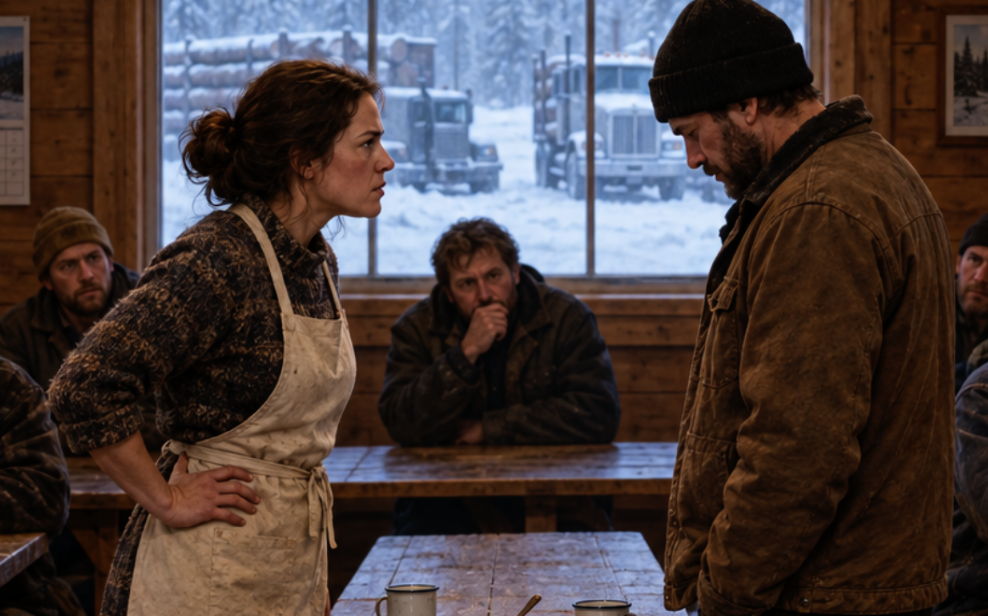
“We have nothing, we can’t pay,” mumbled the drivers stranded by the blizzard, avoiding her gaze. The owner of the struggling café silently fed them, and two days later, she was left completely speechless with astonishment.
The bold signature on the notice about property seizure blurred as a drop of water from the ceiling splattered it. Taisia crumpled up the thick official letter and tossed it into a plastic bucket beneath the metal sink. Outside, a blast of freezing wind slammed so hard against the wall of the roadside café ‘Taiga Route’ that the old wooden window frames rattled, and a damp draft swept across the floor.
The wall clock with its faded face showed it was half past eight in the evening. All day, the cash register held only a meager handful of crumpled bills and some coins. That small amount would barely pay for gasoline for the old Niva Taisia drove to buy supplies in the district center. Paying off the massive loan for the building was out of the question.
Seven years ago, when her husband Matvei suddenly passed away behind the wheel of his truck—his health gave out so fast—she promised herself she would do whatever it took to keep this place. The old Northern route used to be busy around the clock back then. Truck doors would slam constantly, the air smelled of worn brake pads, and at the tables, men in greasy jackets ate hearty soups and handmade cutlets, swapping news from distant roads. Everyone respected Matvei here.
But four years ago, the road builders finished a new federal highway fifty kilometers to the east. The traffic stopped overnight. At first, familiar faces still dropped by, but soon the routes changed for good. Now only lost tourists ever stopped in the lot. A month ago, Taisia nailed a piece of plywood with a ‘For Sale’ sign to a post by the roadside, but who needs a wooden house in a fading forest buried in snow up to the roof?
“Taisia Pavlovna, can I just finish washing the trays and catch the bus home?” Dasha asked shyly from the dishwashing area. The twenty-year-old from the nearby village had been working here as a waitress. Taisia hadn’t been able to pay her full wages in a long time, but Dasha stubbornly showed up every morning, tying on her faded green apron.
“Where would you even go, dear?” Taisia looked out the window, blacked out by snow. “The regular buses were canceled this afternoon. The snowstorm’s so fierce you can’t even see the tree outside. Stay here, I’ll make up a bed for you on the couch in the back room.”
Before Dasha could nod, the heavy front door creaked open with a groan. The wind hurled a fistful of prickly snow into the room. A large man stood on the threshold. His work boots trailed dirty puddles across the linoleum, and water dripped from the collar of his thick jacket. His face, red from the biting cold, was barely visible beneath a pulled-down ushanka hat.
Read more
Credit consultation
Order a truck
Search words
“Lady, mind if I wait out the storm here?” he rumbled from the doorway, brushing off the snow. “The pass is shut tight with snowdrifts. The big rigs are stuck. Road workers just reported over the radio—no equipment will get through until morning.”
Taisia pulled her sweater tighter around her shoulders.
“Come in, take any seat. I’ll start the kettle so you can warm up.”
The man had just taken a step toward the nearest table when the door opened again. One after another, tired and chilled people started coming into the café. There were shift workers in uniforms, truck drivers, and road workers. They breathed heavily, pulled off their wet gloves, rubbed their reddened faces, and sank into the chairs. The air quickly thickened with the smell of damp fabric, lingering diesel, and soaked leather. Within half an hour, there were sixteen people packed into the small room.
One of them, a middle-aged man with deep wrinkles at the bridge of his nose, approached the bar. He nervously twirled his hat in his hands, avoiding Taisiya’s eyes.
“We’re broke, we have nothing to pay with,” the drivers caught in the snowstorm said, their eyes lowered. The man sighed heavily. “Our companies are late with the daily allowances, the gas station card readers aren’t working because of the storm, there’s no network at all. None of us have any cash left. We just need a place to sit on the chairs till morning, we won’t order anything. We’ll head out in the morning.”
Taisiya looked at their drawn faces, at the cold-shaking fingers struggling to unzip their jackets.
“Dasha, get the keys to the freezer,” Taisiya said firmly, tying her apron around her waist. “What do we have left at the bottom?”
The girl disappeared behind the door and came back a minute later, biting her lip apologetically.
“Taisiya Pavlovna, only your personal food is left in there. What you set aside for the winter. A piece of salted pork fat, homemade stew, a sack of potatoes, and some pickled mushrooms. From the shop’s supplies, just two loaves of yesterday’s bread.”
“Bring it all to the kitchen,” the woman said sharply, snapping on the exhaust fan.
“But you were saving that for the hardest times! We won’t have anything to eat ourselves for the rest of the month!”
“It’s not going to get worse, Dasha. Look at those men, they’re about to collapse. Fire up every burner on the stove.”
The kitchen burst into action. Taisiya peeled potatoes, carefully slicing away the thin skin. On a huge cast iron skillet, the pork fat began to sizzle, filling the air with a rich, meaty aroma. Soon golden sautéed vegetables joined in. In a hefty aluminum pot, the last of the homemade stew was bubbling away in a thick borscht.
When Dasha brought out the first deep bowls, steaming with heat, the conversations at the tables stopped. All that could be heard was the hurried clinking of spoons against china. Taisiya moved between the tables, pouring scalding black tea with thyme from a big thermos and slicing thick pieces of bread.
Closer to two in the morning, the lights flickered a few times, the old refrigerator’s compressor groaned—and then everything shut off. The café was plunged into darkness. A few minutes later, there was a hollow metallic noise behind the cast iron radiators, and the heating boiler let out a loud sigh and went quiet. The temperature in the room started to drop frighteningly fast.
“No need to panic, folks,” came the deep voice of the first truck driver in the darkness. He clicked on a powerful handheld flashlight. “I’m Ilya, a seasoned mechanic. Where’s your boiler room, ma’am? Show me the way before we freeze to these chairs.”
Ilya spent almost an hour working in the shed, tools clanking, cursing under his breath, and asking Dasha to hold the flashlight steadier on the fuel filter. Turned out, air had gotten into the old heating system. Finally, something clicked inside the metal housing, the boiler rumbled back to life, and hot water began to flow again through the cold pipes. Ilya came into the kitchen, wiping his oil-stained hands on a rag. Taisiya silently handed him a mug of hot tea.
“This old thing’s been acting up for a while, but there’s no way to call a repairman from the district,” she admitted while wiping down the countertop.
Sitting down on a stool and blowing the steam off his mug, Ilya caught sight of a faded photo on the wall, pinned just beside the calendar. It showed a strong-looking man standing in front of a blue truck.
“It’s tough for you out here. I saw that crooked sign at the turn off the highway—are you selling the place?”
Taisiya lowered her eyes to her worn, calloused hands.
“I am. But who would buy it? The bank’s going to take the building for debt at the end of this month. There’s no good road, no people. Back when my husband was alive, this place was always busy. He put his whole heart into this house. Used to be a driver himself—he knew how hard it could get for someone on the road.”
“What was your husband’s name?” a young guy in a thick gray sweater asked quietly from the corner.
“Matvey. Matvey Andreyevich.”
Ilya stopped chewing. Slowly, he set his half-finished mug back on the table, his eyes fixed on the photograph.
“Matvey? The one with the blue truck with a white stripe on the cab? His radio handle was Cedar, wasn’t it?”
Taisiya looked at him in surprise:
“Yes. How do you know?”
Ilya swallowed hard, looking around at the suddenly quiet men in the room.
“Guys, did you hear that? This is Cedar Matvey’s café.”
All conversations stopped. An older driver with thick grey mustache, sitting by the frosty window, slowly stood up from his chair.
“Is it true, miss? You’re Matvey’s wife? I went with him side-by-side on the winter road back in 2007! My leaf spring broke, it was more than forty below, even breathing was tough. The radio was silent, deep taiga all around. And Matvey showed up out of the snow. He lay under my truck with me for four hours in the snow, gave me his own spare parts so I could make it to base. Later I tried to pay him, but he just waved it off, said we’d settle up on the road.”
“He pulled me out of a ditch near Irkutsk,” another man with a scar on his cheek chimed in. “My brakes failed, went off the road. Matvey was the first to stop. Broke his own steel cable, but he still got me back onto solid ground.”
“He always called out on the radio when there was thin ice or a dangerous curve up ahead,” the young man’s voice trembled. “My dad worked with him for years. He said there wasn’t a more honest man in all the North.”
Taisiya listened to them, palms pressed to her face, her shoulders shaking. She always knew Matvey was a kind man, but she had never realized how many people, scattered across the country, still remembered his name so fondly.
The rest of the long night passed in a blur. The drivers sipped tea, reminisced about tricky stretches of the route, and shared their stories. For the first time in months, Taisiya smiled genuinely, feeling as if life had returned to the house.
By morning, the blizzard had completely calmed down. A pale sun peeked out, casting its light on the towering snowdrifts. The snowplows had cleared a passage through the mountain pass, and drivers started getting ready to hit the road, warming up their engines after the frozen night.
Ilya was the last to approach the wooden counter. He laid down a stack of crumpled bills on the worn oilcloth, collecting every bit he could find from his pockets.
“This is from all of us, Taisiya Pavlovna. For dinner, for the warm stay. And in memory of Matvey.”
“Take it back, right now,” Taisiya tried to push the money back towards him. “The food was from the heart. You warmed my soul last night.”
“Please take it,” Ilya insisted, moving the money even closer. “Don’t offend us. We have to go.”
Once the last heavy truck had disappeared around the snowy bend, Taisiya carefully counted the cash. It was a significant amount for their region, but nowhere near enough to cover the looming bank debt. She sighed, locked the empty cash register, and started taking down the dusty curtains from the windows. It was time to pack up. The bailiffs wouldn’t wait.
The next two days dragged on painfully. Taisiya wrapped up dishes in cardboard boxes taped shut, while Dasha wiped down the empty metal shelves in the kitchen, sniffling as she worked. The air in the cafe felt hollow and lifeless.
On Wednesday morning, Taisiya sat bundled up on the wooden porch, gazing at the silent, snow-covered forest and waiting for the car from the city. Suddenly, the quiet was shattered by a deep, thunderous rumble. It grew louder every second, making the boards under her feet tremble.
From behind a sharp bend in the old road, the massive cab of a heavy truck appeared. Then another. And another. A huge convoy of trucks slowly rolled into the freshly cleared parking lot in front of the cafe. Their headlights beamed, and blasts of their horns scared the birds in the forest. There were so many vehicles, they filled the entire roadside, lining up in a long, solid row.
Taisiya got to her feet. Out of the lead, dark SUV stepped a strong, well-dressed man in a good winter coat, followed by the familiar figure of Ilya. They headed straight for the steps of the porch.
“Taisiya Pavlovna?” The man politely offered his hand. “I’m Boris Nikolaevich, director of the trucking company. Ilya told me your whole story in detail. And the guys spread the word fast over the radio.”
Taisiya nodded in confusion, not understanding what was happening.
“We talked it over with the drivers,” Boris Nikolaevich continued, pulling a thick envelope from his coat pocket. “My guys travel this route every day. On the new road, the food comes in plastic containers, the portions are tiny, and the prices are steep. We need a good, real stop—somewhere people can get a hot meal and rest properly.”
He placed the envelope in Taisiya’s hands.
“We’ve collected this from several trucking companies and independent drivers. This should be enough to solve your bank problem and do a full overhaul of the boiler room. Think of it as an official advance. We’re signing a long-term contract to provide meals for all our crews. We’ll take the detour on the old track—it’s not far, and our people will be well fed.”
Taisia leaned her back against the doorframe.
“I don’t understand. Why do you need to do this?”
Ilya stepped forward.
“Taisia Pavlovna, Matvey Andreevich helped many of us out on that harsh road. When he left, we didn’t even get a chance to say goodbye. And now we’ve learned that his wife gave away their last winter supplies so that strangers wouldn’t freeze in the storm. Here in the north, we believe in paying back our debts in full.”
From the group of drivers, a young guy came forward. In his hands, he carefully held a heavy wooden sign. Beautiful, bold letters were burned into the wood: ‘At Matvey and Taisia’s. We don’t abandon our own in trouble.’
Dasha, hearing the commotion, rushed out of the kitchen and covered her mouth in surprise as she looked at the row of parked big trucks.
Taisia caught her breath, glanced at the overcast sky, and turned confidently to her assistant.
“Dasha, bring up a bucket of potatoes from the cellar. We’re going to feed these people.”
Six months later, the café had been completely transformed. The grounds were much larger, now covered with an even layer of gravel to make it easier for trucks to park. The staff had tripled, and a powerful radio now stood on the bar counter. It was almost never silent. Taisia had learned to master the airwaves: she regularly broadcasted weather updates and took orders for hot lunches from drivers still on their way to the pass, knowing for sure they would always be welcome here.