The doors of the suburban PAZ bus slammed shut with a clang right in Oksana’s face. She even managed to slap her hand against the dirty window, but the driver, without so much as a glance in the mirror, turned the wheel. The bus spewed a cloud of blue diesel exhaust onto her legs and groaned away toward the railroad crossing.
Oksana was left standing on cracked asphalt. Her watch read twenty-two fifteen. The next bus wouldn’t come until morning.
She rubbed her frozen cheeks hard. Her shift at the bakery had been brutal: the dough mixer broke, so half the batches had to be kneaded by hand. Her back felt like it was about to give out, and now she’d missed her bus. Five kilometers home, through the industrial area and a residential neighborhood. She couldn’t bring herself to spend money on a taxi, not right before the weekend.
She pulled her jacket tighter and had just stepped off the curb when she heard the sharp crack of tearing plastic behind her.
Oksana turned around. Under the dim shelter of the stop, large potatoes were rolling into a puddle. Standing nearby was a short, slender woman in a bulky grey down jacket and a dark headscarf. She looked confusedly at the torn handles of her checkered bag.
“Oh, for heaven’s sake…” the woman muttered. Her voice was unexpectedly firm, with none of the typical old-lady waver.
Oksana closed her eyes. At home, Denis was waiting for her—he hated it when she was late. An unwashed uniform and an unpacked bag for tomorrow’s trip also waited. But she couldn’t just turn and walk away into the darkness.
“Here, let me help,” Oksana squatted down, gathering the muddy potatoes into the bag’s surviving corner. “How did you even carry this? It must weigh twenty kilos.”
“Your own burdens aren’t heavy, dear,” the woman gripped the bag from the bottom. “But these days, the materials are so cheap. The handle just gave out.”
“Do you have far to go?”
“Over the railroad tracks, to Stroitelnaya Street.”
Oksana silently propped up the bag from below. Her fingers immediately cramped from the weight. They walked along the concrete factory fence. There were no working streetlights, and their feet squelched through watery mud. They moved silently, the only sound was the woman’s heavy breathing.
“My name’s Antonina,” the woman finally said as they turned down a narrow alley between fences. “Why are you sighing the whole way? Coming back from work?”
“From work.”
“And your husband’s going to be mad at home because you’re late?”
Oksana smiled wryly:
“He’ll be mad. We’re supposed to go visit his mother tomorrow. I haven’t even packed, let alone bought gifts. Margarita Vasilievna can’t stand any fuss—everything has to be by the clock. And once again, I’ve messed it all up.”
“So you’re off to the mother-in-law, huh?” Antonina stopped at some old gates made of weathered corrugated iron. “Well, this is my yard. You can set it right here on the ground. I’ll handle it from here.”
Oksana gratefully set down the heavy bag. Her shoulders were burning.
“Thank you. Not many people are willing to get involved in someone else’s trouble these days,” Antonina said, looking at her. In the darkness, her face was hard to make out—only her eyes gleamed.
“It was nothing,” Oksana flexed her stiff fingers and turned away.
“Oksana.”
She froze. Her stomach clenched with unease. She hadn’t told anyone her name.
The woman stood by the gate, making no move to take the bag.
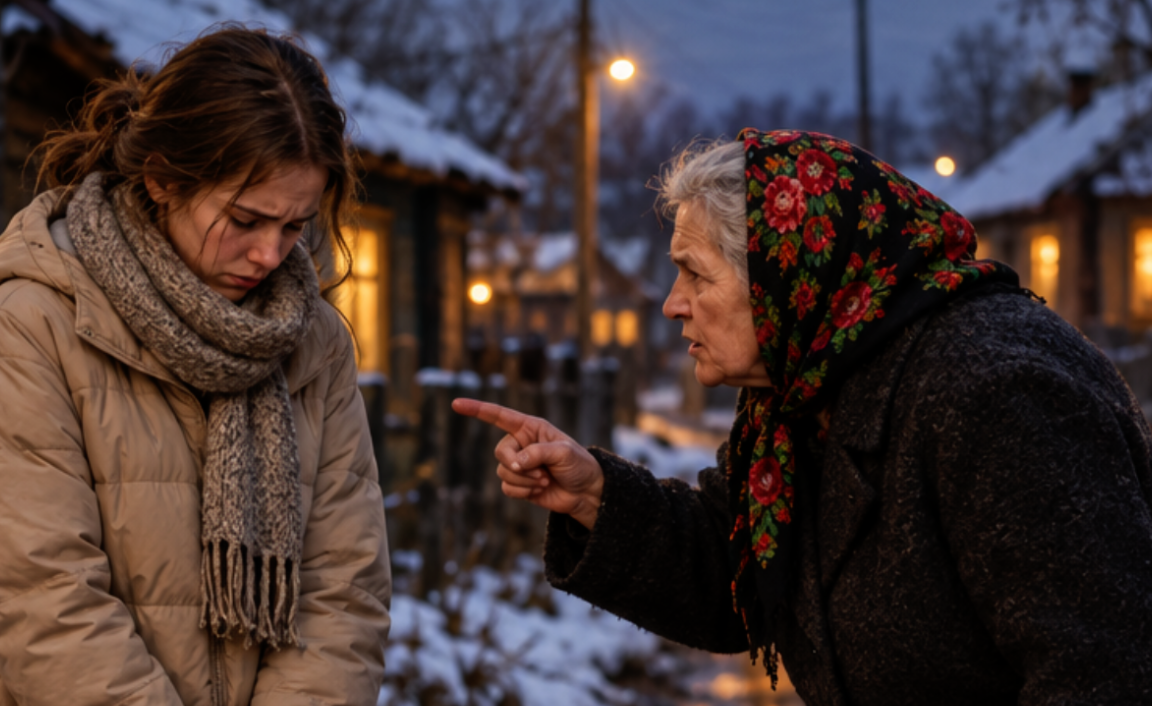
“Don’t go to your mother-in-law’s village tomorrow,” she said plainly. Her tone was flat, not a hint of emotion. “No matter what your husband says, no matter how much he yells, stay home.”
“How did you…” Oksana began, but Antonina had already noisily slid back the bolt and disappeared into the yard, dragging her duffel behind her.
Oksana made it to her five-story building somehow, not even sure how she got there. That strange, ridiculous phrase kept swirling in her head. When she turned the key in the lock, the smell of food wafted from the kitchen.
Denis was sitting at the table in a stretched-out t-shirt, scrolling through his phone feed.
“It’s almost eleven,” he said without looking up from the screen. “I called you three times.”
“My battery died in the cold. I missed the bus and walked home from the factory.”
“Fantastic news. And where are the bags?”
Oksana pulled off her damp boots and leaned against the doorway.
“What bags?”
Denis finally put his phone aside.
“We’re going to my mom’s tomorrow for the whole weekend. You promised to buy decent cheese at the market, meat for roasting, and a cake. I’ve been working on the car in the garage all morning, asked you to stop by after your shift.”
“Denis, our dough mixer broke down. I had to throw forty kilos of dough by hand. What market? I can’t even feel my legs. We’ll buy everything tomorrow on the way at the supermarket.”
“Mom can’t stand store-bought pastries!” he snapped, pushing his mug away. “We haven’t been there in over a month. She’s getting ready for us, waiting. And you’re leaving everything until the last minute again. Your work always comes first.”
Oksana looked at her husband—at his annoyed face, at the crumbs on the table he hadn’t even bothered to brush off. Suddenly, the old woman’s words sprang to her mind as clearly as if she were standing right behind her.
“I’m not going anywhere,” Oksana said quietly.
Denis frowned, clearly not expecting this turn of events.
“What do you mean? Are you doing this just to spite me?”
“No. I’m just completely exhausted. If I go to Margarita Vasilievna’s tomorrow and have to serve at the table while she sighs about what a lousy wife I am, I’ll lose it. Go by yourself. Tell her I’m sick.”
Denis stood up from the table, red spots appearing on his face.
“Fine. Just great. So I’m going alone. And don’t expect me to cover for you in front of her.”
He stormed off to the bedroom, slamming the door. Only the monotonous hum of the fridge filled the room.
The next morning, they hardly spoke. Denis made a show of packing his gym bag, rattling his keys. He drank his coffee standing up, not even offering her a cup.
“I’ll be back Sunday evening,” he said brusquely as he pulled on his jacket. “Don’t get too bored.”
The door slammed. Oksana went to the window, hugging herself. Denis’s old Toyota pulled out of the yard and disappeared around the corner.
The road to the village took no more than an hour. He should have arrived by ten in the morning. By eleven, Oksana couldn’t take it anymore and dialed his number. “The subscriber is temporarily unavailable.” It was the same at noon.
She started cleaning the apartment just to keep her hands busy. She scrubbed the stove and sorted the clothes in the closet. Oddly enough, her mother-in-law hadn’t called either. If Denis had shown up alone, Margarita Vasilievna would have already bombarded her phone with calls about her wifely duties.
At three in the afternoon, an unknown number popped up on my phone screen.
“Hello, I’m listening.”
“Is this Oksana Vladimirovna?” The voice was dry and metallic. “This is Inspector Makarov from the road service. Your husband has been in an accident at the thirty-second kilometer of the highway.”
The sponge slipped from Oksana’s hand, falling straight into the soapy water.
“What happened to him?”
“He’s alive. He suffered a hard blow to his chest, and there’s a suspected serious shoulder injury. There’s no cell signal in that area, so with all the paperwork, calling the tow truck… An ambulance is already taking him to the district hospital. Please come over with his documents.”
Oksana didn’t even remember how she called for a taxi or made her way down the gray, slushy road. The driver listened to a monotonous radio station the entire trip, while she simply stared at the wipers sweeping muddy water off the windshield.
The hospital reception smelled of chlorine and old linoleum. The duty nurse, not looking up from her monitor, nodded down the corridor:
“Sokolov? Second exam room. He’s waiting for the doctor.”
Oksana pushed the flimsy white door open.
Denis was sitting on the exam table. His right arm was tightly strapped to his torso with an elastic bandage. He had a scrape on his cheekbone, and his t-shirt was torn across the chest. He looked gaunt and lost.
When he saw his wife, he didn’t look away. He just exhaled, and his shoulders slumped.
“So, I made it,” he said.
Oksana walked up to him and gently touched his uninjured shoulder.
“How did it happen?”
“The tires,” Denis rubbed his forehead with his good hand. “It started sleeting—rain and snow together. The asphalt was like soap. On the bend near the sawmill, the car just slid sideways. The brakes failed. We hit a concrete post at the old bus stop.”
He fell silent. Then he looked up at her.
“Oksana… the hardest impact was on the right side. Right where the passenger seat is.”
She stopped breathing.
“The investigator said,” Denis’s voice went very quiet, “he said if anyone had been sitting there… it’s scary to imagine what would have happened. The door was crushed into the cabin almost to the gearshift. It’s a good thing you didn’t come with me.”
Oksana’s knees buckled, and she sank onto the hard chair next to the exam table. Her nose burned. “That’s not your road for tomorrow.” The words of the elderly woman echoed in her mind, as clearly as if Antonina was standing right here in the medicine-scented hospital room.
Two weeks later, when Denis was recovering at home, Oksana made a point to visit that exact bus stop in the industrial zone.
She walked to Stroiteley Street, turned into a familiar alley, and stopped. The metal gates were gone. Instead, there was a sagging wooden fence overgrown with dried burdock. Behind it stood a half-rotted log house with windows nailed shut in a cross. The gate was bound with thick, rusty wire.
Across the street, an elderly man in a padded jacket was shoveling snow.
“Excuse me!” Oksana called to him. “Do you know if there was a woman living here, Antonina? She was a short lady. Do you know where she moved to?”
The man leaned on his shovel handle and pushed his cap back.
“Aunt Tonya? Oh, dear. There was no moving. She passed away about eight years ago. That house has been empty ever since—no heirs have shown up.”
Oksana nodded slowly. The snow crunched beneath her feet. She turned around and headed back to the bus stop. The wind tugged at her hair, but she didn’t feel cold at all. She just walked, realizing that sometimes you need to trust someone else’s voice to protect what matters most.