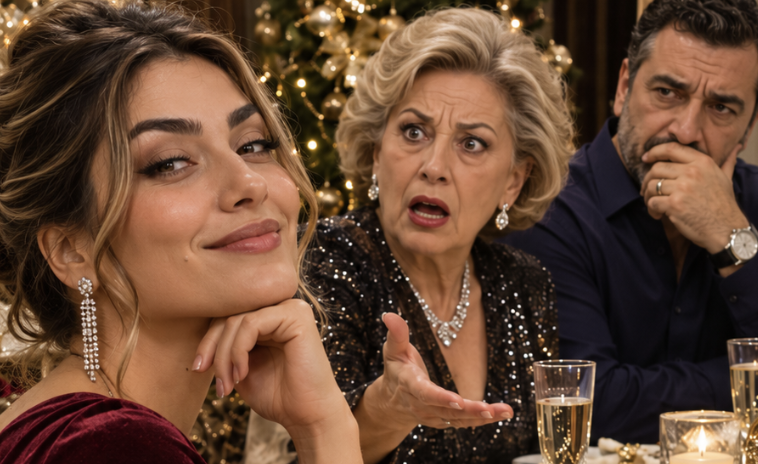
Dasha stood by the window, watching large snowflakes slowly fall onto the gray asphalt of the courtyard. In the kitchen, the refrigerator hummed its familiar tune, while vegetables for Olivier salad finished cooking on the stove. But this year, everything was different. Inside her, tension vibrated like a tightly stretched string, ready to snap at any moment.
On the table lay a shopping list she had made a week earlier. One item had been crossed out with a red marker: “Red caviar (2 jars) — for the Tsarsky Salad.”
“Are you sure?” Viktor asked, wrapping his arms around his wife from behind. He could feel how tense she was. “Mom will never forgive you. You know that salad is a symbol of status for her. If there’s no caviar on the table, she thinks the entire year has been wasted.”
“Then let her refuse to forgive me, Vitya,” Dasha replied quietly but firmly. “I’m tired of buying their love. Or rather, trying to buy something that doesn’t exist. For five years, I’ve been trying. I prepare elaborate dinners, listen to your mother’s and Ira’s nasty remarks. For five years, I’ve sacrificed things for myself just so Galina Nikolayevna won’t call me a penniless nobody who disgraces the family. Enough.”
Viktor turned her toward him and looked into her eyes. There was no fear in them, only exhausted determination. He knew something the others didn’t.
Three days earlier, a registered letter had arrived from St. Petersburg.
Aunt Nina, a distant relative on Dasha’s mother’s side whose existence the family had almost forgotten, had passed away.
Dasha had been the only person who wrote her handwritten letters throughout all those years. Not for personal gain—Aunt Nina had lived modestly and worked in a library—but simply because Dasha felt sorry for the lonely elderly woman.
In her letters, Dasha never complained. She merely wrote about the weather, books she had read, and sent holiday cards.
And now there was a will.
An apartment on Vasilyevsky Island. A historic building with high ceilings and a view of the Neva River.
And a collection of antique books whose value even the notary had hesitated to estimate on the spot.
“They won’t understand,” Viktor sighed. “But I’m with you. You know that.”
“I know. That’s why I’m not afraid.”
The guests began arriving around eight in the evening.
As always, Galina Nikolayevna was the first to sweep into the apartment. She didn’t merely enter—she sailed in, carrying her substantial figure before her like a royal banner.
Behind her hurried her younger son, Seryozha, weighed down with bags containing gifts for himself and his wife. Ira brought up the rear.
Ira was wearing a new sequined dress whose sparkle was almost painfully dazzling.
“Ugh, what awful weather!” Ira announced from the doorway, shaking snow directly onto the clean doormat. “Seryozha was driving so fast I thought we were going to crash. But at least we made it! Dasha, why are you so pale? Working yourself to death again? I had a wonderful night’s sleep. Seryozha and I decided a woman needs relaxation before New Year’s. A spa, a massage… You could use some of that yourself. You look forty.”
Dasha was twenty-nine.
She smiled silently and took her mother-in-law’s coat.
“Dashenka,” Galina Nikolayevna said, critically inspecting the hallway. “Why is the mirror covered in streaks? That’s a bad omen. It means there won’t be any money. Although,” she snorted, “you never have any money anyway. Vitya, sweetheart! Come kiss your mother!”
Also attending dinner was Tamara Nikolayevna, Viktor and Seryozha’s aunt.
She was a loud, tactless woman with the remarkable talent of devouring all the best food within the first fifteen minutes of any gathering.
“Well, little hostess, what are you going to feed us?” Tamara boomed as she settled herself at the head of the table—the seat belonging to Viktor, which she had taken without asking.
The conversation immediately turned to Galina Nikolayevna’s favorite subject: Seryozha’s achievements and the worthlessness of Viktor and Dasha.
“My dear Seryozha received a bonus,” his mother announced loudly while helping herself to meat aspic. “One hundred and thirty thousand rubles! That’s what happens when an employer truly appreciates an employee. Ira has already picked out a fur coat. Mink, a short one for driving. And you, Vitya, are you still driving that old wreck?”
“We manage just fine, Mom,” Viktor replied calmly as he poured champagne.
“Manage just fine…” Ira snorted. “Dasha is wearing the same blouse she wore to my birthday two years ago. That’s not called managing. That’s called being dirt poor. Sorry for being so direct, but we’re family.”
Dasha tightened her grip on her fork.
In the past, she would have cried, run into the kitchen, and started making excuses.
Now she simply looked at Ira as though she were some strange insect.
There was a psychological principle Dasha had read about in one of Aunt Nina’s books:
“When someone tries to hurt you with insults, it means they feel their own self-esteem is threatened. Happy people don’t need to be cruel.”
That thought helped her keep her back straight.
“Where is the Tsarsky Salad?” her mother-in-law’s voice suddenly cut through the conversation.
Galina Nikolayevna froze with her spoon suspended in midair.
Her eyes searched the table, crowded with salads, cold cuts, and hot dishes.
But she couldn’t find the most important thing: the crystal serving bowl containing the salad whose top layer was supposed to be generously covered with red caviar.
“Dasha?” Her mother-in-law’s voice turned sharp. “I specifically asked you. I even called on Tuesday to remind you. It’s a tradition.”
Silence fell over the room.
The only sound was the ticking of the wall clock.
“I didn’t make it, Galina Nikolayevna,” Dasha said calmly.
“Why not?” Her mother-in-law’s face turned red. “Were you too cheap to spend the money? For your husband’s mother? We came here with open hearts. I even brought you kitchen towels as a gift, and you couldn’t spare a jar of caviar?”
“What else can you expect from her, Mom?” Ira sneered. “She wouldn’t give you snow in winter. They’re always pretending to be poor. Seryozha and I pay our mortgage every month, and we still set a richer table than this. Meanwhile, these two live in Grandma’s tiny Soviet-era apartment and count every penny. Disgraceful.”
“Indeed, Vitya,” Aunt Tamara joined in, chewing a salmon sandwich. “It’s disrespectful. Your mother asked for one dish. Just one! I consider this a slap in the face.”
Viktor slowly put down his fork.
He could see Dasha’s hands trembling despite her efforts to remain composed.
He had witnessed this scene for years.
They pecked at his wife like pigeons attacking a crust of bread—systematically and cruelly, making themselves feel important by humiliating her.
“So this is about the caviar?” Viktor asked quietly.
“It’s about respect!” Galina Nikolayevna shrieked. “Just look at your wife! A little gray mouse who can’t even organize a proper holiday dinner. I’ve always said Seryozha was lucky with his wife. Ira is a queen. But you ended up with… absolutely nothing special. A penny-pinching accountant. I bet she hid away the money I gave her for her birthday, and now there’s nothing on the table!”
Dasha’s eyes began to sting.
Not because she felt sorry for herself, but because she suddenly felt a sharp, overwhelming pity for the girl she used to be.
She remembered how, three years earlier, her only pair of winter boots had torn.
It had been twenty degrees below zero.
She had asked Galina Nikolayevna to lend her five thousand rubles until payday.
Her mother-in-law had replied, “You need to learn to live within your means, darling. Wear your autumn boots. It’ll toughen you up.”
The very next day, she bought Ira an expensive handbag for no reason other than “to cheer her up.”
For a week, Dasha walked around with wet feet and developed chronic cystitis.
But she never told her husband, because she didn’t want to cause a conflict between him and his mother.
Tears filled her eyes but did not fall.
“Enough!” Viktor slammed his palm against the table.
The clatter of dishes made everyone jump.
Seryozha choked on his Olivier salad.
“Why are you yelling at Mom?” his brother protested.
“I said enough,” Viktor repeated, rising to his feet.
He somehow seemed taller now, his shoulders broader.
“You come into my home, eat my food, and insult my wife. Over a salad? Over three thousand rubles?”
“It’s a matter of principle!” Galina Nikolayevna began.
“Principle, you say?” Viktor gave a bitter smile, looking at his mother with a new and almost frightening kind of pity.
“Fine. Let’s talk about principles. Dasha didn’t make that salad because we couldn’t afford it. She didn’t make it because she no longer has to bend over backward to earn your approval.”
He walked to the dresser, took out a folder of documents, and tossed it onto the table in front of Ira.
“Read it. You’re the educated one here.”
Ira opened the folder with visible distaste.
Her eyes skimmed the first page.
Then they widened, and her mouth fell open.
“This… what is this? St. Petersburg? Vasilyevsky Island? One hundred and twenty square meters?” Her voice rose into a high-pitched squeak.
“What?” Galina Nikolayevna snatched the papers. “What apartment? Where did this come from?”
“Dasha inherited property from her aunt,” Viktor announced, carefully emphasizing every word. “And not just an apartment. There’s a library and valuable antiques. According to the preliminary estimate, Dasha is now about ten times wealthier than all of you put together.”
A deafening silence filled the room.
Outside, early fireworks could be heard exploding in the distance.
Galina Nikolayevna’s face began to change.
Anger gave way to confusion, then realization, and finally an excessively sweet, ingratiating smile spread across her face.
The transformation was so sudden and unnatural that Dasha felt physically sick.
“Dashenka…” her mother-in-law cooed in a completely different voice. “So that means… Aunt Nina? May she rest in peace. You know, I’ve always said you came from such a distinguished family! Vitya, why didn’t you tell us? We would have honored her memory…”
“Oh, Dasha!” Ira immediately changed her posture, leaning forward eagerly. “Listen, St. Petersburg has always been my dream! Seryozha and I were just planning to go there for the May holidays. Does the apartment need renovating? I could help with the interior design. You know I have excellent taste. We could turn it into something spectacular!”
“Exactly,” Aunt Tamara chimed in, pushing away her plate. “Family should stick together. Such sorrow and such joy at the same time. Dashenka, I actually need some dental implants, so perhaps…”
Dasha stared at them as though she no longer recognized them.
Where had their arrogance gone?
Where was their contempt?
Sitting before her were strangers—greedy people ready to reverse their attitudes in an instant if there was something to gain.
All their talk about family had been nothing but a lie.
She slowly stood up.
“You don’t understand,” Dasha said quietly.
“What don’t we understand, sweetheart?” her mother-in-law asked tenderly.
“I didn’t make the salad because I wanted to test something,” Dasha replied, looking around at everyone gathered at the table.
“Would you still love me without the caviar? Would I still matter to you if I were just an ordinary, exhausted woman with no money?”
She took a breath.
Viktor stepped beside her and took her hand.
His palm was warm and reassuring.
“Now I have my answer. To you, I’m not a person. I’m a function. A wallet. A cook. A punching bag who makes Ira look like a queen.”
“How dare you…” Seryozha began, but stopped when his brother looked at him.
“I dare,” Dasha said firmly. “This is my home. And this is my holiday. And I want to enter the New Year with a clear conscience and surrounded by people who genuinely care about me.”
She looked directly at her mother-in-law.
“Galina Nikolayevna, do you remember my boots? The torn ones? I cried all night because my feet hurt so badly. You told me it would toughen me up. You were right. It did make me stronger. And that’s why I’m asking all of you to leave our apartment. Right now.”
“You’re throwing your husband’s mother out on New Year’s Eve?” Galina Nikolayevna cried dramatically, clutching her chest. “Vitya, are you hearing this?”
“I hear her, Mom,” Viktor answered calmly. “And I completely agree. I’ve already called you a taxi. It’s waiting outside the building. You can take some Olivier salad with you. In a container.”
Their departure was chaotic and furious.
Ira hissed something about “arrogant rich people.”
Seryozha threatened never to shake his brother’s hand again.
Galina Nikolayevna cried without shedding a single tear, cursing her ungrateful daughter-in-law.
Aunt Tamara tried to discreetly stuff several sandwiches into her handbag, but when Viktor looked at her, she reluctantly put them back.
When the door finally closed behind them, a blessed silence settled over the apartment.
Dasha sank into a chair and covered her face with her hands.
Her shoulders began to shake.
“It’s over now,” Viktor murmured, crouching beside her and gently stroking her hair. “It’s all over. You’re the bravest woman I know.”
“I feel sorry for them, Vitya,” Dasha sobbed, lifting her tear-filled eyes.
“Not because we threw them out. But because they’re empty inside. All they have is possessions, money, and anger. Aunt Nina had books and a kind heart. I want to be like her.”
“You already are,” her husband said with a smile. “Only better.”
He walked over to the refrigerator and took out a small, carefully hidden jar of the finest genuine Far Eastern red caviar.
He had secretly bought it with his bonus.
“I knew you were planning a rebellion,” he said with a wink. “But celebrating New Year’s without at least one caviar sandwich just wouldn’t be right.”
“Come on, my love. Let’s celebrate. Just you and me. And maybe St. Petersburg in our future.”
Dasha smiled through her tears.
For the first time in many years, she no longer felt the crushing weight of obligation.
Instead, she felt the lightness of freedom.
She picked up a slice of bread, spread a generous layer of butter over it, and thought about what happiness truly meant.
Happiness wasn’t owning an apartment in St. Petersburg.
Happiness was having someone beside you who would help you remove the wrong people from your life.
Outside, fireworks thundered across the night sky, announcing the beginning of a new life