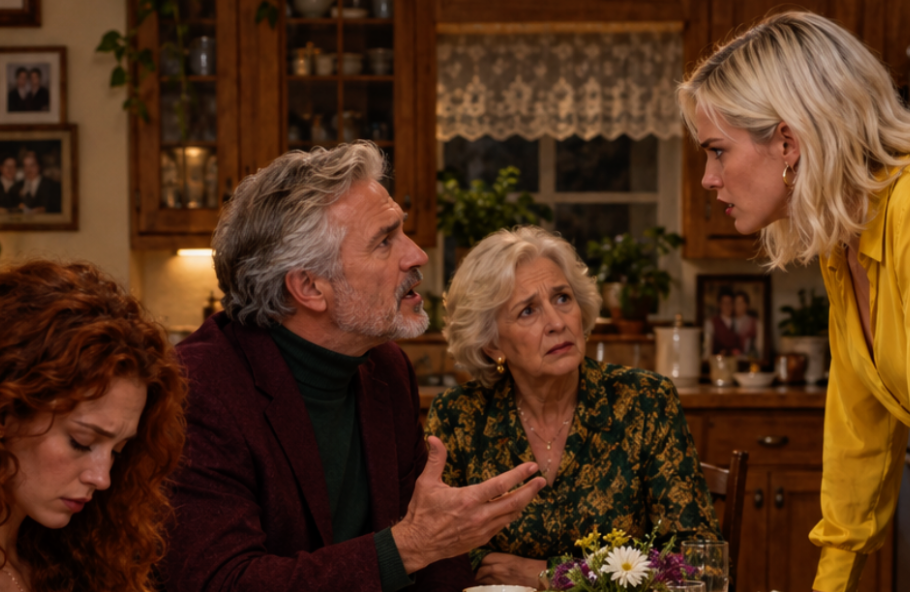
When I walked into the kitchen carrying two heavy bags, Valentina Sergeyevna was once again sitting in my spot by the window.
She didn’t even look up.
Spread out in front of her were the utility receipts, a calculator, and my favorite ceramic sugar bowl decorated with blue flowers. But as usual, my mother-in-law had moved the sugar bowl right up next to the sink.
“The heating bill is outrageous again,” she grumbled. “Are you sure you’re submitting the meter readings on time?”
I set the bags down on the floor.
“I’m sure.”
“Tamara next door pays less.”
“That’s because her apartment is smaller.”
My mother-in-law pursed her lips.
I started unpacking the groceries.
Milk.
Grains.
Vegetables.
Chicken.
When she saw the pack of chicken, Valentina Sergeyevna sighed heavily.
“Chicken again?”
“Yes.”
“Artyom likes pork.”
“There are six days left until pay day.”
“A man should eat properly.”
I looked at her.
“Then he can buy pork for himself.”
She raised her eyebrows.
“That’s why your household has this kind of atmosphere.”
Just then, our fifteen-year-old daughter Liza walked into the kitchen.
“Mom, do you need help?”
“Please put away the vegetables.”
Liza picked up a bag, then glanced at her grandmother.
“Grandma, you’re sitting in mom’s spot again.”
Valentina Sergeyevna smiled.
“There’s no such thing as mine or yours in a family.”
I stayed silent.
After seventeen years of marriage, I had heard that phrase far too many times.
For some reason, “everything is shared” always meant my paycheck was shared.
My apartment—shared.
My time—shared.
But Artyom’s car, his phone, his money, and his weekends always remained just his.
A door slammed in the hallway.
“Anyone home?” my husband called out.
Artyom entered the kitchen, kissed his mother on the cheek, and immediately peered into the pot.
“You bought chicken?”
“Yes.”
He grimaced.
“I asked for pork.”
“You spent almost your entire paycheck on new car rims.”
“The car is for the family.”
Liza quietly said:
“But you’re the only one who ever drives it.”
My husband turned to her sharply.
“Stay out of this.”
Our daughter lowered her gaze.
I didn’t say anything.
Back then, I still knew how to keep quiet.
The next day at work, my colleague Inga gave me a long, thoughtful look and asked:
“Do you ever get to rest?”
“Of course.”
“When?”
I had to think about it.
And I couldn’t remember.
I worked as a railway engineer, managed the house, shopping, bills, Liza’s school, my mother-in-law’s dacha, and a dozen other things.
Artyom called all this my “obsession with controlling everything.”
But his brand-new smartphone, bought on credit, he called “essential for work.”
A few days later, I came home and saw an unfamiliar pair of women’s boots in the hallway.
There was a striking blonde in her mid-thirties sitting in the kitchen.
Well-groomed.
Calm.
Artyom was laughing about something, leaning closer to her than a married man should.
Valentina Sergeyevna was beaming.
“Natasha, meet Kristina. She’s the daughter of my friend.”
“Nice to meet you,” the woman smiled.
“Likewise.”
“Kristina is helping Artyom with some paperwork,” my mother-in-law quickly explained.
My husband glanced at me and added:
“A smart woman is always a pleasant surprise.”
I picked up on his hint.
But I pretended not to notice.
After Kristina left, my mother-in-law came over to me.
“Did you see what a woman she is?”
“I saw.”
“Well-groomed. Easygoing. She knows how to listen to a man.”
I slowly took off my coat.
“Valentina Sergeevna, are you seriously trying to promote a potential mistress for my husband to me right now?”
She blushed immediately.
“How horrible! What is going on in your head?”
“Then why are you telling me this?”
My mother-in-law turned away.
A minute later, Artyom walked into the kitchen.
“Did mom upset you again?”
I looked at him.
“Did you pay the electricity bill?”
He rolled his eyes.
“Here we go again.”
“Tomorrow’s the last day.”
“Can you just not do the accounting for one single evening?”
That was the moment I truly saw our family dynamics for the first time.
All the problems were created by Artyom.
But somehow, I was always the one to blame—because I was the one reminding everyone about these problems.
A week later, money disappeared from our joint account.
I had been saving up for winter boots for Liza.
I called my husband.
“Did you take out the money?”
“Yeah.”
“Why?”
“I invested it in something.”
“In what?”
“You wouldn’t get it.”
“That was our daughter’s money.”
He sighed with irritation.
“I’ll return it.”
“When?”
“By Friday.”
“Where from?”
Pause.
Then he calmly said:
“Kristina will lend it to me.”
In that moment, it felt like the light inside me just switched off.
I didn’t scream.
Didn’t make a scene.
Suddenly, I just felt completely calm.
Two days later, Artyom and Valentina Sergeevna sat down with me at the kitchen table.
I made soup.
Liza was doing her homework in her room.
“Natasha, we need to talk,” my husband said.
“Go ahead.”
“It’s hard for me at home.”
I was surprised.
“Hard?”
“You’re always putting pressure on me.”
“With what?”
“With everything.”
He started counting on his fingers.
“Bills. Money. Shopping. Liza. The car. You control everything.”
I listened.
Then I asked:
“Which of these would you actually like to handle yourself?”
He fell silent.
My mother-in-law immediately jumped in:
“You need to inspire a man, not make demands!”
I looked at her.
“Inspire him to what? To return our daughter’s money?”
Artyom slammed his palm on the table.
“See! You’re always putting me down!”
“I’m just calling things what they are.”
My husband turned away.
After a short pause, my mother-in-law said:
“You two need to live apart for a while.”
I nodded.
“Sounds like a good idea.”
A satisfied smile appeared on her face.
But only for a moment.
“Artyom will stay here,” she continued. “And you can move into Liza’s room for now.”
It took me a moment to process what she just said.
“Excuse me?”
“He needs some space.”
I slowly looked around the kitchen.
My kitchen.
The apartment I’d owned even before we got married.
“So I’m supposed to move out of my own bedroom so your son can be comfortable?”
“Don’t exaggerate.”
“No.”
Artyom smirked.
“I’m registered here.”
I picked up the sugar bowl—the one my mother-in-law had again pushed by the sink.
I placed it directly in the center of the table.
“We’ll see.”
Everything ended on Friday.
Although in the morning, I still didn’t know it yet.
I fried potatoes and made cutlets.
Liza set the table.
Valentina Sergeevna arrived earlier than my husband.
Artyom showed up exactly at seven.
He looked unusually confident.
He sat down.
He ate.
He wiped his mouth with a napkin.
And then he said:
“I’ve made a decision.”
I put down my fork.
“What decision?”
“We’re getting a divorce.”
My mother-in-law nodded approvingly.
“Okay,” I replied.
My husband froze.
“What?”
“Okay.”
“That’s it?”
“What else?”
He was clearly expecting tears.
Maybe some begging.
Maybe even a scene.
But suddenly, all I felt was relief.
Artyom frowned.
“Then you should know: I’m not leaving alone.”
“Congratulations.”
And that’s when he decided to strike back.
One last time.
To make it hurt.
He leaned back in his chair with a smirk and said:
“We don’t need you anymore. We’ve already found a better woman.”
My mother-in-law immediately backed him up:
“At least Kristina knows how to appreciate a man.”
The kitchen fell silent.
I looked at the man with whom I had spent seventeen years of my life.
Maybe before, those words would have crushed me.
But now, they almost seemed funny.
“We found.”
As if a wife is some kind of household appliance.
The old one breaks, you just buy a new one.
I was about to respond, when suddenly, a chair scraped sharply nearby.
Liza stood up.
My daughter’s face was white.
“Who is ‘we’?”
Artyom frowned.
“Liza, sit down.”
“No.”
“This is a conversation for adults.”
“Then act like adults.”
Valentina Sergeyevna gasped.
“Lizochka…”
“Don’t call me that.”
My daughter turned to her grandmother.
“You’re sitting in Mom’s apartment. Eating food Mom bought. Using everything Mom pays for. And then you tell her you don’t need her?”
“Your mother put you up to this!” Artyom snapped.
Liza looked at him.
“Mom barely ever talks about you at all.”
That hit harder than yelling ever could.
“I see everything myself, Dad.”
“What do you see?”
“That Mom comes home tired and still cooks dinner. That Mom pays the bills. That Mom helps Grandma at the dacha. That Mom buys me clothes. And you? You bought a phone with the money that was supposed to be for my boots.”
“I was going to pay it back!”
“You always say that.”
Artyom blushed.
“You have no right to talk to your father like that!”
Liza smirked.
“And you have the right to talk to Mom that way?”
He fell silent.
For the first time in years, Artyom had no reply.
I looked at my daughter and suddenly felt ashamed.
Not of her.
Of myself.
For letting her see, all these years, how I allowed myself to be treated.
I stood up.
“Liza, go to your room.”
“Mom…”
“It’s okay.”
She hesitated for a moment and left.
I turned to my husband.
“Now you.”
“What about me?”
“Pack your things.”
He laughed.
“Are you serious?”
“Absolutely.”
“I’m registered here.”
“This is my apartment. The lawyer will handle it.”
My mother-in-law jumped up.
“Natasha! It’s the middle of the night!”
I looked at her.
“You just said you found him a better woman.”
I turned to Artyom.
“Go to her, then.”
He sat motionless for a few more seconds.
Maybe waiting for me to get scared.
Maybe hoping I’d change my mind.
Expecting I’d try to save him from the consequences of his own choices, just like before.
But not this time.
Half an hour later, the front door closed behind him.
First, I heard the elevator.
Then, silence.
Such unfamiliar silence, I just stood in the hallway for several minutes.
Liza came out of her room.
“Mom…”
I hugged her.
She was the first to cry.
Then I did.
“I’m sorry,” my daughter whispered.
“For what?”
“I’ve wanted to say this for a long time.”
I stroked her hair.
“And I should’ve done this a long time ago.”
In the morning, I woke up late.
Sunlight stretched across the floor.
No one slammed any doors.
No one asked why there was no meat.
No one moved my things around.
A cup of tea was waiting for me in the kitchen.
Liza was sitting by the window.
“Mom, I was just thinking…”
“About what?”
“Let’s go somewhere this summer.”
“Where to?”
She shrugged.
“To the sea. We’ve never gone together, just the two of us.”
I smiled.
“Let’s do it.”
Three months later, the divorce was finalized.
At first, Artyom sent long messages.
Then he started blaming me.
Then he asked to talk.
One day, he even said Kristina was “a completely different person from who I thought she was.”
I didn’t ask what he meant.
I just didn’t care anymore.
That autumn, Liza and I really did go to the sea.
On our first evening, we sat on the shore, watching the sun dip into the water.
Suddenly, Liza asked me:
“Mom, aren’t you scared to be alone?”
I thought for a moment.
And then I answered:
“I’m not alone.”
She smiled and rested her head on my shoulder.
Then I added:
“You know what’s most surprising? For so many years, I was so afraid of losing my family that I didn’t notice I was slowly losing myself.”
“And now?”
I looked out at the sea.
“Now, I’ve found myself again.”
When we got home, the first thing I did was step into the kitchen.
Right there on the table was that same sugar bowl with blue flowers.
Exactly in the center.
I smiled.
Before, it was just an ordinary object to me.
Now, it reminded me of one simple truth:
sometimes freedom doesn’t begin with a dramatic exit.
It begins the moment you stop letting others decide where you belong.